


Categories: How to Concentrate the Mind?
May the blessings of the Triple Gem be with you all!
Today, for those of you exploring the spiritual life with us, we hope to offer a practical understanding of the mind’s nature. If you gain some insight from this teaching, you know it will aid your spiritual journey. We trust that this understanding will help your spiritual life progress beyond the limits you might imagine, a confidence born not from blind faith, but from your own practical experience.
Here, we explore both tranquility meditation (Samatha) and insight meditation (Vipassanā), offering various perspectives to help you understand and develop your own mind. You know well that as we continuously practice these teachings, we can attain their fruits. A common state we encounter on this path is a feeling of agitation or hurry. We can call this a state of restlessness. I have spoken on this topic before, and you have surely experienced it. For anyone practicing mindfulness, understanding this restlessness is essential.
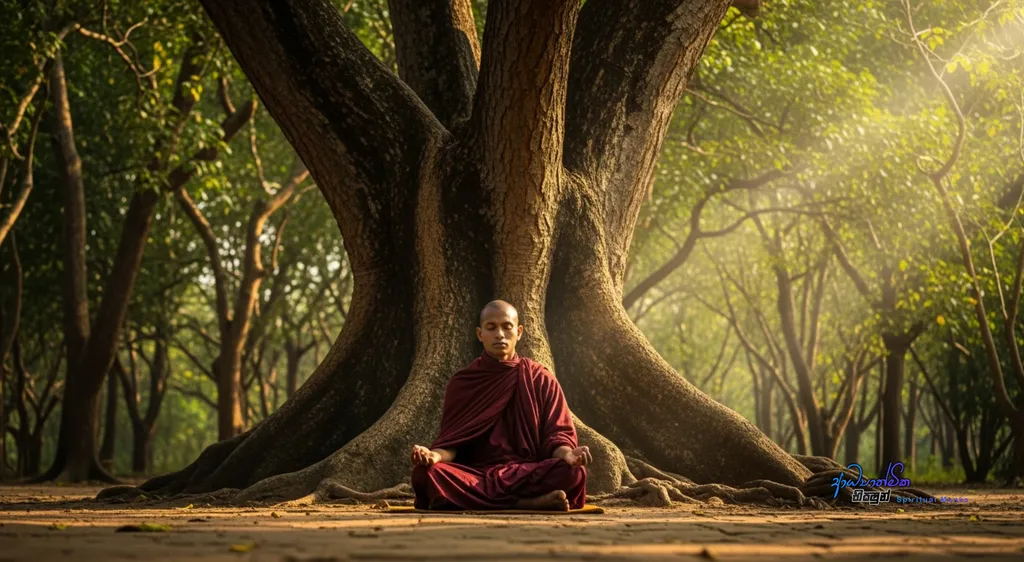
The Spiritual Hurry: Why Eagerness Becomes a Barrier
This feeling of restlessness often begins as an eagerness to progress quickly in meditation. When you start your spiritual journey for instance, by exploring our foundational teachings you might hear about developing the ‘third eye’ or attaining meditative states of absorption known as Jhāna.
A common thought arises: ‘I must open my third eye quickly.’ We have explained that certain sacred places, like the great Ruwanwelisaya stupa, can be visualized with these abilities. Hearing this sparks curiosity and a powerful desire in those drawn to this path.
Enthusiasm itself is not a problem. However, this eagerness often leads to an expectation of immediate results, which is born from restlessness. This is a subtle trap. There is a sudden rush to attain enlightenment (Nibbāna), or to quickly reach the stages of awakening like Stream-enterer (Sotāpanna), Once-returner (Sakadāgāmī), and Non-returner (Anāgāmī). The thought, ‘I must reach these states immediately,’ is a restless, agitated thought.
Similarly, desires arise to quickly attain meditative absorptions, psychic abilities (Abhiññā), or other spiritual powers. Some may fixate on smaller steps: ‘I need to feel pressure in my forehead quickly,’ or ‘I must see the inner light-sign (āloka saññā) now,’ or ‘I must perceive mental images (citta–rūpa) immediately.’ This constant expectation for the next step creates a deep-seated restlessness. True spiritual development, whether through tranquility or insight, cannot be cultivated in a state of agitation. This is something we must understand through mindfulness.
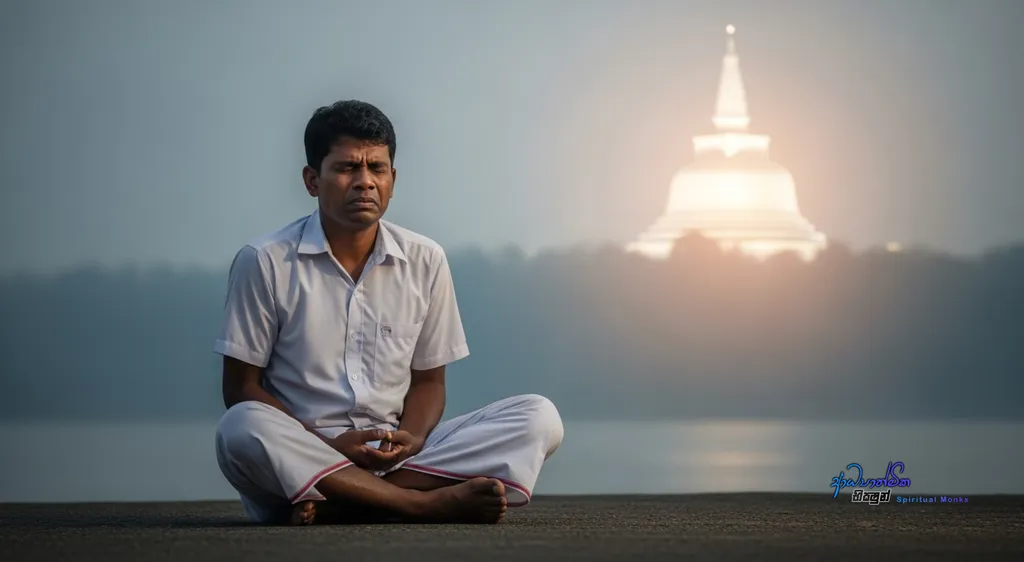
The Murky Lake of the Mind: The Five Hindrances to Clarity
When the mind is restless, it loses its equanimity, a balanced state the Buddha called Upekkhā. To see things clearly, our mind must be calm. Imagine a lake. If the water is stirred up and murky, you cannot see its depth or what lies at the bottom. Only when the lake becomes calm, when the stirred-up sediment settles, and the floating leaves drift aside, can you see clearly. You can see the fish, the plants, the rocks, and the nature of the lakebed. Our mind is just like this lake.
This calmness is also crucial for developing memory and learning. The Buddha taught in the scriptures (Sutta Piṭaka) that our memory weakens when the mind is agitated, just like the murky lake. He identified five specific things that stir the mind, which are known as the Five Hindrances, or Nīvaraṇa, as they block the path to liberation. They are:
- Sensual Desire (Kāmacchanda): Craving for pleasant sights, sounds, smells, tastes, and feelings.
- Ill Will (Vyāpāda): Feelings of anger, hostility, and aversion.
- Sloth and Torpor (Thīna-middha): A state of mental lethargy, dullness, and sleepiness.
- Restlessness and Worry (Uddhacca-kukkucca): An unsettled mind and feelings of remorse or anxiety. This is the heart of our discussion.
- Skeptical Doubt (Vicikicchā): A lack of conviction or trust in the path.
You can learn more about these hindrances from teachings by monks or from books and online resources. But for now, understand that these states, including fear, constantly push our mind into agitation.

The Antidote of Awareness: How to Observe Restlessness
Whatever state arises in your mind, there is no need to become agitated. The mind does not remain in a single, fixed state; on a spiritual journey, it moves through many different conditions. It is as changeable as nature itself. We have discussed this in a previous teaching about how the mind changes like the natural world. When the mind becomes unsettled, we often feel we can no longer observe it properly. But this is precisely the moment for practice.
If you truly wish to understand your mind, you must learn to watch it silently. Whether you are in formal meditation or simply using mindfulness in your daily life, the practical step is the same: when your mind is disturbed, your only task is to watch it with steady awareness and mindfulness (Sati).
By watching, you begin to see. You see the restless nature itself, how it affects your body, how it engages your senses the eye, ear, nose, tongue, and body. You understand how swiftly this agitation can trigger a reaction. The only way to completely and gradually eradicate this restlessness is to observe it patiently. Without this direct observation, we can never truly understand it.
Facing the Unknown: Overcoming Fear in Spiritual Experiences
This leads us to the topic of fear. Often, when we encounter a new spiritual experience, we get scared. For example, during meditation, you might suddenly feel as if your mind-made body (manomaya-kāya) is separating from your physical body. Many people panic at this moment and immediately stop meditating, opening their eyes. This fear and the resulting agitation cause them to lose a precious opportunity it could be the dawn of a new spiritual ability or a tangible result of their meditation.
When you recoil in fear, that experience is lost, and it becomes much harder to access again. You have essentially harmed your own progress due to the defilement of restlessness. Later, after someone explains what happened, you might feel regret: ‘If only I hadn’t become agitated then!’ We have seen this happen many times. So remember, especially if you are new to this path, these principles are essential. Agitation never helps us develop our spiritual life.

The Mark of a Mature Mind: From Agitation to Equanimity
If you reflect, you realize that fully enlightened beings like the Buddhas, Private Buddhas (Paccekabuddhas), and Arahants are never agitated. You may have heard stories of noble disciples, even those at the first stage of awakening (Sotāpanna), who remain calm even upon hearing that their own child has been killed. They do not become agitated by the news. The stories of accomplished ones are filled with such examples of profound calm.
Therefore, if we can reduce the agitation in our own minds, we have achieved a great victory. It means we are beginning to understand our own mind. The more we understand the mind, the less agitated we become. In fact, a key characteristic of a spiritually mature person is their lack of restlessness.
If you feel a hurry to see Nibbāna, to gain paths and fruits, to master the eight absorptions (Aṭṭhasamāpatti), to awaken the seven Kundalini chakras, or to acquire cosmic energy and psychic powers if you have this restlessness, you can never attain them. Not until you understand the very nature of this agitation.

The Paradox of Desire: Practicing Without Expectation
So what is it that we are so restless about? It is the subtle desire and expectation to develop quickly in meditation. As long as this desire exists, you will inevitably fall into a state of agitation. It’s the nature of the mind. While this restlessness is present, you must continue your daily practice at the appointed time.
However, you must practice without craving (taṇhā) and without expectation. We simply do what needs to be done, practically and daily. As you continue to do this, the restlessness itself will begin to diminish.
But as long as it is present, it is impossible to progress. The moment the thought of restlessness arises, our mind becomes blinded. We become deluded, as if covered by ignorance (Moha). We cannot see our own mind at all. Therefore, understand that you do not need to be afraid of anything that arises. Just observe.

Finding Truth in Turmoil: The Final Practice
When the mind is restless, it is impossible to even understand the thoughts that are passing through it. Why? Because it is stirred up and unsettled. We cannot see the defilements (kilesa) present at that moment. We can’t see with insight what we are bound by, what desire is active. The solution, which I have repeated throughout this teaching, is to practice observing it. If we do this practically, the mind will settle into a state of calm, and we will gain the ability to understand every thought that arises in that moment.
The most important thing to remember is this: within the state of restlessness itself, there is a truth to be seen. But we must be skillful, using mindfulness to understand it correctly in that very moment. If we instead get caught by the restlessness if we become agitated *about* our agitation we will never see the truth within it.
But if we do not get caught, if we stand back and observe it, we can understand the universal nature of phenomena (the Dhamma) right there. Every word of this teaching points to one thing: your dedication to this practice.
I have explained what is necessary in the way that is needed. Though more could be said, there is no need to extend it further. The essential point has been delivered. I will now conclude this teaching.

Blessings for Your Journey
May the powerful blessings of the Buddha, Dhamma, and Sangha the Triple Gem give you the strength to understand these matters practically and to move forward on your path.
We invite you to walk this path with us. Read our teachings, and most importantly, apply them practically in your own life. as you practice, questions will naturally arise. Please feel free to share your experiences and questions in the comments below, via email or contact form. I will do my best to offer guidance in future talks based on your progress. For now, begin this practice with an open heart and a mind free from expectation. Cultivate it correctly, and may you find the clarity and peace you seek.
Thank you for joining us. We hope this blog will be of great benefit to your spiritual journey.
May you all be well and happy.
May the blessings of the Triple Gem be with you all!


