


Categories: Other Meditation Teachings
May the blessings of the Triple Gem be with you all!
Today, we wish to clarify a question that often arises for those new to our spiritual articles and teachings. As you begin to explore the path of practical understanding, a common and important query comes up: Do I need to have prior knowledge about meditation before I start practicing?
This is a question we’ve received from many who are just starting their journey with us. To address this, and to support both newcomers and those who have been practicing for some time, we want to explore the topic, ‘Should one have an understanding of meditation before meditating?’ This exploration will be a great help, even for explaining the process to others.
You may already have some practical understanding of what meditation is from exploring these teachings, a knowledge gained through your own effort and practice, not because someone else did it for you. But as we begin this practical path, some of us have a foundational knowledge of meditation, while others have none. Let’s delve into how this difference plays out in one’s spiritual progress.

The Double-Edged Sword of Knowledge
We have observed a distinct pattern in the progress of those who come to meditation. Curiously, those who arrive with a great deal of pre-existing knowledge, whether from academic study or extensive reading of spiritual texts, often find it more difficult to maintain a steady, continuous practice. The mind, or sitta as it’s called in Pali, becomes harder to train when it is filled with concepts.
I have spoken about this before in a teaching titled, ‘Don’t Let Your Knowledge Become a Demon.’ I encourage you to read that article for a deeper understanding. Does this mean knowledge is an obstacle for everyone? No, not at all. For a person with wisdom and intelligence, someone who can skillfully integrate what they know, knowledge does not have to be a barrier.
They can use it to advance their spiritual development, whether in concentration practices like Samatha, insight meditation known as Vipassanā, cultivating deep meditative states called Jhāna, or working with energies like Kundalini or universal energy.
However, for many, this knowledge does become a hindrance. This is especially true for those with high levels of worldly education, such as professors or those with PhDs. While their academic knowledge is perfectly useful in their professional lives, it can become a significant obstacle in their spiritual practice. This isn’t about looking down on education or knowledge; please do not misunderstand. It is about recognizing when a tool becomes a barrier to developing the mind.

The Trap of the Analyzing Mind: When Knowledge Hinders Practice
So, how exactly does this happen? Imagine you sit for meditation. You may choose a formal posture, perhaps the half-lotus or full-lotus pose, known as baddha paryaṅka or padmāsana, and straighten your back. You close your eyes to begin the work of training your mind. If you try to bring all the concepts and theories you’ve learned over the years into this quiet space, it will almost certainly become a barrier.
Let’s take a concrete example from our third-eye meditation program. A practitioner might begin to perceive a sign of light, known as the āloka saññā. The person with extensive knowledge, whether academic or from reading texts like the Visuddhimagga, will immediately start to analyze it. Their mind will be flooded with intellectual thoughts, or vitakka:
- ‘Is this a real light sign, or am I imagining it?’
- ‘Is this the first Jhāna (a state of deep meditative absorption), or not?’
- ‘This light isn’t very bright. It can’t be the real thing.’
This internal questioning, this doubt and analysis, is a habit built over years of learning. But in meditation, it shatters your concentration. The single-pointed focus, or ekaggatā, dissolves, and the light sign fades away. This is the primary obstacle that your own knowledge creates, preventing you from attaining the fruits of the path, from realizing the ultimate peace of Nibbāna, or from developing deep states of meditation.
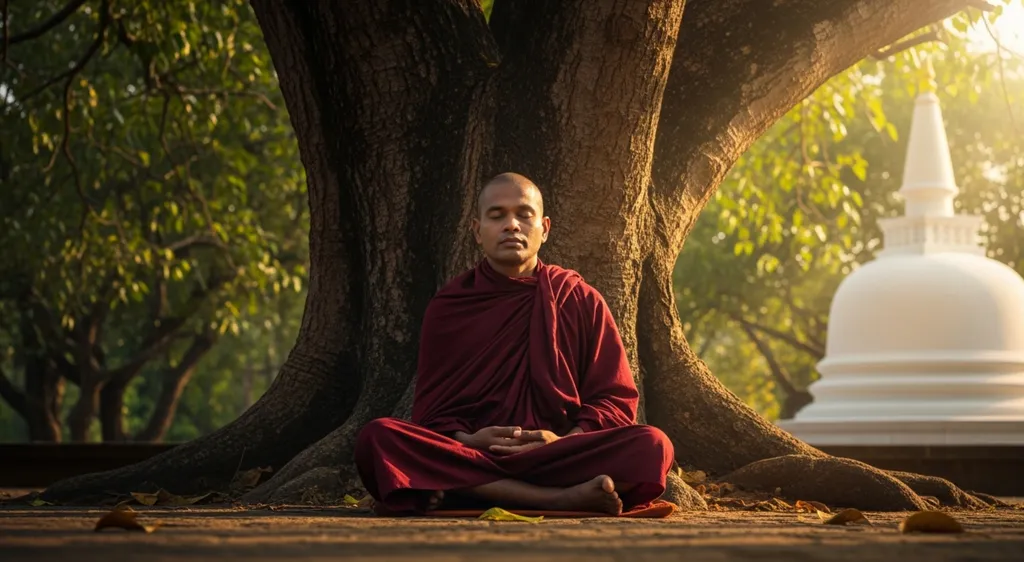
The Wisdom of a Child: How to Practice with a Beginner’s Mind
What, then, is the correct way to proceed when such an experience arises? You must become like a small child. A child possesses no doctrinal knowledge, no academic theories. They are free from the burden of concepts. When you see the light sign, your task is to simply observe it with this childlike innocence.
As we have instructed in our practical third-eye meditation programs, you simply maintain your focus on whatever appears and gently repeat your meditation word, such as ’empty,’ in your mind. In that moment, as you sit with your back straight and eyes closed, you are a child. This mindset is absolutely essential. It is in this state of pure, non-analytical awareness that true spiritual progress can flourish.
In contrast, someone without this prior knowledge has a much simpler experience. When they see a light whether it resembles a small torchlight, a lamp, or an electric bulb it is not a problem or a source of doubt. They simply see it and continue to watch it while repeating their meditation object.
No intellectual chatter arises. They might have a fleeting thought, ‘Ah, this must be the light sign the teacher mentioned,’ and that’s it. There is no doubt, and no train of thought to break their concentration. They just carry on with the practice. This is why such a person often progresses very quickly. The truth or untruth of what I am saying can be verified by anyone who has practiced meditation for even a single day.
The Right Place for Reflection
This does not mean you can never think about your experiences. But there is a right and a wrong time. You must not analyze or question *during* your meditation session. After you have finished, opened your eyes, and are taking a break, it is not a problem to reflect on what you saw. However, it is even better if you can avoid over-analyzing even then.
Why? Because many spiritual experiences are not confined by what is written in books. You may not find an explanation in any text, or you may misunderstand what the texts are trying to convey. Your practical development is far more valuable than understanding a page in a book. One day, when you have progressed practically, you will gain the ability to understand these experiences on your own terms. Practical understanding is always more important.

Beyond Knowledge: Confronting the Universal Obstacle of Fear
There is another significant obstacle that affects everyone, regardless of their level of knowledge, background, age, or nationality: fear (baya). If fear is present, it doesn’t matter what you know or don’t know; you will not be able to develop your meditation practice.
Fear is one of the ten armies of Māra, the symbolic representation of the forces that prevent enlightenment. It is an immense barrier to spiritual progress. We have discussed fear at length in other teachings, and I encourage you to explore the playlist on this topic to gain a full understanding of how to work with it.
When you encounter various spiritual phenomena, fear can arise. In those moments, it is crucial to face them without fear, adopting that same childlike mind we have been discussing, a mind that is innocent and free from judgment. If you can do this, your ability to develop spiritually is certain.
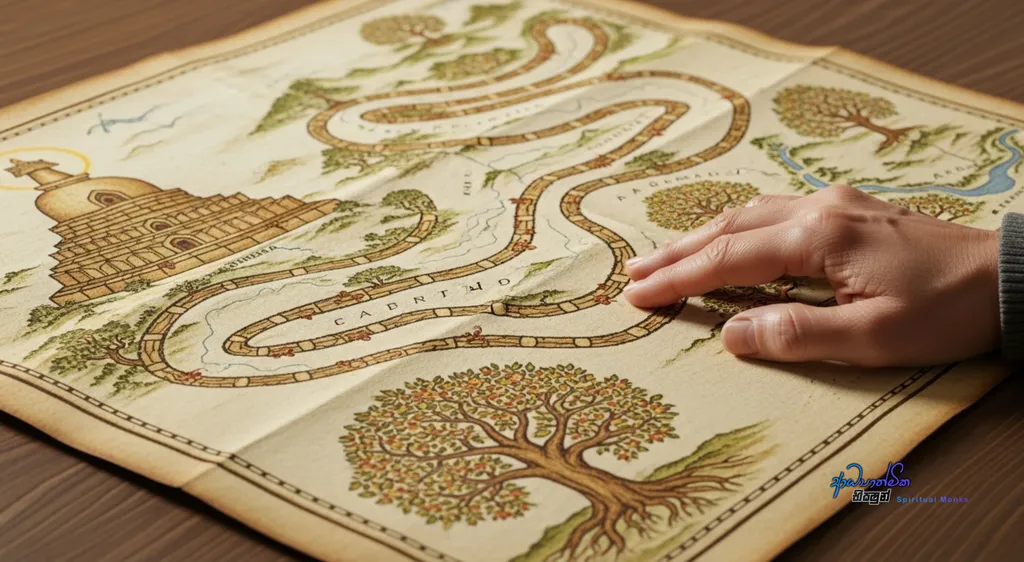
The Dhamma as a Map, Not a Burden
So, to those who have asked me this question, who feel stuck or wonder why they are not progressing despite being highly educated or well-read in the Dhamma, this is often the reason. You may be stuck in one place because your knowledge has become a barrier. Other factors also contribute, such as a lack of virtue or ethical discipline (sīla), particularly celibacy (brahmacariyā), or not practicing meditation consistently.
The Lord Buddha taught that even the Dhamma itself is a tool. He used the famous simile of a raft. The teachings, virtue, concentration (samādhi), and wisdom (paññā), are like a raft used to cross a river. Once you have reached the other shore (Nibbāna), you do not carry the raft with you. The one who has crossed over embodies these qualities naturally; they don’t need to force themselves to practice them anymore. This is a profound point.
Therefore, please understand that all the teachings we offer, over 200 of them, are meant to be a map for your journey, not something to be memorized for the sake of knowledge. Some people try to become teachers, driven by a subtle pride or arrogance (māna). They listen to our teachings, read books, and gather information to present themselves as gurus. If they do not see these defilements (kilesa) within themselves, they will find it impossible to progress spiritually.
You do not need to read the entire Tipiṭaka (the Buddhist canon) to realize Nibbāna. The 84,000 teachings were given to countless beings, humans, gods, and brahmas, not just one person. It is fine to read and study until you gain insight, but once you reach certain stages of awakening, you won’t need all of it.
Your Path, Your Practice: A Final Encouragement
I hope this gives you a broader understanding of whether you need knowledge before starting meditation. To summarize the answer: knowledge is neither required nor a fault. What is truly necessary is to face your practice without fear.
If you feel you need a foundation before you begin, that is perfectly fine. You can start by reading our earlier articles in chronological order to build a sense of understanding and confidence. We encourage many to practice as they read, integrating both simultaneously. But for those who feel they need knowledge first, follow that path. Do what feels right for you.
Our only goal is to help you reach a state of true awakening. We do not want to trap you into endlessly consuming teachings. If you can listen to one or two talks, gain some understanding, and use it to realize the fruits of the path, attain the Jhānas, or develop higher knowledges (abhiññā), then our purpose is fulfilled. This is the path. Adjust it to your own needs, and proceed with courage and an open, childlike mind.
May you have the strength and wisdom to understand these points, apply them practically, and overcome any challenges on your path.
We invite you to walk this path with us. Read our teachings, and most importantly, apply them practically in your own life. as you practice, questions will naturally arise. Please feel free to share your experiences and questions in the comments below, via email or contact form. I will do my best to offer guidance in future talks based on your progress. For now, begin this practice with an open heart and a mind free from expectation. Cultivate it correctly, and may you find the clarity and peace you seek.
Thank you for joining us. We hope this blog will be of great benefit to your spiritual journey.
May you all be well and happy.
May the blessings of the Triple Gem be with you all!.


