


Categories: Dhyana: Practical Training
May the blessings of the Triple Gem be with you all!
For those of you who have been practicing both Samatha (calm-abiding) and Vipassanā (insight) meditation, today we will explore, from the very beginning, the process of entering a state of meditative absorption. The method we refer to is the “Practical Meditation Method to the Brahma Worlds.” This article aims to be a clear and simple guide for anyone, of any age, background, or faith, to navigate these profound states.
There are different paths to these states. For those who have already awakened the “third eye,” there is a more direct path to the formless states known as the Ārūpāvacara Jhānas: infinite space, infinite consciousness, nothingness, and neither-perception-nor-non-perception. However, this teaching is designed to be especially helpful for those who have not yet had this awakening.
We offer this detailed explanation of the eight stages of meditative absorption so that you can proceed on your spiritual journey with understanding, without fear or panic. When you understand what to expect how these states feel and how to face them you can move forward with confidence. The teaching may be detailed, so please read it with mindful attention and apply it to your practice. Do not be afraid of the experiences that arise.

Beginning Your Journey: Setting the Intention for Meditative Absorption
This practice is for everyone, but it is especially beneficial for those who have been trying to awaken the “third eye” without results after a long period of practice perhaps six months or a year. Instead of struggling, you can begin with this method. Re-read this teaching as often as you need; it will be a great help as you move forward.
To begin, find a comfortable point of focus. This could be between your eyebrows, in the middle of your forehead, or anywhere along the vertical line from the center of your forehead down to the middle of your nose. Many people choose the point between the eyebrows, while others prefer the center of the forehead. Choose whichever spot allows your mind to gather and concentrate most easily. This is your anchor.
Once you have your focus point, you make a gentle but firm resolve, an intention known in Pali as Adhiṭṭhāna. Silently repeat three times, “May the first Jhāna arise.” Then, keeping your mind on your chosen spot, continue to cultivate concentration with the phrase, “May my mind become concentrated.” Repeat this gently.
You don’t need to repeat these words forever; they are simply tools to guide the mind toward meditative absorption. Once the mind is trained, it will find its way there automatically, without the need for constant verbal cues.
The First Jhāna: When the World Fades and the Mind Becomes Still
How long will this take? It’s impossible to say. It depends on your unique past actions, or kamma, and your capacity to grasp the technique. It could take a day, a week, a month, or a year. The key is to practice patiently until it happens. As you continue, you will notice your mind beginning to settle. The usual stream of thoughts from the outside world will lessen.
This is the hallmark of entering the first stage of meditative absorption, or the First Jhāna. Suddenly, thoughts about the sensory world what is called the Kāma Loka in Buddhism disappear. Worries about home, work, family, along with thoughts of desire or aversion, simply do not arise. Your mind is powerfully drawn to the point of focus, as if pulled by a strong magnet.
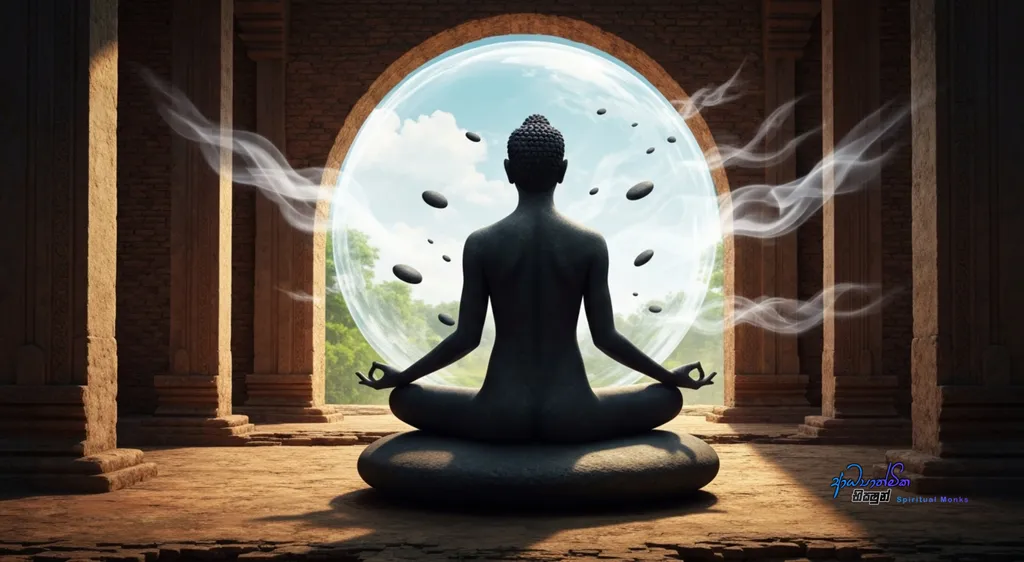
Physically, you might experience your body becoming very still, heavy, or even feeling as solid as a rock. If you are new to this, you might only stay in this state for five minutes, even if you meditate for half an hour. But with continued practice, the duration will naturally increase. You can also use your intention (Adhiṭṭhāna) to gently encourage the state to last longer. In the First Jhāna, the two defining experiences are a mind powerfully unified on its object and a body that feels profoundly stable and still.
The Third Jhāna: Experiencing a Happiness Beyond the Everyday
As you become established in the first state of meditative absorption, your mind will naturally progress. It will move to a higher, more refined state of being. The experience is like a complete shift in your reality. Imagine you have only ever eaten plain rice your whole life. Then, one day, you are given a bowl of noodles. The new taste, the different texture it’s a completely novel and delightful experience. This is what it’s like to enter the Third Jhāna.
Here, you experience a profound sense of well-being, a deep pleasure and happiness known as sukha. This isn’t just a mental state; it’s a physical sensation that permeates your entire body. The rock-like solidity of the first Jhāna gives way to a body and mind filled with an immense, peaceful bliss.
You can simply recognize this by noting, “There is happiness.” After spending weeks, months, or even years in the previous state, you will clearly recognize that you have transcended it. The characteristics of the prior stage fade, and this deep, satisfying happiness becomes the dominant reality. This is an immense pleasure that must be experienced to be understood.
The Fourth Jhāna: The Power of Perfect Equanimity (Upekkhā)
After mastering the bliss of the third stage of meditative absorption, you are ready to move beyond even that. You know the previous state intimately its mental and physical feelings are familiar.
Now, you sense another shift is coming. To use our food analogy, you’ve gone from rice to noodles. Now, you are brought to taste a world-class Italian pizza for the very first time. The flavor is so exquisite, so perfectly balanced, that words fail you. You are simply in awe.
This is the Fourth Jhāna, defined by a profound quality called Upekkhā, or equanimity. Your mind becomes incredibly direct, straight, and stable. It possesses a powerful, dignified presence and a deep neutrality. Some people mistakenly think they have reached enlightenment here, but this is a state of supreme mental balance.
The mind is light, free, and imbued with a unique energy and vitality. It feels as if you could remain in this state indefinitely. Physically, the body feels extremely subtle, to the point where it may almost seem to disappear. Yet it is still present, just perceived in a very refined way.
At this level of meditative absorption, the mind is the meditation object, or kammaṭṭhāna. The words to describe it come from your own heart. If you speak English, the recognition will arise in English. It’s the most honest expression of your state: “My mind is so peaceful,” or “What an incredible equanimity.” This is the authentic experience, a mental and physical state of sublimity you have never before encountered.
Returning to the World: How to Skillfully Exit Meditative Absorption
A beautiful feature of these states of meditative absorption is that you can learn to navigate them with skill. Let’s say a practitioner is accustomed to staying in the Fourth Jhāna for two or three hours, but today they have an urgent appointment and can only meditate for one hour.
They can sit down and make a clear resolution: “May I remain in the Fourth Jhāna for one hour only.” After making this determination three times, they enter the state. If they sat at 4:00 PM, at exactly 5:00 PM, the mind will automatically begin its descent.
The process feels much like riding an elevator down from a very high floor. You gently pass through each state, feeling the shift in consciousness as you descend from the sublime equanimity of the fourth, through the bliss of the third, and back to the normal sensory world. The mind transitions smoothly from a state of meditative absorption back into the consciousness of the human realm, the Kāma Loka.
Embracing the Journey Without Fear or Agitation
It is crucial to approach this journey with understanding. If someone with strong past-life tendencies for meditation were to suddenly fall into the Fourth Jhāna without any knowledge, it could be disorienting and frightening. They might, as we say in simple terms,“mess it up” out of panic.
However, a person with even a basic understanding of these states will not be alarmed. They will recognize the signs the profound mental and physical shifts and know that they are entering a deep state of meditative absorption. They will understand that the correct response is to remain mindful, calm, and not give in to fear or excitement.
This knowledge is your greatest protection. It allows you to become a person who can face these powerful inner experiences without fear or agitation, and to progress spiritually. This understanding is essential for your development. Please grasp these points about the first four states of meditative absorption for now. We share these teachings repeatedly to deepen your understanding and empower you to become a spiritually developed individual who walks this path with confidence.
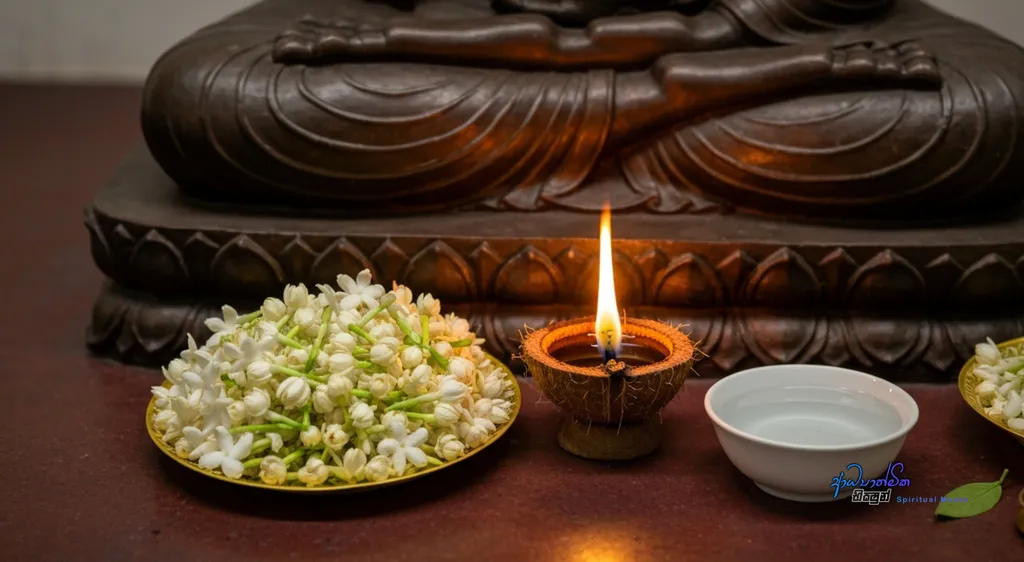
Your Path to Inner Peace and Understanding
By understanding the journey through the stages of meditative absorption, from the initial concentration to the profound equanimity of the Fourth Jhāna, you equip yourself with a map for your inner world. This teaching is offered to conclude our simple, step-by-step explanation of this profound practice.
With the powerful blessings of the Buddha, the Dhamma, and the Sangha the Triple Gem may you all gain the ability, the energy, the enthusiasm, and the mindfulness to comprehend these teachings thoroughly and to practice them accordingly. With this blessing, we conclude today’s teaching.

We invite you to walk this path with us. Read our teachings, and most importantly, apply them practically in your own life. as you practice, questions will naturally arise. Please feel free to share your experiences and questions in the comments section below, via email or contact form. I will do my best to offer guidance in future talks based on your progress. For now, begin this practice with an open heart and a mind free from expectation. Cultivate it correctly, and may you find the clarity and peace you seek.
Thank you for joining us. We hope this blog will be of great benefit to your spiritual journey.
May you all be well and happy.
May the blessings of the Triple Gem be with you all!


