


Categories: Maintaining Mindfulness
May the blessings of the Triple Gem be with you all!
Today, as we continue our spiritual exploration together, we will turn our attention to a feeling that touches every one of us: the feeling of loneliness. We will look at how to experience it practically and, more importantly, how to work with it skillfully. The very title of this reflection holds a key; for a person of wisdom, simply seeing the topic can spark an immediate understanding of how to face this profound emotion.
But wisdom unfolds differently for each of us. For those who see the path clearly, may this serve as a confirmation. For those who are still searching, may this teaching illuminate the way to practically experience and transform this state of mind.
This feeling of loneliness, or paaluwa as it is known in Sinhala, is an unavoidable part of the human condition. It touches the young and the old, across all walks of life and at every stage of our existence. It makes no distinction between race, class, or religion; it does not care if you are beautiful or plain, rich or poor.
Every human being in this world is bound to experience it. It is an absolute, a certainty, much like a law of nature. In Buddhism, we call such an unalterable principle a Dhammatā,a natural phenomenon. The world is composed of these natural laws, and this deep feeling of loneliness is one of them.

When Loneliness Appears: The Subtle Sting of Everyday Life
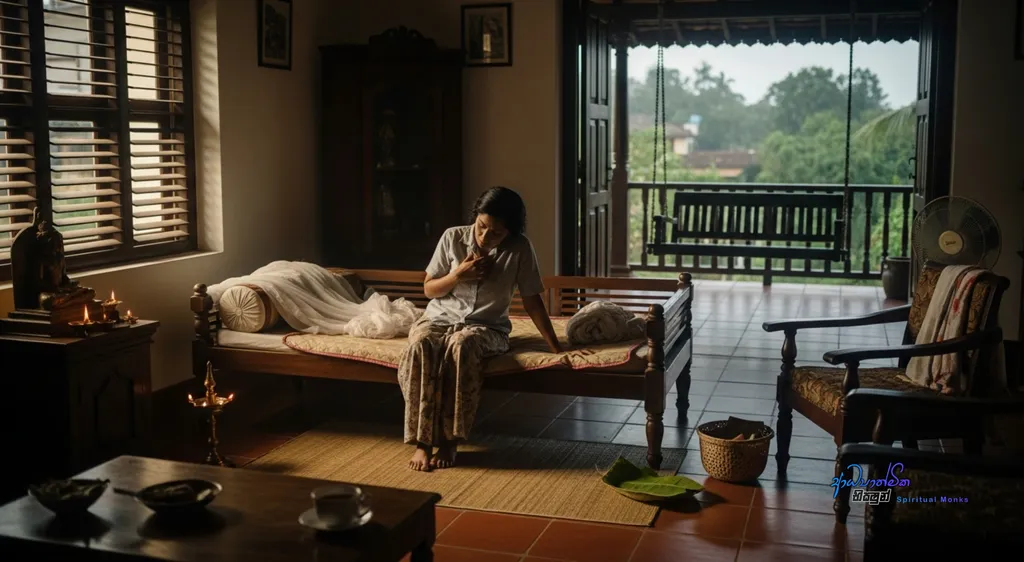
This experience can arise in the most ordinary moments. Consider this: you take a nap in the afternoon, perhaps at home, in a dorm room, or wherever you are staying. When you wake up and your eyes open to the world around you, you might feel a bit lazy or still sleepy. You might notice physical sensations, like hunger.
But alongside these, another feeling can surface,a sudden, heavy sense of gloom, a deep feeling of loneliness. If it’s a hot, sunny day, this feeling can manifest as a kind of desolate, dreary emptiness. And this isn’t limited to sunny weather; it can happen just as easily on a rainy day. It’s a common human experience.
The intensity of this feeling can vary. If you have family at home, your children, spouse, or parents, or people you care about are nearby, the loneliness might not feel so sharp or it may pass quickly. For some, it is still palpable, while for others, its presence is fleeting. Yet, almost everyone has felt this subtle sting of loneliness, even for a brief moment.
Now, imagine that same scenario, but you are completely alone in the house for the day. You wake from your nap, and the silence amplifies the emptiness. The feeling of loneliness can become immense, accompanied by the thought, ‘There’s no one here.’ This is the nature of how this feeling takes hold, especially for those who are often by themselves. It arises not from the environment itself, but within your own mind.
The Deep Ache of Loss: How Attachment Breeds Loneliness
Let’s explore a deeper instance. Think of someone you love, a partner or a cherished friend. Imagine that relationship suddenly ends. They leave you, perhaps for someone else, or circumstances force you apart. If you have shared one, two, or three years of your life with this person, the sudden absence brings a wave of sadness and pain, that is a separate matter. But nestled within that grief is a distinct and powerful feeling of loneliness.
You are haunted by the absence of shared experiences. A weekend arrives, and you remember the trips you used to take together. You might visit a place you once went to with them, but this time with your parents, and the memory instantly surfaces: ‘I came here with the one I loved.’ This is why so many songs are written about specific cities, Nuwara Eliya, Colombo, Anuradhapura, places that become intertwined with love and memory. This is the nature of the mind.
For someone going through this, waking up from an afternoon nap can trigger an overwhelming feeling of loneliness, even if their family is home. The grief and pain amplify it. If they are truly alone, the feeling becomes immense, a desolate moodiness. This isn’t just about breakups. Consider those who move abroad, leaving behind their beloved spouse, children, and parents in Sri Lanka.
Arriving in a foreign land with a different language and culture, they are suddenly, utterly alone. For the first few days, memories of their life back home flood their minds. The absence of familiar faces and comforts creates an unbearable feeling, a profound sadness mixed with an intense, crushing feeling of loneliness. See how the things your mind clings to cause such immense suffering when they are gone? This is the nature of attachment.

The Way Through Is Within: Observing Loneliness with Mindfulness
So, what are we to do when this feeling of loneliness arises? We are conditioned to run from it, to distract ourselves. But the Buddha taught us a different way. The path through this feeling is to turn inward and observe it with mindfulness. This practice is known as Sati, or moment-to-moment awareness.
The next time you wake from a nap and that familiar wave of loneliness hits, don’t immediately reach for your phone or turn on the TV. Instead, simply turn your attention to the feeling itself. Look at your own mind. How does this ‘feeling’ manifest? What are the thoughts that arise with it? How does it feel in your body? Is there a pressure, an ache, a hollowness? Just watch it with careful, gentle awareness.
Stay with it and observe. As you continue to watch with mindfulness, you will begin to see it clearly: ‘Ah, this is what is happening. This is how the feeling of loneliness feels. This is how long it lasts.’ You don’t need to analyze or suppress it. Your only task is to remain aware.
This is the practice of mindfulness, of Sati-Sampajañña (mindfulness and clear comprehension), of insight meditation (Vipassanā), and the Four Foundations of Mindfulness (Satipaṭṭhāna) that the Buddha taught. Simply watch. If you are new to this, I recommend exploring our other articles that teach how to silently watch the mind and how to establish mindfulness in daily life.
But the core instruction is the same: when the feeling of loneliness appears, whether it’s from a lost love, a memory, or the absence of a phone call you were expecting, watch it. Even if you hear their voice in your head, just observe that phenomenon with mindfulness.

A Moment’s Feeling, an Eon’s Journey: Loneliness and Rebirth
This practice is not just for emotional comfort; it has profound implications for our entire journey through life and death. The feeling of loneliness is a form of mental defilement, a kilesa, born from attachment and craving. The mind clings to what it had, and the absence creates suffering.
Now, consider this: if you were to pass away while your mind is gripped by this powerful feeling of loneliness, what kind of rebirth do you think you would find? If your final moment of consciousness before death, what is called the cuti-citta, is colored by this state of attachment, grief, and emptiness, it will inevitably lead you to a lower, less fortunate realm of existence. Ponder for a moment where such a state of mind could lead. I can say with certainty that it leads to a weak, unhappy birth.
Conversely, if your final moments are free from such clinging, if you are able to bring to mind a good deed, a moment of generosity, or the calm from your meditation practice, that wholesome state will guide you to a good rebirth in a fortunate realm.
This highlights how dangerous the journey of existence, or Samsāra, truly is. A single moment of heedlessness, a single mistake at the crucial time, can have consequences that ripple across lifetimes. When you reflect on this, you begin to see the reality of this world, the reality of human nature, and the truth of existence. This understanding naturally motivates you to cultivate mindfulness, because you see it is the only way to navigate this perilous journey safely.
The Wisdom of Impermanence: Facing Life’s Truths with Mindfulness
This feeling of loneliness is deeply connected to change. Consider famous singers or actors. In their prime, they are adored. The calls from television and radio stations are constant. But as they age, new artists emerge. The phone stops ringing. The place they once held in the world is gone, and this absence can bring immense pain and a profound feeling of loneliness.
This applies to all of us as we age. Even if you are listening to this teaching as an older person, in Sri Lanka or abroad, your mind is still capable. You can still look at your mind. You can practice the mindfulness the Buddha taught.
Let’s take a more personal example. Imagine you are an older person living alone, perhaps in a quiet town like Anuradhapura, and your children and grandchildren live in a busy city like Colombo. They come to visit for a holiday weekend. For a few days, your house is filled with life.
You cuddle your grandchildren, share meals, and enjoy their company. Then, they have to leave. In the days that follow their departure, watch the feeling of loneliness that arises. It can be overwhelming, a physical ache in your chest. It’s an incredibly powerful experience.
If you are a practitioner of mindfulness, you can work with this. You know from past experience the pain that follows their departure. So this time, you prepare your mind. ‘The children are coming again. Last time, the pain of their leaving was intense. But as a follower of the Triple Gem, this time I will be mindful.’ When they arrive, you engage with them fully, laughing, talking, eating, but all the while, you maintain an undercurrent of awareness.
You watch your mind’s attachment forming. As the time for their departure nears, you observe the feelings that arise. You watch as they get in their car and drive away, and you watch the wave of pain and loneliness that follows. You don’t fight it; you simply watch it with mindfulness.

From Fragility to Fortitude: Cultivating an Unshakeable Peace
By practicing like this again and again, something remarkable happens. Over time, the experience begins to lose its sting. Their arrival and departure become a natural rhythm. ‘They come, they stay for a few days, we enjoy our time, and then they go.’ It transforms into a neutral, natural event in the mind. You develop a deep equanimity.
Now, let’s take this a step further. This may be difficult to hear, but life includes such possibilities. Imagine that on their way back, your family is in a tragic accident and they all pass away. Some may say it is inauspicious to speak of such things, but the Buddha himself taught unflinchingly about the uncertainty of life and death.
For a person who has trained their mind to face the smaller loneliness of departure, this devastating news will be met differently.
If you receive a call with this terrible news, you will not be completely shattered. If you have reached a high level of attainment, such as an Anāgāmi (a Non-returner) or have realized Nibbāna (liberation), there would be no overwhelming grief, no tears. Enlightened beings do not cry because they see the nature of reality as it is. But even for a dedicated practitioner, the pain will be manageable. The thought will arise, ‘This, too, has happened.’
You will remember the law of impermanence (Anicca) that you have been cultivating. You will realize, ‘Because I have practiced mindfulness as the Buddha taught, I can bear this. They, too, have met the inevitable nature of life.’
This is the strength you gain. You begin to understand how much you have let go of clinging and aversion, and how deeply you have understood the truth. This is how you can measure your progress on the path.

Beyond Distraction: Why Temporary Fixes Aren’t Enough
Reflect on how you currently deal with the feeling of loneliness. When you are young, strong, and able to get around, you have many ways to escape. If you’re alone at home and loneliness strikes, you might call your best friend to chat or gossip. You might watch a movie, scroll through Facebook or YouTube, or lose yourself in social media.
You might seek out a party, a concert, or a social club. These are all temporary solutions, like putting a small bandage, a palastara, on a deep wound. They provide fleeting relief, but the underlying defilement (kilesa) of attachment remains untouched. Over time, even these distractions can become tiresome.
Many people, especially as they get older and retire, form societies and clubs precisely to combat the pain and feeling of loneliness that comes from inactivity. They plan trips and outings to keep themselves busy. But what happens when you get too old even for that? The pain returns, stronger than ever.
Many older people find they can’t sleep through the night. They might sleep for a few hours in the afternoon and then lie awake until dawn, their minds flooded with an endless stream of thoughts and memories of things they did when they were young, both good and bad. These temporary fixes work only as long as you have the strength to pursue them. The path of mindfulness, however, is a true solution that you can practice at any age, in any condition.
The Final Challenge: Finding Freedom When the Body Fails
The most severe test comes in deep old age. Your body weakens, your beauty fades, and you can no longer stop the process of decay. Your limbs may fail you. You might become bedridden, unable even to clean yourself. We have all seen people in this state. This is a reality of life. Facing this truth, ask yourself: ‘If I end up in that state, how will I face the overwhelming feeling of loneliness? Will I just endure it helplessly, like my grandparents or parents might have, simply waiting to die?’
Or will you choose a different path? This teaching is an invitation to prepare now. Imagine a loving couple who have spent their whole lives together. One of them passes away. The one who remains, now old and frail, is left with a flood of memories.
Their children and grandchildren may provide food and care, but they are busy and cannot talk for long. This person is left alone with their thoughts, memories of their life with their spouse, their youth, their shared moments. This is the inescapable law of the world, the truth of existence. This feeling of loneliness can be a terrible torment.
You may use temporary patches in your youth, but a day will come when you are truly alone, forced to face this feeling. You will have to endure it, perhaps unhappily and with great resentment. This is why you must understand this now. This is a particular struggle for many in foreign countries, who find themselves isolated in their old age.
Even if they have money for a nurse, the nurse comes, does their duties, and leaves. Then, the loneliness returns. So, reflect deeply: When your body fails, how will you manage your mind? By contemplating this now, an idea will form: ‘I must practice.’
Your Path Begins Now: A Practical Invitation
This teaching, first shared by the Lord Buddha over 2,500 years ago, is offered again to you based on our own practical experience. I invite you to experience it for yourself. When you practice these methods, you become a mentally strong, elevated, and powerful individual. This is what must happen. By understanding this now, while you are young or middle-aged, you can start to train.
Little by little, as you age, your mind will grow stronger even as your body decays. Your limbs may fail, but your mind will remain youthful, not in the sense of craving sensual pleasures like some older people who wish to relive their past, but youthful in its clarity, maturity, and wisdom. You will age with a profound understanding of life. On that day, whether someone is with you or not, it will be all the same to you. Your mind will have found a state of peace where the feeling of loneliness no longer has power.
Begin your practice now. When the feeling of loneliness arises, watch it with mindfulness. The speed of your progress depends on your practice in this life and past lives, so be patient with yourself. Gradually, you will weaken its hold. This is the path to becoming a person who does not need to cry in the face of life’s changes.
As you engage in this practice, your experience can become a help to others. When you share your insights, you help them understand their own minds, and this act becomes a wholesome deed that deepens your own understanding.
Today, we conclude this teaching on watching the feeling of loneliness with mindfulness. We will continue to explore the various defilements that arise in the mind and the methods to overcome them, so that you can elevate your mind, shorten your journey in Samsāra, and realize the true nature of life. It is only through your own practical application that you can truly understand what we have shared and what the Buddha taught so long ago.
May the power and blessings of the Triple Gem support you in this endeavor.

We invite you to walk this path with us. Read our teachings, and most importantly, apply them practically in your own life. as you practice, questions will naturally arise. Please feel free to share your experiences and questions in the comments section below, via email or contact form. I will do my best to offer guidance in future talks based on your progress. For now, begin this practice with an open heart and a mind free from expectation. Cultivate it correctly, and may you find the clarity and peace you seek.
Thank you for joining us. We hope this blog will be of great benefit to your spiritual journey.
May you all be well and happy.
May the blessings of the Triple Gem be with you all!


