


Categories: Maintaining Mindfulness
May the blessings of the Triple Gem be with you all!
Today, through this teaching, I wish to clarify something that everyone on a spiritual path eventually faces. Whether you are following the practical guidance offered in our articles or practicing under another teacher, you will encounter the various natural states and levels of the mind.
This article aims to help you understand these states correctly, to see them with true insight, and to continue on the path without falling into confusion or despair. Many people, not just those who read our articles, but anyone engaged in spiritual work, can face difficulties because they don’t understand this crucial point about the inherent nature of the mind.
Why We Struggle with Consistency: The Mind’s Search for Motivation
Let’s begin by observing a fundamental tendency. When we try to do something consistently, especially on our own, the mind often resists. This is its nature. To sustain an effort, we usually need some form of external encouragement or pressure. Think about your daily life.
At work, you have a manager or a boss. In a team, you have a leader. When we were children, we had the guidance of parents and teachers. This external support provides the impetus to keep going.
There can also be other motivators, things we call worldly desires or benefits. If you work for a company, you receive a salary. This compensation allows you to eat, drink, wear clothes, build a home, and live your life. We are driven by this result, this tangible outcome.
It’s like waiting for a bonus; the expectation of a reward, whether we are being supervised or not, gives us the strength to continue. Without such a clear, external incentive, sustained effort is incredibly difficult. When an activity is entirely under our own control, we often find it hard to proceed.
This is the first thing to understand about the challenge of self-directed spiritual practice and the nature of the mind.

Finding Your Inner Drive: From External Pressure to Self-Motivation
As children, most of us studied in school because we were motivated by a fear of our teachers or parents. But as we mature, we begin to understand our own needs and the path we must walk in life. We see what is required at different stages and realize we must acquire certain skills or resources to meet those needs.
This leads to a powerful internal drive. Some people cultivate this inner desire so strongly that they achieve great success in the worldly sphere on their own. For example, an entrepreneur might cultivate a powerful ambition and push forward relentlessly, achieving success without anyone else’s direct encouragement. Their own mind provides the motivation.
Similarly, someone in academia might be driven by the desire to achieve the highest degree, like a PhD, pushing themselves to the peak of their field. This becomes their personal passion. This motivation, which develops with maturity, is different for everyone. It is influenced by gender, intelligence, social environment, and personal inclinations. But the principle remains: sustained effort often requires a strong driving force, whether external or internal.
In the spiritual realm, the ultimate example of this self-generated effort is the Buddha himself. He realized the Dhamma, the universal truth alone, by cultivating his own energy, his own enthusiasm, his own relentless effort. He is the supreme example of one who mastered the nature of the mind without an external guide for his final awakening.

The Unpredictable Weather of the Meditating Mind
Now, let’s apply this understanding to our practical meditation. When you are engaged in spiritual practice, whether it’s a practice of calm (Samatha) or insight (Vipassanā), your mind goes through natural cycles. I know for a fact that you have experienced this. It looks something like this:
- For a while, the meditation feels good. Then, for a while, it doesn’t.
- For a while, many thoughts arise. Then, for a while, the mind is quiet.
- For a while, you achieve deep concentration, a state known as Samādhi. Then, for a while, you can’t concentrate at all.
- For a while, you experience deep meditative states, called Jhāna. Then, they disappear.
- For a while, the ‘third eye‘ or inner vision might feel awake and clear. Then, it seems to vanish.
These things happen in our minds. At times, a memory of a past good or bad deed will surface. If it’s a negative action, the mind might start tormenting you with it, replaying it over and over. Then, at other times, the mind is empty, peaceful, and serene. But that peacefulness also changes. Every person who engages in spiritual work faces these experiences. This is the undeniable nature of the mind.

The First Trap: Why We Give Up on Our Practice
As I mentioned, many people misunderstand these fluctuations. They take it personally and become disheartened with their spiritual practice, sometimes to the point of disgust. Because of this disillusionment, they abandon their efforts. They give up their meditation.
Why?
Because they fail to understand the nature of the mind. They don’t realize that this is how the mind behaves. They mistakenly believe the mind they carry through countless lives is something they fully control, and when it proves unruly, they quit. They abandon their meditation, their own heart.
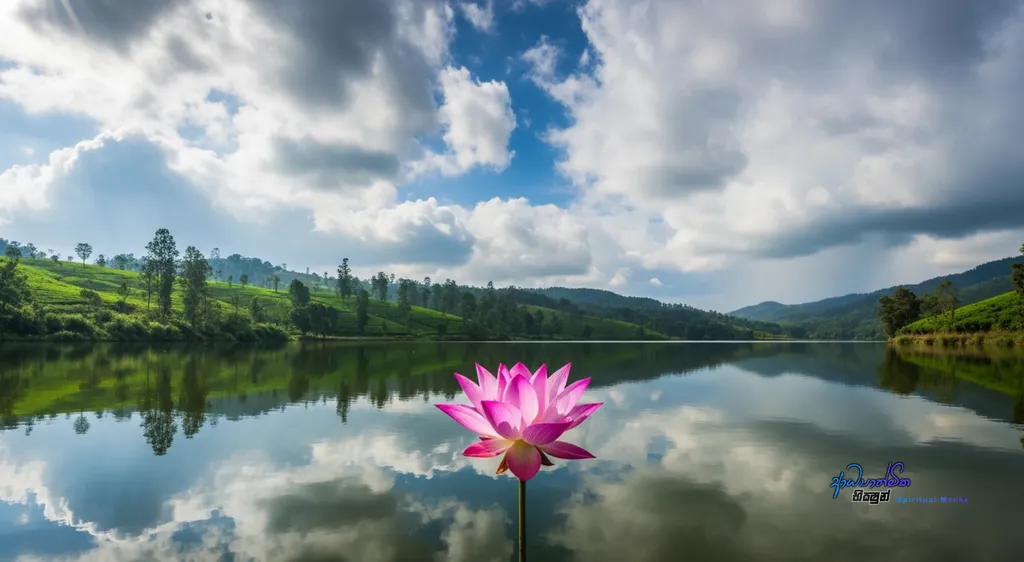
The title of this teaching is: The mind changes just like nature. For a person with wisdom, this phrase is enough. They will understand completely. If you do not yet understand, I will now explain further. So please listen with focused attention. If you can, close your eyes and settle into a meditative posture as you read.
Whether you are using headphones or a speaker, just close your eyes and absorb these words. I ask you to do this so that these points penetrate your mind more deeply than usual. When they do, this understanding will become a great source of strength, enabling you to continue your spiritual work. We must understand this.

Two Common Paths, One Common Lesson
Let’s explore this with a few practical scenarios.
Scenario One: The Promising Start and Sudden Crash
Imagine a person, a man or a woman, starts meditating. Perhaps they use a meditation object like focusing between the eyebrows and repeating the word ‘empty.’
In the beginning, they might find their mind settles quickly, and they experience a state of emptiness and concentration. For two or three days, the meditation progresses wonderfully. But on the fourth day, despite continuing the practice diligently, a flood of thoughts begins. It’s an endless, unstoppable stream.
Past thoughts, plans, all of it comes rushing in. If we categorize them, we see thoughts of desire (rāga), greed (lobha), anger (dvesha), and delusion (moha). Diving deeper, we see jealousy, stinginess, love for mother, father, spouse, and children, attachment to property, gluttony, ill will towards others, all of it surfaces on that fourth day.
The person thinks, ‘Oh no, my meditation is ruined! It was so good for the first few days, but now it’s useless. I can’t do this. I’m sick of this whole thing!‘ Some, using their wisdom, will watch this storm, understanding ‘This is the nature of the mind.‘ But many others do not.
They get angry, and if they used to meditate for an hour, now they can’t even last for half an hour. Frightened by the thoughts, they jump up from their meditation. This is the first trap set by the mind, or what we might call Mara’s first trick. They stop meditating, thinking, ‘I can’t do this.‘ This lack of understanding, this foolishness, can cause them to abandon the practice for the rest of their lives, always saying, ‘Meditation doesn’t work for me, my mind is too busy.‘

Scenario Two: The Difficult Start and the Danger of Attachment
Now, consider another person. When they start, their mind doesn’t concentrate at all. It’s scattered. But they persist. For three days, their mind is restless. On the fourth day, however, it becomes beautifully concentrated, just like the first person experienced on their first day. They feel blissful and think, ‘Ah, this is it! This is wonderful!‘ and they grow attached to that peaceful state. They enjoy this deep concentration for some time, perhaps even for a month.
But after a month of steady, calm practice, a problem arises in their life at work, in their family, with friends, or with any external issue. They continue to meditate, but now the mind is turbulent again because of that external problem. The mind that was so calm and concentrated is now agitated. And they make the same mistake.
They think, ‘Oh no, I can’t meditate. My mind is all over the place. What is this nonsense?‘ Like the person in the first example, they use this as a reason to give up. They had the good fortune to be on the verge of concentration on the fourth day, but their foolishness and impatience made them quit on the third, missing the opportunity.
In both cases, the root cause is a misunderstanding of the nature of the mind. They create rigid rules: ‘My mind must be calm today.‘ When the mind doesn’t obey, they fall into despair. They fail to see that the mind, just like nature, has its own weather. It has sunny days and stormy days. This is not a flaw in your practice; it is the very essence of the mind you are working to understand.
Embracing the Ever-Changing Mind
So, this teaching on how the mind changes just like nature is meant to bring you this crucial insight. May the power and blessings of the Triple Gem help you to grasp this reality, to understand the true nature of the mind. May you gain the wisdom to see its fluctuations without being discouraged, and with that blessing, I conclude this teaching for today.

We invite you to walk this path with us. Read our teachings, and most importantly, apply them practically in your own life. as you practice, questions will naturally arise. Please feel free to share your experiences and questions in the comments below, via email or contact form. I will do my best to offer guidance in future talks based on your progress. For now, begin this practice with an open heart and a mind free from expectation. Cultivate it correctly, and may you find the clarity and peace you seek.
Thank you for joining us. We hope this blog will be of great benefit to your spiritual journey.
May you all be well and happy.
May the blessings of the Triple Gem be with you all!


