


Categories: Maintaining Mindfulness
May the blessings of the Triple Gem be with you all!
Today, through our spiritual teachings, we wish to illuminate a particular aspect of your mind. As we have explored before, we will once again delve into the nature of the mind, analyzing it in detail. The goal is to show you a practical method, a practice to cultivate mental well-being, freedom, and tranquility.
This approach involves changing a pattern of thinking. It’s about learning to see things in a completely different way, with mindfulness and wisdom. In simple terms, this is a highly practical technique you can apply in your life.
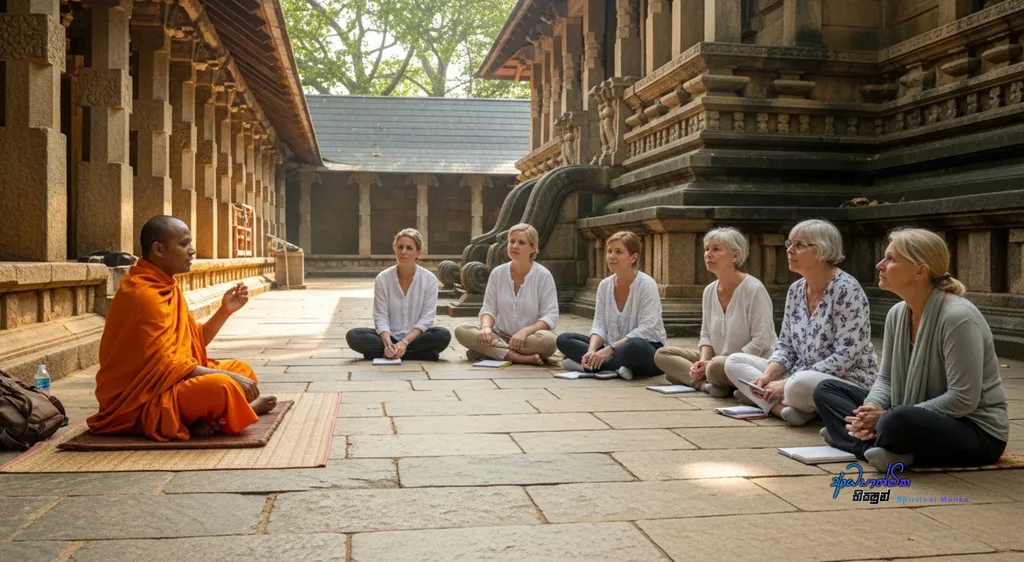
The First Step: Knowing Yourself Through Mindfulness (Sati)
In our teachings, we consistently emphasize the practical application of maintaining mindfulness. We have previously discussed how to cultivate mindfulness with the support of calming meditation, known as Samatha bhāvanā, and how to apply it in your daily life. But what does it mean to be mindful in our day-to-day activities?
Those who have practiced this know the results and understand what happens within. Through mindfulness, we gain a profound understanding of our own minds, becoming more self-aware than ever before.
Imagine a person named Kamal. Through this practice, Kamal begins to truly know himself. He asks, ‘Who am I, this person called Kamal? Am I a person with excessive desire, intense aversion, or deep delusion?‘ He starts to recognize his own unpleasant thoughts, jealousy, hypocrisy, and negativity, as well as his wholesome thoughts, like those of merit and kindness.
This recognition happens through one key activity: the practical and consistent training of mindfulness, or what is called Sati in the Pali language. This is the foundation we lay to truly understand our own mind. As this foundation is built, we begin to comprehend our inner world, whether we are at our job, riding a bus, studying at school or university, running a business, or doing manual labor.
This practice is universal, transcending class, wealth, profession, race, or religion. Whether you are a clerk, a doctor, an engineer, or hold any other position, if you begin this practice as we explain, you will have the capacity to deeply understand the teaching we are about to explore.

The Universal Struggle: Why We Shouldn’t Make Thoughts a Torment
The topic I want to focus on today is something that affects everyone: ‘Don’t let your thoughts become a torment.’ This is a challenge we all face, especially when we engage in meditation. Whether you practice ‘Third Eye’ meditation, meditation for rebirth in the celestial Brahma worlds, or any other form of calming meditation (Samatha), you will inevitably encounter this issue.
It is also a significant hurdle for those practicing insight meditation (Vipassanā), which is fundamentally about maintaining mindfulness. Because this is such a common obstacle, I want to discuss it in detail and explain how you should see it, how you need to perceive these painful thoughts to find freedom.
Your Mind: A Lifelong Record of Experience and Dukkha
So, what is actually in our mind?
From the very day this life began, everything we have done and said has been recorded and stored, moment by moment. This process will continue until the day we die. As life unfolds, we inevitably face various hardships, sorrows, and upheavals.
In today’s world, these manifest as economic problems, family conflicts, issues with relatives and friends, and a wide range of social pressures. These problems never seem to end; they don’t just stop. They may decrease for a while, then return. They disappear, only to re-emerge. This is the cycle of challenges we face.
Consider a wealthy person who has no financial worries. They might still have family problems with their spouse, children, or parents. Even if they have no such issues, there might be something from their past that torments their mind. Now, think of a poor person. They may have financial problems and social issues, but they are also burdened by regret over past actions and recurring memories of things they did, both right and wrong.
No matter how you look at it, you should see that our minds are often steeped in regret. This feeling of dissatisfaction is a pervasive part of the human condition, known in Buddhism as Dukkha. While there are moments without regret, the feeling of being troubled is far more common.

The Haunting Echoes of the Past
Look at our elderly mothers and fathers. Take a retired government worker, for instance. Even after finishing their careers, they often live with some form of regret. Look closely at the elderly; perhaps their children are not living as they wished, or their grandchildren are not nearby.
There is always some reason. If you investigate, you’ll find they are not truly happy. They are enduring some mental torment. This is true for all people in the world, regardless of race, caste, or religion. By not understanding the nature of the mind, they suffer either from current social issues or, even if their present is calm, from events of the past.
Many elderly people who have no financial or family problems in the present still lie awake all night. Why? Because memories of past deeds come flooding back, endlessly and without pause.
This is the nature of the mind. Observe your own mind when you are alone. Don’t memories of things you’ve done try to surface? They insistently remind you. We cannot simply dismiss the past. Young people often tell me they are haunted by memories of an old boyfriend or girlfriend, leading to regret. When we are alone, our past mistakes resurface to torment us. These painful thoughts become a heavy burden.

Temporary Escapes and the Illusion of Relief
This torment intensifies with age. When we are young, we have physical strength and can temporarily suppress these feelings by engaging in other activities. When a young person feels lonely and painful thoughts from the past arise, they have options.
Today, some turn to drugs or alcohol for temporary relief. Others go to concerts, take trips, or wander around with friends. By engaging in these various activities, they manage to reduce the pressure for a short time. Some try to become excessively busy.
This also offers a temporary escape from the mental pressure and tormenting thoughts. But it is only temporary. The moment they step away from those activities, the same feelings return.
This is how our mind torments us. For an elderly person, controlling this is extremely difficult. The torment becomes relentless. This is why the Buddha taught that we should strive to begin this practice from a young age. I am not saying it’s impossible when you are old, but it is much harder. The mind becomes so difficult to understand because it torments you so intensely.

The Wisdom of Starting Now: Why Youth is the Time for Practice
Imagine someone who is 70 years old. The events of their entire 70 years replay over and over. If they have committed unwholesome actions, what Buddhism calls unskillful kamma, those actions will begin to torment them.
Think of a man who was strong in his youth but is now bedridden. The things he did in his youth, chasing women, using alcohol and drugs, engaging in sexual misconduct, killing animals, breaking all five precepts, will come back to haunt him relentlessly. He cannot stop them. His body is weak, so he cannot distract himself with other activities. Nobody wants to sit and talk with him for long.
Think about it: when we have a problem, we feel relief when someone listens to us. Sharing the burden lightens the load in our heads. But when an elderly person is confined to bed, who listens to their problems? Their children may care for their physical needs, but they rarely ask about the state of their minds.
Meanwhile, the memories arise. This is why so many people can’t sleep. Insomnia from worry is not limited by age; when a problem arises, we can be awake all night. Even if we do sleep, we might have a dream related to the problem. This is the nature of our mind. It constantly tries to control us, to pull us into its sway. We must understand this.

The Five Rivers of Perception and the Ocean of the Mind
The Buddha pointed out five doors through which the mind receives information: the eye, ear, nose, tongue, and body. Think of these five as five great rivers. Where do all these rivers flow? To the ocean. The ocean is like the mind. All the data you gather through the five senses, sight, sound, smell, taste, touch, all of it comes into the mind.
Therefore, you must learn to watch the mind itself, because it is from the mind that the ‘games’ are played.
Consider a deceased person. They still have eyes, ears, a tongue, and a body. All five sense doors are there. But if we open their eyes and stand in front of them, do they see us? No. Why? Because their consciousness has left that life. Their mind is no longer in that body. The data from the sense organs cannot be processed without the main machine: the mind, or citta.
Only if the mind is present does the body function and allow us to experience these things. Medical science tells us that six hours after death, all bodily functions cease. This is why organ donations are encouraged within that timeframe. Our physical body becomes inactive. The mind is the essential activator.

The Technique: How to Handle Painful Thoughts Without a Fight
This is why I constantly tell you to maintain mindfulness and see that everything is happening “in the mind“. Watch the mind, observe the thoughts that arise. I have repeated this instruction in many of our talks. For those who practice this, whether through calming meditation or simple mindfulness, a common experience occurs: a particular thought begins to torment them. It could be anything I mentioned before: a past love affair, a mistake made toward a parent or friend, an injustice suffered, a moment of shame, or something desired but never obtained.
It could be an object, a person, a word someone said to you, or a word you said to someone else. These painful thoughts bother all of us, young and old. And they will get worse as we age if we don’t learn to understand them now.
Here is the technique. Many people, when confronted with these painful thoughts, immediately try to fight and banish them. For example, a young woman is tormented by the memory of her ex-boyfriend, who left her a year or two ago. The pain is still fresh, especially when she is alone and not distracted. At such moments, first, mindfully recognize the painful thought that has come to bother you. After recognizing it, just watch it. Don’t fight it. It will come, torment you for a bit, and then go away.

The Fruit of the Practice: Causeless Joy and Equanimity (Upekkhā)
Some people tell me the pain is so great they feel like dying or self-harming. The mental pressure can become immense. In those moments, you must recognize the thought but refuse to make it a torment. Use this technique whether you are in formal meditation or going about your daily life.
This method is for monks in forest hermitages and laypeople in villages alike. It is for anyone who finds their mind to be an obstacle. By using it, your mind becomes simple, calm, and serene. With time and practice, it becomes equanimous, a state known as Upekkhā.
So, when the painful thought arrives, do not panic. Do not make it a burden. Simply stay put and watch the thought. Let it come and, to put it simply, let it ‘perform its dance‘ and go. Let it do whatever it wants and leave. Yes, in that moment, you will feel pain in your head or body; you will feel sadness. Acknowledge this, and then look at it with wisdom, or Paññā.
Understand: ‘This is the nature of the mind’s system. This is what happens when one clings to something too much.‘ Realize, ‘This is how the mind torments us with things we have stored from the past.‘ Through this understanding, your mind will calm down. It will find a state of happiness for no reason at all.

Your Path Forward: A Practical and Independent Journey
People in the world need reasons to be happy: a baby is born; a child passes an exam. Worldly happiness depends on such causes. But spiritual happiness has no such external cause. It is a joy that arises spontaneously. To experience this kind of joy, you must continuously practice what the Buddha taught: maintaining mindfulness and looking at yourself with awareness. If you do this, painful thoughts will no longer be a torment.
I believe this teaching on ‘Don’t let your thoughts become a torment‘ is sufficient for today. Finally, I want to emphasize that all the methods we teach are practical. This is not a dream world; it is real and applicable. So, apply these practical teachings. Spirituality has no age limit; even a child can practice if they understand. Use this practice for your own benefit, and if you can, teach it to someone else. However, if they are not ready to understand, let it go and continue your own independent journey. Only teach those who ask.
As promised, I will continue to offer more teachings in the future, covering calming meditation, the nature of the mind, and many other aspects. As you continue to understand these teachings, I will conclude for today.
May the power and blessings of the Triple Gem be with you all. May you look upon your mind with mindfulness, without making your thoughts a torment. May you walk this spiritual path with wisdom, understand your mind, create happiness and freedom within it, and realize its future potential. With this blessing, I end today’s teaching.

We invite you to walk this path with us. Read our teachings, and most importantly, apply them practically in your own life. as you practice, questions will naturally arise. Please feel free to share your experiences and questions in the comments below, via email or contact form. I will do my best to offer guidance in future talks based on your progress. For now, begin this practice with an open heart and a mind free from expectation. Cultivate it correctly, and may you find the clarity and peace you seek.
Thank you for joining us. We hope this blog will be of great benefit to your spiritual journey.
May you all be well and happy.
May the blessings of the Triple Gem be with you all!


