


Categories: Be Happy 24 hours
May the blessings of the Triple Gem be with you all!
As we begin this new year, I have decided to start our series of spiritual teachings by focusing on the most fundamental aspect of our journey: the mind. In Sinhala, we call it hitha or manasa.
Why start here?
Because if we can begin by understanding our own mind and its activities, we gain the ability to navigate our path and reach our spiritual goals. By starting the year with this foundation, we empower ourselves. Understanding the mind is the key that unlocks the door to our deepest aspirations.
Therefore, I felt it was essential to share these teachings with you at the very start of this year, as recognizing the mind’s workings is incredibly important for every single one of us.
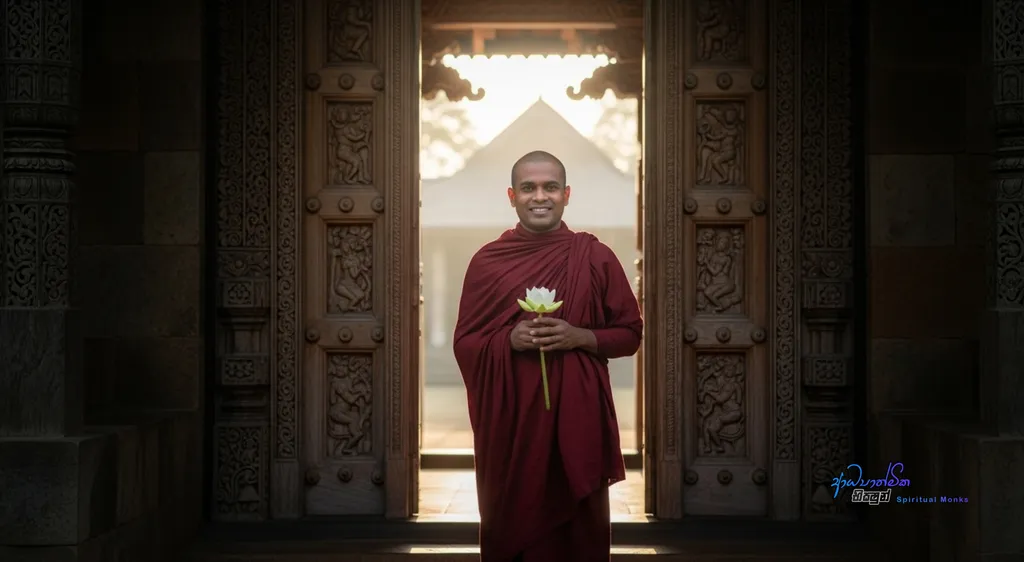
The Promise of Inner Practice: From Happiness to Liberation
This practice of observing the mind is not a small thing; it is a pathway to profound transformation. A previous teaching, titled “Let’s Be Happy 24 Hours a Day,” introduced a practical meditation method to begin this journey. If you commit to watching your mind in this way, you create the conditions for incredible growth. This path can lead you to the ultimate liberation, which we call Nibbana (Nirvana).
It can help you awaken your Kundalini, a powerful spiritual energy within you. It enhances your ability to receive universal energy, dissolves mental afflictions and stress, and can even open the door to higher mental powers, known as adhimanasika, and deep states of meditative absorption, called Jhanas. The simple practice of aiming for happiness by observing the mind for 24 hours a day is an immensely helpful and supportive tool for your entire spiritual life.
Beyond Prophecy: The Power of Practical Experience
Many people have asked me for predictions about the new year. They want to know, “Will it be a good year? A bad one?” I want to be very clear: I do not make predictions, either personally or as part of these teachings. To put it in a local way, I am not interested in “planting sweet potatoes with my mouth” making empty promises that have no practical value. There are plenty of people who make predictions, but we never truly know if they will be right or wrong.
My purpose is different. I want to give you something practical, something you can do and verify for yourself. So few teachers focus on giving you the tools to practice and develop on your own. Instead, many try to draw you into their own world for their own benefit. I wish to remain free from that.
This is why I share my experiences and all the knowledge I have gained without any “teacher’s secret” (guru mushtiya). I repeatedly encourage you to do the practices and see the results for yourself. This is the foundation you must understand.
Transcending Good and Bad Fortune with Equanimity
So, whether 2022 is auspicious or inauspicious, for us, our only goal is to continue our spiritual journey and deepen our practice. When you engage in practical meditations, whether it’s the “24 Hours of Happiness,” the Third Eye practice, or meditations for higher realms, you will find mental relief and develop your mind. You know this brings many benefits: awakening Kundalini energy, developing states of calm (Samatha meditation), and gaining the ability to walk the path of insight (Vipassana) toward Nibbana.
With such profound inner work to do, how can we say if the year is “good” or “bad”?
For anyone who sincerely practices meditation, it makes no difference. A good year is the same as a bad year. There is no problem. This is how I think for myself as well. Whatever comes, I receive it. Whatever I don’t get, it is the same. We must become neutral and develop equanimity. This is the state of mind, which we call Upekkha, that I am teaching you to cultivate by observing the mind, managing it, and recognizing its nature.

What is Mindfulness? The 24/7 Art of Paying Attention
To do this, we must use a critical tool. I mentioned an important word: mindfulness. In the Pali language of the Buddha’s teachings, this is called Sati. It means to be aware, to be present, to remember to watch. In a previous teaching series on the Third Eye, I gave the word “empty” (his) as a point of focus. The special quality of this teaching series is that there is no single word to focus on. Instead, the practice is to use mindfulness, or Sati, to bring yourself to a state of happiness for 24 hours a day by repeatedly looking at your own mind, at yourself.
This is not a method you only do while sitting in a formal meditation posture. It is for every moment: when you are sitting, walking, eating, drinking, bathing, and even as you are falling asleep. You apply this mindfulness to every action, watching a movie, looking at the TV, in every possible way. This is something necessary and, more importantly, something you can do. Please try to grasp this point. Believe that this is possible, and then you can act for your own happiness and mental peace. This requires your own practical effort.
How to Observe Your Mind: A Practical, Moment-to-Moment Guide
Many people ask the question, “But how do I watch my mind?” Let me give you some clear, practical examples to answer this. The mind is something everyone has, from a small child to an elderly person. We all know we have a mind. We know it has thoughts, and that it is the force behind our actions. We eat, drink, and bathe because of the mind. We know this body will end, and the mind will lead to a new birth somewhere else.
We know it is the mind that makes new discoveries and seeks entertainment. It is the mind that feels happy, and it is the mind that feels sad. The Buddha taught that nothing is as important as the mind; the entire eighty-four thousand bundles of teachings (the Dhamma) are about this mind.
So, how do you watch it?
Think about when you are eating a delicious meal. As you eat, look at your mind. Observe it. How does your mind behave? What kind of thoughts arise? When you are getting dressed, working in your office, or engaged in your job, how does your mind operate? If you are a man talking to an attractive woman, how does your mind react? When you visit a beautiful place in nature, what happens inside?
Does the mind become happy or sad?
What thoughts come with that feeling? Watch this constantly. When you are traveling, for all 24 hours, just keep observing the mind. We spend most of our lives looking at others. Starting today, look at yourself. The Buddha taught us to look at ourselves, to see ourselves within ourselves. This is what is meant by the phrase Paccattaṃ veditabbo viññūhi (to be realized by the wise, each for themselves)

Meeting Your Inner World: From Defilements to the Eight Worldly Conditions
For the women who are at home, cooking and looking after children, observe your mind during these activities. What thoughts arise? Are they thoughts of anger? Lust? Greed? Or are they neutral? What is happening in your mind?
If you are facing a difficult problem, a situation causing you immense pressure, watch how your mind behaves. What is your mind telling you? Observe its state in every moment.
In our last session, I taught you to simply identify your feelings: if it’s sadness, recognize it as sadness; if it’s happiness, recognize it as happiness. Now, we go a step further. We live in a world of dualities, which the Buddha called the Eight Worldly Conditions or Atalo Dahama: gain and loss, fame and disgrace, praise and blame, pleasure and pain.
These are the main sources of our happiness and sorrow. When you feel happy, watch how your mind reacts. Does it grasp at the feeling with craving? What does your mind say? Similarly, in moments of sorrow, how does the mind behave?
You will begin to see how attached you are to the cause of that sorrow, and that the attachment itself is the source of your pain. By simply identifying the thoughts of sadness, the sadness itself begins to diminish. The same is true for happiness. When you see it clearly, its intoxicating power also fades. In every moment, stay vigilant and pay attention to your thoughts.
Letting Go Without Leaving: The Secret of Mental Detachment
A very common question I receive is this: “We have children and families. We run businesses and need to earn money. How can we possibly practice mental letting go?” People message me, worried that if they “let go,” they won’t be able to achieve their goals or provide for their families.
I want to clarify this. I am asking you to let go mentally, not physically. Do not abandon your children or your responsibilities. You are letting go of the mental bondage you have to them. When you release this mental attachment, the pressure, the sorrow, and the frantic happiness associated with them disappear. You enter a strange, new state of 24/7 contentment.
Their value to you changes, but does this mean you stop fulfilling your duties? No. You still earn money, but you are not the same person who did it before, the one driven by greed and excessive effort. Now, you provide for your family and fulfill your responsibilities simply, without attachment to the future. That is the difference you must grasp.
Think about it this way: our lives are uncertain. We could die tomorrow in an accident or a natural disaster. In that moment, you will have to leave everything behind instantly, your children, your parents, your spouse, your friends, your money, your property, your businesses.
Since you will have to leave it all anyway, what are you truly holding onto now? The answer is to practice letting go with the mind. You can keep your family and your property, you can enjoy them, but release the mental attachment. This is the spiritual meaning hidden in everything.
The Surprising Truth: Your Mind as a Mirror
As you continue this practice of observing the mind, while driving, walking down the road, visiting relatives, going to the market, talking with someone, having a drink, playing a game, or even while reading this teaching, you will begin to see what is really going on inside. You will start to realize, “My mind is a terrible, dirty thing!”

Living in the World, but Not of It
Once you see this, the anger, jealousy, greed, and all the unwholesome thoughts we call kilesa (defilements). you can truly begin to work. The minds of all ordinary, unenlightened people (puthujjana) are like this. So please, understand this and just watch. By looking in this way, you will find it possible to reach a place of spiritual wellness, of being happy 24 hours a day.
You will still live in the world. You will fulfill your duties, raise your children, and provide for their future. You will do everything that is required in the physical, secular world. But internally, you will be living in a state of spiritual happiness. Those on the outside may not see it. Only you will understand it, only you will experience it. You will have arrived at a completely different place. Please try to comprehend this.
A New Year Blessing: Your Path to Inner Freedom
This is the most important message I wanted to share with you for the new year. As I said at the beginning, I will not offer predictions, so there is no use in asking. We must do the practical work that allows us to see the truth for ourselves. So, remember, whether 2022 is good or bad, it is the same for us. Conventionally, of course, I can wish you a Happy New Year, and I do.
So, take this teaching from our spiritual channel and put it into practice. Listen to these words carefully and use this method of observing the mind to develop yourself. With that, I conclude today’s new year’s teaching.
Conventionally, I wish you all a very, very Happy New Year for 2022. As a spiritual monk, I want to add this blessing: May all your mental afflictions and suffering be completely eradicated. May you awaken to the truth, develop your spiritual energies, and bring your mind to a state of unshakable happiness. May this new year be one in which you are constantly reminded of the need to develop your mind day by day. May you gain the ability, courage, and strength to advance on the path of meditative absorption (Jhana), higher knowledge (Abhiññā), Kundalini energy, insight (Vipassana), and final liberation (Nibbana). By the power of the Buddha, Dhamma, and Sangha may this be so for you.
We invite you to walk this path with us. Read our teachings, and most importantly, apply them practically in your own life. as you practice, questions will naturally arise. Please feel free to share your experiences and questions in the comments below, via email or contact form. I will do my best to offer guidance in future talks based on your progress. For now, begin this practice with an open heart and a mind free from expectation. Cultivate it correctly, and may you find the clarity and peace you seek.
Thank you for joining us. We hope this blog will be of great benefit to your spiritual journey.
May you all be well and happy.
May the blessings of the Triple Gem be with you all!


