


Categories: Spiritual Expectations
May the blessings of the Triple Gem be with you all!
Today, I wish to explore a topic that many of you have asked about: Setting Goals Without Expectation in our spiritual practice. Specifically, I want to discuss how to meditate with a goal, yet release any attachment to the outcome. This idea may sound like a contradiction, and I understand that it can often be a source of confusion.
Many feel that it’s impossible to do anything without expecting a result. It is precisely because this concept is so vital, and so often misunderstood, that I want to clarify it for you. Let’s unravel this together, so you can walk the path with clarity and confidence.
How We Function in Everyday Life: The Union of Goals and Hopes
First, let’s look at how we operate in our everyday, worldly life, which in Buddhism we might call the laukika world. In this realm, having both a goal and expectations is not only normal but necessary for success. Think about starting a business, pursuing your education, or developing a skill in sports.
You set a clear goal, or an ilakkayak as it’s called in Sinhala. For example, your goal is to pass your advanced-level exams and get into a university.
This goal is essential; it gives you direction. But then, we build a host of expectations, around that goal. You dream about what university life will be like, the friends you’ll make, and the subjects you’ll excel in. You see others who have succeeded, and you build a detailed mental picture of your own success.
The same applies to a business. The goal is to make it successful. The expectations are the specific milestones, the beautiful shop you’ll build, the specific products you’ll stock. Look into your own mind and heart; you will see this pattern of setting a goal and then weaving a rich tapestry of hopes and desires around it.
The Inevitable Stress of Worldly Hopes: Understanding Dukkha
Now, what happens when reality doesn’t match our carefully constructed expectations?
This is where we encounter a universal truth the Buddha taught: this clinging leads to suffering, a deep sense of stress and unsatisfactoriness known as Dukkha. Imagine a business owner who started their venture in 2020 with a five-year plan to achieve great success by 2025.
They had clear expectations for each year. But then, an unforeseen economic crisis hits the country, as we have seen in Sri Lanka. Suddenly, the path to the goal is blocked. The target feels impossible to reach.
What arises in the mind?
Frustration, sadness, anger, and perhaps even despair. We suffer mentally and emotionally. This happens when an exam is failed, when our children don’t turn out the way we hoped, or when a relationship ends. The pain comes not from the goal itself, but from the shattering of the expectations we attached to it.
We become so entangled in our hopes that when they collapse, we collapse with them, experiencing immense mental pressure and pain. You may even lose the will to try again, at least for a while.

The Trap: Applying Worldly Logic to the Spiritual Path
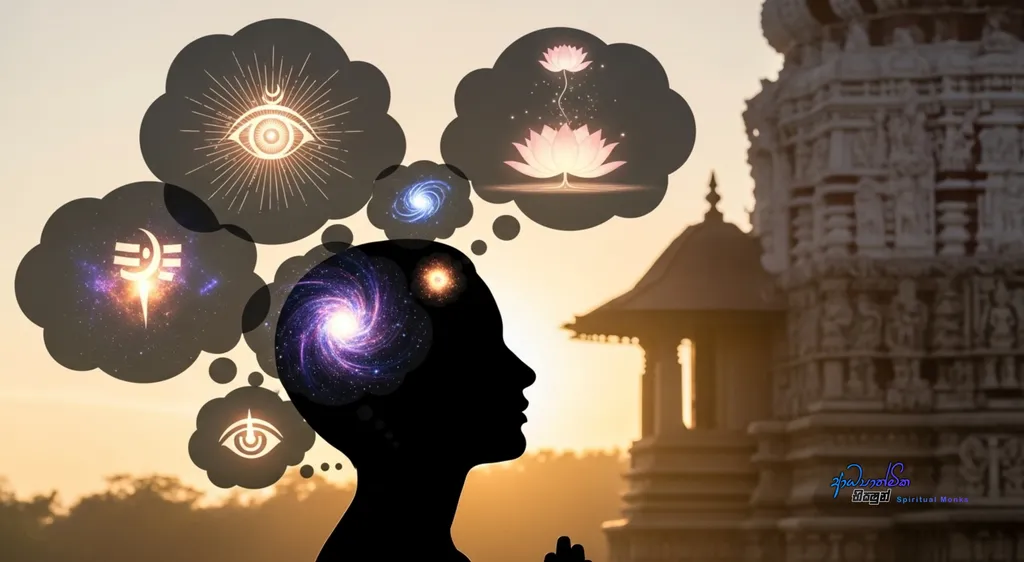
The critical mistake many of us make is applying this same worldly logic to our spiritual life, the ādhyātmika path. We hear about profound spiritual goals like achieving liberation (Nibbana), developing deep states of calm (samatha), or opening the third eye. We set this as our goal, which is good. But then, just as with the university or the business, we build a dense cloud of expectations around it.
We start to think: ‘I must see a divine light,‘ ‘I need to awaken my Kundalini energy,‘ ‘I want to see past lives or otherworldly beings,‘ ‘I will gain psychic powers to impress others or get revenge on those who wronged me,‘ ‘I will become a famous spiritual teacher.‘ We see the spiritual goal, like Nibbana, and then we project our worldly desires and fantasies onto it.
This is how we begin our practice of meditation without expectation, incorrectly, by treating the inner world like an external project.
Why Spiritual Expectations Become Barriers to Progress
Why does this approach fail on the spiritual path?
Because the mind is not a physical building you can construct with a blueprint. You cannot force it to yield specific results on a timeline. When you sit for meditation with a bag full of expectations, you create tension, striving, and self-judgment. You are no longer observing the mind; you are fighting with it.
If the expected light doesn’t appear, or the profound peace doesn’t descend, you become frustrated. This is the greatest harm: you start to believe the practice isn’t working, and you give up. The person who meditated three times a day reduces it to once, then to once a week, and then stops altogether.
The spiritual journey stalls because the fuel of our worldly desires and expectations is toxic to it. You can’t carry a heavy bag of hopes and desires and expect to walk the path to freedom. It is a fundamental law of the inner world that you cannot achieve these states while craving them.
This is the core reason we must practice meditation without expectation.

The True Path: A Clear Goal with Effort, Not Hope
So, what is the correct way?
The key is to hold your spiritual goal (ilakkayak) while completely letting go of your expectations (balāporoththu). Your goal can be simple and powerful: ‘I will walk this path toward liberation,‘ or ‘I will practice diligently to understand my mind,‘ or even ‘I will practice meditation every day until the end of my life.‘ This goal provides direction and motivation.
Once the goal is set, you release all attachment to the outcome. You shift your entire focus to the process itself. Your attitude becomes: ‘Results may come, or they may not. That is not my concern. My only duty is to practice with diligence and consistency.’
This requires great energy and effort, which we call vīriya. You practice without laziness, without giving in to sleepiness, with a steadfast resolve. You simply do the work. This is the heart of meditation without expectation. The journey itself becomes the destination.
Trusting the Path: The Role of Faith (Saddhā) and Natural Unfolding
But how can we keep going without the motivation of our hopes and dreams?
This is where another crucial quality comes in: faith, or saddhā. This isn’t blind belief, but a deep trust and confidence in the path shown by the Buddha and the teachers who have walked it successfully. They have already completed the journey and have told us: ‘This is how it works with the mind. Let go of your expectations, and the path will open.‘
When you practice with this trust, you allow nature, or the universe, to do its work. By consistently practicing letting go, letting go, letting go, you become closer to the natural flow of reality. And then, the universe provides what is needed.
The deep states of concentration (dhyāna), the psychic abilities, the cosmic energy, and the insights they arise naturally when you stop demanding them. They are gifts of the path, not prizes to be won. Trust the process.
Your Only Task: A Resolute Commitment to the Practice
Therefore, all that is truly required of you now is your commitment. You have the goal. You understand the trap of expectation. Now, all that’s left is to make a firm determination (aditthāna): ‘I will practice this path, diligently and continuously, for the rest of my life. I will meet whatever arises with mindful awareness and let it go.‘
When you cultivate this mindset, the practice will never become tiresome or a burden. You won’t feel discouraged or want to give up. You can proceed with a mind that is free, light, and joyful. By letting go of the mental chains of expectation, you allow your true spiritual potential to blossom naturally.
This is the path to overcoming all suffering. Understand this, take it to heart, and move forward with your practice in freedom.
May you all be able to see these thoughts with great mindfulness, understand your own expectations, and find the space to let them go. May you be blessed to walk this path with a clear goal and a free heart.

We invite you to walk this path with us. Read our teachings, and most importantly, apply them practically in your own life. as you practice, questions will naturally arise. Please feel free to share your experiences and questions in the comments below, via email or contact form. I will do my best to offer guidance in future talks based on your progress. For now, begin this practice with an open heart and a mind free from expectation. Cultivate it correctly, and may you find the clarity and peace you seek.
Thank you for joining us. We hope this blog will be of great benefit to your spiritual journey.
May you all be well and happy.
May the blessings of the Triple Gem be with you all!


