


Categories: Other Meditation Teachings
May the blessings of the Triple Gem be with you all!
Today, through our spiritual teachings, I wish to clarify a crucial point for your practice: why you should not meditate with worldly expectations. I hope to provide you with a clear understanding of this principle.
When we begin to meditate, we are all that you might call ‘ordinary people’ (puthujjana) in the Pali language. This means we are filled with different ideas, attachments, and various flaws. Anyone can meditate, but the challenge is that most people begin the practice holding onto many expectations. This attachment significantly impacts the journey in various ways.
Many people are eager to learn and practice meditation. They feel a strong desire to begin. However, this desire is not enough if their minds are cluttered. They come to meditation carrying a heavy load of hopes and cravings. When you start this way, it becomes nearly impossible to maintain a consistent practice. You may find yourself stopping midway, growing tired of meditation, or even becoming disillusioned with the entire path.
There are clear reasons for this, and they all stem from a fundamental misunderstanding: meditating with specific goals in mind. In my previous teachings, I have constantly emphasized one thing: engage in meditation without any expectation or desire. This is a point I have returned to again and again. Yet, in today’s world, many people are drawn to the idea of meditation but bring these worldly hopes with them.

The Trap of Spiritual Craving: The ‘Third Eye’ Example
Let me give you a concrete example. In our collection of teachings, I have offered guidance on a practical meditation for what is known as the ‘third eye‘. I have provided a large number of guided programs on this topic. Naturally, when people learn about this, they become very interested. They feel an intense desire to try it and see the results for themselves. We have discussed how one might perceive places like the great Ruwanwelisaya stupa or the ancient rock fortress of Sigiriya using this inner vision.
Now, if someone listens to these teachings and begins to meditate with the specific thought, ‘My third eye must awaken so I can see these things,’ they will not be able to develop their meditation. It is almost certain. Furthermore, their third eye will not awaken. Why is this? The reason is the expectation itself – a form of craving, or what we call tanha in Pali.
This is a subtle ‘spiritual craving’ or adhyathmika tanhava. The very presence of this spiritual thirst makes it impossible to deepen one’s practice. As I mentioned before, this feeling is what leads to disillusionment, frustration, and a sense that meditation is yielding no results. This single thought becomes a powerful obstacle.

The Corruption of Worldly Desires: Chasing Money and Fame
This is a point we must understand deeply and with certainty. I have received messages, for instance through WhatsApp, asking me, ‘Venerable Sir, are there people whose third eye is awakened? We could make a lot of money, Sir. We could set up a profitable business.’
I never chase after money. If I did, I could have become very famous and wealthy. But I have no desire for such worldly, trivial things. The kind of people who are drawn to these ideas are, to be frank, foolish people stuck in a worldly mindset. Not everyone, of course, but certain fools chase after money and mundane gains. I am not such a person.
When I receive these kinds of voice messages and texts, I feel no affinity for them. In fact, I have replied quite sternly, telling them, ‘You are fools! Do not contact me, you who chase after money.’ So, why do these people turn to meditation? Their goal is to use spiritual abilities, like the third eye or the deep meditative states called dhyana, to make money. They try to turn the fruits of meditation into a commercial enterprise. But because they are meditating with this worldly expectation, they will never receive the true results of the practice.
This brings us back to our main topic: as long as you hope for worldly things, you cannot gain the fruits of meditation. The title of this reflection is a direct warning: do not meditate with worldly expectations. You truly cannot. As I have said many times, meditation should be a light, free journey, like walking on a path of flowers. It must be approached without baggage.
I’ve even taught previously that knowledge itself can become a burden, a teaching I called, ‘Don’t let knowledge become your demon‘. The principle is the same: do not carry it as a weight.
Poisoned Intentions: Revenge, Ego, and Other Obstacles
Let me outline a few more of these misguided intentions, as there are many. I will share a few so this teaching becomes perfectly clear.
The Desire for Revenge: Some people, both men and women, begin meditation with the hope of getting revenge. Perhaps they were wronged by a former partner or someone they loved. They think, ‘I will awaken my third eye and give them a ‘return’ or use some power to get back at them.’ I have spoken to people with such ideas, both online and in person.
Please, do not approach meditation with such petty, childish thoughts. Your practice will never succeed if your mind is filled with these base intentions. You must remember this. To develop in meditation, these kinds of destructive thoughts must be absent.
The Ego of Healing : Others approach me and say, ‘I want to meditate so I can heal the sickness of others.‘ On the surface, the intention seems good and the heart pure. However, hidden within this thought is another layer of mental defilement, or kleshas. Beneath the desire to heal lies the thought: ‘By healing illnesses, I will become a big shot. I will become a personality.
I will make people come to me, and I will build up a great sense of pride.’ This is a thought rooted in ego and arrogance, or māna. Spiritual healing abilities are something that must arise naturally; they cannot be acquired by force. One can study and receive an education to become a Western or Eastern doctor, or an Ayurvedic practitioner. But to develop a natural gift, a healing touch, you cannot meditate with this kind of intention.
This very motivation will cause your practice to decline. You won’t feel like meditating, and even if you do, you won’t be able to accomplish the most basic instructions, like focusing on the point between your eyebrows. You won’t even feel the subtle sensations that a normal practitioner would, because your mind is blocked by this heavy, worldly burden.
Previously, I explained that disrespecting the Triple Gem, the Buddha, Dhamma, and Sangha – is one cause for such blocks. But holding onto these worldly expectations is another major cause.

Even ‘Good’ Goals Can Be a Trap: The Problem with Improving Memory
You must understand this point. Even something that seems beneficial, like improving memory, can be a trap. Students who are in the field of education know the importance of memory. I have mentioned in some teachings that meditation does indeed improve memory.
However, we should not begin meditation even with this seemingly positive worldly goal. If you meditate with the expectation that your memory will improve for an exam, what happens if you suddenly forget something while writing it? You might become angry with meditation itself. You might get frustrated and think, ‘What is this nonsense? I couldn’t remember it when I needed it most!‘ This shows that we should not meditate with even this kind of worldly expectation.
We must grasp these points firmly. So far, I have pointed out several examples: chasing after money, seeking revenge, and even trying to improve memory for exams. These are all worldly goals that hinder our practice.
Letting Go of All Expectations: Worldly and Spiritual
There are so many more examples of worldly expectations, but as you explore this teaching, you can begin to see for yourself what they are. You can ask yourself, ‘What worldly hopes, what worldly cravings, am I expecting from meditation?’
Beyond worldly things, we must also let go of spiritual expectations. Do not hold onto the idea that you “must” attain special abilities, that you “must” achieve the meditative absorptions known as dhyana, that you “must” see a sign of light, or that your third eye “must” awaken. Do not have even this ‘spiritual craving‘. If you can meditate without these rules and demands, your practice can develop.
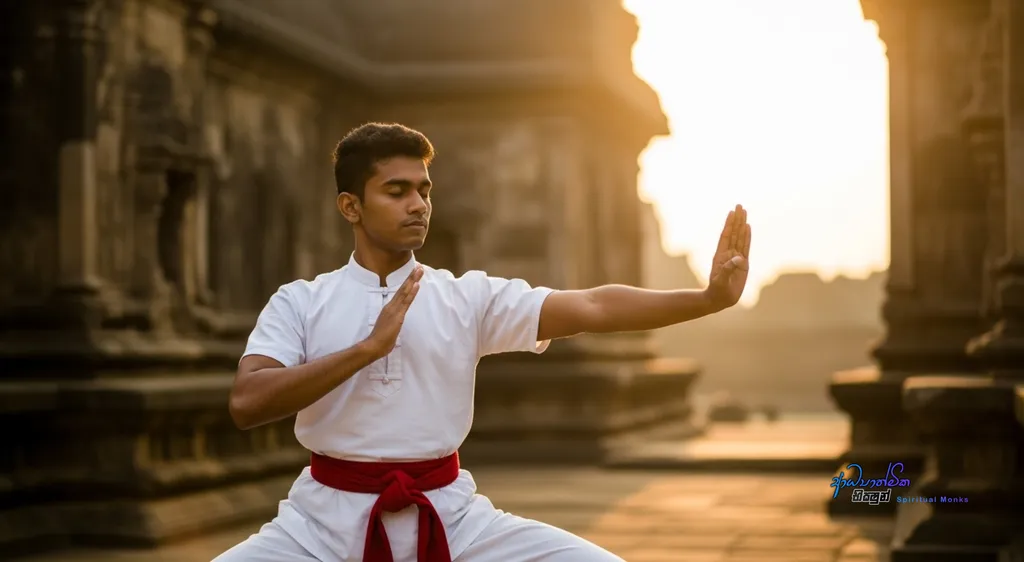
Consider martial artists. I speak with people who practice various arts like Angampora, Karate, and Kung Fu. They also meditate. My advice to them is this: do not meditate with the specific idea of improving your martial arts ability. Simply meditate. And separately, continue your physical practice.
The benefits you seek – such as composure, sharp mindfulness, and the mental clarity to anticipate an opponent’s move – will arise as auxiliary results of your meditation. They are byproducts of maintaining mindfulness. You do not need to aim for them directly.
The Path Forward: Meditating with a Pure Heart
I have repeated this point again and again throughout this teaching, highlighting different examples, to emphasize one core truth: do not hold on to any worldly expectation or worldly craving (laukika tanhava). Furthermore, do not hold on to any spiritual expectation or spiritual craving (adhyathmika tanhava).
Please, align yourself with this understanding. When you prepare to enter into meditation, to begin your practical journey, be mindful of your intention. You know what is in your own heart. As you proceed with a pure mind, you will see results arise naturally.
We have provided teachings to guide you, and our WhatsApp number is available to clarify questions as you move forward. There is a beautiful, clear path ahead of you. Do not corrupt it from the very beginning by carrying these various cravings and desires.
Grasp this point well, and let us develop our spiritual being, our meditation practice. With that, I will conclude today’s teaching on the topic, ‘Do Not Meditate with Worldly Expectations.’
May the powerful blessings of the Triple Gem : the Buddha, the Dhamma, and the Sangha help you all to develop your spiritual energies and your spiritual being. May you be able to deepen your meditation with clear mindfulness and a pure intention, free from any worldly expectation or spiritual craving. With this blessing, I conclude this teaching for today.
We invite you to walk this path with us. Read our teachings, and most importantly, apply them practically in your own life. as you practice, questions will naturally arise. Please feel free to share your experiences and questions in the comments below, via email or contact form. I will do my best to offer guidance in future talks based on your progress. For now, begin this practice with an open heart and a mind free from expectation. Cultivate it correctly, and may you find the clarity and peace you seek.
Thank you for joining us. We hope this blog will be of great benefit to your spiritual journey.
May you all be well and happy.
May the blessings of the Triple Gem be with you all!


