


Categories: Lost Your Meditation Spark?
May the blessings of the Triple Gem be with you all!
Today, we will explore a question that touches nearly everyone on a spiritual path: Why meditation practice feels stale or unappealing over time?
This is a common experience for practitioners of all ages and backgrounds, whether you are following a guided path or practicing independently. It doesn’t matter if you practice Samatha (calmness) or Vipassanā (insight) meditation; this challenge is an almost inevitable part of the journey. It’s a hurdle that every spiritual seeker, or Yogavacara, will likely face.
This feeling of meditation discouragement is a natural, albeit difficult, part of the process. Based on our experiences, we want to help you understand not only how to resolve this issue but, more importantly, why it arises in the first place. Understanding the root cause is the first step toward lasting progress.

The Core Problem: Meditating with Expectations
So, why does this sense of weariness set in?
The primary reason is that we often begin our meditation practice laden with expectations. Many of us turn to the spiritual life with specific hopes and desired outcomes, and this is completely normal for a beginner. Whether man or woman, young or old, we carry anticipations into our practice.
These expectations are often shaped by our worldly life or our successes and failures. We project the same goal-oriented mindset that we use to achieve things in the material world onto our spiritual practice.
We think, ‘If I do X, I will get Y.’ This very mindset, which may have served us in our careers or personal lives, becomes the single biggest obstacle to spiritual development. These hopes create a subtle but significant harm to our progress, turning the practice into a source of potential meditation discouragement.

The Hidden Agenda: A Catalogue of Spiritual Ambitions
When we, as ordinary worldlings what Buddhism calls puthujjana begin to meditate, we do so hope for a specific result. This is the great trap. The mind, conditioned by worldly goals, brings a shopping list of spiritual ambitions to the cushion. Think honestly about your own mind. Do any of these goals resonate?
- ‘I must advance quickly in this meditation.’
- ‘I will awaken my third eye.‘
- ‘I want to attain the Jhānas (states of deep meditative absorption).’
- ‘I am doing this to achieve the stages of enlightenment and realize Nibbāna (liberation).’
- ‘I want to access universal energy or awaken Kundalini.‘
- ‘I will develop psychic powers and special abilities.’
- ‘I will use these powers to become a great person who serves my country and religion.’
- ‘I will become a prophesied great king, like the Diyasena Kumaraya of Sri Lankan folklore.’
- ‘I will use this power to get revenge on those who have wronged me.’
- ‘I will find hidden treasures.’
- ‘I will become a famous spiritual teacher and make money.’
These are just a few examples of the narrow and varied mindsets people bring to the practice. Take a moment to look inward with mindfulness and see what secret expectations and goals you might be holding. This bundle of desires is the primary source of future meditation discouragement.

How Daydreams and Desires Sabotage Your Practice
What happens when you sit to meditate with this heavy bundle of expectations?
You may begin the practice, perhaps focusing on the point between the eyebrows as taught in some techniques. But soon, the mind begins to drift. Those deeply held desires surface as thoughts and elaborate daydreams.
You might start fantasizing about being a king, or exploring Area 51 with your psychic powers, or investigating the secrets of the pyramids. The mind builds entire worlds based on these ambitions. As I’ve explained in previous teachings, you get lost in mental fabrications. This isn’t a conscious choice; it happens automatically.
For the first few days, you might brush it off and continue. But the thought is there when you start, it’s there in the middle, and it’s there when you finish. You’ve read about the signs of progress like light phenomena (āloka saññā) or mental images (citta rūpa) and you expect them to appear quickly.
But they don’t. Why?
Because your mind is not unified. It is scattered, lost in the very daydreams your expectations created. This failure to meet your imagined timeline leads to disappointment, sadness, and regret, which are the seeds of meditation discouragement.

The Impatient Mind: Craving for Instant Results
This brings us to another critical point: impatience. Some people practice for a week and then complain, ‘Venerable Sir, I’m not getting any results!‘ Is it reasonable to expect profound results in just one week? For some, progress can come in a day, or even a minute, if they have cultivated the path in past lives. For others, it may take months or even a year of dedicated effort.
The Buddha himself acknowledged this in the Satipaṭṭhāna Sutta, the core teaching on mindfulness. He said a dedicated practitioner could attain liberation in as little as seven days or it could take as long as seven years. The time it takes is unique to each individual’s journey of understanding their own mind.
This desperate need for quick results is nothing but greed and craving, or Taṇhā in Pali. It’s the feeling of ‘I need it now!‘ This very impatience is a form of clinging. You cannot rush the mind. The more you demand and hurry, the more you solidify the very attachments you are trying to release, leading directly to frustration and meditation discouragement.
The Inner Deceiver: When Your Own Mind Becomes the Obstacle
When the expected results fail to appear, the mind begins to turn on the practice itself. Thoughts arise like: ‘This meditation technique is useless.‘ ‘There are no results here.‘ ‘The teacher is incompetent.‘
Who is telling you this?
It is your own mind. The part of your mind that resists progress, which we can call your inner Māra (the tempter or deceiver), begins to show you that your efforts are pointless. It suggests you quit and go back to your old life.
These are just thoughts. If you don’t recognize them with mindfulness for what they are mere mental events you will fall for their tricks. You will be pulled back into your old habits. By bringing these patterns to your attention now, you can learn to identify them when they arise in your own practice. Recognizing this internal saboteur is crucial to avoiding meditation discouragement.

Mental Simplicity: The True Measure of Wealth on the Spiritual Path
True progress requires a simple mind. But what does ‘simplicity‘ mean?
It is not about being materially poor. Many believe you must be physically simple to walk the path to Nibbāna, but this is a misunderstanding. A person can live in a mud hut but have a mind filled with expectations, impatience, and greed. Is he simple?
No. He is poor both materially and mentally.
Conversely, a wealthy person can be mentally ‘poor‘ in the best sense of the word is simple, unattached, and free from expectation. The one who has cultivated a mind free from these burdens, who sees his own thoughts with mindfulness, is mentally rich and truly simple.
It is this mental simplicity, not your social or financial status, that allows you to walk the path. A wealthy person clinging to expectations is mentally weak. A poor person who has let go of them is mentally prosperous. The key is to cultivate a simple mind, free from grasping. This is also known as alpecchathavaya, or contentment with little.
The Desolate Graveyard: When the Practice Becomes Tasteless
So what happens when you follow this advice and begin to let go of your expectations?
Your spiritual world, once filled with exciting, heroic daydreams, like a character in an Avengers movie suddenly collapses. When I point out these illusions and you begin to dismantle them, the practice can feel barren. It becomes a desolate, silent place, like a ruined city or a lonely graveyard.
The ‘flavor‘ is gone. Meditating feels like the act of a dead person eating without tasting, living without feeling. This is a very real stage, and it is a powerful cause of meditation discouragement. The practice feels flat and empty because the fantasies that made it feel exciting are gone. This is the next major hurdle you will face.

Living in the Emptiness: The Courage to Continue
What should you do when you arrive in this desolate graveyard?
You must learn to love it. ‘Loving it‘ doesn’t mean creating a new attachment. It means accepting and living with this state of being. Live in that feeling of a lonely tomb. Dwell in the emptiness that arises when hopes and dreams are absent.
And as you live with it, you continue to meditate without interruption. Just as you meditated consistently when your mind was filled with dazzling fantasies, you must now meditate consistently in this barren landscape. This is the moment of true progress. You are no longer fueled by illusion. By persisting through this phase, you develop a profound stability that is not dependent on pleasant feelings or exciting results.
This is how you overcome deep-seated meditation discouragement.
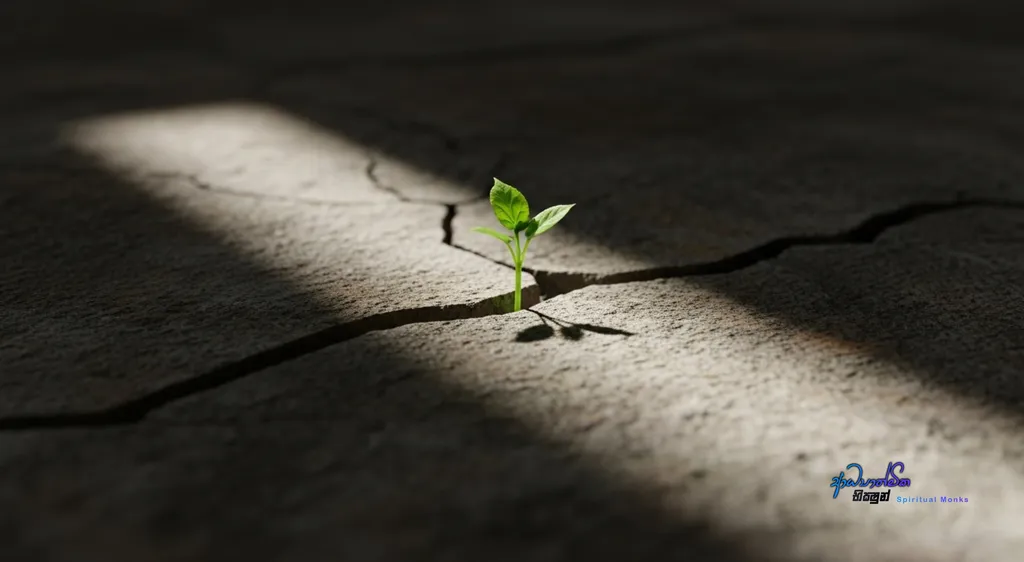
The Unshakeable Mind: Finding Balance in Upekkhā (Equanimity)
When you learn to continue your practice through both the beautiful dream world and the desolate graveyard, you have discovered the path to true development. These are the mental barriers, the frames, and the limits we speak of. Recognizing them is growth.
Eventually, a beautiful dream world is the same as a lonely tomb or neither one moves you. You simply continue to meditate. And then, the signs of progress, like light phenomena, may begin to appear. But now, you feel no special joy when they come. And if they disappear, you feel no special sorrow or anger. Your mind is reaching a state of balance, of neutrality.
This is Upekkhā, or equanimity. Your mind is settling into the Middle Path, where both calmness (Samatha) and insight (Vipassanā) can grow together.
The Unwavering Resolve: A Practical Strategy to Persist
Here is a simple, powerful strategy. Whatever obstacle arises in your mind, treat your meditation practice as non-negotiable. In your daily life, no matter the difficulty, you go to work to feed your family. You persevere. Adopt this same attitude toward your practice.
Treat your meditation like your child, your spouse, or the hunger in your belly it must be attended to.
Whatever problem or suggestion the mind throws at you, just say, ‘That’s okay,‘ and continue to meditate. The more the feeling of meditation discouragement arises, the more you should practice. The more the mind tries to make it tasteless, the more you should commit. This is the application of Viriya, or persistent effort, a key quality on the Buddhist path.
You must do the opposite of what the deceptive mind tells you to do.
When you do this, you will arrive at a state where results are fine, and no results are also fine. Taste is fine, and no taste is also fine. Your mind becomes light, positive, and free. You are mentally simple, mentally prosperous. This is true freedom.

Conclusion: The Path of Mindful Perseverance
By understanding these few simple points, you can see the path forward. You now understand why meditation discouragement occurs and the attitude needed to move through it. The key is to recognize your own thoughts with constant mindfulness. All the obstacles and the desires, the impatience, the boredom, the doubt are your own thoughts. Recognizing them is the path itself.
I encourage you to share your experiences in the comments of these articles. Doing so strengthens your own resolve and inspires others. It is an act of merit that will, in turn, support your own journey. By seeing that others face the same challenges, we all gain the strength to continue.
May you grasp these points and proceed with a clear understanding of your own mind. May you have the mindfulness to see these thoughts as they arise and the wisdom to not be caught by them. With the blessings of the Buddha, the Dhamma, and the Sangha, may you have the strength to continue your noble practice.
We invite you to walk this path with us. Read our teachings, and most importantly, apply them practically in your own life. as you practice, questions will naturally arise. Please feel free to share your experiences and questions in the comments below, via email or contact form. I will do my best to offer guidance in future talks based on your progress. For now, begin this practice with an open heart and a mind free from expectation. Cultivate it correctly, and may you find the clarity and peace you seek.
Thank you for joining us. We hope this blog will be of great benefit to your spiritual journey.
May you all be well and happy.
May the blessings of the Triple Gem be with you all!


