


Categories: Third Eye: Practical Meditation
May the blessings of the Triple Gem be with you all!
Today, through our spiritual reflections, I wish to share a new teaching on the topic of the third eye, specifically the third practical meditation in this series. Before we explore the practical steps of this third eye meditation, it’s important to revisit the foundations we have discussed previously. For those of you who are new to this path, I encourage you to explore the teachings from the very beginning, as each one builds upon the last. This will provide a complete and stable foundation for your practice.
From today onwards, I want to introduce a vital preliminary step to be done before you begin any meditation session. We must ask for forgiveness from the Triple Gem, the Buddha, the Dhamma (His teachings), and the Sangha (the community of noble disciples). In the Pali language, the traditional verse is:
“Kāyena vācā cittena, pamādena mayā kataṁ, accayaṁ khama me bhante, bhūripañña tathāgata. Accayaṁ khama me dhamma, sandiṭṭhika akālika. Accayaṁ khama me saṅgha, supaṭipanna anuttara.”
You can recite this in Pali if you wish, or you can reflect on its meaning in English, which is:
“To the noble Triple Gem, the Buddha, Dhamma, and Sangha if I have committed any fault with body, speech, or mind, knowingly or unknowingly, may I be forgiven.”
Repeat this request for forgiveness three times. After humbly clearing your heart in this way, you are ready to sit for your third eye meditation.
Recapping Our Starting Point: The Meditation Between the Eyebrows
In our first practical teaching on third eye meditation, we discussed a technique focusing the mind on the point between the eyebrows. As you develop this practice, many people report a variety of physical sensations. It is helpful to be aware of these so you are not alarmed.
You might feel a pressure or tightness on your forehead, right between the brows. Some feel a spinning sensation, while others feel as if they are being gently pulled upwards from that point. It is also not uncommon to experience a headache, a feeling of pressure in the center of the head, or even a tightness in the middle or lower back. Your whole body might feel constricted. These are just some examples, and you might experience other physical shifts not mentioned here. These are normal signs that energy is beginning to move and concentrate as you practice this third eye meditation.
Just as you may experience physical sensations, you might also have visual experiences during your third eye meditation. As you hold your attention between the eyebrows, you may perceive lights of various colors: yellow, blue, purple, white, or red. Some people see what looks like a black hole or a dark cave. Others may see rays of light radiating outwards.
In time, more complex images might appear. You could see a form of the Buddha, a celestial being (deva), a non-human being (amanussa), or a high spiritual being like a Brahma. You might also see beautiful natural scenes, like waterfalls and rivers. The possibilities are vast, and you may see things not listed here. These visions are a part of the journey, early signs that your inner perception is beginning to awaken.
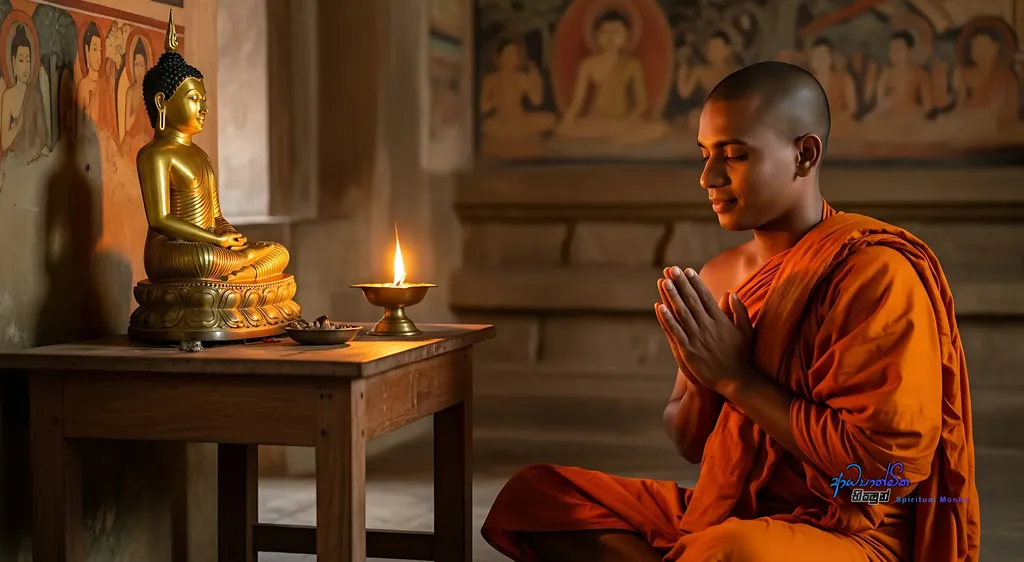
The Heart of the Practice: Meditating on ‘Emptiness’
Today, we introduce a new, powerful concept to take your practice deeper. It is the idea of ‘emptiness‘ or ‘spaciousness.’ In Pali, the language of the early texts, a related concept is Sunyata. This doesn’t mean a negative void, but rather a boundless space free from the clutter of constant thinking. It is the next step in learning how to open your third eye.
Here is the practical technique. If you find your mind is busy and restless with thoughts, bring your attention to the point between your eyebrows and gently, without force, think to yourself, ‘his…‘ (meaning empty). Pause for a few seconds. Then, gently think, ‘his…‘ (meaning empty) again. Do this calmly, without rushing.
However, if your mind is already calm and settled, you do not need to force your attention between the eyebrows. Simply rest your awareness at eye level, in that quiet, open space. If restlessness returns, you can always go back to focusing on the forehead and the thought of ‘his….’ The goal is to cultivate this feeling of peaceful, open emptiness for your entire meditation session.
If, during your meditation, the mind becomes restless again, simply return your focus to the point between the eyebrows. Use the “his….” thought to calm it down. Once the mind settles, which might take a few seconds or a few minutes, you can return your awareness to the spaciousness at eye level. Whether you meditate for five minutes or two hours, your task is to gently cultivate and become familiar with this perception of “emptiness.” This is the core of this advanced third eye meditation.
When the Veil Lifts: Navigating Visions and Perceptions
When you practice in this way, the opening of the third eye happens on its own, often without you even noticing it. The lights and signs we discussed earlier are the preliminary stages. As you cultivate the “his….” perception, this process deepens.
As you cultivate this perception of emptiness, the veil of ordinary reality may begin to thin. This is a sign that your third eye meditation is bearing fruit. You might find clear images arising in your mind’s eye. You could see your own home, the rooms within it, or even loved ones, as clearly as if you were there. Sometimes, you may perceive things beyond the physical realm, such as nature spirits in a tree or the lingering energy in a place.
This happens because your inner light, or āloka saññā, is developing. You may also experience unusual sounds, both beautiful and startling, or distinct smells, from heavenly fragrances to unpleasant odors. Do not be afraid. These are simply your senses becoming more refined. The key is to remain a balanced, calm observer, without getting carried away by excitement or fear.
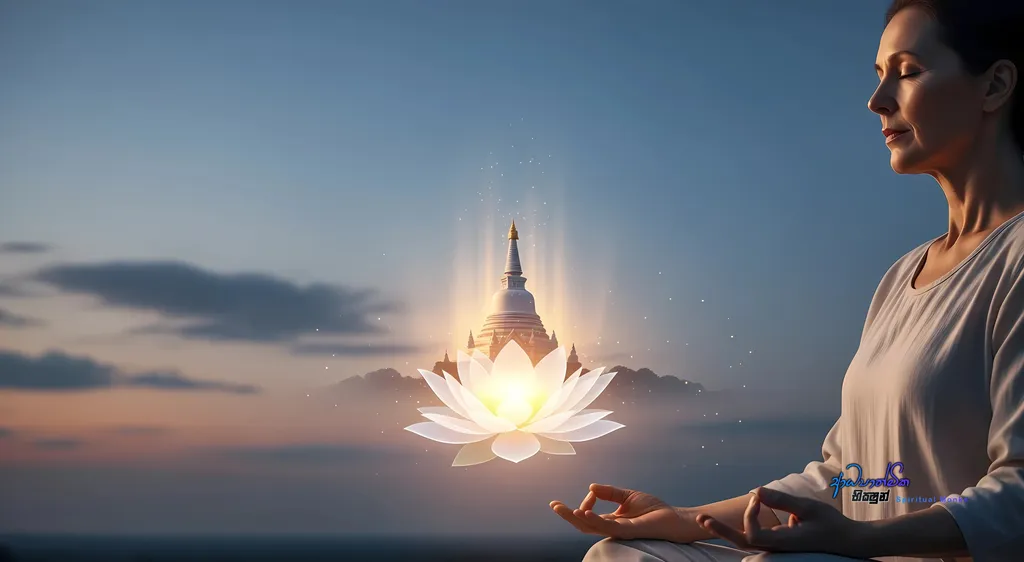
Your Spiritual Toolkit: Staying Safe and Centered
As your inner world opens up, it is wise to have tools to keep you grounded and protected. If any experience feels frightening or overwhelming, remember these practices we have shared. The most powerful tool is Mettā Bhāvanā, or loving-kindness meditation. Radiate feelings of unconditional love and goodwill to yourself and all beings. This creates a powerful shield of positive energy.
You can also rely on the protective power of pirit, which are traditional Buddhist chants that invoke the virtues of the Triple Gem to bring peace and safety. Finally, you can make a strong determination, known as adhiṭṭhāna. This is a firm resolution where you set a positive intention for your practice, such as, ‘May I be safe, may my practice lead to wisdom, may all beings be well.‘ These tools ensure your spiritual journey is always safe and beneficial.
You can find a detailed guide to these practices in the article “Buddhist Daily Practice: What to Do During Meditation?“ This resource offers practical advice on how to incorporate pirit chants and adhiṭṭhāna into your daily meditation routine, helping you cultivate safety, peace, and positive intention throughout your spiritual journey.
Your Path Forward: Trusting the Process and Purpose (Emptiness)
Please remember, this path is unique to each person. The experiences you have, or do not have, are shaped by your journey through countless lives and your past intentional actions, which we call Kamma. Do not be discouraged or compare yourself to others if you don’t see lights or have profound visions. These are not the goal.
The true purpose of third eye meditation is not to gain psychic powers, but to cultivate the profound wisdom, or paññā, that sees reality as it is. It is about freeing the mind from suffering and finding unshakable peace. Trust the process, be patient with yourself, and walk the path with a sincere heart.
May you have the strength and courage for this practice. May the protection of the Triple Gem be your guide, and may you awaken the deep wisdom that lies within.
We invite you to walk this path with us. Read our teachings, and most importantly, apply them practically in your own life. as you practice, questions will naturally arise. Please feel free to share your experiences and questions in the comments below, via email or contact form. I will do my best to offer guidance in future talks based on your progress. For now, begin this practice with an open heart and a mind free from expectation. Cultivate it correctly, and may you find the clarity and peace you seek.
Thank you for joining us. We hope this blog will be of great benefit to your spiritual journey.
May you all be well and happy.
May the blessings of the Triple Gem be with you all!


