


Categories: Third Eye: Practical Meditation
May the blessings of the Triple Gem be with you all!
Welcome. In this teaching, we will continue to explore a powerful and practical technique: the fourth practical meditation on the Third Eye – Emptiness Present, which we call “His Sanjñāva“, or the ‘sign of emptiness‘. In a previous article, we introduced this concept and the basic method.
However, some of you may still be wondering what this ‘sign of emptiness‘ truly is. Therefore, I will begin by clarifying the nature of this practice.
Before we explore the practical steps of this third eye meditation, it’s important to revisit the foundations we have discussed previously. For those of you who are new to this path, I encourage you to explore the teachings from the very beginning, as each one builds upon the last. This will provide a complete and stable foundation for your practice.
What is Emptiness Present Meditation and How Does It Work?
This practice is a form of Samatha bhāvanā, which is a type of calm-abiding or concentration meditation. It is a specific sign or concept used to unify the mind, preparing it for deeper states of consciousness like the meditative absorptions known as Jhāna, and for developing higher psychic abilities, or Abhiññā.
What happens when you practice this form of emptiness meditation?
Your mind becomes focused. It stops scattering. Thoughts diminish, and the mind becomes clear and empty. This leads to the arising of Jhāna and other deep states of meditative attainment. We are sharing this technique with you because we have used it ourselves and experienced its profound benefits.
To give you an example from the Buddha’s teachings, the Lord Buddha taught forty different meditation subjects, known as the forty kammaṭṭhāna.
One of these involves the concept of ‘earth’ or paṭhavī, a Pali word meaning ‘solidity’ or ‘hardness’. A person can take this very word, paṭhavī, and use it to concentrate their mind. Imagine placing a solid object, like a watch, on a table. By looking at this solid object and mentally repeating ‘watch…, watch…, watch…,’ or ‘solid…, solid…, solid…,’ the mind gradually becomes unified and stops wandering.
It stays with the object, and through that sustained focus, concentration arises. This is just an example, but you are welcome to try such practical exercises for yourself.
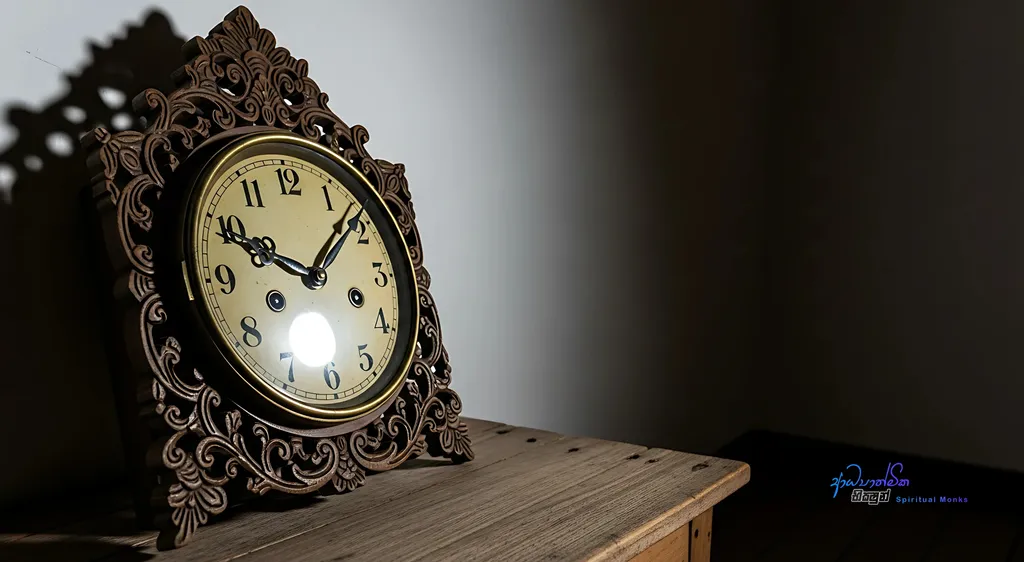
Using Simple Objects to Cultivate a Calm Mind
Let’s take another example. Imagine you are in a dark room with a flashlight. You can use that single point of light as an object of meditation. By focusing on it and mentally repeating ‘light…, light…, light…‘ (āloko, āloko), your mind will settle and become one-pointed.
After practicing this for some time, you may find that even when you close your eyes, the image of the light appears in your mind. In Buddhist philosophy, particularly in the Abhidhamma, this mental image is called the uggaha nimitta, or the ‘acquired sign.’
Similarly, if you were to focus on a blue shirt and repeat ‘blue…, blue…, blue…,’ your mind would unify on that color. You see, everything in our environment can become a ‘sign’ or nimitta for either concentration (Samatha) or insight (Vipassanā) meditation. In these teachings, we are focusing on Samatha meditation. For this purpose, the word ‘his...‘ (empty) is one of the easiest and most effective tools to develop concentration, unify the mind, and guide it toward deeper states.
In our previous discussion, I explained how to cultivate this sign, whether you currently perceive inner lights or not. The practice of emptiness meditation, when done correctly, helps to reduce and control thoughts, unify the mind, and makes it much easier to attain states of deep peace, psychic abilities, and meditative absorption.
For those who already experience inner lights or visions, this emptiness meditation practice is incredibly helpful. It can help enhance and expand those light signs, and through them, you may begin to perceive subtle, unseen worlds.
This practice is a great support for reaching these states. That is why I am explaining it to you all. Now, I will guide you on how to integrate this practice into both your daily life and your formal meditation sessions. This guidance is for everyone, whether you perceive inner lights or not.

The Foundation: Bringing Mindfulness into Your Daily Life
There is a systematic way to develop this ‘sign of emptiness‘ in your daily life. The absolute foundation for this is mindfulness. In Pali, this is called Sati. You must live by watching yourself, by being present.
Why is this so crucial?
Often, when you sit down to meditate, you might find your mind is completely scattered. It feels chaotic and uncontrollable. This happens whether you are a layperson or a monastic. If your mind has been turbulent all day, filled with conflicts and reactions, you cannot expect to come home, sit down, and immediately enter a state of calm concentration. It simply doesn’t work.
The reason for this is that we spend most of our lives in a state of un-mindfulness, or asihīya. We are not living ‘here.’ We are not living in the present moment. This is why the mind rebels when you suddenly try to force it into meditation.
Therefore, you must make your entire day a meditation. Every task at home, every duty at your workplace, every moment of your commute you must learn to live fully in that moment. Be present with the task at hand. This provides a powerful foundation that makes developing the sign of emptiness during formal meditation much, much easier.
You have likely experienced this for yourself. Now, let me show you how to practice mindfulness in a way that directly supports this emptiness meditation.
The Sword of Emptiness: Cutting Off Past Thoughts
Let’s take a common daily activity: sweeping the yard. Pay attention to your mind the next time you do this, or cook, or clean the house. From the moment you begin, are you truly present?
No. Often, when you are sweeping, your mind is in the past or the future. Your body performs the action, but your consciousness is living somewhere else entirely lost in memories or future plans. You are not in the moment of ‘sweeping.‘
This is where we use the ‘sign of emptiness‘ as our tool. As you are sweeping, you might notice your mind drifting to the past two days ago, a week ago, a month, a year, or even to your school days, university life, or a past job. Your mind goes there automatically. When you are practicing mindfulness, you will see this happen. You will catch the thought: ‘Ah, my mind has gone to the past.‘
The moment you notice this, you must use the sign of emptiness to ‘kill’ that thought. Cut it down. Imagine the word ‘his...‘ (empty) is a sword or a weapon. When the thought carries your mind to the past, you see it, and you simply think: ‘his...‘ (empty). Use this word to cut the thought stream. Instantly, your mind will return to the present moment, to the act of sweeping.
Now, let’s look at the future. While sweeping, your mind might start planning: ‘Tomorrow I have to do this, then I need to do that… I want to build my house this way; I need to go to that place...‘ An endless stream of future-oriented thoughts arises.
When this happens, you are not living in the present; you are living in the future. The moment you recognize, ‘My mind has gone to the future,‘ you know what to do. Just as you did with the past-thought, you use your weapon. Think ‘his...‘ (empty) and cut it down. Imagine it like a precise shot to the head of an enemy; the thought dies instantly. It shatters, and your mind returns to the present moment.
You must engage with your mind in this way. All thoughts that arise past, future, or even present-moment chatter that isn’t related to your direct goal must be cut down. Annihilate them. By doing this throughout the day, you will find it incredibly easy to meditate when you come home. Your whole day becomes a meditation. Every moment is a practice of mindfulness.
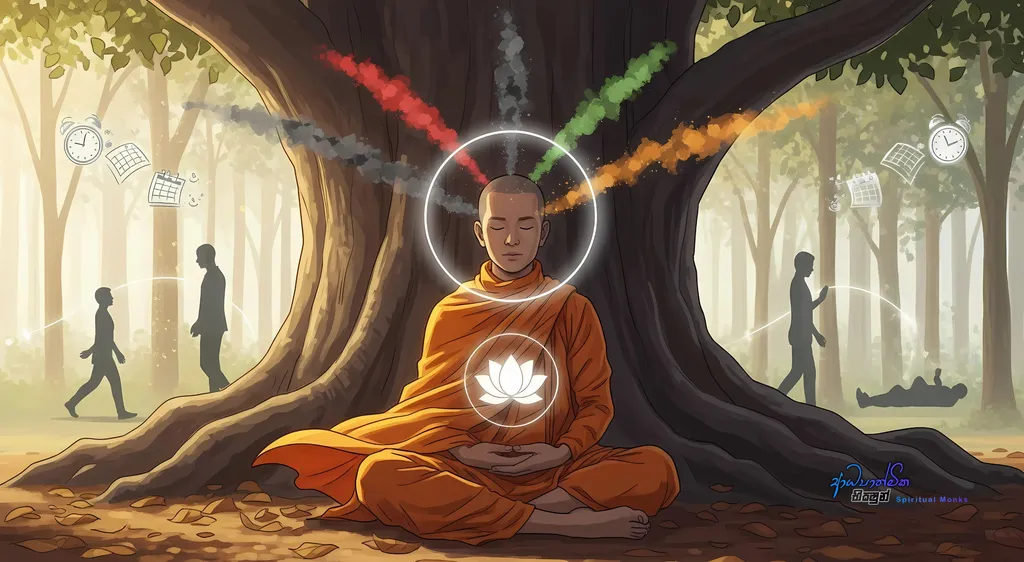
Overcoming Inner Obstacles: From Desire to Anger
This practice extends to what the Buddha called kilesa, or mental defilements.
Let’s say a thought of desire or lust (rāga) arises. This is just another thought, usually tied to the past or future. You can cut it down with the ‘his...‘ (empty) sign. Many people wonder if concentration practices can increase desire. Yes, sometimes they can. However, by using the ‘his...‘ (empty) sign, we can reduce, control, and suppress these defilements. We can fragment them and break them apart.
This applies not only to desire but also to anger (dvēṣa), irritation, jealousy, hatred, and resentment. These are the kinds of thoughts that flood our minds, along with memories of things we’ve said and done, and plans for the future. Sometimes the mind just wanders aimlessly. By maintaining mindfulness, you can observe this process and use the ‘his...‘ (empty) sign to break it. Destroy the thought, and your mind will naturally rest in the present.
I have explained this in a simple way, but you must apply it practically. I used sweeping as an example, but this applies to everything: eating, drinking, sitting, walking, and lying down the four postures described by the Buddha. All your activities fall into these postures. Understand this, and practice mindfulness this way throughout your daily life.
Living 24/7 in a Meditative State
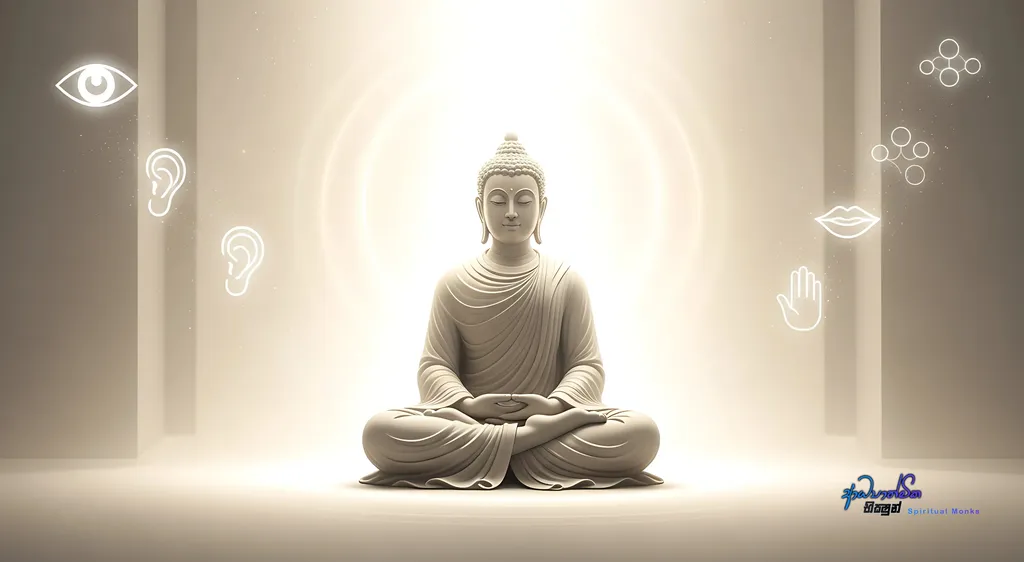
As you practice this mindfulness with your six senses the eye, ear, nose, tongue, body, and mind at work, at home, or while traveling, you will feel a sense of peace and lightness. After doing it for just two or three days, it becomes very easy. You will feel that you are living within yourself, and you can even develop your good human qualities and correct your own faults.
Mindful Seeing: The Gateway of the Eye
Now, let me explain how to apply this practice to each of the five physical senses. Imagine you are sweeping, and your eye sees a beautiful flower a jasmine or a rose. Your mind is drawn to this beautiful sight. At that moment, are you sweeping? No. Your mind has followed your eye. You are no longer in the present. You might even stop sweeping and just stare, lost in the sight.
You have become unmindful. The moment you realize, ‘Ah, my mind was lost in that sight,’ you have returned to mindfulness. Immediately, use the ‘his...‘ sign to cut the connection to that thought. Break it and return to the act of sweeping.
Now, imagine you see something unpleasant while sweeping, like dog droppings. You see it, and a feeling of anger or disgust arises. ‘What a mess,‘ you think. Your mind has become entangled in aversion and hatred. You are again unmindful.
So what should you do?
In the very moment you see your mind reacting with aversion, use the ‘his...‘ sign to cut that thought. The problem is not the object, but the mind’s reaction. By cutting the thought, the mind doesn’t get carried away by hatred. It returns to the present. You can then mindfully deal with the situation find the source of the mess and clean it up while remaining in the present moment, free from agitation.
Mindful Hearing: The Gateway of the Ear
Let’s consider the ear. While you are sweeping, you might hear a familiar sound, like the music from a bread van (a ‘choon paan’ van in Sri Lanka). The moment you hear the music, your mind identifies it: ‘Ah, that’s the bread van.‘ The sound is converted into a thought, perhaps ‘what a nice song.‘ Your mind has followed the sound. What should you do? Realize your mind has wandered, think ‘his...‘ and cut that thought. You ‘kill’ the thought about the song.
Conversely, what if you hear an unpleasant sound, a loud noise that disturbs your peace, especially while trying to meditate? Your mind reacts with irritation. ‘Why is this happening now?‘ This is a thought of aversion. So, what do you do?
Think ‘his...‘ Cut the thought of irritation. The mind immediately returns to the present. This is exactly how you should handle sounds that arise during your formal sitting meditation.

Mindful Smelling: The Gateways of the Nose
Next is the nose. You might smell a pleasant fragrance, like incense or perfume. Your mind follows it. ‘That smells lovely.‘ You know your mind has wandered along with that pleasant scent. What should you do? Think ‘his...‘. Cut the thought. The thought dies, and your mind returns to the present moment of your meditation.
What if you smell a foul odor, like burning tires? It’s difficult. The mind reacts with aversion. ‘This smell is unbearable.‘ The mind gets entangled with the unpleasantness. You see this happening; you see the aversion arise. What do you do? You contemplate the ‘his...‘ sign. You use your weapon. ‘his...‘. You cut it down. Instantly, the mind returns to the present.
Mindful Flavor: The Gateway of the Tongue
And the tongue? Even just thinking about a delicious food like rice and curry, kottu, or pizza can make your mouth water. A thought about taste arises, and your mind follows it. During meditation, what do you do? You see it as just a thought, and you cut it with ‘his...‘. The mind returns to the present. If you experience an unpleasant taste, like a dry mouth during meditation, the mind can react with irritation. This irritation is the obstacle. So, what do you do? Think ‘his...‘. All those feelings disappear, and the mind returns to the present.
Mindful Feeling: The Gateway of the Body
Finally, the body. Imagine you are sweeping and feeling very sweaty. Suddenly, a cool breeze blows, bringing a pleasant sensation of relief. Your mind latches onto it: ‘Ah, that feels so good.‘ You crave for it to happen again. You see your mind creating stories around this pleasant feeling. What do you do? Use the ‘his...‘ sign. Cut the attachment to the sensation. The feeling might still be there, but your mind no longer chases it. It remains in the present. After practicing this for a few days, you will get the hang of it. You will start to live within yourself, developing your positive qualities and gaining control over your reactions.
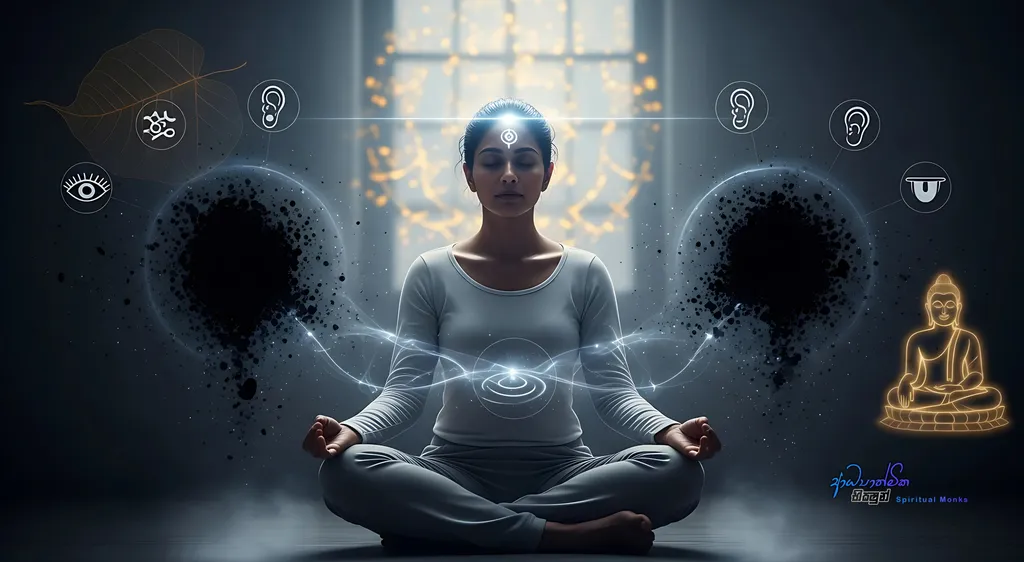
As I mentioned, you’ll gain control over anger, desire, and all other unskillful states.
So, practice maintaining mindfulness this way in your daily life. I have explained it simply so that those of you who follow our method of meditation can understand how to do it. Start today. Start this very moment. Continue this process again and again.
As I said before, when you finish your work for the day and sit down in your meditation posture, you will find it remarkably easy to meditate. Why? Because you have been in a state of meditation for 24 hours. You have been meditating in all four postures.
The only thing that changes is your physical posture, but your mind has been with you, living in the present. Therefore, it won’t be subject to intense pressure or agitation. When you come home, you have no expectations because you have seen that expectations are just thoughts, and you have already ‘killed’ them with your sword, the ‘his...‘ sign. You can simply sit down and meditate with ease. I hope this is clear to you.
Formal Practice: Applying Emptiness Meditation with Eyes Closed
This next part of the instruction applies to everyone, whether you perceive inner lights and images or not. Please listen carefully, as I will now adapt this practice for the formal meditation session when your eyes are closed. I will address the senses of hearing, smell, taste, body, and mind first.
When you close your eyes to meditate, your mind can still wander to the past or the future. This is natural. Just as you did when your eyes were open, the moment you recognize the mind has drifted to your school days, to yesterday, to tomorrow you must cut it. Think ‘his...‘. Sever that thought. The mind will immediately return to the present, to the level of your eyes.
The same applies to future thoughts. If the mind starts planning or worrying, you must establish mindfulness, recognize the thought, and cut it with ‘his...‘. The mind returns to the present. If you notice an internal monologue, a voice chattering away inside, recognize it and cut it too. ‘his...‘. The chatter will stop. It may start again a moment later with a different topic, but you just keep applying the same technique. This method is for everyone, regardless of what you see or don’t see.
For Meditators Who Perceive Darkness: Cultivating the Sign
Now, let me speak specifically to those who do not see any lights or images during meditation. You are keeping your mind at your eye-level, in the darkness. Don’t be discouraged by this; as I always say, it is perfectly fine. As you continue your 24/7 mindfulness practice, you will notice your mind becoming empty, with very few thoughts. It will be a state of peacefulness.
While resting in this emptiness, in this darkness at your eye-level, comfortably and without thoughts, begin to contemplate the sign of emptiness.
Think ‘his…’ Rest for a few seconds. Think ‘his…’ again. Rest again. Within the emptiness, keep repeating the thought ‘his…‘ If your mind starts to wander to the senses, cut the thoughts as we discussed.
Then return to this space. Stay there for a few seconds, think ‘his…’ Wait a few seconds, think ‘his…’ Continue this practice throughout your meditation session.
Use this sign when you wake up, before you go to sleep, and all throughout the day.
For Meditators Who Perceive Light: Deepening the Vision
For those of you who do see things images of deities, rivers, celestial beings, the Buddha, or even frightening forms; visions of the sun and moon, or various light signals your practice is slightly different. When these things appear to your inner eye, you must use them as your object.
For instance, if you see a white light, look at it and, as I explained in the previous teaching, think ‘his…’ The light may expand, perhaps even enveloping your entire body.
Think ‘his…’ again. Wait a few seconds, and think ‘his… again.
By continuing to apply the ‘his…‘ sign while observing the vision, it may become clearer.
You might suddenly be able to see everything in the room you are in, as if it were daytime, even if the lights are off. Through this, you might perceive non-human beings who share your space, or local earth deities (bhūmaṭṭha devas). Do not be afraid of anything that appears. Face it, and continue to apply the ‘his…‘ sign. This will clarify the visions, making them as vivid as what you see with your physical eyes.
Please understand that what appears depends on each individual’s accumulated merit (puñña). It relates to past meditation practice, offerings of light, and other generous acts performed throughout many lives. Understand this and proceed with the practice accordingly.
Conclusion: Your Path to Deep Attainment
So, continue to use the ‘his…‘ sign to maintain mindfulness for 24 hours a day. Engage in this meditation. Everything we are teaching you is a way to develop calm-abiding meditation, to attain jhānas, psychic powers, states of bliss, and meditative absorptions.
We are showing you the shortest, most direct way to walk this path and to quickly achieve things that may seem difficult. Please understand these points and practice accordingly. I wish that you all receive the ability to develop the ‘his…‘ sign and maintain mindfulness 24 hours a day, through the powerful blessings of the Buddha, the Dhamma, and the Sangha, the Triple Gem. We will conclude this teaching on the sign of emptiness for today.
We invite you to walk this path with us. Read our teachings, and most importantly, apply them practically in your own life. as you practice, questions will naturally arise. Please feel free to share your experiences and questions in the comments below, via email or contact form. I will do my best to offer guidance in future talks based on your progress. For now, begin this practice with an open heart and a mind free from expectation. Cultivate it correctly, and may you find the clarity and peace you seek.
Thank you for joining us. We hope this blog will be of great benefit to your spiritual journey.
May you all be well and happy.
May the blessings of the Triple Gem be with you all!


