


Categories: Other Meditation Teachings
May the blessings of the Triple Gem be with you all!
Today, we will explore a topic that often sparks debate, leads to rigid views, and becomes a point of extremism: the Buddhist view on eating meat and can you eat meat and still be spiritual?. You may already have strong feelings or questions about this subject. Before we begin, I invite you to read this entire teaching with an open and neutral mind. The goal is to arrive at understanding, to cultivate a state of equanimity, a balanced perspective known in Pali as Upekkhā. which will support your spiritual journey and meditation practice.
The perspective shared here is not a personal opinion, but is drawn directly from the teachings of the Buddha as preserved in the Dhamma. Our reference point is the Buddha’s own words, found within the Tipiṭaka (the three baskets of the Pāli Canon), its commentaries (Aṭṭhakathā), and sub-commentaries (Ṭīkā). We will begin by exploring a specific discourse, or sutta, from this ancient collection.
The Ancient Text at the Heart of the Debate: Introducing the Āmagandha Sutta
The Buddhist canon, the Tipiṭaka, is divided into three main sections: the Sutta Piṭaka (discourses), the Vinaya Piṭaka (monastic discipline), and the Abhidhamma Piṭaka (higher philosophy). Our primary source comes from the Sutta Piṭaka, which contains 42,000 of the 84,000 bundles of teachings.
Within the Sutta Piṭaka is a collection called the Khuddaka Nikāya (the collection of short texts). Inside this, we find the Sutta Nipāta (the group of discourses). And within its Cūḷa Vagga (the minor division), there is a powerful discourse named the Āmagandha Sutta. The story that provides the context for this sutta is found in its commentary, the Sutta Nipāta Aṭṭhakathā. To understand the verses and their profound meaning, one can refer to the Buddha Jayanti Tripitaka Series. It is this story from the commentary that we will explore first.
A Tale of Ascetics: The Story of Rishi Āmagandha and the Villagers
During the time of our Gautama Buddha, while he was residing at the Jethavana Monastery in Savatthi, there lived a rishi (an ascetic sage) named Āmagandha in the Himalayas. He was the teacher to a group of 500 young rishis. They were all strict vegetarians, consuming only vegetables and greens. It is said they didn’t even consume salt
Because of this extremely restricted diet, Rishi Āmagandha and his followers developed a disease called pāṇḍu, which is similar to anemia or jaundice. Needing treatment, they traveled from the Himalayas to the nearest town. The townspeople, impressed by the sight of these ascetics, were filled with joy and faith. For four whole months, they looked after the rishis, providing them with all necessary food and drink. They offered them well-prepared vegetable dishes that included salt.
After four months, their illness was cured. As the rishis prepared to return to their hermitage, the grateful villagers provided them with everything they might need: bedding, household items, and a plentiful supply of rice and other dry foods. This became an annual tradition. Every year, the rishis would come down from the mountains, and the villagers would support them, ensuring they remained healthy before returning.
A Shift in the Village: The Buddha’s Arrival and a Puzzling Question
One year, the Gautama Buddha, seeing with his wisdom that Rishi Āmagandha and his 500 followers had the potential to attain insight and realize Nibbāna (liberation), traveled with his community of monks to that same town. He taught the Dhamma to the townspeople, and as a result, many of them attained the noble stages of stream-entry (Sotāpanna), once-returning (Sakadāgāmī), and non-returning (Anāgāmī).
At the usual time, Rishi Āmagandha and his followers arrived in the town. Immediately, the head rishi sensed a change. The villagers were no longer as outwardly excited or overjoyed to see them as before. Although they had prepared all the necessary provisions, their demeanor was different. Puzzled, Rishi Āmagandha asked them three questions:
‘Are you suffering under the king’s displeasure or punishment?‘
‘Are you facing a famine or food shortage?‘
‘Has a holy man more virtuous than us come to this city?‘
The villagers replied, ‘We are not in trouble with the king, nor are we facing a famine. But a supremely enlightened one, the Gautama Buddha, has visited our city.‘ The moment Rishi Āmagandha heard the word ‘Buddha,’ an immense joy arose in him. But his very next question was deeply tied to his own practices and identity. He asked,
‘Does this Gautama Buddha consume āmagandha?’
The villagers asked for clarification, ‘What do you mean by āmagandha?‘ The rishi replied, ‘Does he eat meat and fish?‘ The villagers confirmed, ‘Yes, the Gautama Buddha consumes meat and fish.‘
Hearing this, the rishi felt a surge of anger and agitation. Yet, setting aside his initial judgment, he decided he must meet the Gautama Buddha in person. Along with his 500 disciples, he set off to find him, with the eagerness, as the commentary says, of a calf seeking its mother.
The Confrontation: Redefining the True ‘Stench’
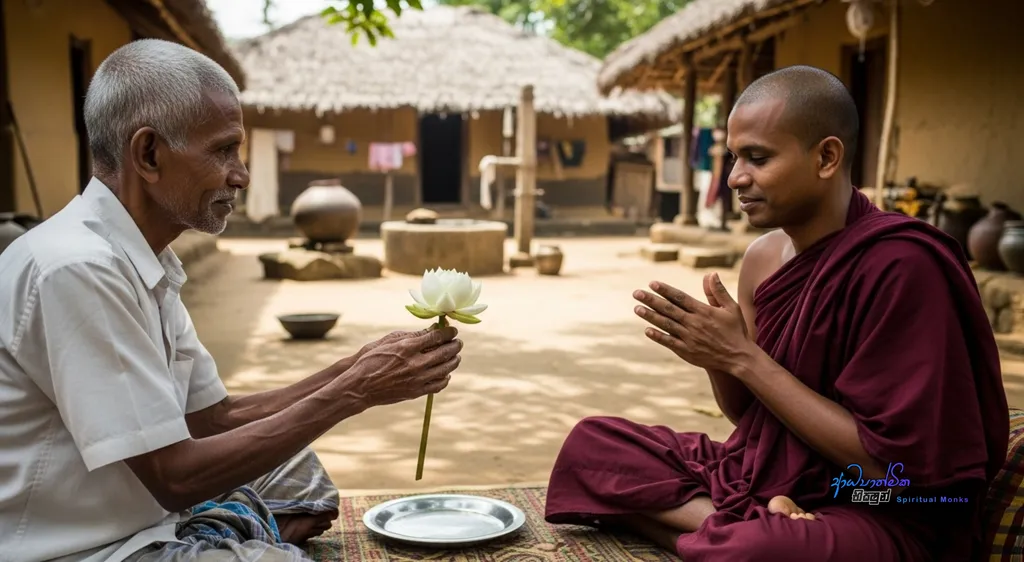
Upon arriving at the Jethavana Monastery, the rishis met the Buddha, sat down, and engaged in a friendly conversation, as was the Buddha’s custom with all visitors. They inquired about each other’s well-being. Then, Rishi Āmagandha asked his critical question directly:
‘Oh, Gautama, do you consume āmagandha?‘
The Buddha, rather than giving a simple yes or no, replied with a question of his own:
‘What do you define as āmagandha?‘
The rishi stated his definition plainly: ‘The consumption of meat and fish.’
The Buddha then confirmed, ‘Yes, by your definition, I consume what you call āmagandha.‘ But then, he delivered the core of the teaching. He explained that in his Dhamma, āmagandha does not refer to physical food. The real āmagandha, the true stench or defilement, is something else entirely: it is unwholesome mental states, known as kilesa. A Buddha does not ‘consume‘ these sinful defilements.
He taught that one could eat meat and fish without partaking in the true stench of mental impurity. To illustrate this timeless principle, the Buddha then shared a story from a distant past.
Echoes from the Past: The Same Question Posed to a Previous Buddha
The Buddha recounted a tale from the era of a previous Buddha, Kassapa Buddha, a figure you may have heard of. Before his enlightenment, Kassapa was a divine being who was conceived in his mother’s womb. On that very same day, the being destined to become his chief disciple was also conceived, in the womb of the wife of the royal priest. The two boys were named Kassapa and Tissa, and they grew up as the closest of friends.
As they matured, Tissa’s father, the wise priest, told his son, ‘One day, your friend Kassapa will attain Buddhahood. On that day, you must go with him, renounce the world, and end this cycle of rebirth.‘ Tissa agreed to do so. While still young, Tissa urged Kassapa that it was time for them to leave the worldly life.
The Bodhisatta (the future Buddha) Kassapa, knowing the time was not yet right for him, told Tissa, ‘May you be well. Do what you see fit.‘ So, Tissa left on his own, built a hermitage, and lived the life of an ascetic.
Meanwhile, Kassapa remained in the palace and, through practicing Ānāpānasati (mindfulness of breathing), developed the four meditative absorptions (jhāna) and the five higher knowledges (pañca-abhiññā). Using his psychic powers, he traveled through the air from his palace to the Bodhi tree, where he ordained himself and sat in meditation. After seven days, he attained supreme Buddhahood. Kassapa Buddha then traveled to Benares and taught the Dhamma to 20,000 ascetics, leading them all to Nibbāna.
One day, a man from Benares went into the forest searching for sandalwood and came across Tissa’s hermitage. Tissa asked the man about the state of the city. The man replied, ‘A Buddha named Kassapa has arisen in the world!‘ Hearing this, Tissa was overjoyed; his childhood friend had become a Buddha. Yet, just like Rishi Āmagandha, his very next question was, ‘Does this Kassapa Buddha consume āmagandha (meat)?‘ The man replied, ‘Yes, he does.‘
Upon hearing this, Tissa’s joy turned to rage. ‘This man is a fraud!‘ he thought. ‘He cannot be a Buddha.‘ Driven by this angry thought, he went to find Kassapa Buddha.

The Stench of the Mind: What the Buddha Calls True Impurity
Tissa, who was destined to become the chief disciple, approached Kassapa Buddha and began to scold him harshly. ‘Yesterday you claimed not to consume the stench of defilement, but today you have! You are no Buddha! The ascetics in the Himalayas are better than you; they are vegetarians!‘ He leveled many such accusations.
Kassapa Buddha listened patiently. Tissa, despite his anger, was wise and possessed the knowledge of reading a person’s physical characteristics. He examined Kassapa Buddha and saw that he possessed all thirty-two marks of a Great Man. He realized,
‘Without a doubt, this is a Buddha. There must be something I don’t understand about his definition of āmagandha.‘
His wisdom arising, he humbly asked Kassapa Buddha, ‘What do you define as āmagandha?‘ Kassapa Buddha then explained, one by one, what constitutes the true stench:
- The Five Precepts: ‘One who engages in killing, stealing, sexual misconduct, lying, and taking intoxicants, that person consumes āmagandha.’
- Wrong View and Livelihood: ‘One who is greedy for sensual pleasures, engages in wrong livelihood, and holds to the ten forms of wrong view, that person consumes āmagandha, the stench of defilements. Eating meat is not it.’
- Corruption and Deceit: ‘One who fails to repay debts, accepts bribes, engages in fraudulent business, acts righteously on the outside while being immoral within, or harms others, that person consumes āmagandha. Not the one who eats meat.’
- Cruelty and Harm: ‘One who attacks others, is cruel, uses harsh and abusive language, these are the ones who consume āmagandha, not those who eat meat.’
- The Three Roots of Evil: ‘One who is overcome by greed (lobha), hatred (dosa), and delusion (moha). all such beings in the world consume āmagandha.’
‘Not eating meat, shaving one’s head, performing sacrificial rites, or worshipping gods, none of these practices can purify a person if their mental defilements are not cleansed. These are empty actions.’ ‘But one who guards the senses, does not indulge the eye, ear, nose, tongue, body, and mind, and works to abandon the roots of evil (passion, aversion, delusion). that person does not consume āmagandha.’
At the end of this discourse, Tissa attained Arahantship (full enlightenment) and became the chief disciple of Kassapa Buddha. These stories reveal that the core of the Buddhist view on eating meat is about inner purity, not external diet.
Rejecting Extremism: Why the Buddha Denied Devadatta’s Five Strict Rules
This principle of avoiding extremes is reinforced by another famous incident involving the Buddha’s cousin, Devadatta. Seeking to create a schism in the Sangha (the monastic community), Devadatta proposed five strict, compulsory rules for all monks, presenting them to the Buddha for approval. These are recorded in the Vinaya Piṭaka.
The five proposals were that for their entire lives, monks must:
- Live only in the forest.
- Subsist only on alms food collected on pindapāta.
- Wear only robes made from discarded rags (pāṃsukūla).
- Dwell only at the foot of a tree.
- Abstain completely from eating meat and fish (be vegetarian).
The Buddha rejected all five of these proposals. Why? Because his wisdom, which sees across the past, present, and future, understood the consequences. If he had agreed, the Buddhist monastic tradition would have become unsustainable. Laypeople would not have been able to support monks in village temples, make offerings of food for merit, or have monks visit for ceremonies. The path would have become too austere for most, and the Sangha might have vanished long ago.
The fact that the Buddha explicitly rejected compulsory vegetarianism shows that the Dhamma is not a doctrine of dietary extremism. Some of these practices are found in other traditions like Jainism or among those who worship deities, as some gods are believed to dislike the presence of meat. But the path to Nibbāna, to liberation, is different. The Buddha who taught us to avoid the unwholesome act of killing is the same Buddha who rejected this rule, based on his deep compassion and foresight.
The Practical Guideline: The ‘Threefold Purity’ Rule for Monks
So, what is the practical guideline for monks? The Buddha laid out a clear rule known as the Tikoṭika Pārisuddha Maṃsa, or ‘meat that is pure in three aspects.’ This is explained in suttas like the Jīvaka Sutta in the Majjhima Nikāya. This rule allows a monk to consume meat if three conditions are met. The meat is considered inappropriate if:
- It is seen: The monk has seen that the animal was killed specifically to be offered to him.
- It is heard: The monk has heard that the animal was killed specifically for him.
- It is suspected: The monk has a reasonable suspicion that the animal was killed specifically for him.
If the food is free from these three faults, it is permissible for a monk to eat. This rule strikes a balance, preventing monks from being a direct cause for the killing of an animal while allowing them to accept the generosity of lay supporters without being overly fussy. This teaching, too, is found within the Tipiṭaka, the same source that gives us the path to liberation.
Beyond Taste: How Monks View Food as a Tool for Liberation
Consider the daily life of a monk on an alms round (piṇḍapāta). Villagers offer various foods into their bowl: rice with bitter gourd, rice with lentils, leafy greens, different vegetables, and sometimes dried fish, curried fish, or meat. When the monks return, they often combine all the offerings into one large vessel and mix everything together before sharing it among themselves.
Before eating, they practice a reflection known as paccavekkhanā. The Pāli reflection begins: Paṭisaṅkhā yoniso piṇḍapātaṃ paṭisevāmi, neva davāya, na madāya, na maṇḍanāya, na vibhūsanāya…
This translates to: ‘Wisely reflecting, I use this alms food not for fun, not for pleasure, not for fattening, not for beautification, but only for the maintenance and nourishment of this body, for keeping it healthy, for helping with the holy life. Thus I will allay hunger without overeating, so that I may live blamelessly and at ease.‘
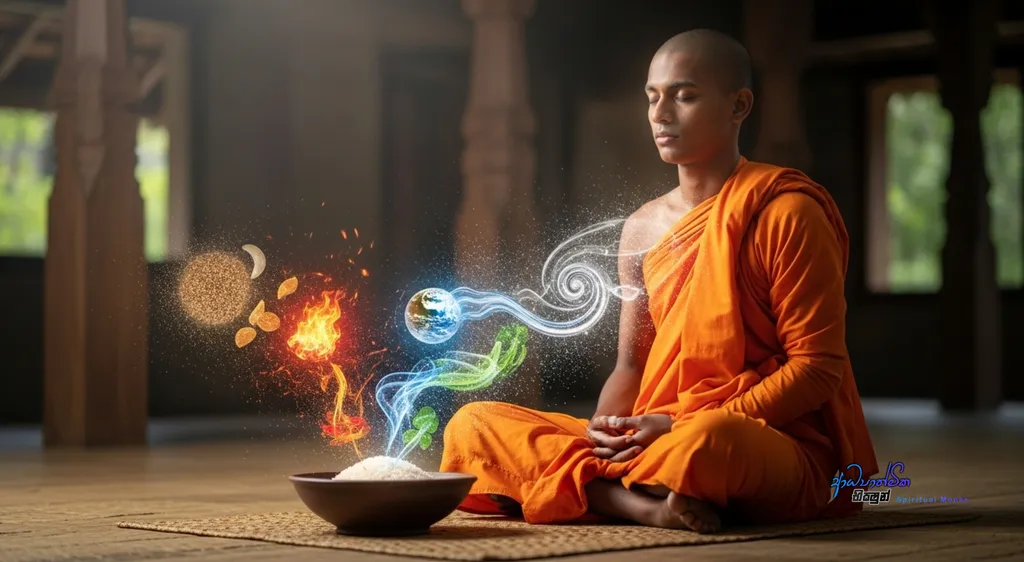
A monk training for liberation sees this food not as ‘meat’ or ‘vegetables’ but through the lens of their meditation practice. They see it as the four primary elements: earth (paṭhavī), water (āpo), fire (tejo), and air (vāyo). They see it as name-and-form (nāma-rūpa), as a collection of impersonal phenomena. For such a person, there is no attachment or aversion to the food. It is simply fuel to sustain the body so they can continue the work of ending the journey through saṃsāra (the cycle of birth and death). This is how the Buddhas, Paccekabuddhas, Arahants, and all noble ones consume their food with this detached wisdom.
The Intricacy of Kamma: Why Clinging is More Dangerous Than Diet
The law of kamma (intentional action) and its results (vipāka) is far more complex than a simple equation. The Mahākammavibhaṅga Sutta explains that a person who does many unwholesome deeds in this life might be reborn in a heavenly realm, while a person who does many meritorious deeds might be reborn in a state of suffering. The Buddha taught that the final thought-moment at death (cuti citta) is profoundly influential in determining the next birth.
For example, we have observed through meditative insight cases of individuals who were heavily addicted to eating meat. At the moment of death, that clinging was so strong that they were reborn as a fierce demon (yakkha). In another case, a person who was a strict vegetarian, eating only vegetables, had a strong craving for a young jackfruit curry (polos) at the time of their death. This intense craving led them to be reborn as a hungry ghost (peta) haunting a jackfruit tree.
The lesson here is that the problem is clinging and craving, which are rooted in greed, hatred, and delusion. This is why the Buddha advised against excessive speculation on the precise workings of kamma, the cosmos, or the mind, as it can lead to madness. The results of kamma can ripen in this very life, the next life, or many lives later, and some kamma may never ripen at all (becoming ‘defunct’ or ahosi kamma). Understanding this complexity helps us move beyond simplistic judgments about food.
Challenging Modern Dogma: Is My Body a Temple or a Graveyard?
Today, many who advocate for strict vegetarianism hold strong views. They might say, ‘Eating meat is the same as killing,‘ or ‘My body is not a graveyard.‘ Let’s examine this from the Buddha’s perspective. For the kamma of killing to be complete, five factors must be present:
- There must be a living being.
- One must perceive it as a living being.
- There must be an intention to kill.
- One must make an effort or apply a means.
- The being must die as a result of that effort.
Eating a piece of meat from an animal already dead does not fulfill these conditions. To say eating it is a sin is a misinterpretation. The true unwholesomeness lies in the mind. If you eat a piece of meat greedily, you are creating unwholesome kamma through greed. But if you eat a vegetable dish with that same greed, it is also unwholesome. If you harbor hatred towards a piece of meat, you are creating kamma through aversion. The problem is not the object, but the reaction.
As for the body being a ‘graveyard,’ the Buddha taught that the body is already a collection of thirty-two impure parts (dvattiṃsākāra). hair, nails, teeth, skin, organs, etc. It is, in a sense, already an ‘impure corpse’ that we carry around. To cling to the idea of its purity is a delusion. The goal is not to preserve a non-existent purity but to use this impure body to achieve the ultimate purity of Nibbāna.

The Exception That Proves the Rule: The Ten Meats Forbidden by the Buddha
Here is a question for those who insist that the Buddha and his teachings were entirely vegetarian: If that were the case, why did the Buddha explicitly forbid monks from eating ten specific types of meat? This list is found in the Vinaya Piṭaka (specifically the Mahāvagga Pāli, in the section on medicines, the Bhesajjakkhandhaka). The ten forbidden meats are:
- Human flesh
- Elephant flesh
- Horse flesh
- Dog flesh
- Snake flesh
- Lion flesh
- Tiger flesh
- Leopard flesh
- Bear flesh
- Hyena flesh
The logical conclusion is that if the Buddha had intended a blanket prohibition, he would have said, ‘Do not eat any meat.‘ Instead, he laid out specific exceptions. This is a powerful piece of evidence from the canon itself that refutes the idea of compulsory vegetarianism in early Buddhism.
Why would he not simply accept Devadatta’s proposal if that was his true intention? It is because his path was the Middle Way, avoiding the extremes of indulgence and pointless austerity.
Your Path to Purity: A Practical Guide for the Sincere Practitioner
So, what should you, as a sincere practitioner, do? The path is one of equanimity (upekkhā) and the middle way.
- Be Neutral: Whether you eat meat or are a vegetarian, do not judge or condemn others. A meat-eater should not criticize a vegetarian, and a vegetarian should not harbor contempt for a meat-eater. Such conflict only fuels our own defilements of anger, hatred, and pride.
- Look Inward: Instead of policing others’ plates, observe your own mind. Do you still lie? Do you engage in sexual misconduct? Do you slander others or speak harshly? Are you envious, angry, or arrogant? This is the true āmagandha. A person can be a strict vegetarian yet full of hatred and jealousy. Their diet has not purified them.
- Understand the Goal: A Buddha appears in the world not merely to teach the Five Precepts or debate about diet. These concepts existed even before him. A Buddha appears to teach the way to end all suffering. to use ethics (sīla), concentration (samādhi), and wisdom (paññā) to achieve Nibbāna.
For those practicing meditation with us, whether it’s developing the Third Eye, awakening Kundalini energy, or practicing mindfulness, know this: eating meat or not eating meat is not a barrier. I myself am not a vegetarian. We have practitioners who eat meat and have opened their Third Eye, and we have vegetarians who have done the same.
The real barrier is clinging to views. If a vegetarian accidentally eats a piece of fish and thinks, ‘Oh no! Now my spiritual progress is ruined!‘, it is that very thought, that rigid view, that becomes the obstacle. It is a mental defilement, a self-imposed limitation, like the story of the Naga king Erakapatta who suffered for millennia because of a single regretful thought. The real work for both groups is the same: to reduce and eliminate the defilements of passion, aversion, and delusion (rāga, dosa, moha).
Conclusion: Finding Freedom Beyond Food
Having explored this topic fully, I hope you have gained a clearer understanding and can now approach this issue with equanimity and a balanced mind. The path to freedom lies in letting go of all rigid views. The states of Sotāpanna, Sakadāgāmī, Anāgāmī, and Arahant are reached when all views are abandoned.
Do not get into arguments with those who attack you for your choices. Let them remain in their views. Such dogmatic standpoints are rarely changed through debate. Instead, focus on your own journey. Free your mind from these external debates and cultivate inner peace. By doing so, you will find your spiritual practice. whether it be Samatha (calm) or Vipassanā (insight) meditation develops much more quickly.
I believe this provides a complete answer to the many questions I receive on this subject. You have the right to your own opinion and to act accordingly, but do so from a place of understanding, not dogma. This is the path to true freedom.

We invite you to walk this path with us. Read our teachings, and most importantly, apply them practically in your own life. as you practice, questions will naturally arise. Please feel free to share your experiences and questions in the comments below, via email or contact form. I will do my best to offer guidance in future talks based on your progress. For now, begin this practice with an open heart and a mind free from expectation. Cultivate it correctly, and may you find the clarity and peace you seek.
Thank you for joining us. We hope this blog will be of great benefit to your spiritual journey.
May you all be well and happy.
May the blessings of the Triple Gem be with you all!


