


Categories: Path to the Brahma Realm: Practical Meditation
May the blessings of the Triple Gem be with you all!
Today, we will explore a new, practical meditation technique (Path to the Brahma Realm). This teaching is offered to you through our spiritual series, and we are happy to share this method with you all. This new series of articles was started for a specific reason. We began with a program called ‘Third Eye Practical Meditation Part 1‘ and over time, we have shared many techniques and methods within that series.
This new approach is offered specifically for those who have practiced the first Third Eye meditation for a period, say at least one month, but have not yet experienced any kind of light signal what we call Āloka saññā or seen any kind of inner images. If this is your experience, please do not let your mind fall into worry or sadness. We are simply going to guide you along a different path. It is important to understand this distinction.
Now, for those of you who are experiencing light signals, seeing images, or feel your ‘third eye‘ has opened, we have heard from many of you through messages and calls. You are welcome to experiment with this new method if you are curious, but it is not mandatory or necessary for you.
We encourage you to continue with the instructions given in the ‘Third Eye Practical Meditation‘ series that are already working for you. This new practical meditation technique is truly intended for those who have not yet seen any light signals at all. Please understand this point as we move forward.

Before you begin this new practical meditation technique, it is essential to continue with the preliminary practices we have already taught. You must perform the foundational disciplines and make your resolutions, or Adhiṭṭhāna. These are not optional. During your meditation period, you must continue to practice loving-kindness meditation (Mettā Bhāvanā), engage in chanting, and set your powerful intentions. These actions create the necessary foundation for your practice to flourish.
The Core Practice: Finding Your Point of Focus
To begin, both men and women should find a comfortable meditation posture. You can sit in a cross-legged position on the floor, on a cushion, or sit upright in a chair. Choose a quiet, peaceful environment, whether it’s in front of your home’s Buddha shrine, on your bed, or simply in a calm corner of your home.
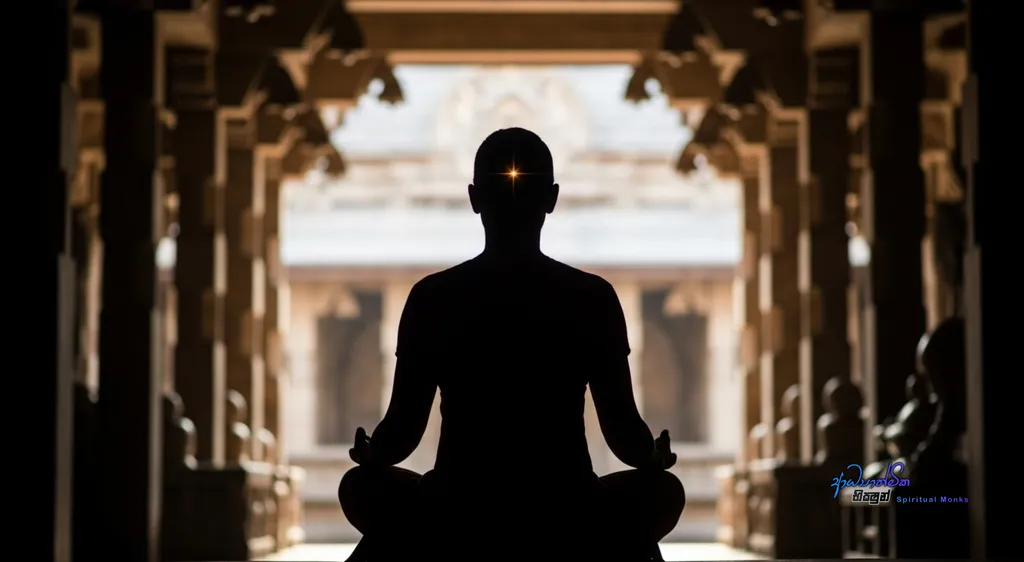
Once you are settled, close your eyes. The goal is to locate the natural resting place of your mind. This point will be somewhere along the vertical line that runs from the middle of your nose up to the center of your forehead. For some, the mind naturally settles between the two eyes. For others, it’s between the eyebrows. And for some, it is in the center of the forehead. There is no right or wrong place; it’s about finding where your awareness naturally gathers.
For those who have already practiced our first ‘Third Eye’ meditation for a month, you may already have a sense of concentration built up. You might feel a sensation of pressure or tightness in the forehead, between the eyebrows, or between the eyes. If you can tolerate this sensation without discomfort, you can use that very sensation as your object of focus. Otherwise, simply close your eyes and gently direct your mind to its natural resting point along that central line. Hold your mind there. Look at that spot with your mind’s eye. This is your anchor.
Setting Your Intention: A Powerful Resolution
With your mind resting gently on your chosen point of focus, there are three resolutions you should make. It is one statement, repeated three times. As you begin your meditation, with your eyes closed and your mind held in place, make this powerful intention:
‘May the first Jhāna arise.’
Repeat it three times with conviction. Now, it is crucial to understand that this is only a resolution, an aspiration or a blessing for your practice. Meditative states of deep absorption, known as Jhāna, do not arise simply because we say these words. This is not a magic spell. However, we use this resolution as a way to orient the mind and set a clear, positive direction for our meditation. It is a supportive tool, so please understand it in this way.
How to Cultivate One-Pointedness of Mind
After making your resolution, keep your mind fixed on that point of focus, let’s use the space between the eyes as an example. Keeping your awareness there, you should now begin to think,
‘May my mind become one-pointed.’
From the moment you start your session until the very end, continue to repeat this thought. Think it gently, perhaps every five seconds or so. Now, just as with the previous resolution, please do not misunderstand this. Simply chanting a phrase will not automatically lead to a concentrated mind, or what we call Samādhi. Many people mistakenly believe that repeating words will cause deep states to arise, but it doesn’t work that way.
The real work is to remain mindful. Your primary objective is to keep your awareness anchored to that point on the line from your nose to your forehead. The phrase ‘May my mind become one-pointed‘ is a tool to help you do that. The true mindfulness, the true wisdom, is in the act of keeping the mind right there. When you can maintain your attention on that spot without wavering, that is when the mind truly becomes one-pointed.
Path to the Brahma Realm: Working With a Wandering Mind
It is natural for the mind to wander during this practical meditation technique. If you find your mind drifting into the past or worrying about the future, your task is simple: just know that it has wandered. Become aware of it.
In a previous teaching, we discussed a ‘emptiness meditation‘ and the importance of being mindful for all 24 hours of the day. It is essential that you practice this continuous mindfulness in your daily life. While you are standing, walking, and going about your day, maintain the present-moment awareness we taught in that lesson.
However, when you come to your formal sitting meditation posture, you should switch to this specific technique. When your mind wanders away from its focal point, the spot between your eyes or on your forehead. simply notice that it has become scattered. You don’t need to get agitated or frustrated. If thoughts are racing, don’t make it a problem. Gently and patiently return your awareness to your chosen point of focus and continue holding it there.
Consistency is Key: Your Practice Schedule
To see results with this path to the brahma realm practical meditation technique, you must practice with consistency. You can practice for extended periods, like two or three hours a day, or break it into smaller sessions, perhaps half an hour at a time. If you can, try to practice at least three or four times a day. The more you engage with the practice, the better.
There is no special or forbidden time for this meditation. You can do it at midnight, at 2 AM, at 3 PM, at 8 AM, or in the middle of the afternoon. Whenever you have a moment, you can engage in this practice, even if it’s only for five minutes. The key is to do it regularly.
What to Expect: Sensations on the Path
As you continue with this practice, I believe the instructions I have given will become clear through your own experience. You may begin to notice certain things. Your mind might feel as if it is held to your focal point by a magnet, completely one-pointed. Even if there are sounds in your environment, like a television playing, you will hear them, but your mind will not be disturbed. It will be like the sound just passes by, without your mind wanting to investigate what it is. Your mind will feel anchored, drawn to that single point.
You might feel a sense of stability, as if your mind has become as solid as a rock or as fixed as a magnet. These are just a few examples of the mental experiences you might have. You could feel many other things, both mentally in the mind and physically in the body. When these things arise, please let us know by sending a message, but do not be afraid.
Embracing the Journey
When these mental and physical sensations arise, learn to experience them without fear. Get used to feeling them. As you experience them, continue to maintain your one-pointed concentration on your focal point. This is how you develop the meditation further.
This path to the brahma realm practical meditation technique is one of the shortest paths to developing your mind. It can bring you immense mental peace and well-being, and it can help you unlock various abilities and states of wellness. So, please, practice this diligently. You will see significant results after a few days, a week, or a month of consistent practice.
Do not practice for only a short time and then expect big results. The fruits of this practice are yours to harvest, but you must do the work. The more you practice, the more results you will receive. It is vital that you understand this principle.
With this, I conclude the first teaching in this series. May you put this method into practice and may you receive great results. I bless you with the refuge of the Triple Gem.
We invite you to walk this path with us. Read our teachings, and most importantly, apply them practically in your own life. as you practice, questions will naturally arise. Please feel free to share your experiences and questions in the comments below, via email or contact form. I will do my best to offer guidance in future talks based on your progress. For now, begin this practice with an open heart and a mind free from expectation. Cultivate it correctly, and may you find the clarity and peace you seek.
Thank you for joining us. We hope this blog will be of great benefit to your spiritual journey.
May you all be well and happy.
May the blessings of the Triple Gem be with you all!


