


Categories: Dhyana: Practical Training
May the blessings of the Triple Gem be with you all!
Welcome. In this article, we will explore a practical spiritual path, focusing on the development of the mind through a specific meditative technique.
This teaching, derived from our ‘Third Eye Practical Meditation Program,’ is designed to provide you with a clear understanding of a calming, concentration-based meditation, what we call the Samatha aspect of practice. We will guide you, step-by-step, on how to engage with it practically.
The results of the ‘Third Eye’ program can vary from person to person. Some may experience profound results, while others may not. This often depends on one’s past conditioning, the practices and efforts cultivated in previous lives. This is what we refer to as Samsara Kusalaya, or ‘samsaric merit.’
If this foundation exists, success in these practices becomes more certain. However, today we will focus on a meditation method taught by the Buddha himself: Anapanasati meditation, or mindfulness of breathing. This practice is detailed in the Satipatthana Sutta of the Digha Nikaya, specifically under the section of Kayanupassana, or contemplation of the body.
While Anapanasati meditation is often taught from an insight (Vipassana) perspective, our focus here will be on developing it from the Samatha, or tranquility, perspective. Therefore, do not expect this guide to be an insight-focused teaching. Its primary goal is to show how Anapanasati meditation can be a vehicle for opening the third eye.
However, for those who practice with consistent mindfulness (sati), as we have taught previously, this practice can naturally lead to insight as well. When mindfulness is present, any Samatha practice can incline the mind toward a Vipassana-style of seeing.
The Foundation: Consistency and the Universal Path
So, how do we use Anapanasati meditation to develop the third eye? What experiences might you face, and how do you cultivate this practice from beginning to end? I will explain this simply, in a way that anyone can understand, regardless of age, nationality, caste, or religion.
It is crucial to remember that if you commit to a meditation practice, you should engage with it for no less than three months. Whether you are following our ‘Third Eye Practical Meditation Program’ or the ‘Practical Meditation Program to Brahma Loka’, a method designed to facilitate deep states of absorption (Dhyana), commit to at least three, or preferably six, months of consistent practice.
We have previously discussed various methods for awakening universal energy, Kundalini energy, and the third eye. I have explained that many different meditation techniques can lead to the same destination.
We only need different bodily anchors and meditation objects to build the initial foundation, to establish a concentrated mind. Once the mind achieves a state of deep concentration (Samadhi), the path becomes one.
It is like how all rivers, no matter which mountain they start from, eventually flow into the same ocean. Though the initial journey might feel different depending on the practice you choose, the core experiences eventually converge. Whether you seek Dhyana, the five supernormal knowledges (Pañca-abhiññā), psychic abilities, or the experience of universal energy, the underlying principles are the same. This is a vital point to understand.
Some may feel that we haven’t provided enough practical instructions in other teachings. I invite you to explore all of our articles. Our purpose is to provide practical, technique-based guidance, not just empty talk. We have laid out everything you need, and many are already achieving results.
Preparing Your Body and Space for Meditation
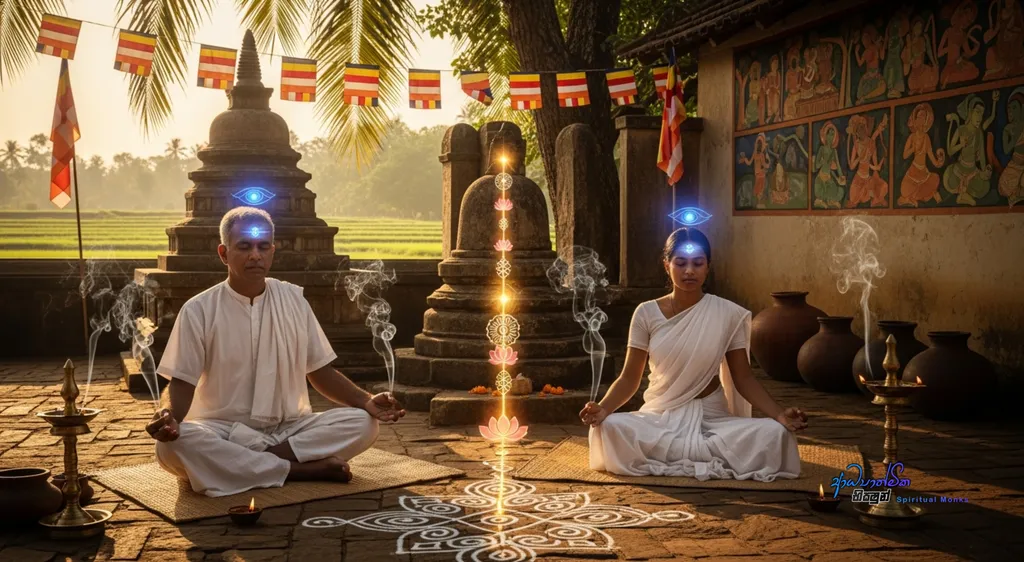
Let’s explore how to practice Anapanasati meditation to cultivate the third eye. Before you begin, choose a suitable place. As we’ve mentioned before, this could be a clean, tidy corner of your room. It doesn’t matter if you have incense or not, but ensure there is fresh, clean air.
If you face opposition from family, you can practice privately with the door closed. Meditating on your bed is acceptable, but if you find yourself becoming drowsy, it’s better to move to the floor. Use a small cushion or a woven mat, even a half-inch thick cushion is enough.
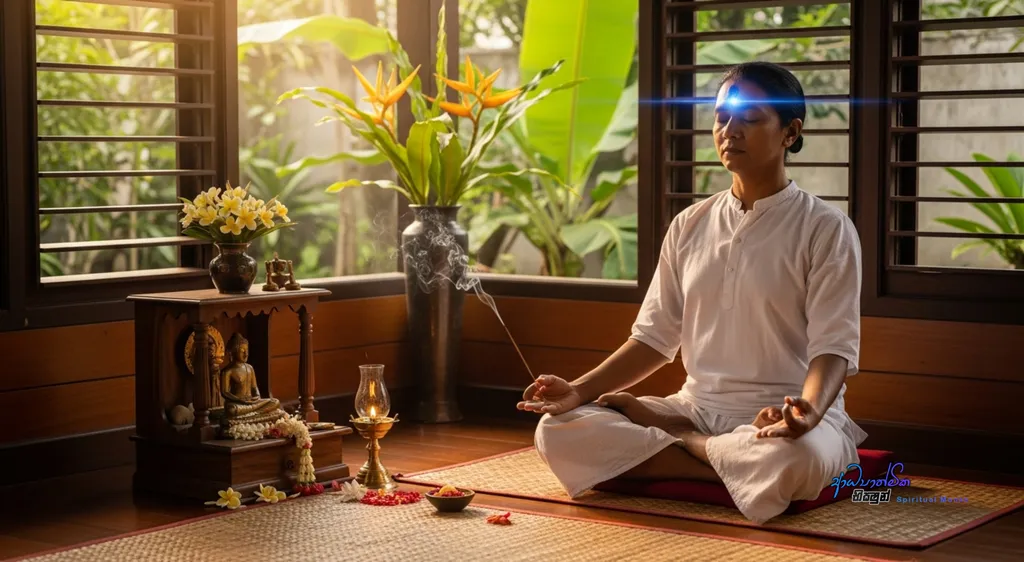
If you have a Buddha statue at home that you venerate, and the space is suitable, meditating before it is highly recommended. Otherwise, any quiet space with a sense of openness, perhaps with a connection to nature, is ideal. Wear simple, loose, and comfortable clothing; this will make your practice much easier. Once you are ready, sit in the proper meditation posture.
The recommended posture is the full-lotus position, or Baddha Padmasana. This applies to both men and women. Some female practitioners ask if it is acceptable to sit in the half-lotus with legs folded to one side. For developing deep concentration, this is not ideal.
Both men and women should aim for the full-lotus posture to effectively calm the mind and enter Dhyana. The other posture is fine for listening to a Dhamma talk as a sign of respect, but for serious Samatha practice, the stability of the full-lotus is most important. Remember this. This is the key posture for developing a calm, concentrated mind.
The First Steps: Focusing on the Breath
Now that you are seated, close your eyes. With your eyes closed, bring your attention to your breath. When you first do this, your mind will likely wander. If you are new to meditation, especially if this is your first time practicing after reading this article, your mind will be scattered. It might drift to the past or future, and you will lose focus on the breath. Do not be anxious about this.
We have other teachings on how to concentrate the mind that may help beginners. Place your hands comfortably; it doesn’t matter if the left hand is over the right or vice versa. You can use a specific hand gesture (mudra) if you like, but it is not necessary to hold it for the entire session. Do what feels natural.
Once settled, take a few deep, slightly forceful breaths. Inhale deeply, hold for a few seconds, and then exhale. Do this once or twice. You will feel it. After this, bring your mind to the natural rhythm of your breath.
Ordinarily, you never pay attention to your breath. It happens automatically whether you are sweeping the floor or doing chores. The ‘machine’ works on its own. The special thing you are doing now is deliberately directing your attention to the breath. As soon as you bring mindfulness to this process, you will start to notice how the breath enters your body, moves within, and exits. This is the power of mindfulness taking root.
Observing the Nuances of the Breath
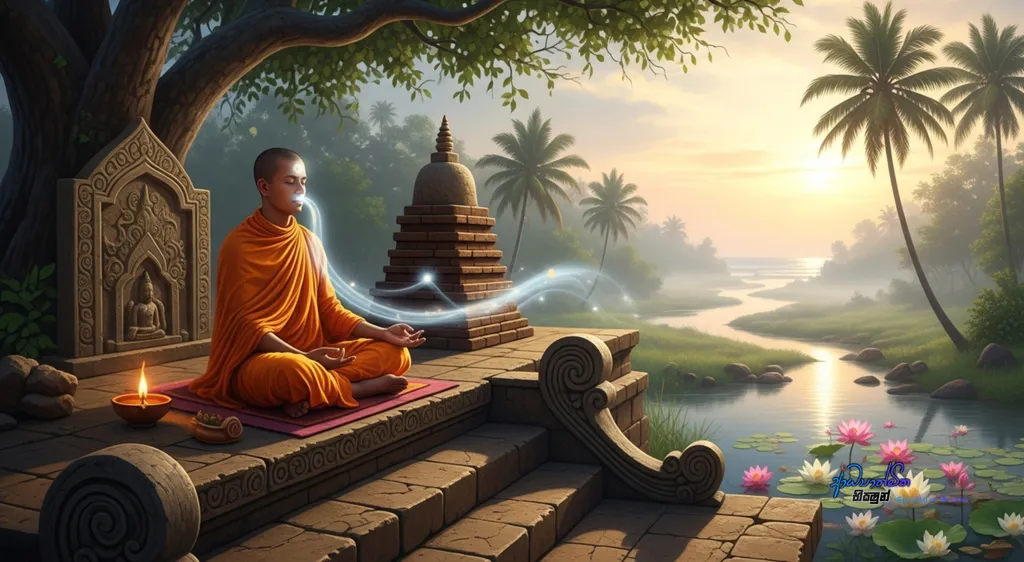
With your eyes closed and your mind focused, simply observe the breath moving up and down. These experiences I am about to describe may happen on your first day, within minutes, or it may take several days, weeks, or even longer. It is relative to each individual and depends on your Samsara Kusalaya. But don’t dwell on whether you have past merit or not; you won’t know until you try. Just commit to practicing for at least three months, as mentioned earlier.
As you watch the breath, you will first notice it simply going up and coming down. Then, it might feel like it’s speeding up, rising in a second and falling in a second. These are the initial sensations.
The Buddha described these experiences in detail in his teachings on Anapanasati meditation within the Satipatthana Sutta. You can read those texts for more knowledge, but I will not go into a detailed sutta analysis here. What matters is that these experiences happen just as the Buddha described. Your job is to simply understand and observe.
You will notice what is called a ‘short breath.’ Suddenly, it feels like a short puff of air drops down and then rises again. This can repeat. At the same time, your mind will be filled with thoughts. You’ll remember things from the past, childhood, what you ate yesterday, a conversation you had.
Your mind will also jump to the future, plans to complete a degree, build a house, or arrange a wedding. This is normal. When you notice your mind has gone to the past, simply acknowledge it. With mindfulness, your attention will naturally return to the breath.
If you catch your mind planning for the future, gently recognize, ‘My mind has gone to the future.’ The moment you mindfully identify this, your attention will come back to the breath. Our teachings on ‘Establishing Mindfulness’ explain this process in detail.
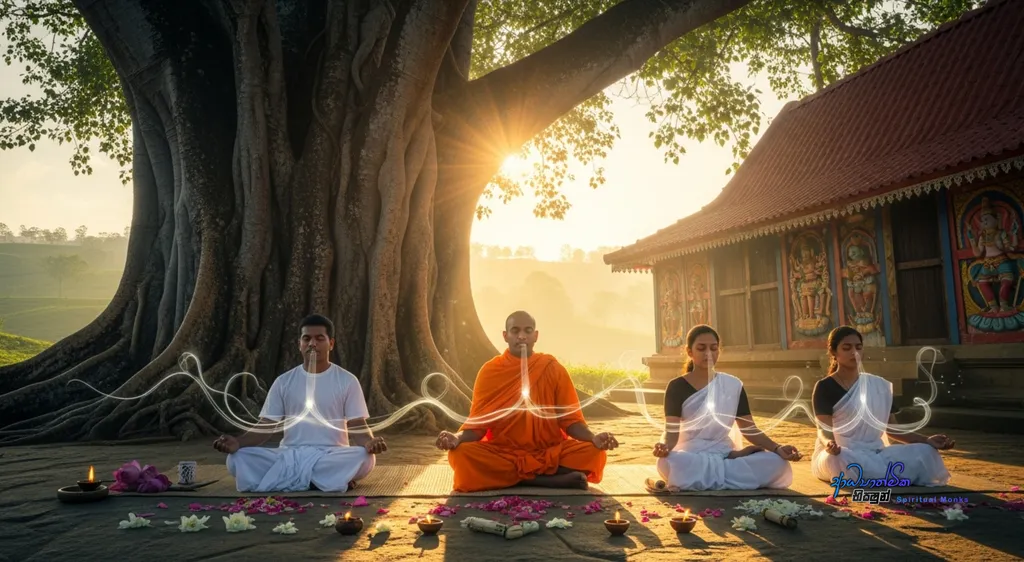
At other times, you will experience a ‘long breath.’ It will feel as if you are drawing in a deep, long inhalation that rises all the way up. You might hold it for a moment before releasing it as a long exhalation. So you will experience both short breaths and long breaths. Do not be afraid of this. Some people get startled when a sudden, deep breath occurs. There is nothing to fear. It is a natural part of the process.
The Body’s Response and the Cessation of Breath
Why do these things feel so pronounced? Because you have never paid this much attention to the machine of your body before. The only ‘magic’ here is that you are bringing a concentrated and mindful awareness to a process that is usually unconscious. That’s why you can perceive its workings so clearly.
As you continue, you may reach a point where you wonder, ‘Am I breathing at all?’ Many practitioners contact me with this concern, saying, ‘Venerable Sir, I have a doubt whether I am breathing. I feel like I might be dead.’ Some even get scared and deliberately take a forceful breath to check if they are still alive. This is unnecessary. At this stage, the breath has become extremely subtle, and your mind has also become very refined. The sensation of breath seems to disappear because of this subtlety.
During this process, you may also experience physical sensations. Your body might feel very light, similar to the factors of Dhyana we described in the ‘Practical Meditation Program to Brahma Loka.’ You might feel a sensation like ants crawling on your skin or itching. You become so sensitive that you can even feel the activity of microorganisms on your skin. These are natural bodily processes.
Don’t give them too much attention. If an itch becomes unbearable in the early days, you can scratch it gently and then return to your focus. Don’t make it a habit, or you will be scratching forever. It is a minor interruption, and as you become more practiced, you will be able to regain your concentration quickly. Do not make these small things into big problems.
Stage 1: The Pressure Point and the Shift in Focus
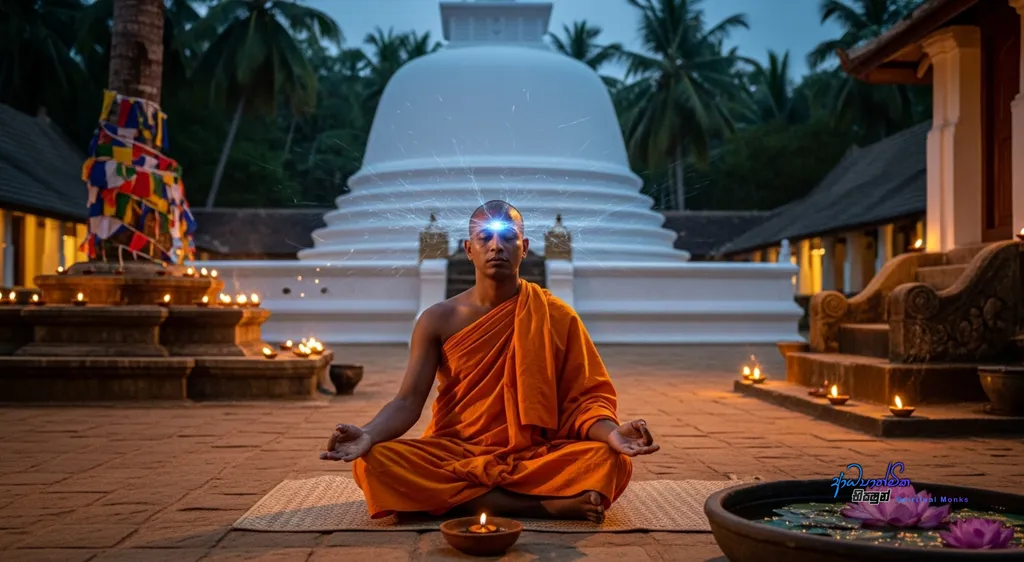
As you continue watching your breath in this way, your mind will become very concentrated. After some time, it could be one day, several weeks, or a few months, the next stage will occur. You will begin to feel a ‘tightness’ or ‘pressure’ in the middle of your forehead, between your eyebrows. This pressure may be felt slightly above the nose, along that central line.
This is a neurological response related to the pineal gland as the mind becomes deeply concentrated, causing a stimulation of the nerves in that area.
Let me be very clear: I am not teaching the method of Anapanasati meditation as the Buddha taught for insight (Vipassana). I am guiding you on how to use the Buddha’s method from a Samatha perspective to develop the spiritual ability of the third eye. This clarification is for those who might otherwise have misconceptions.
When you reach this stage, when you feel this distinct pressure or other sensations like coolness in the forehead, you have arrived at a critical juncture. At this point, you should refer to our teaching on ‘Emptiness.’ This is where you transition. The initial practice of Anapanasati meditation has served its purpose.
Stage 2: Cultivating the ‘Emptiness’ Sign
Once the pressure on your forehead begins, you must start cultivating the ‘Emptiness’ sign (His-sañña). A question may arise: ‘Should I continue to pay attention to the breath?’ The answer is no. There is no need to focus on the breath anymore. Remember the analogy: all rivers flow to the sea. The breath was the mountain source, the foundation. You used mindfulness of breathing only to lay the groundwork. Now, you have reached the second step.
Your new focus is to cultivate the ‘Emptiness’ sign. This pressure on the forehead happens to everyone who practices Anapanasati meditation deeply, whether their goal is insight or concentration. It is a natural milestone.
To learn how to cultivate this ‘Emptiness’ sign, please refer to the specific guidance in our ‘Third Eye Practical Meditation Program,’ as I will not detail the technique here. You must listen to that teaching and practice accordingly.
Stage 3 & 4: Mental Images and the Luminous Sky
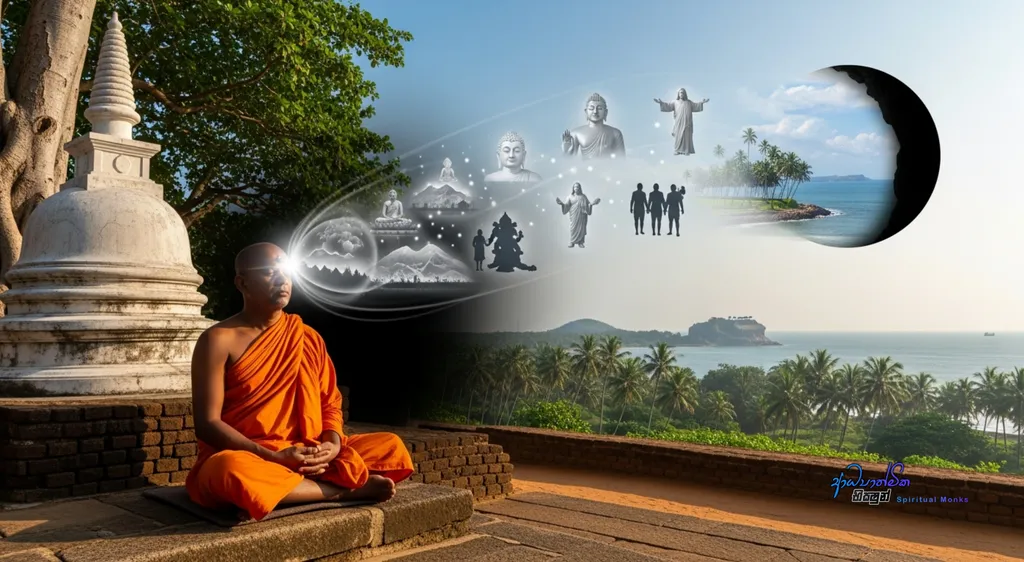
As you practice with the ‘Emptiness’ sign for some time, focusing on the area between your eyebrows, the next stage will arise: the appearance of ‘mental images’ (Chittarupa). These are often images of things you are strongly attached to or fond of. A Catholic might see Jesus; a Buddhist might see the Buddha.
You might see non-human beings or things you fear. Do not be afraid. This is just a stage. You might see mountains, trees, the sun, or the moon. If you admire figures like Lord Ganesha, Lord Shiva, King Ravana, or King Dutugemunu, they might appear.
Images of your parents, siblings, people you love, and even people you dislike will surface. These images are manifestations of your own mind’s content, which is why we call them Chittarupa.
When these images appear, you continue to cultivate the ‘Emptiness’ sign. Sometimes, preceding this, you may see light signs or feel as if you are passing through a cave or a black hole. As we have explained in our program, you must use the ‘Emptiness’ sign to move through this. Eventually, you will reach the stage of Chittarupa.
Again, the question: ‘Venerable Sir, should I go back to the breath?’ No. You are in the fourth grade now; don’t go back to kindergarten work. From this new stage, you continue to cultivate ‘Emptiness.’
Next is the fifth stage. You will begin to perceive ‘the sky’ (Ahasa). After passing through the mental images, a clear, open space like the sky will appear to you. When this happens, you must shift your focus and begin cultivating the ‘sky’ sign. This is the next critical step. For instructions on how to do this, refer to our teaching titled ‘The Sky’ in the ‘Third Eye’ program.
It is important to know that a practitioner of Anapanasati meditation might jump directly to this fifth stage. Depending on your past karmic conditioning, you might not consciously experience the forehead pressure, the lights, or the mental images. You could find yourself perceiving the sky almost immediately.
This is relative to the individual. If this happens, do not go back to the breath. Work with what is present. If you see the sky, which appears like a screen, you must practice with the ‘sky’ sign.
The Final Step: Awakening the Third Eye and Moving Forward
By now, the river analogy should be clear. No matter which meditation you start with as a foundation, the advanced stages are remarkably similar. Once you can hold the perception of the sky, you can begin to direct your intention (adhitthāna) to see things, as taught in our ‘Third Eye’ program, such as the Ruwanwelisaya stupa or Sigiriya. Being able to do this means your third eye, or what is known as the divine eye (Dibba-cakkhu-ñāṇa), is open.
The perception of the sky corresponds to the first formless state of absorption, Ākāsānañcāyatana. From here, you can progress to higher Dhyanas by following the steps we have laid out in our other teachings.
I have met countless people in Sri Lanka and around the world who practice Anapanasati meditation, reach the stage of seeing lights, and then get stuck. Not knowing what to do next, they just keep returning to the breath, wasting their precious karmic potential. This is a great shame. It happens due to a lack of understanding or not having a competent teacher to guide them to the next step. Now that you know, you can move forward.
Once you reach these higher stages, the foundation of Anapanasati meditation is no longer needed. To put it bluntly,and I do not mean this disrespectfully, you can ‘kick it away.’ It has served its purpose. Only if your practice degenerates, if sensual desires (kāma) overwhelm you and you fall back, will you have to pick it up again and start from the beginning.
But because you have the knowledge and experience, progress will be much faster the second time, though it will still take time to reduce the sensual desires that caused the decline. Remember, progress in these practices, especially towards Dhyana, requires a reduction in sensual craving.
I believe this gives you a clear, practical understanding of how to use Anapanasati meditation to open the third eye. In the future, I hope to explain how to use other meditation methods to achieve this and how to use Anapanasati meditation to specifically enter the Dhyanas. There are many paths to build the foundation, but the journey beyond is one.
May the power and blessings of the Buddha, Dhamma, and Sangha, the Triple Gem, give you the wisdom and ability to practice these teachings successfully.
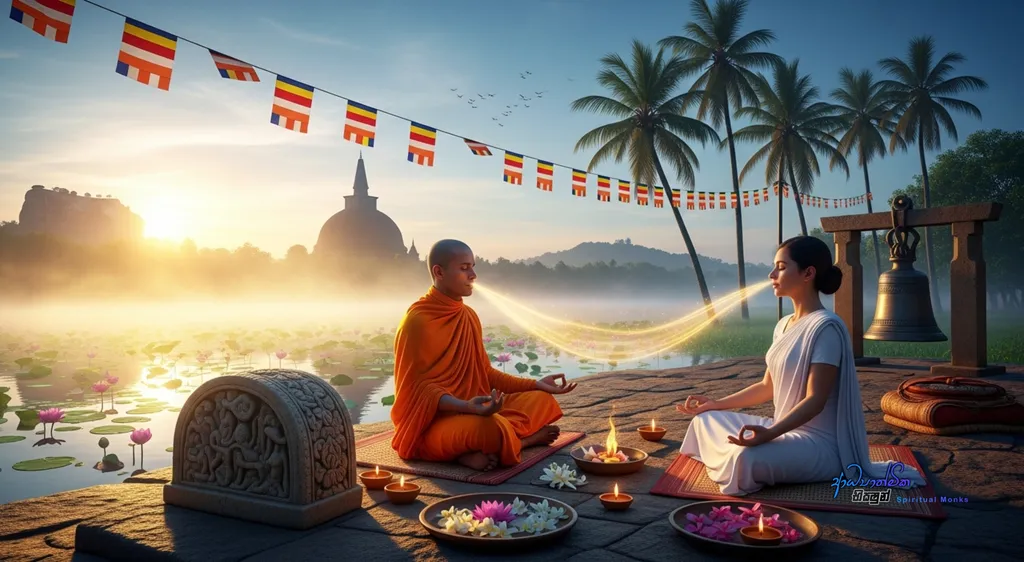
We invite you to walk this path with us. Read our teachings, and most importantly, apply them practically in your own life. as you practice, questions will naturally arise. Please feel free to share your experiences and questions in the comments below, via email or contact form. I will do my best to offer guidance in future talks based on your progress. For now, begin this practice with an open heart and a mind free from expectation. Cultivate it correctly, and may you find the clarity and peace you seek.
Thank you for joining us. We hope this blog will be of great benefit to your spiritual journey.
May you all be well and happy.
May the blessings of the Triple Gem be with you all!


