


Categories: Cosmic & Kundalini Energy
May the blessings of the Triple Gem be with you all!
Whether you are actively exploring a spiritual life or simply listening to these teachings with a curious mind, there is a topic that often brings up questions for everyone. We have touched upon it in previous discussions, but it became clear that a dedicated article was needed to provide a complete answer. Understanding this can be a powerful support for your own spiritual journey.
You have likely encountered terms like the ‘Third Eye,’ ‘Cosmic Energy,’ and ‘Kundalini Energy.’ In the world of spirituality, especially in Asian countries with deep meditative traditions like India and Sri Lanka, these words are very well-known. Their mystique has attracted people from both the East and West. When you read books, search online, or learn from a teacher about Kundalini, for instance, it sparks a deep interest and a desire to practice meditation.
These terms are often described in extraordinary ways as a vast power, an ability to do anything, or a superhuman mental faculty. This is how they are presented in books, on the internet, and by various teachers, and it’s likely the information you have come across.
One River, Many Names: Understanding the Universal Experience Behind the Words
These concepts are often claimed by different traditions. Some say they belong to Hinduism, others to different Indian faiths, and some attribute them to the ancient Brahminical tradition. There are many opinions. However, from the perspective of this practical spiritual teaching, I want to show you something essential: no matter what name is used, the function they describe is one and the same.
Consider water, a simple element of nature. In Sri Lanka, the Sinhala people call it ‘jala’ or ‘wathura.’ In English, it’s called ‘water.’ Tamil speakers might call it ‘thanneer.’ Different cultures use their own unique languages to describe the same substance that quenches thirst. The name changes, but the water itself does not.
In the same way, I see the terms ‘Cosmic Energy,’ ‘Third Eye,’ ‘Kundalini,’ and ‘Chakras’ as just words. They may be associated with India, Sri Lanka, or Hinduism, but through my own practical meditative experience, I see them as labels for a universal process. They are simply different names for the same core experience of cultivated spiritual energy.

Does Buddhism Talk About the Third Eye? A Look into the Scriptures
Now, you might wonder if these specific terms are part of Buddhism. Whether you are a Sinhala Buddhist or someone from another background studying the Buddha’s teachings, you might search for ‘Third Eye’ or ‘Kundalini’ in the core Buddhist texts. The foundational teachings of Buddhism are found in the Tripitaka, a large collection of scriptures. The Tripitaka consists of over 57 volumes, along with commentaries (Atuva) and sub-commentaries (Tika) that explain them.
If you were to read all of these texts, you would never find the words ‘Cosmic Energy,’ ‘Third Eye,’ ‘Kundalini Energy,’ or any mention of the seven chakras like the Manipura or Svadhisthana chakras. Searching for these specific terms within the Buddhist canon would be a fruitless effort. They are simply not there.
However, as I explained, my point is based on personal, practical meditative experience. These are just words. In other traditions, they are used to describe experiences that are very real. The key is to understand the underlying function, not to get lost in the terminology.
The Meditator’s Journey: Experiencing Inner Light on a Non-Buddhist Path
To understand this practically, let’s consider an example. Imagine a person following a Hindu path who begins to practice a form of concentration meditation, known in Buddhism as Samatha. Let’s say this person focuses their attention between their eyebrows or on the center of their forehead and begins to chant a mantra like ‘Om.’
After some time, it’s very likely that ‘light signals’ (what we might call aloka sanna) will begin to arise in their field of vision. This experience of light is a common milestone. From that point on, whether guided by a teacher or their own wisdom, they will continue to navigate the experiences that follow.
This process is not exclusive to one tradition. For those who have followed our practical meditation programs, you’ll recognize this is similar to the instructions for awakening the ‘Third Eye,’ where the arising of these light signals is a key step. The path is determined by the guidance they receive or their own level of understanding after this initial experience of spiritual energy.
The Buddhist Path to Inner Light: Anapanasati and Buddhanussati
Now, let’s look at this from a Buddhist perspective. Buddhism is not truly a religion or a philosophy in the conventional sense; I have repeatedly described it as the Dhamma, the eternal, unchanging nature of reality. Within this framework, the Buddha taught practical meditation methods. Let’s take Anapanasati, which is mindfulness of breathing.
Imagine a Sinhala Buddhist who begins to practice Anapanasati. As they progress, they will inevitably experience a pressure or tightness between the eyebrows or in the middle of the forehead. As their mindfulness deepens, they will begin to clearly perceive the entire path of the breath as it enters the body, turns, and flows back out. With this sustained concentration, the nervous system is stimulated, and neurons in the brain associated with meditation become active.
This neurological activity creates that feeling of pressure and, subsequently, leads to the arising of light signals. Just like the Hindu practitioner, this person will then proceed on their path, either with a teacher’s guidance or through their own wisdom.
Let’s take another Buddhist practice: Buddhanussati, or the recollection of the qualities of the Buddha. This is for someone who wants to cultivate faith (saddha). Think about someone you love dearly a partner, a spouse. You naturally recall their loving words, their kind actions, their touch. Thinking of them brings a sense of joy and warmth, perhaps even a gentle smile when you’re alone. Your mind and body feel uplifted.
Recollecting the qualities of a Buddha is infinitely more powerful. By focusing on one of the nine qualities that resonates most deeply with you just as you are drawn to a specific quality in a loved one your heart fills with a profound sense of clarity and joy.
For many who practice this and other recollection meditations (Anussati), or even impurity meditations (Asubha), the result is the same: their concentration deepens, and they too begin to experience these light signals and enter the stage of mental images (citta rupa). Many who have practiced the forty traditional Buddhist meditation subjects (kammatthana) can attest to this. This cultivated spiritual energy is a natural outcome of focused meditation.
Converging Rivers: How Different Practices Lead to the Same Meditative State
So, look at what has happened. The person from a Hindu tradition who meditates on ‘Om’ and the person from a Buddhist tradition who practices mindfulness of breath or recollection of the Buddha both arrive at the same practical junction. Both may feel pressure in the forehead. Both may see inner lights and mental images. Both may open their ‘Third Eye’ and perceive beings from unseen realms, like gods (devas) or brahmas. Haven’t they all arrived at the same place, experiencing the same phenomenon of heightened spiritual energy?
It is like all rivers, as I often say, eventually flowing into the same ocean. The paths may begin in different lands, but they converge at this stage of deep concentration, which we call Samatha (calm abiding).
A CRITICAL CLARIFICATION: This does not mean all religions are the same. I have stated in previous teachings that they are not. Other religions may speak of joining with a divine being after death. Buddhism teaches the law of Kamma (intentional action) that our actions, words, and thoughts determine our future births.
It speaks of a cycle of rebirth called Samsara, and most importantly, it teaches that this cycle can be ended. We must work to realize a state of non-rebirth. This core difference is crucial to understand. My comparison here is strictly about the mechanics of concentration meditation, not the ultimate goal of the path.

The Great Divide: Mundane Power (Lokiya) vs. Supramundane Liberation (Lokuttara)
This is where the fundamental distinction lies. The experiences of spiritual energy we have discussed the inner light, the psychic powers, the blissful states of absorption called Jhana are, in their initial form, considered mundane, or Lokiya. They exist within the world, within the cycle of Samsara. Without the Buddha’s teaching, this is as far as the path goes.
The unique contribution of Buddhism is the way to make these experiences supramundane, or Lokuttara transcendent, leading beyond the world. This is accomplished through wisdom and practices like the Four Foundations of Mindfulness (Satipatthana) and understanding Dependent Origination (Paticcasamuppada). These concepts, which lead to the Four Stages of Enlightenment and ultimately to Nibbana (liberation), are not found in any other teaching. They were taught only by a fully enlightened Buddha.
Outside of the Buddhist path, spiritual practices often focus on developing psychic abilities, extending lifespan, or achieving blissful states. While practitioners in these traditions may gain some understanding of the mind and live ethically, their knowledge remains on a conventional level. They may align with nature and the universe to a great extent, but they have not yet touched the path that leads out of the cycle entirely.
From Power to Wisdom: Transforming Spiritual Energy into a Path of Liberation
To become fully aligned with the nature of reality, one must turn these mundane spiritual abilities into a path for liberation. This is done by applying mindfulness (sati) to the experiences themselves. We teach this in our programs: to maintain mindfulness during the arising of the ‘Third Eye’ experience, and to maintain it within the Jhanic states. By observing the arising and passing of thoughts, recognizing clinging and aversion, the experience itself becomes an object of insight.
The person who awakens their ‘Third Eye’ or Kundalini without this framework sees the world through a lens of power and experience. They are attached to it. The person who awakens the same faculty which in the Abhidhamma is called the ‘divine eye’ or dibbacakkhu-ñana and applies supramundane wisdom, sees the world with a profoundly superior understanding. Their mental state is elevated, their range of perception is wider, and their wisdom is far greater because it is free from attachment.
Long before the Buddha’s enlightenment, there were masters who had attained great psychic powers and the eight absorptions (Aṭṭha samāpatti). The Buddha’s own teachers, Alara Kalama and Uddaka Ramaputta, had reached these states. But these were still mundane achievements. While they had moved beyond sensual desires, they were still attached to their refined spiritual states and abilities.
The one on the Buddhist path to liberation, the one practicing insight (Vipassana), develops these same attainments but feels no attachment to them. They abide in the Middle Way, viewing these powerful states with equanimity (upekkha). They are not bound by them and thus are not reborn in even the highest heavenly realms.
A famous story tells of the ascetic Kondañña, who, upon seeing the infant Siddhartha’s auspicious marks, declared he would become a Buddha. He then wept, not from sadness for the prince, but because he knew he would be reborn in the highest formless realm (Nevasaññānāsaññāyatana) with a lifespan of many thousands of aeons. He would miss the Buddha’s teaching. Such is the trap of mundane attainment.
The one on the supramundane path who reaches the stage of Non-Returner (Anāgāmī) is reborn at most in the Pure Abodes (Pañca Suddhāvāsa), from where they can attain final Nibbana.
The Final Turn: The Role of Wisdom in Transcending Spiritual Experiences
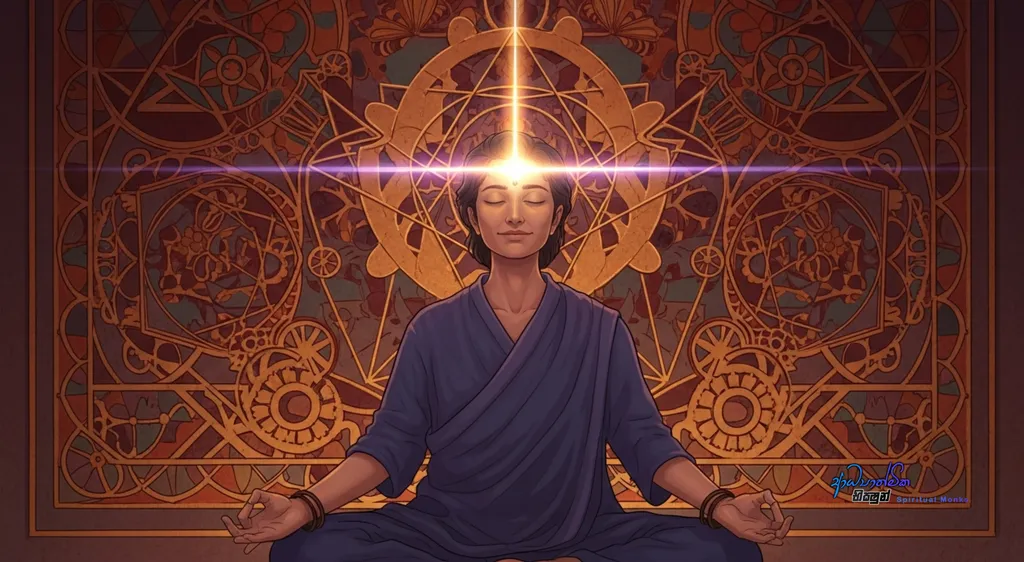
So now, you should be able to make a clear distinction. On the level of calm-abiding meditation (Samatha), the mundane experience is the same for everyone. The activation of the chakras, the awakening of spiritual energy these happen for a Buddhist practitioner too, even if the words are not in our texts. The seeing and hearing of unseen things, developing psychic powers, reading others’ minds, and seeing past lives are all potential outcomes of dedicated practice.
The key insight from this entire discussion is this: the words are different, but the initial, mundane experiences are the same. This I say from my own experience. The radical difference occurs only when the path becomes Lokuttara, or supramundane.
This is when the practitioner begins to break free from the patterns of the non-Buddhist or secular spiritualist. The person on the supramundane path views these psychic abilities and meditative states not as a final goal, but as tools to be observed with wisdom, free from attachment and aversion.
Someone on a mundane path may change their perspective from the sensual world to the spiritual world, but they often stay fixed in that new perspective, attached to their abilities. They do not know how to change the angle of viewing again to transcend even that. To do so, they would have to turn towards the path the Buddha taught.
Conclusion: One Journey, Two Destinies
I hope this clarifies why, in our teachings, we sometimes use popular terms like ‘Third Eye,’ ‘Cosmic Energy,’ or ‘Kundalini.’ We use these words because you are familiar with them, and perhaps you are lost among them. Our goal is to meet you where you are and guide you onto the correct path. We could speak only in the language of the Dhamma, but then those who are disoriented by these other terms might not find their way.
The words may change, and the starting points may seem different, but as the journey of concentration unfolds, the experiences converge. Understanding this is essential. I believe this explanation is sufficient for now. You should now have a clearer understanding of the Buddhist perspective, the distinction between concentration (Samatha) and insight (Vipassanā), and how concepts from outside Buddhism relate to the practical experiences within it.
Though this teaching may be deep, and perhaps confusing at first, I encourage you to reflect on it. Some may grasp it at once, others may need to revisit it. Understanding this is crucial for your forward progress. As we continue to share these teachings, we will further explain how to make these spiritual abilities supramundane.
It is not a strange, complicated act; it is simply a shift in how you see. Just as you shifted your view from the sensual world to the spiritual, you make one more shift: seeing the spiritual world itself with non-attached wisdom. When that angle of view changes, the experience becomes liberating.
With the understanding you have gained today, may you be able to clarify these questions for yourself and proceed on your path with confidence. By the power of the Buddha, Dhamma, and Sangha, may you grasp these points well. May you all be well.
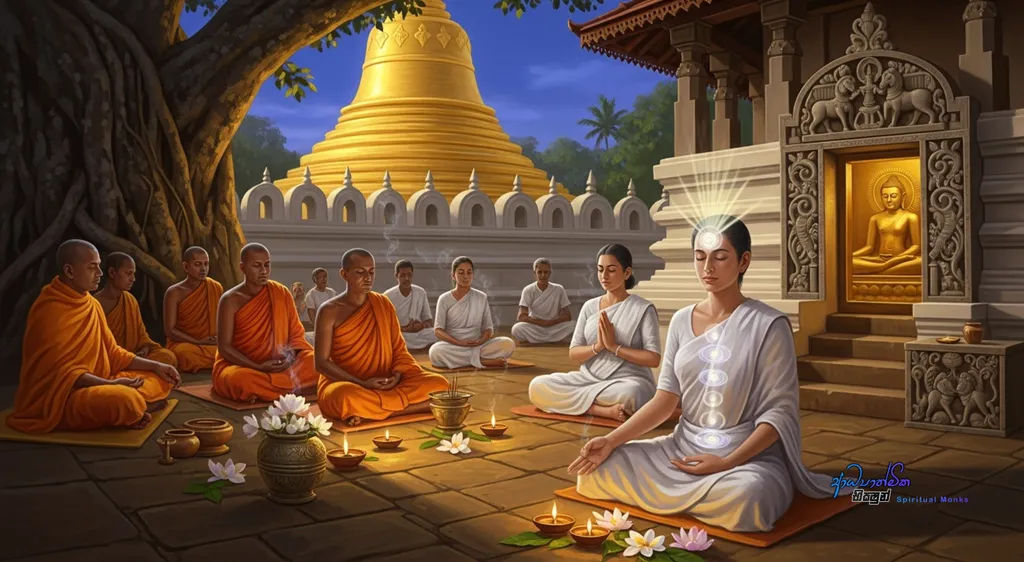
We invite you to walk this path with us. Read our teachings, and most importantly, apply them practically in your own life. as you practice, questions will naturally arise. Please feel free to share your experiences and questions in the comments below, via email or contact form. I will do my best to offer guidance in future talks based on your progress. For now, begin this practice with an open heart and a mind free from expectation. Cultivate it correctly, and may you find the clarity and peace you seek.
Thank you for joining us. We hope this blog will be of great benefit to your spiritual journey.
May you all be well and happy.
May the blessings of the Triple Gem be with you all!


