


Categories: Be Happy 24 hours
May the blessings of the Triple Gem be with you all. For those of you who have been following our spiritual teachings, this article aims to further clarify how to maintain mindfulness in your practical, everyday life. We will explore how to practice it, the various ways to cultivate it, and offer a broader analysis to help you develop your mind, strengthen your mentality, and achieve a deeper understanding of your own inner nature. Through these methods, you will learn to see the mind’s true characteristics.
For a long time, we have offered teachings on the practice of mindfulness, explaining what it is, how to maintain it, and what you need to do. Our series of talks on this topic has covered it from many angles. Anyone who engages with this practice can gain an understanding of their mind, see its nature, and recognize its flaws.
Although we teach this, it is something you must experience for yourself, and many have already done so. This is the teaching of the Buddha. The practical application of the teachings happens right here, in your own experience. Because of this, you can understand yourself, who you truly are. To understand your mind is to understand yourself.
Today, I will explain in even simpler terms how to go about practicing mindfulness in your daily life. This is a practice for anyone, of any age, there are no distinctions between young and old, child or adult. There are no barriers of race, caste, religion, or color. It doesn’t matter if you are sick or healthy, busy with work or not, or a student.
None of these conditions affect your ability to practice. What I am sharing today is incredibly simple, so that anyone can do it. If you are new to these teachings, I especially recommend exploring our playlist on practicing mindfulness, particularly the initial articles like “Silently Watch the Mind.” These foundational teachings will be of great help to you.

The First Moment: Mindfulness Upon Waking
Let’s begin right from the moment you wake up. After a night’s sleep, you suddenly awaken, perhaps to an alarm or simply because your body is used to waking at a certain time. Your eyes open. From that very first moment of opening your eyes, begin to watch your mind. Let’s say you wake up at four in the morning. This moment of awakening, of waking from sleep, is your starting point. As soon as this happens, look at your mind. Usually, the first thing you do is look around with your eyes. Instead, train yourself to first look at your mind.
When you look at your mind at this early hour, you will notice it isn’t immediately agitated. It is not yet burning with desire or anger. Old thoughts, events from yesterday or the day before, or memories from the distant past have not yet started to flood in. They will come, but slowly.
After a good night’s sleep, where your body and mind have rested, the mind is generally in a simple, calm state. We might say it’s ‘cool.’ Just stay with this calm mind and observe it. By watching it in this state, you can gain a simple understanding: “Right now, my mind is cool.” Just watch.

The Rush of Thoughts and the Pull of Technology
As you continue to watch, suddenly, the tasks for the day will begin to surface. If you have to go to work, that thought will arise. If you are a student, you might remember homework you haven’t done. If you are a homemaker, the thought ‘I need to cook’ will appear. One by one, a variety of thoughts will start to emerge. This is a simple, universal experience for everyone in the world, regardless of background.
Many people have a habit of waking up and immediately searching for their phone. They grab it and start scrolling, a habit driven by modern technology. From a medical standpoint, it is not good to look at a phone screen immediately after waking. The artificial rays are harmful. Similarly, it’s not good to use it excessively right before sleep. If you do, you may find it very difficult to even open your eyes in the morning.
Lack of quality sleep leads to mental stress, a weakened body, and a decline in health. It is bad for your nervous system and your eyes. Technology helps us in limited ways, but you must understand that it can cause more harm than good. This is clear even from a scientific perspective. If you practice mindfulness and observe your mind, you will see for yourself whether what I am saying is true.
Many young people stay up late using their phones and then can’t wake up on time. Try an experiment: for a few days, put your phone away half an hour or an hour before you sleep. If you sleep at 9 PM, stop using your phone around 8 PM. You will find that you can wake up easily in the morning, and your eyes will open without difficulty.
How to Watch the Mind: Using the Mind Itself
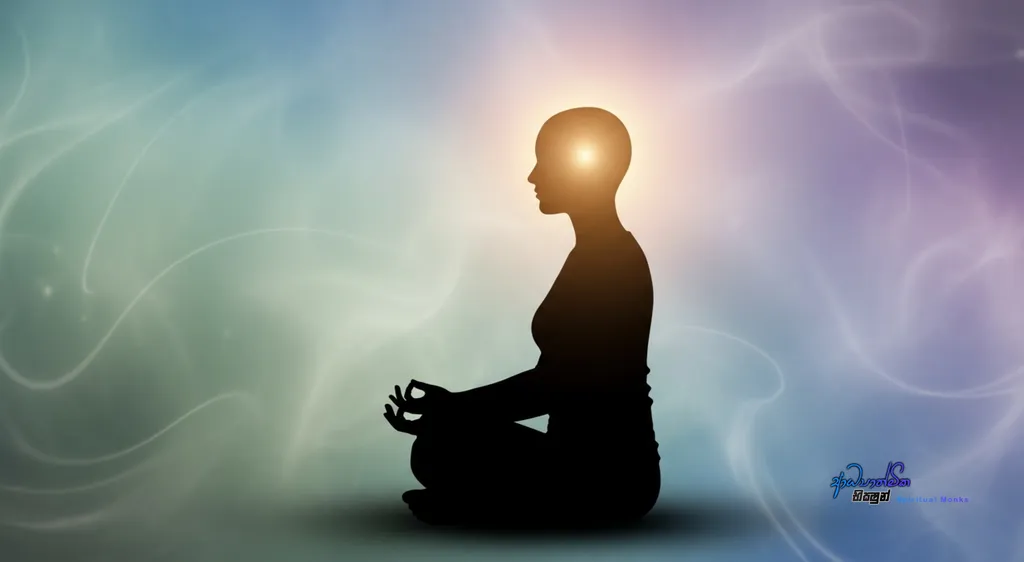
As thoughts come, ‘Where is my phone?’, ‘Let me check Facebook,’ ‘What WhatsApp messages did I get?’, the mind starts to scatter in different directions. Watch this collection of thoughts with good mindfulness. Watch it with your own mind. Some people ask me, “Is this done with the mind?” Yes, it can only be done with the mind. You cannot use anything else. To understand the mind, you must use the mind itself.
Some, trying to be clever, ask if we are watching with our consciousness, using deep words like Viññāṇa (the Pali word for consciousness). But Viññāṇa is just the mind. It’s a Pali term. I am explaining this in simple language, without using Pali, so that anyone can learn. So, just watch the mind. Though Viññāṇa is a Pali word, it is indeed consciousness that is watching. In the Buddha’s teachings, especially in the Abhidhamma, consciousness is analyzed in many complex ways. But you don’t need those deep words. If you understand what I am saying, that is enough. If the Buddha were alive today, he would not speak to you in Pali.
He would speak in a language you understand. The Buddha, having perfected his virtues (pāramitā) over countless lifetimes, had the ability to speak to anyone in their own language. If he met a foreigner who needed to hear the teachings in English, he could do so. This ability comes from the practice accumulated over many lifetimes. But for our purpose, you do not need to get lost in deep terminology. Simply watch your own mind with your mind.

Mindfulness in Motion: From Bed to Bathroom
After watching your thoughts and perhaps setting your phone aside, what is the next step? Getting out of bed. As you prepare to put your feet on the floor, observe how your mind interacts with this action. Your mind gives the command: ‘Now, put your feet out of the bed and stand up.’ Watch this instruction. Then, as you slowly place your feet on the floor, watch with clear mindfulness.
It’s possible to lose mindfulness here; you can’t be mindful continuously at first. It is something to be practiced little by little. As you practice, watch how your hands and feet move according to your mind’s direction. Observe your fingers, arms, legs, eyes, and ears. Are they moving like a robot, or is there a natural flow? You can catch this more easily in the early morning because your thoughts are fewer after a good night’s sleep.
From here, you might go straight to the bathroom to take care of your bodily needs, like washing your face. As you walk there, watch. Are you walking with mindfulness? Observe the act of walking to the bathroom, the way your legs move. Does it happen automatically out of habit, or do you consciously think about each step? Just watch this movement of the body with your mind.
As you go to the bathroom, take the toothpaste, put it on your brush, observe how this happens. Watch this process with clear mindfulness. Then, as you brush your teeth, moving the brush inside your mouth, are you brushing the way you want to, or the way your mind wants to, or are you just doing it mechanically, the way you’ve done it for years? Observe all of this, even if you are still half-asleep. Just watch these moments.

Mindfulness in Daily Chores: The Mind’s Secret Travels
After this, some people might iron clothes for work or school. Others, especially the women in the household, go to the kitchen to cook. Observe the way vegetables are chopped with a knife, the way a cup of rice is measured. Watch all of this with mindfulness directed at your mind.
If you drink a glass or two of water for your health, observe the way you drink it, the way it enters your mouth, touches your tongue, and goes into your body. You cannot watch everything at once. I repeat this again and again: practice little by little. You will only catch these moments here and there.
At the end of this morning period, reflect: how much mindfulness did you maintain? The Buddha taught us to be mindful not just in the formal sitting posture but in all postures, sitting, standing, and walking. Apart from formal meditation, how much have you practiced mindfulness, or what is called Sati Sampajañña (mindfulness and clear comprehension)? How much has your mind been strengthened? How much understanding of your mind have you gained through these simple morning activities? Try this practically, and you will understand.
For those who practice our formal Samatha (calm) meditations in the morning, like the ‘Third Eye’ or ‘Brahma World’ practices, this is also for you. From the moment you wash your face until you sit down in your meditation posture, observe how much mindfulness you are maintaining.
As you arrange your legs and hands into the posture, are you doing it with mindfulness? Your mindfulness may break; you may become unmindful. That’s okay, don’t make it a problem. Just keep watching the mind, little by little. By doing this, you will begin to understand how your mind becomes defiled in the morning.

The Opening of the Floodgates: Where Your Mind Really Is
When you are asleep, the thoughts and events of the previous day are somewhat suppressed. When you wake up, they don’t all come at once. But as you gradually become unmindful, it’s like opening a floodgate. The old thoughts, sad events, happy moments, worries, jealousies, and all the various mental defilements (kilesa), begin to pour in, one by one. This is how your morning begins.
Let’s take a clear example. Pay close attention to this part. When you are eating, you mix the food on your plate. As your hand is mixing the food, is your mind present with that action? Or is your mind somewhere else while your hand moves out of habit? Is your mind in the past, back in your school days? Is it worried about your financial problems, your spouse, your children, your job? Or are your thoughts on some other topic entirely? Watch and see if your mind is in another place while you are mixing your food. When you notice this, your mind will naturally return to the present moment.
There is no special technique here; the only practice is to maintain mindfulness. You don’t need to chant words or contemplate complex doctrines like Paṭiccasamuppāda (Dependent Origination). The point is to see these truths for yourself by practicing mindfulness.
When you are brushing your teeth, is your mind with the act of brushing? Or has it traveled to Anuradhapura, to Colombo, to your job, to your university? Is it lost in a book or a movie? You will realize, ‘Even while my body is doing something, my mind is often somewhere else.’ This is how you begin to understand the incredible speed of the mind.

The Incomparable Speed of the Mind
The Buddha said that nothing can be used as a simile for the speed of the mind. He gave similes for everything else, but for the mind’s speed, there is no comparison in this physical world. You cannot compare it to a high-speed train or even the speed of light; the mind is astonishingly fast. Now, just for a moment, consider this from the perspective of calm-abiding meditation (samatha).
If a person develops the mind to the point of gaining psychic powers (iddhi) and brings the mind under their control, imagine the speed at which they could move their physical body, using the mind’s natural velocity. Imagine how quickly they could master spiritual abilities and meditative states (jhānas) with such a tamed mind. This is not our primary goal, however. Our goal is insight (vipassanā), or what is established through the Four Foundations of Mindfulness, which I am explaining without the deep terminology. By practicing, you will understand this directly.
Extending Mindfulness Throughout Your Day
Now, let’s continue. Observe your mind as you sweep the yard with a broom or sweep the house. When you feed your child, are you present with that action? Or does your mind wander? As you feed your child with love, notice how attached your mind becomes. When you speak lovingly to your spouse, when you are on the phone with a loved one, watch your mind.
At times, you might realize, ‘This is an illusion.’ You may see that it is just a collection of thoughts, that there is nothing substantial to it. But when you become unmindful, you fall back into attachment and feel, ‘I need this love.’ When mindfulness returns, you might think, ‘I don’t need this love, it’s just a performance, a falsehood.’ Keep watching your mind like this.
From getting dressed for work to walking down the street, watch your mind. When you smile at someone, how do you smile? When you talk to them, how does your mind react? A note here: as you continue practicing mindfulness, you will find you have less desire to talk about unnecessary things.
Your mind becomes accustomed to the freedom and peace of inner silence, and you will want to enjoy that freedom more and more. When you greet people in the morning, watch your mind. If you meet someone you argued with yesterday, an enemy, what is your reaction? How does your mind face them? How do you perceive their posture? Watch all of this with mindfulness.

The Transformation: You Are Not the Same Person
This practice extends to your entire day. Getting on the bus, waiting at the bus stop, driving your car. If you are a driver, you may follow the rules, but others on the road may not. When someone cuts you off, how does your mind react? Does anger flare up? When you see injustices or how people behave, do you laugh strangely, or feel hatred? Or, with mindfulness, does a sense of equanimity arise, seeing them as simply unfortunate? True equanimity (upekkhā) is not feeling pity or merit; it’s a neutral state that sees this is just the way things are. Watch your mind for this simple neutrality.
Continue this at your workplace, during lunch, when talking with colleagues, on your way home, while bathing, cooking, eating, and even as you use your phone before bed. In every moment, practice watching your mind and how your body behaves in response. At the end of the day, from the moment you woke up until you go to sleep, see how mindful you have been.
Without formal meditation, how much have the Four Foundations of Mindfulness grown in you? How much more do you follow the Buddha’s teachings in your actions? How many defilements have you recognized, and how many have you eliminated? Ask yourself: ‘Am I the same person who went to work ten days ago, a month ago?’ Is the person who was once burning with desire now less so? Is the person who was quick to anger now calmer? This is how you observe your progress, by watching your mind.
Mindful Rest: The Lion’s Posture for Sleep
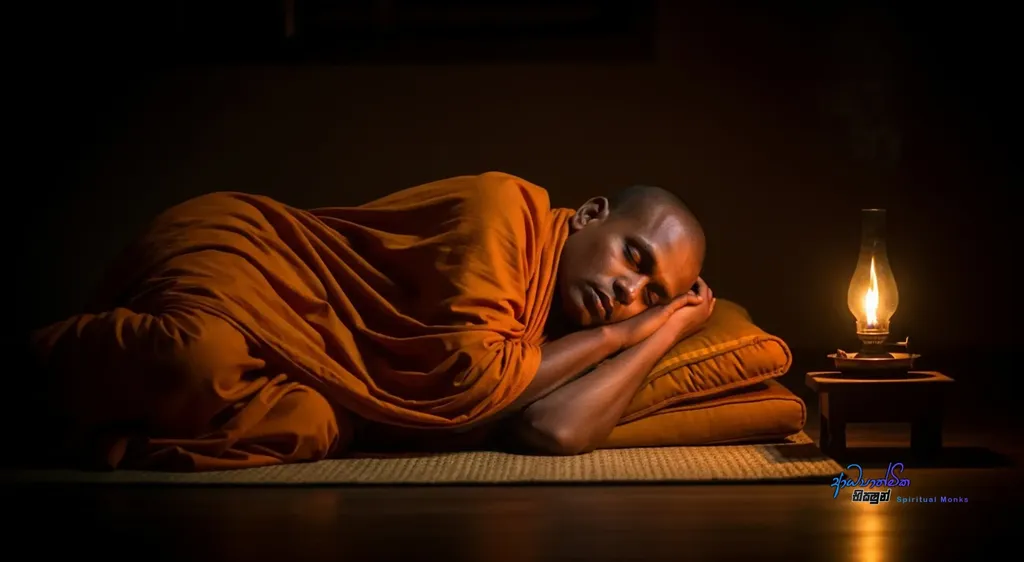
When we go to sleep, we often fall into unmindfulness. In the Aṅguttara Nikāya, the Buddha mentions a discourse on postures for sleeping. He taught that the most mindful way to sleep is the ‘Lion’s Posture’ (Sīha Seyyā). This is lying on your right side, with your right hand under your head. You have likely seen reclining Buddha statues in this posture. This is the posture in which one can maintain the most mindfulness during sleep.
A person who sleeps in this posture will only sleep the minimum amount their body requires. Scientific studies can verify the benefits of this posture for getting the right amount of sleep. It is not an unhealthy way of sleeping; the body gets exactly what it needs. While it might be difficult at first compared to sleeping on your stomach or hugging a pillow, it can be cultivated with practice. This is the best posture for developing mindfulness even in sleep and for overcoming the mental defilements.
Even if you dream, your mindfulness practice will continue. If you dream that an elephant is chasing you, you will practice mindfulness even within the dream. Someone who is not practicing, perhaps a violent person, might dream of an elephant and try to shoot it, reacting according to their habits. A person practicing loving-kindness (mettā) might wish the elephant well in their dream. A person practicing mindfulness will see clearly, ‘I am in a dream, and I am mindful.’ They will recognize the dream as a dream. This is a benefit of the practice.
The Commitment to Practice: Beyond Theory
Sleeping in the Lion’s Posture also has subtle physical benefits. The contact of the right hand and thumb with the nerves on the side of the forehead stimulates the brain in a way that contributes to its development. These are deep matters that spiritual practitioners understand. I am showing you a small part of this to demonstrate its importance. So, try to establish mindfulness as you go to sleep, and begin the next day in the same way I described at the start of this article.
Make a determination to continue this practice. Do not go searching for spiritual attainments (magga phala). Don’t measure how many defilements you have eliminated. Simply observe the changes in yourself. Are you less greedy, less angry, less jealous than before? Just look at that. Don’t go looking for results, and don’t listen to others who tell you to. Those things are not essential. Make a firm resolution that you will do this until the day you die, and practice little by little. The results will surely come.
What I have taught you today is, simply, the Four Foundations of Mindfulness. You don’t need the deep words. When you know what to do, you can do it. The theory in a book is different from the practical application. You can’t fix a car just by reading the manual; the practical work is different. A teacher shows you a practical way to solve a math problem that might be different from the textbook method. This practice is the same.
Many people get confused by the theory and get stuck. They become dogmatic, insisting ‘It must be done this way,’ and they never progress. Don’t be like that. Use these teachings as a guide to practically engage with and understand your own mind with mindfulness.
Your Journey of Self-Discovery
As you practice, you will encounter obstacles and shortcomings. You will see the flaws in your own mind. I will address these in future teachings. For today, the topic was ‘Let’s Practice Mindfulness in Daily Life,’ and I have explained it in simple terms for anyone. If you still don’t understand, make a determination for your wisdom to grow, recall your past good deeds, and read these teachings again and again. Explore our entire collection on practicing mindfulness.
But do not try to understand your mind from my words alone. This will be an empty teaching for you as long as you do not practice it. Take what I have taught, apply it practically, and come to understand your mind through your own direct experience. Understand yourself, by yourself.
With these words, I conclude today’s teaching on practicing mindfulness in daily life. May you have the strength, wisdom, and energy from the Triple Gem, the Buddha, Dhamma, and Sangha, to understand these matters clearly and to continue your practice. May the blessings of the Triple Gem be with you all!

We invite you to walk this path with us. Read our teachings, and most importantly, apply them practically in your own life. as you practice, questions will naturally arise. Please feel free to share your experiences and questions in the comments below, via email or contact form. I will do my best to offer guidance in future talks based on your progress. For now, begin this practice with an open heart and a mind free from expectation. Cultivate it correctly, and may you find the clarity and peace you seek.
Thank you for joining us. We hope this blog will be of great benefit to your spiritual journey.
May you all be well and happy.
May the blessings of the Triple Gem be with you all!


