


Categories: Other Meditation Teachings
May the blessings of the Triple Gem be with you all!
Today, through our spiritual exploration, I wish to offer some clarity on the topic of dreams. Many of you reach out, sharing the details of dreams you’ve seen and seeking answers about their meaning. You send messages hoping for a specific interpretation, a prediction for your life.
While I see this as a natural human curiosity, I approach this topic from a practical and spiritual viewpoint, not as a fortune-teller. My intention is not to interpret every single dream you have to say, ‘this dream means this, and that dream means that.‘ That is not my area of expertise, nor do I wish to engage in it.
Instead, my goal is to provide a framework for understanding dreams in Buddhism so you can develop your own wisdom. I want to help you distinguish which dreams might hold significance, understand why not every dream is a message, and see how many reflections of our own mental and physical states are simply.
This teaching is designed to empower you to look at your own dreams with insight and determine for yourself if they are offering a meaningful hint or not.
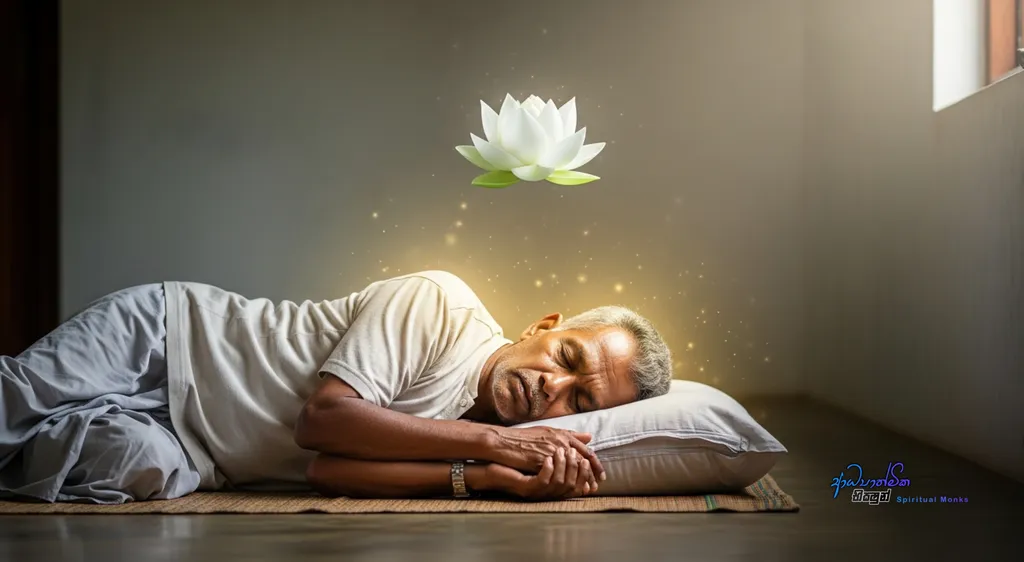
Daytime Visions and Pre-Midnight Whispers: Dreams to Let Go
First, let’s discuss the kinds of dreams we can often gently let go of. Many people come to me asking about dreams they’ve had during the daytime. When we nap in the afternoon, we might experience vivid dreams. Sometimes, you might even see the very room you are sleeping in, perhaps with a strange figure or an unknown person entering. You might even see yourself lying on the bed. This state is what we can call a ‘half-sleep’ or adaninda.
These daytime dreams, and also those that occur before midnight, generally do not carry any profound meaning. They are often a product of our immediate physical environment and condition. For instance, the temperature of our surroundings can influence them. On a very hot day, a daytime nap can feel heavy and disorienting. You wake up feeling groggy, sweaty, and weighed down, not refreshed.
Dreams that arise from such physical discomfort, be it from heat or cold, are simply the body’s response. Therefore, my simple advice for dreams seen during the day is this: do not worry about them. They are like fleeting fantasies of the mind, not messages from beyond.

The Mind as the Dream Weaver: How Waking Life Scripts Our Nightly Dramas
For those who wish to delve deeper into the classical teachings on this subject, there is a wonderful text in our Buddhist tradition called the Milindapañha, or ‘The Questions of King Milinda.‘ This book records the dialogues between the enlightened monk, the Arahant Nāgasena, and the Greek King Milinda. Within it, you can find a section on dreams, possibly titled ‘The Great Dream Question’ (Mahā Supina Pañha), which outlines the types of dreams that are meaningful and explains their causes.
I encourage you to seek out this text or listen to teachings that explore it; it will provide you with a very clear and authoritative answer. However, based on practical experience, we can see that our waking life is the primary scriptwriter for our nightly dramas. Our mind’s preoccupations are the source of most dreams. Consider these examples:
- If you are struggling with a financial problem, perhaps you owe someone money and are constantly worried about it. It is very likely you will dream that the person is coming to demand payment, or even threatening you.
- If you are a student filled with fear and anxiety about an upcoming exam, you will likely dream of being in the examination hall, struggling with the paper.
- Conversely, if you are filled with joyful anticipation for a trip tomorrow, you might be too excited to sleep. If you do manage to fall asleep, you will probably dream that you are already on that wonderful journey.
These dreams are a direct result of strong mental attachment and emotional states. Whether driven by fear, desire, or excitement, these dreams are reflections of our daily lives. They are not prophecies about the future and hold no hidden messages. They are simply the mind processing its own strong impressions. This is a key aspect of understanding dreams in Buddhism.

The Power of a Trained Mind: Bringing Mindfulness Into Your Dreams
So, if most dreams are just echoes, how can we make our dream state more meaningful? This is where spiritual practice comes in. As you cultivate wholesome habits in your waking life, they naturally extend into your sleep.
There’s a traditional practice where people train themselves to constantly repeat a sacred phrase, such as Namo Buddhāya (Homage to the Buddha) or recite the Itipiso Gāthā (a verse praising the qualities of the Buddha). Just as someone who habitually uses profanity will blurt it out without thinking when startled, a person who cultivates a sacred phrase in their mind will find it comes to them automatically.
Now, imagine this person has a nightmare. An elephant is chasing them, or a fearsome entity appears. In the dream, because of their dedicated practice, the phrase ‘Namo Buddhāya’ will arise in their mind. This wholesome thought provides immediate protection and peace, even within the dream.
Those of us on this spiritual path focus on cultivating mindfulness, or sati. Meditators will find themselves practicing mindfulness even in their dreams. I, too, experienced this in my early days of practice; we learn to be mindful even within the dream state.
This is the true specialness of the practice. If you are mindful, it doesn’t matter if you were to pass away in your sleep from a sudden illness. Because your mind is established in awareness, you are assured of a good destination, a fortunate rebirth. This is how the power of mindfulness fits into both sleep and the dream world, offering profound security.

Dreams as a Mirror to Our Inner State
Just as wholesome practice shapes our dreams, so do our unwholesome tendencies. Dreams act as a perfect mirror, reflecting our inner character.
For example, a person with very strong sensual desire, which in Buddhism is called rāga, will constantly have dreams related to lustful thoughts and actions. This happens because their mind is preoccupied with such things. This can happen at any time of night; the more one indulges these thoughts while awake, the more they will manifest in dreams.
Similarly, if a person harbors hatred towards someone and is obsessed with taking revenge, their dreams will be filled with this energy. They might dream of the person they resent, or they might see frightening creatures like snakes, which are often symbolic of anger and aversion. Many people ask me about such dreams, and I often explain that they are arising from unresolved conflict and negativity in their waking life.
On the other hand, a person who engages in wholesome actions, or kusala kamma, will have beautiful dreams. If you regularly practice generosity, perhaps by making offerings at a temple, participating in merit-making ceremonies like a Kathina ceremony, or offering robes, you will dream of these joyful, uplifting activities. The mind loves to dwell on what it is accustomed to and what it cherishes. Therefore, dreams of this nature are a sign of a wholesome mind.
The Rare and Prophetic Dream: When Visions Carry Deeper Meaning
While most dreams are reflections of our minds, there are rare instances of truly significant, prophetic dreams. It is said that fully enlightened beings, like the Arahants, do not dream. The Buddha did not dream. If such a being were to have a vision, it would be a profound omen.
A famous example is the dream of Queen Mahāmāyā before she conceived the prince who would become the Buddha. She dreamt that a magnificent white elephant entered her side, a celestial sign foretelling the birth of a great being. Similarly, some dreams can offer hints, or nimitta, about an unborn child. They might suggest whether the being is coming from a divine world, a human existence, or a less fortunate realm. Such dreams, however, are rare and require immense wisdom (paññā) and careful, intelligent reflection to understand. They are not to be taken lightly or superstitiously.

Your Invitation to Reflect and Share
All these teachings, which touch upon both worldly (lokiya) and spiritual (lokuttara) aspects of life, are offered for your own understanding. The path to understanding dreams in Buddhism is not about finding someone to interpret them for you, but about using your own intelligence and mindfulness to see them clearly.
I invite you to reflect on your own experiences with this new framework. Use your wisdom and awareness to investigate your dreams. You might consider sharing your reflections in the comments below, not for interpretation, but to help others in their journey of self-discovery. When others read about your insights, it creates a supportive community of learning.
May you all be blessed with the clear mindfulness to understand your own inner world. This concludes our teaching on dreams for today
We invite you to walk this path with us. Read our teachings, and most importantly, apply them practically in your own life. as you practice, questions will naturally arise. Please feel free to share your experiences and questions in the comments below, via email or contact form. I will do my best to offer guidance in future talks based on your progress. For now, begin this practice with an open heart and a mind free from expectation. Cultivate it correctly, and may you find the clarity and peace you seek.
Thank you for joining us. We hope this blog will be of great benefit to your spiritual journey.
May you all be well and happy.
May the blessings of the Triple Gem be with you all!


