


Categories: Non-human Problems
May the blessings of the Triple Gem be with you all!
Today, we will explore a profound topic: why non-human beings are afraid of light. What is this light they fear? What causes them to be afraid? And who exactly are these beings, which in the Buddhist tradition we call Amanussa? In this teaching, I will offer a simple explanation of these matters to bring you some clarity and understanding.
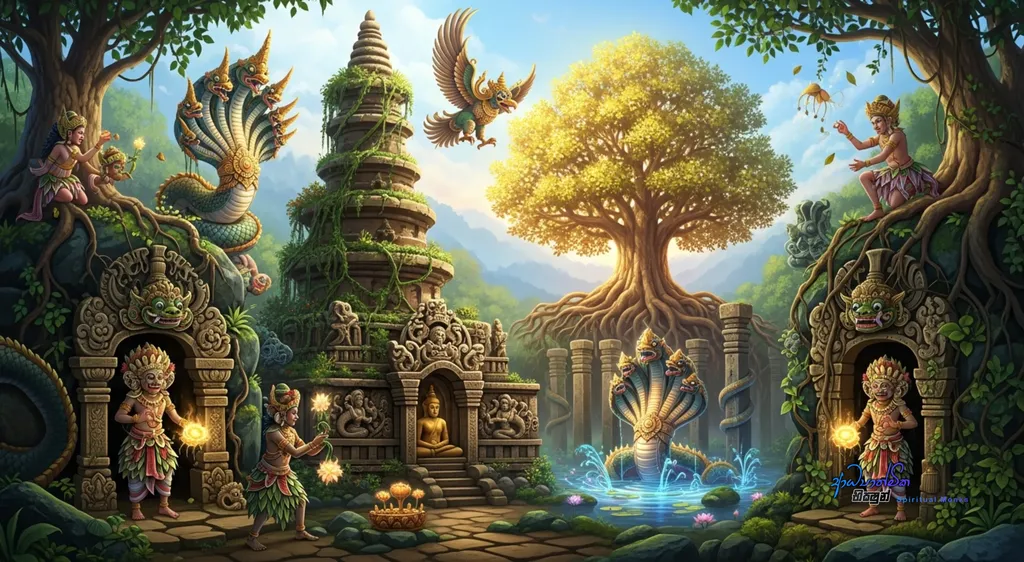
Understanding the Realm of Non-Human Beings
Most of you, whether young or old, already have some awareness of what we mean by non-human beings. You may have heard about them in Buddhist teachings from various monks and learned about the causes that lead to such a rebirth. Let me offer a simple analysis.
Beings are reborn in these states due to akusala, which means unwholesome or demeritorious actions and thoughts. These actions are performed through the mind, body, or speech sometimes one, two, or all three of these ‘doors’ of action. It’s important to understand that not everyone who commits an unwholesome act is reborn this way; it depends on the complex workings of kamma (intentional action) and which particular thought-moment arises at the very end of life.
This final thought-moment is called the chuthi sitha, or death-consciousness. If an unwholesome thought connected to a past action surface and is grasped at this critical moment, it can lead to rebirth in a realm of non-human beings.
Common causes for such a rebirth include:
- Breaking the five precepts (not killing, stealing, engaging in sexual misconduct, lying, or taking intoxicants).
- Harming or troubling others.
- Being dominated by greed (lobha), aversion (dosa), delusion (moha), and sensual craving (rāga).
These mental states lead to birth in various non-human worlds and locations. This entire process is a part of samsara, the endless cycle of birth, death, and rebirth. You know well that if we engage in unwholesome actions, speak harmful words, or continuously entertain negative thoughts without any control, one of these states can seize our mind at death, determining our next existence.
Many of you might even have practical experience of this. If you have ever practiced mindfulness of the mind, you have seen how thoughts arise without control. Imagine if, when we are old and weak, we cannot manage these chaotic thoughts, and a disturbing one becomes our final thought. You can begin to understand what kind of birth might follow.
The Power of Attachment and the Final Thought
Let’s explore this with an example. All our actions are driven by what we desire. The roots of unwholesome states are often greed, aversion, or anger. An intense craving or attachment can very easily lead to a rebirth as a non-human being.
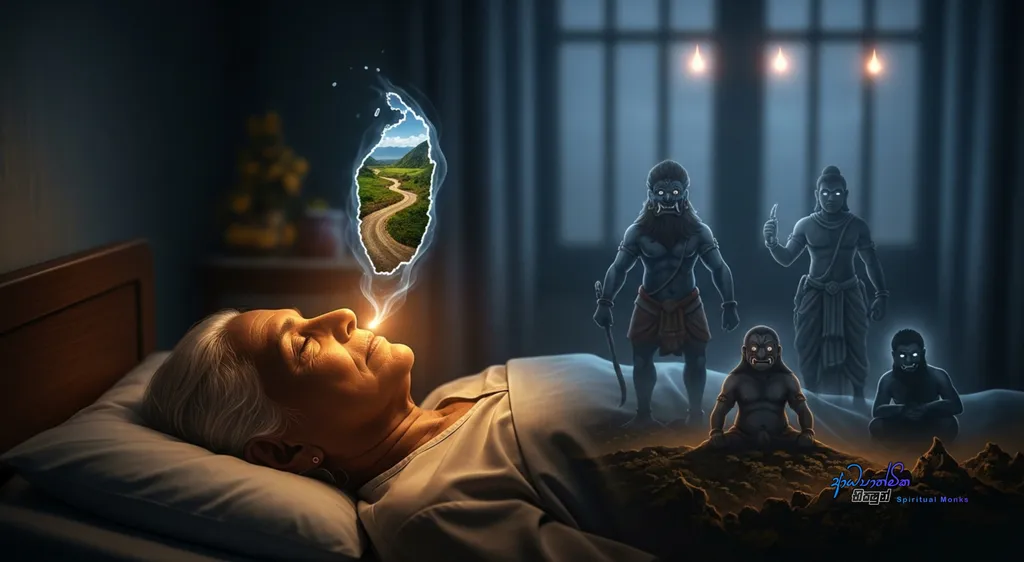
Imagine a person who is deeply attached to their land and property. They are bound to it. If you practice mindfulness as the Buddha taught, watching your thoughts, you can see for yourself how attached you are to things. This person, let’s say, passes away at age 55 or 60.
If at that time, their mind is still filled with intense craving a deep-seated greed for their property and their final thought is of a piece of land they own, this thought becomes their chuthi sitha. In that very instant, their rebirth is determined by that thought.
Where are they likely to be reborn? We can reasonably infer that they would arise in an existence connected to that land perhaps as a bhairava (a type of earth spirit), a yaksha (a fierce nature spirit), or a preta (a hungry ghost), bound to the very place they craved.
However, the workings of kamma are said to be acinteyya, meaning imponderable or beyond ordinary conception. It is not always so straightforward. A person might have committed many unwholesome deeds in this life, but at the moment of death, they might not remember any of them. Instead, a powerful meritorious deed from a previous life could come to mind, leading them to a fortunate rebirth, even in a heavenly realm.
The final thought can be one of three things: a memory of a past action (kamma), a sign related to that action (kamma nimitta), or a vision of the destination of rebirth (gati nimitta). This is why the Buddha said the results of kamma are complex. Only a Buddha, an Arahant (a fully enlightened being), or a meditator with advanced spiritual faculties can see precisely where a being is reborn and why.
Real-Life Stories of Rebirth Through Craving
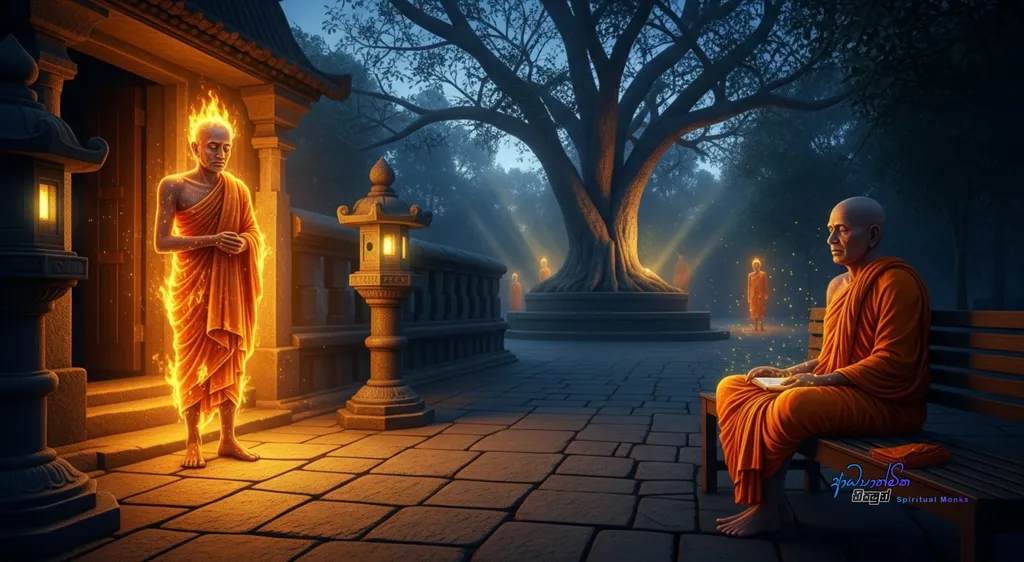
I have personally encountered many instances where beings are reborn in non-human realms due to greed. People who die with intense desire for their land are reborn there. It even happens to monks. Any monk with experience knows of cases where a monk, deeply attached to his temple, passes away and is reborn as a preta, a suffering spirit, still wearing monastic robes, right there on the temple grounds. This happens because the thought of the temple seized his final moments.
The Buddha himself saw this. You may have heard the stories in texts like the Petavatthu (Stories of the Departed) and Vimanavatthu (Stories of the Celestial Mansions). During the time of Kassapa Buddha, a past Buddha, certain monks performed an unwholesome act. As a result, the Buddha Gotama later saw them as a group of fiery pretas engulfed in flames yet still clad in robes. Such beings exist even today.
If a monk becomes attached to his dwelling, his robes, or his belongings, that greed can lead to an unfortunate rebirth. A famous story from Buddhist history tells of a monk who was so attached to a single robe that when he died, he was reborn as a louse living in that very robe for seven days. After seven days, that karmic effect was exhausted, and due to his past merit, he was reborn in a good destination. So, reflect on this: how many unwholesome actions have we performed?
Beyond Merit and Demerit: The Necessity of Mind Training
Sometimes, a person may live a very good life in this present existence. They might observe the precepts on all four holy days of the month, upholding the five or even the ten precepts perfectly. Yet, at the moment of death, an unwholesome kamma from a past life something they have no memory of in this life could surface and become their final thought, leading to rebirth as a non-human being.
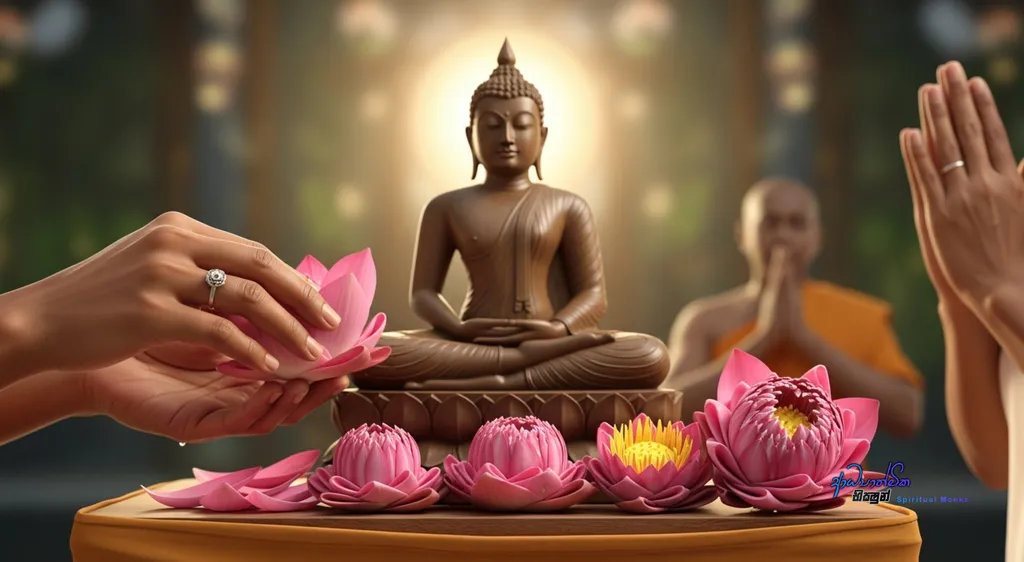
Now, when you hear this, please do not fall into the wrong view that making merit or avoiding demerit is useless. That is not the message here. The Buddha taught that we should not get stuck only at the level of making merit (puñña) and avoiding demerit (pāpa). We shouldn’t stop at observing precepts, giving donations, offering flowers, lights, and incense, chanting, or performing grand ceremonies like Kaṭhina or offering Kapruka trees. These are all good and beneficial, but they are not the complete path.
The wholesome actions we perform will certainly bring their results. Even Devadatta, who committed some of the most heinous acts against the Buddha, will, after enduring the results of his negative kamma in the hell realms, eventually become a Pacceka Buddha (a silent Buddha) due to his past merit. Strong akusala can suppress our merit, and strong merit can suppress our akusala.
You must understand this without adopting wrong views, thinking that material offerings (āmisa pūjā) are pointless. The point is not to stop making offerings, but to not get stuck there. You must also engage in the practice of the path (patipatti pūjā).
In fact, your engagement in practice should be ten times greater than your engagement in offerings. This is what is essential: meditation, watching the mind, and maintaining mindfulness. This is the real work.
The Suffering and Habits of Non-Human Beings
So, we have a basic understanding of how one is reborn into these states. As the Buddha taught, intense hatred can lead to rebirth as a yaksha or a serpent. Intense greed not just for land, but for anything: a spouse, a child, possessions in your room, a phone, a car can lead to rebirth as a spirit bound to those things if that craving dominates the final thought.
Again, this is about probability; a past meritorious act could still arise and lead to a better birth. But the likelihood is higher for an unfortunate one. Once reborn in such a state, there is often no refuge. These beings, especially pretas, suffer the direct consequences of their past actions. They may be covered in wounds or constantly cry out in agony. If someone were to awaken their ‘third eye’ (dibba-cakkhu or divine eye) and look at our world, they would see these beings everywhere.
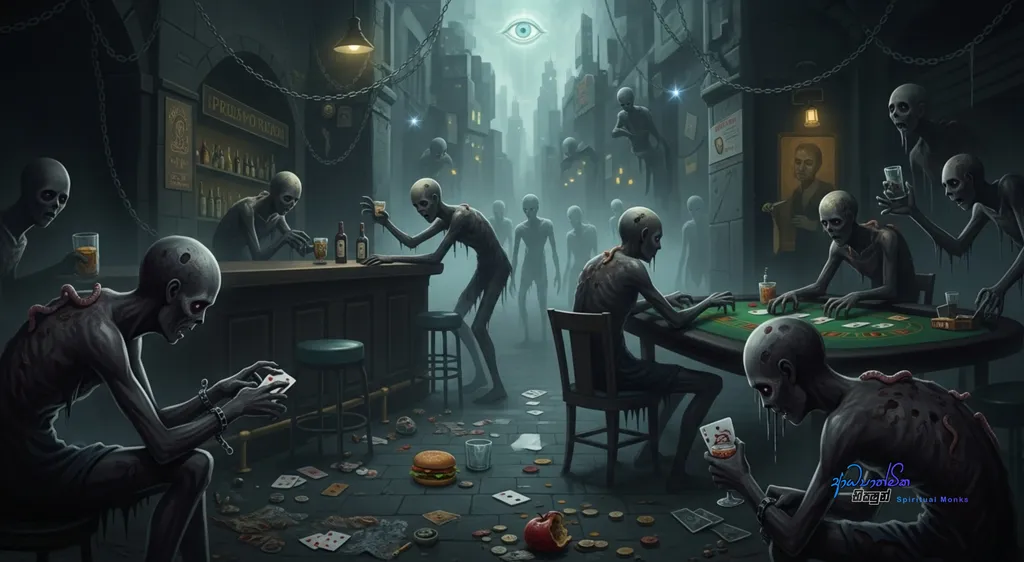
There are spirits that rush to consume the saliva we spit on the ground. There are those who wait to consume our bodily waste. Those with the third eye have seen pretas waiting in toilets to eat excrement. They can be found in bathrooms, laboratories, and especially in places where human passions run high like bars, liquor stores, and gambling dens.
Spirits with intense sensual cravings are drawn to these locations. They endure tremendous suffering from diseases. Some have worms in their mouths that eat their own flesh, a karmic result, for instance, of excessive lying and slander. Reading the Petavatthu in the Tipitaka (the Buddhist canon) can give you a deep understanding of this subject.
Physical Light vs. Spiritual Light
Now, let’s turn to the main question: the light. When I speak of light, some might immediately think of a flashlight or a light bulb. That is not the light I am referring to here.
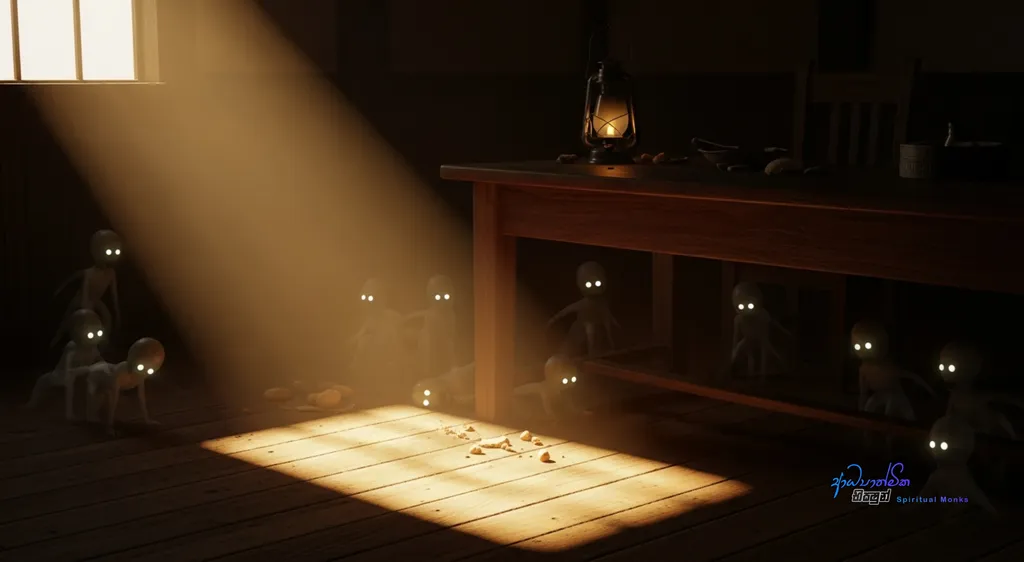
You may have heard that non-human beings often hide in dark places during the day. This is why mediums who use mirrors (añjan), exorcists, and those who perform rituals in shrines often work at night. Why do these beings hide in the dark?
Weaker non-human entities often conceal themselves under beds or in the dark corners of a house. They try to make the house they inhabit darker and unclean, causing food to spoil, preventing the lighting of lamps, and discouraging the chanting of protective verses (pirith). They want to turn the house into a dark, gloomy cave where they feel comfortable and can freely dance, sing, and live out their existence.
The light they dislike is not artificial light but natural light, especially sunlight. They find it hard to bear. This is why they are more active after dusk. But again, this does not apply to all of them. There are powerful non-human beings who can move freely in daylight. However, the majority hide, feeling safer and more at ease in the darkness they create.
The Inner Aura: The True Spiritual Light
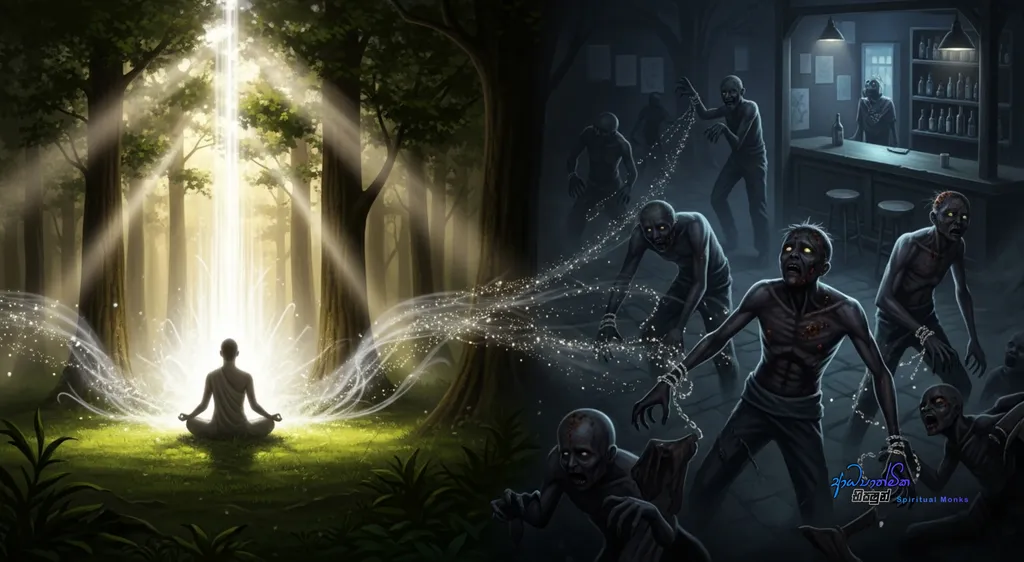
Now I will introduce a different aspect. When our mind becomes pure and a wholesome thought (kusala) arises, our body emits a certain radiance, an aura or a field of light. Every one of us has such an aura, though its nature varies.
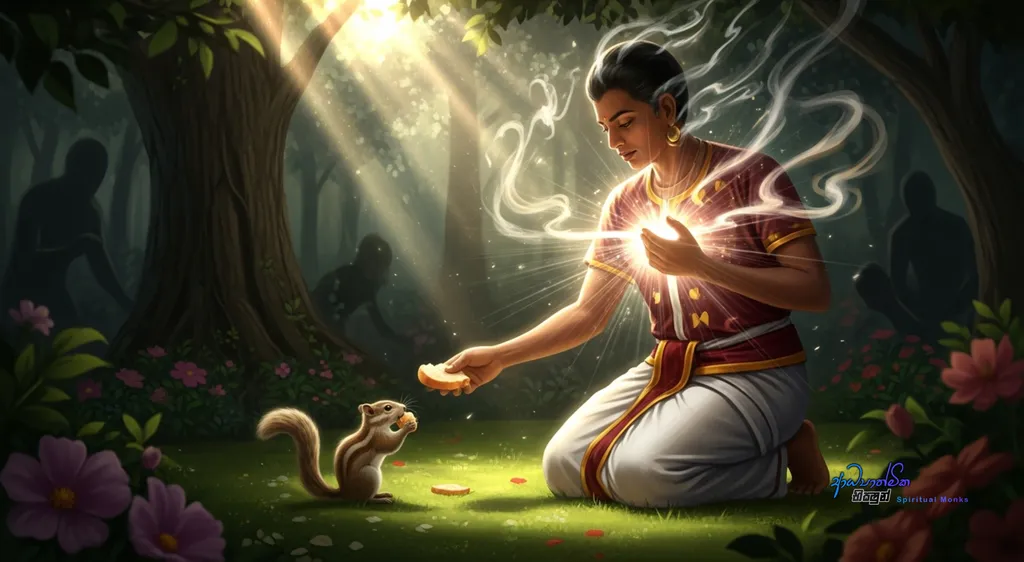
Let me share something we have observed with the third eye, or dibba-cakkhu. Imagine a person who is generally unwholesome and never does meritorious deeds. One day, a kind thought arises to feed a squirrel. At the moment they give a piece of bread to the squirrel, and the animal eats it happily, their mind experiences a brief moment of purity. In that instant, we can see a flash of radiant spiritual light emanate from them. But it quickly fades. Why? Because their underlying mental state is more powerful dominated by greed, hatred, and delusion. Their aura returns to being dark.
Through the third eye, we have seen the auras of many people. Those with dark or black auras are, in that moment, filled with impurity. They might be consumed by intense anger, hatred, lust, jealousy, or greed. Such people are like open invitations for non-human beings. Spirits can easily approach them, influence their thoughts, and even control them. Mara, the personification of temptation and death, can easily manipulate them because they resonate with this dark energy.
Conversely, if that same person does a small good deed, a flash of bright spiritual light appears, but it only lasts for a few seconds because the wholesome habit is not established.
Cultivating and Strengthening Your Spiritual Light
Now, consider someone who regularly performs meritorious deeds. Their spiritual light is stronger and more stable than the dark person’s. We have seen them surrounded by a white aura because they are always giving, always engaged in wholesome activities. Their mind is often pure.
However, even for this person, if a moment of intense lust, anger, or jealousy arises, their beautiful white aura can instantly turn dark. The state of our aura is dynamic and changes with our thoughts. This is how the spiritual light of a person fluctuates.
If you were to look at society with the third eye, you would see that most people are shrouded in darkness. It is rare to see someone whose face is genuinely bright and whose mind is pure and mindful; these are the ones with a stronger spiritual light.
When we move beyond simple good deeds and into dedicated spiritual practice like tranquility meditation (samatha), mindfulness of thoughts, or chanting pirith this spiritual light grows immensely powerful. I must address a common fear: many worry that meditation will open their third eye and attract problems from non-human beings. This is a baseless fear.
If you are chanting, practicing mindfulness, purifying your mind, and following the Buddha’s teachings, your aura becomes incredibly pure and bright. Of course, moments of anger can still dim it, but if you practice continuously, your purified state becomes the dominant one. This spiritual light is natural; it is not artificial. It is born from the purity of your mind, body, and speech.
The Protective Power of Chanting and Practice
Let’s take the example of someone who only chants pirith and makes offerings for perhaps an hour a day. While they are chanting, a powerful spiritual light emanates from them. Pirith is the word of the Buddha, and the Pali language itself is a universal sound vibration that has power when chanted with conviction.
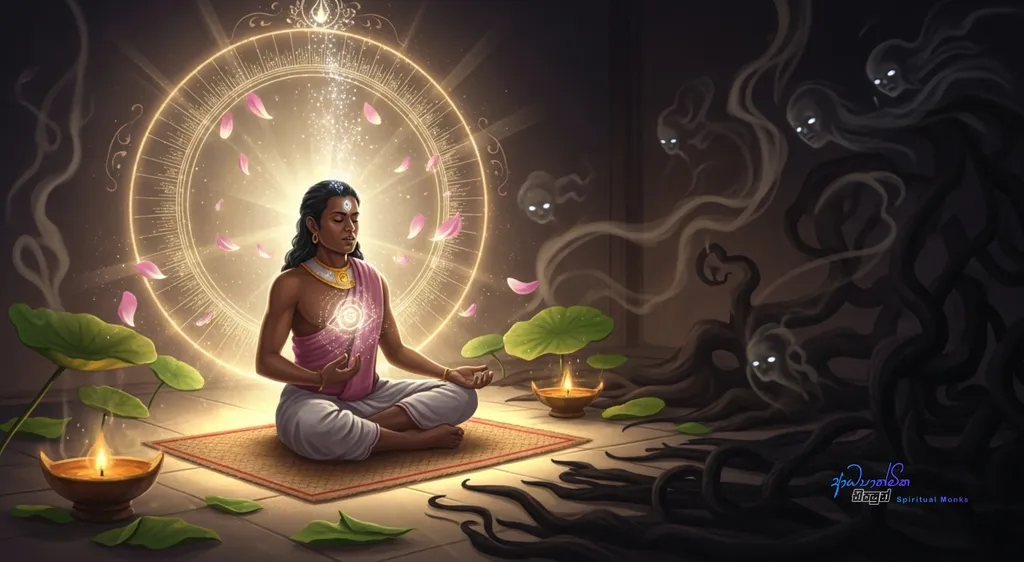
This is why it’s important to both chant the suttas and practice what they teach. By chanting, you generate a powerful wholesome energy, a radiant aura around your subtle body. This protective light lingers even after you finish, gradually fading as unwholesome thoughts begin to creep back into the mind.
But imagine this person finishes chanting and immediately gets into an argument. Lacking mindfulness, they instantly erupt in anger and shouting. In that moment, their beautiful white or yellow aura vanishes and is replaced by darkness. This is precisely why non-human beings try to disrupt your spiritual practice. They create obstacles to stop you from meditating, being mindful, or chanting.
Many people, unfortunately, lack the wisdom to understand this. They fall for wrong views, like the idea that it’s bad to play a recording of pirith in the house 24 hours a day. Let me be clear: pirith is the word of the Buddha, a universal blessing. If you are doing something wholesome that harms no one, do not let the ignorant opinions of others stop you. Be wise. If you always listen to what others say, you will spend your life dancing to their tune, unable to progress on your own spiritual path.
The Ultimate Light of Enlightenment and Why Spirits Flee
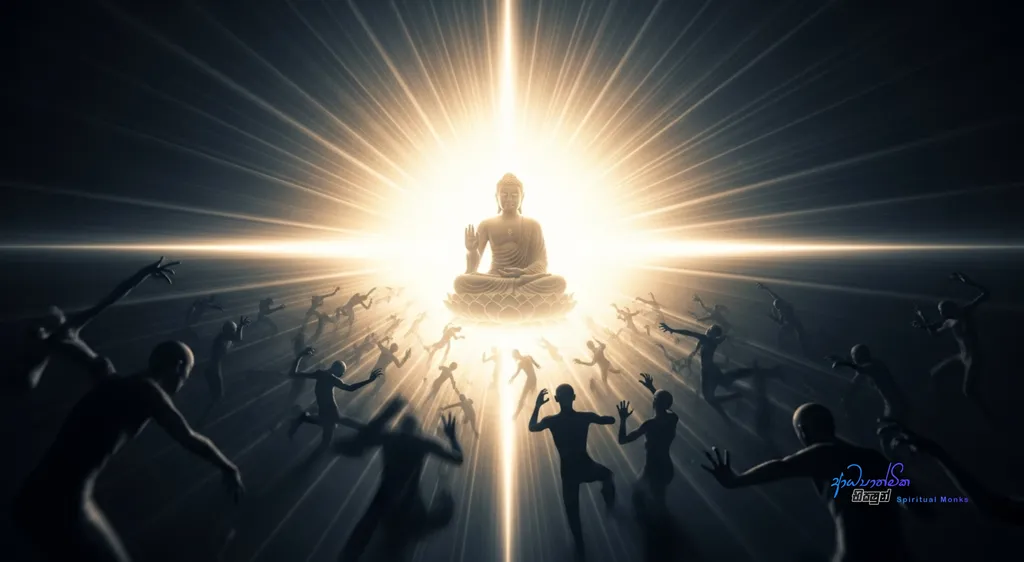
Now, think beyond this to someone who has realized Nibbana an enlightened being like the Buddha. The Buddha constantly emitted a radiant aura, a spiritual light he could control at will. The same is true for Arahants and advanced meditators. They can manage this radiance because their minds are completely under their control. Even the gods (devas), who are born in celestial realms due to their great merit, appear radiating light when they visit the Buddha to hear the Dhamma.
But have you ever heard of a non-human being from a lower realm appearing with light? No, because their minds are consumed by unwholesome states. This pure spiritual light, born of a purified mind, is what they fear. They cannot bear its presence.
This is why spirits are afraid of dedicated meditators. The meditator’s mind is consistently pure, so their radiance is constant. When spirits encounter such a person, they run and hide. The power of this light is far greater than that of mantras, which work on a frequency that is unbearable to these beings, like painfully loud music is to us.
The spiritual light from a pure mind is something they cannot even look at. In paintings of the Buddha’s visit to Mahiyangana, the yakkhas are depicted turning their faces away, unable to withstand his radiance. That is the power of a completely pure mind.
A blessed thread (pirith noola) tied by a virtuous monk also creates a protective field of this energy, but its power fades over time. As it weakens, a spirit may be able to approach again.
Why Some Are Afflicted and Others Are Not
You might wonder why some people are affected by spirits while others are not. Non-human beings do not approach everyone. They are primarily drawn to individuals with a weak mental state this has nothing to do with gender, age, or religion. A weak mind is an open door.
Conversely, you may know people who are deeply immoral, who never perform a single meritorious deed, and who fear nothing. They seem to have no spirit problems. This is because their entire being already resonates with darkness. Spirits are already around them, feeding on their negative energies their lust, their anger, the energy from killing animals for food. A spirit doesn’t need to perform a dramatic possession because that person is already under its influence.
They can be controlled subtly through thoughts. Dramatic possessions often occur when a spirit wants to completely take over a person’s body and mind. This is a complex topic we can explore another day.
Your Path: A Resolution to Cultivate Inner Radiance
You should now have a clearer understanding of what spiritual light is, how non-human beings are born, and why they fear the radiance that comes from a pure mind. They are not afraid of artificial light, but of the natural light born from spiritual cultivation.
From this day forward, I encourage you to make a firm resolution to develop your own inner spiritual light. This is not about seeking light for its own sake, but about developing your mind. For those who feared meditation might attract spirits, you now have your answer: consistent practice is your greatest protection. Playing pirith in your home creates a field of light and a frequency they cannot bear.
How do you do this?
- Practice constant mindfulness (sati).
- Develop insight meditation (vipassanā) and tranquility meditation (samatha).
- Chant pirith in your home.
- Balance material offerings (āmisa pūjā) with the practice of the path (patipatti pūjā).
- Read and understand the teachings of the Buddha from the Tipitaka.
An Arahant, who has realized Nibbana, is beyond merit and demerit. They do not need these practices for themselves, just as an advanced student doesn’t need to relearn the alphabet. They engage in these acts out of compassion, to show us the way.
Advanced Practice and the Power of Loving-Kindness
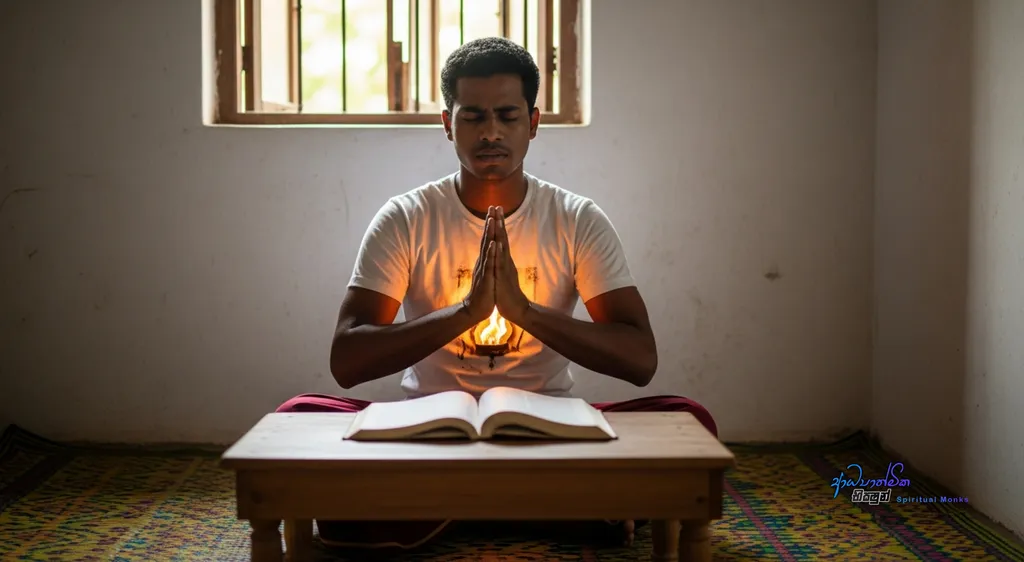
There is a more advanced aspect to this, related to energies like Kundalini. A meditator who has developed these faculties can consciously project their spiritual light. It is possible for them to send beams of this energy from their fingertips or forehead and literally burn a non-human being. It is a real spiritual power. I mention this so you understand the potential, but I strongly advise against ever doing this, as it causes immense pain like setting them on fire with a lamp.
Instead of projecting harmful energy, project thoughts of loving-kindness (mettā). When you fill your mind with boundless goodwill, you will feel your own fear disappear. A benevolent spirit will be pacified by your kindness, and a malevolent one will be unable to bear it and will leave. If you have a friend with an open third eye, you can try this and ask them what they see. The practical results will become clear.
Conclusion: Your Journey Towards the Light
I have shared many things with you today from my own practical experience on why non-human beings fear spiritual light. I believe this is sufficient for now, though there is much more that can be said, which I will share in future teachings as needed.
May the power of the Buddha, Dhamma, and Sangha the Triple Gem bless you all. May you be able to develop your practice, whether it is offerings, conduct, mindfulness, insight, tranquility, or working with universal energy. May you awaken your wisdom. Through this, may the radiant beam of your own inner spiritual light grow ever brighter.
We invite you to walk this path with us. Read our teachings, and most importantly, apply them practically in your own life. as you practice, questions will naturally arise. Please feel free to share your experiences and questions in the comments below, via email or contact form. I will do my best to offer guidance in future talks based on your progress. For now, begin this practice with an open heart and a mind free from expectation. Cultivate it correctly, and may you find the clarity and peace you seek.
Thank you for joining us. We hope this blog will be of great benefit to your spiritual journey.
May you all be well and happy.
May the blessings of the Triple Gem be with you all!


