


Categories: Be Happy 24 hours
May the blessings of the Triple Gem be with you all!
Today, for those of you exploring the spiritual life with us, for those of you developing your mindfulness practice, we will explore another aspect of this journey. This teaching is designed to help you extend your mindfulness, to move from one moment of awareness to the next, and to see your life with a clear and profound understanding.
We are going to learn how to practically apply mindfulness to observe the various forms of suffering and trouble that the mind feels. You have likely experienced many kinds of suffering in this life. From the day you were born until this very moment, if you reflect honestly, you will find that the moments of sadness and pain far outnumber the moments of happiness. Take a moment to look back at your past.
When you contemplate your history, you can see the nature of suffering, the amount of pain you have endured. This reflection also gives you a sense of how much more suffering you might face in the future. This experience of pain, which we call Dukkha in the Buddhist teachings, is a universal truth. Dukkha is not just physical pain but a deeper, pervasive sense of stress, unsatisfactoriness, and unease.
It can be felt physically and also mentally, in the heart and mind. This is common to all beings. Even in heavenly realms, like the six celestial worlds mentioned in Buddhist cosmology, beings experience mental suffering. According to the Abhidhamma, the higher philosophical teachings of the Buddha, celestial beings do not have physical illnesses as we do. They are free from bodily ailments. However, they are not free from the feelings of mental sorrow and happiness. These two experiences exist for them as well.
In our human world, however, we have both. We experience physical suffering and mental suffering. We also experience mental happiness and, at times, physical pleasure. But the pleasurable moments are fleeting and rare. Most of what we experience is a form of Dukkha. You can see this just by observing your own body.
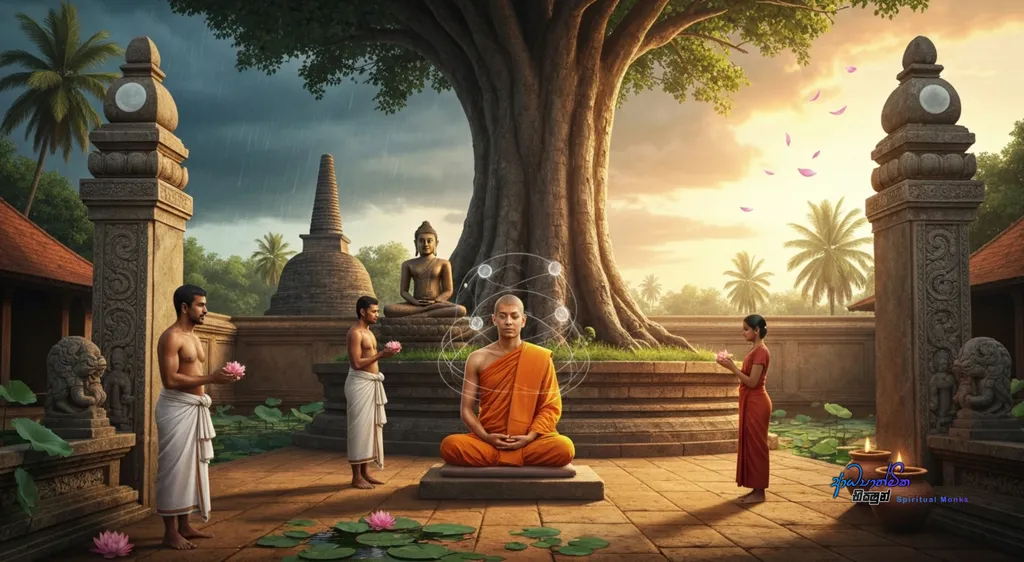
The Body’s Unspoken Truth: Observing Suffering in Everyday Postures
Think about your body. Can you keep it in a single posture for a long time? Even sitting in a chair, can you remain perfectly still without moving at all? No. You have absolutely no ability to maintain your body in the exact way you want. You must change your posture, even slightly, to temporarily relieve the pain that arises from staying still. This pain forces you to move.
As you engage in this practice, watch this feeling of suffering with clear mindfulness. Look at your mind, and through your mind, look at your body. When you are sitting in a chair, observe the sensations of pain that arise. If you are sitting in a meditation posture, whether cross-legged or in a lotus position, watch the pains that emerge in your body.
For some, the legs go numb and tingle. For others, after just half an hour, or even five minutes, the legs begin to ache. Some people lean against a wall for support, but even then, the back starts to hurt. It becomes difficult to keep the spine straight. Look at these pains. See how much pain your body gives you.
Contemplate how often we shift and change our posture just to avoid or escape these feelings. Watch this with mindfulness. When you are meditating and a physical pain arises, like your legs falling asleep or aching, observe it with a clear and steady attention. In Buddhism, this mindful, discerning awareness is called Sati-sampajañña. When you watch with this quality of mind, you begin to understand these pains and remember, ‘Ah, this is how it happens.’ You see the process as it unfolds.
This happens everywhere. When you go to the restroom and sit for a while, observe if pain arises from holding that posture. When you’re riding on a bus for a journey of an hour or two, notice how much pain the body generates. If you have to stand on that bus or train, see how painful that becomes. Initially, when you get on a bus, your greatest hope is to find a seat. You think, ‘If I can just get a seat, I can travel comfortably to my destination.
‘ Imagine you get that seat. You sit down, but after an hour of a two or three-hour journey, you start to feel that sitting itself has become unbearable. You might even think, ‘If only I could stand up for a bit.’ You squirm in your seat, trying to relieve the pain without giving up your spot, fearing you won’t get it back. While you are on that bus, watch your mind and body with mindfulness.
Observe the thoughts entering your mind and the physical sensations of pain. This is how you apply the practice we have discussed in previous teachings about watching the mind.
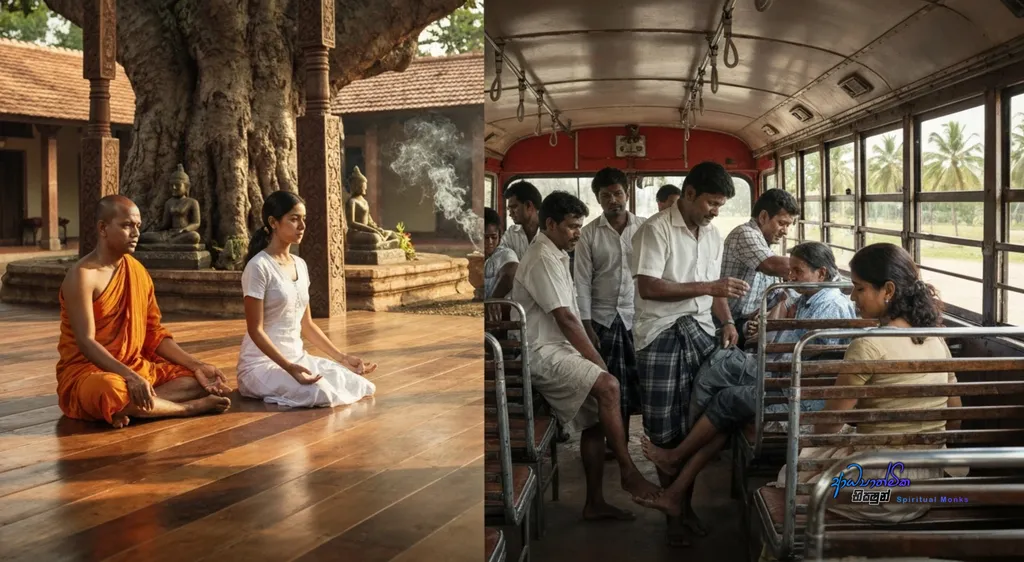
The Illusion of Control: Understanding Not-Self (Anatta) Through Pain
Now, imagine you give in to the discomfort. You get up from your seat on the bus to relieve the pain of sitting. Standing up feels like pure bliss. ‘Ah, what a relief!’ your mind and body both exclaim. This is now your happiness. But as you continue standing for half an hour or an hour, that posture too becomes intensely painful, perhaps even more quickly than the sitting did. See how your mind changes. It now craves to sit again.
You start looking for a seat. If you could, you would wish for a bed to lie down on right there on the bus or train. Look at how the four main postures of daily life, sitting, standing, walking, and lying down,bring you so much pressure and pain. Can we walk continuously without end? No, walking also becomes painful after a while.
Right here, you have an opportunity to understand something profound: is this body truly yours? If this body was really yours, under your complete control, you should be able to sit comfortably for a two or three-hour journey without any pain. You should be able to command the pain to disappear. But you cannot.
You cannot eliminate the pain that arises whether you are in your own car or on public transport. There is something to contemplate here. You can begin to understand: ‘This body is not mine. This does not belong to me.’
When we say it’s not ‘mine,’ this doesn’t imply it belongs to someone else. This is the teaching of cause and effect, what we call Paticcasamuppada, or Dependent Origination. In this view, we don’t grasp at the idea that a ‘self’ or ‘soul’ exists, nor do we grasp at the idea that a ‘self’ does not exist. We must look with neutrality.
What is happening is a process of cause and effect. This body is a result we have received based on our past actions, both skillful and unskillful, the good deeds and the bad deeds. This is what is meant by our actions, or kamma. So, the body we have is a result of this impersonal process.
From the Dance to the Disease: The Body’s Inherent Lack of Control
Consider this. You go to your bed, which you think of as the most comfortable place. For many, there is no place as comfortable as their own bed in their own room. Some people can’t sleep anywhere else. Yet, even there, can you sleep in a single position all night? No.
You might fall onto the bed, hugging your pillow, thinking, ‘This is the greatest comfort right now.’ But do you stay in that position? After a few minutes, that posture becomes uncomfortable, and you shift to another one, and then another. Watch this process, this sequence of events, with the same mindfulness.
In our series of teachings on mindfulness, we have so far emphasized watching the thoughts that come to the mind, thoughts of greed, hatred, delusion, jealousy, anger, good and bad thoughts, skillful and unskillful thoughts. We taught you to watch whatever comes through the senses of the eye, ear, nose, tongue, and body, as they all register in the mind. Now, apply this to the body. Watch the thoughts your mind presents in response to physical pain.
See the mind’s suggestions: ‘Change your posture.’ Watch how the body shifts accordingly, almost as if it’s being controlled automatically. When a pain arises that the mind can no longer bear, you find yourself changing your sleeping position naturally, without a conscious command. You do this constantly. Because you are so used to it, it has become an automatic, conditioned response. Watch these thoughts. See just how much of a torment this body is.
Here you can understand what the Buddha meant when he taught that this body is Anatta, or ‘not-self.’ As I mentioned before, we don’t assert there is a self, nor do we assert there is no self. We see it as a process of cause and effect, Paticcasamuppada, and we look at it with neutrality. The body is a result that we have received.
You can see how much pain these postures cause you. I am not even talking about illnesses yet, just the pain of maintaining the body in a single posture. What about things you enjoy? Put on a song you love and start dancing. You might feel a wonderful sense of freedom. But after a while, you will get tired of dancing and want to sit down. Imagine your mind wants to dance for five or six hours straight because it enjoys it.
Does your body allow it? No. After a few hours, the body brings forth pain, and your mind is forced to stop dancing and sit in a chair. The physical pain becomes too great. Gradually, you can see that you have no real control over this body.
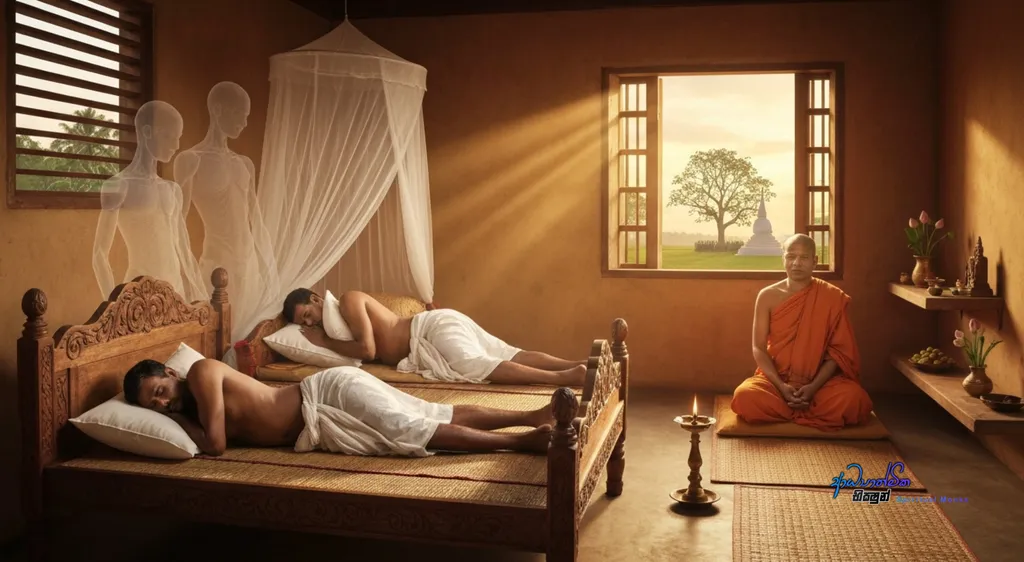
Sickness and Helplessness: The Body’s Final Betrayal
Based on our previous mindfulness teachings, we have explained that the mind is not under your control. Now you see the body is not under your control either. So, understand this: who is really in control here? You who say ‘me’ and ‘I,’ who claim ‘this is my body, this is my mind’,is it really yours? If you investigate this practically, with mindfulness, you can understand if it is truly ‘you,’ someone else, or simply a process of cause and effect.
This profound truth, taught by a Buddha over 2,500 years ago, a truth that only a fully enlightened being can reveal, can be seen by you, regardless of your race, caste, or religion. You can see this reality for yourself, step by step.
Next, let’s look at what happens when your body gets sick. Consider this part. We experience all sorts of illnesses: fever, colds, coughs, and more serious diseases like cancer. There are diseases that cannot be cured. The Buddha referred to this body as a ‘decaying corpse’ because it is so far beyond our control.
If this body were truly under your control, if you had cancer, you should be able to make it disappear in an instant. But you cannot. Your mind is not under your command, and you cannot even remain in a single posture as you wish. See how this body makes you helpless through sickness.
If you put too much food into this body, or toxic food, or things that are harmful, it reacts. You might enjoy flavorful foods with artificial additives, but the body doesn’t like them. If you consume them, it gets sick. See how limited we are. People struggle so much, thinking they should be able to eat, drink, and have fun as they please. But can you really? Look at this from the perspective of your mind and from the perspective of your body.
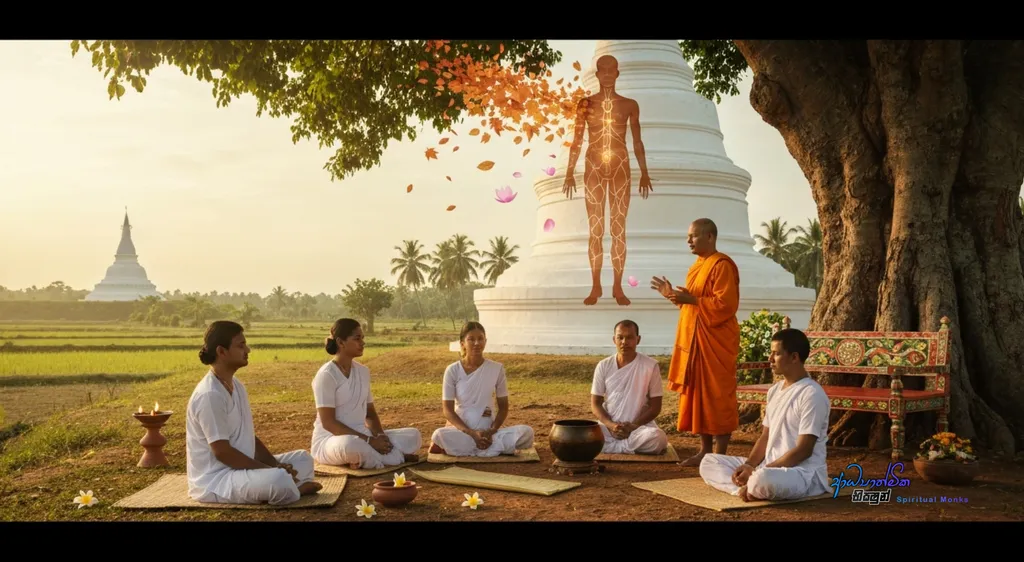
Look at all of this with clear mindfulness, with Sati-sampajañña. From the moment you started reading this teaching until the end, and even after, keep watching your body and your mind at all times. When you do, you will begin to notice how certain things in the body function. If your concentration (Samadhi) develops through this practice, and you apply mindfulness within that state of calm, you will practically begin to see and encounter the inner workings of the body.
Mindfulness in Sickness: A Practical Path Through Physical Suffering
So, observe in this way. See the pain that arises from postures and from illness. Imagine you have a fever and a cold, you’re mentally broken down with a headache, runny nose, and no energy. After taking all your medicine, you’re just lying in bed. In that state, watch with clear mindfulness. Perhaps right now, as I mentioned earlier, you are someone who is bedridden, in a wheelchair, or using crutches due to some illness.
Whatever your condition, watch your illness with mindfulness. I mention this because people in these situations have spoken to me. As you watch, you will gain an understanding of it. You will feel the pain spread, you will feel it lessen slightly, then increase again. It feels like it goes down and comes back up.
You will notice it increasing and staying for a while, then decreasing and staying for a while. Your mindfulness will start to catch this, piece by piece. Just keep observing these things. Look at the suffering that arises from your body’s postures and the pain that arises from illness. Watch all of it.

Turning Inward: Observing Suffering in the Landscape of the Mind
Next, let’s look at our mind, our heart. Various kinds of suffering arise in the mind as well. Someone says a word, and you feel hurt. This is especially common, though not exclusive to, women and girls. But anyone can feel hurt; men feel it too. There is no age limit, no distinction of race, caste, or religion.
This suffering is universal. If someone scolds you and you feel sad, don’t focus on the words they said. At that moment, turn your attention inward and watch your own mind with clear mindfulness. See how much pain their words have created in your heart. Watch those thoughts.
As you watch, whether it’s the physical sensations I mentioned earlier or these emotional ones, do nothing extra. Don’t start chanting or repeating any words. Don’t analyze concepts like ‘name-and-form’ (nama-rupa) or any terms from Dependent Origination (Paticcasamuppada). Don’t even repeat the Pali or English words for the Three Characteristics of Existence: Anicca (impermanence), Dukkha (suffering), or Anatta (not-self). Just watch.
Simply remain with mindful observation. Watch the pain and sadness your mind feels without analyzing it with concepts. When someone scolds you, just watch the anger and hurt that arise. You will see that after a while, the feeling starts to fade. Then it might flare up again. You’ll see the thought arrive.
You might notice another thought mixed in, urging you to retaliate: ‘Why did they say that to me?’ A whole cascade of thoughts begins to build around the initial pain. Watch these pains closely. Continue this practice of observing suffering with mindfulness, over and over again.
You will gain a great understanding. You will see thoughts arise, exist for a moment, and then disappear. At first, you may only see them arising and disappearing. But as you practice for a longer time, you will begin to see the three distinct phases: arising, persisting, and ceasing. Continue to practice this.
There is no special meditation object here. In true insight meditation, or Vipassana, there is no special technique other than mindfulness itself. The concepts in teachings like the Four Foundations of Mindfulness (Satipatthana) or Dependent Origination are things to beseen, not chanted.
They are things you see naturally once mindfulness is established. If you try to force yourself to see them, you never will. You might see a little, but you won’t be able to go deeper, because your mindfulness is not yet developed. As we develop mindfulness, the ability to see these truths arises naturally.
Witnessing the Four Noble Truths in Your Own Life
So, when someone scolds you, your mother, father, husband, wife, children, or your boss at work, just watch the pain in your mind. If your beloved pet dies, or a family member, a friend, or anyone you are close to, and you feel grief, watch your mind in that moment. Don’t just focus on the external tragedy.
Of course, you should take care of what needs to be done. If someone needs help, help them. If your pet dies, you perform the necessary rites according to your customs. But while you do all that, keep watching your own mind. Watch the pain and see what it feels like.
This is how you can directly understand the Four Noble Truths that the Buddha taught. Imagine your beloved dog suddenly dies. You watch your mind with clear mindfulness. As you observe, you will begin to understand in your own words, ‘Why did this pain arise in me?’ It doesn’t matter what language you speak,English, Sinhala, Tamil,or where you are from.
You will see, ‘Ah, this suffering arose because my dog died.’ There, you understand suffering (Dukkha). You also see its cause (Dukkha-samudāya): ‘It’s because I was attached to my dog.’ This understanding comes from your own direct observation.
As you continue to watch, you will feel the pain naturally begin to subside. It disappears on its own. That is the experience of the cessation of suffering (Dukkha-nirodha). The very act of watching mindfully is the practice of the path leading to the cessation of suffering (Dukkha-nirodha-gāminī-paṭipadā), which is the Noble Eightfold Path.
It happens automatically. Can you see from this explanation that the only thing needed is mindfulness? This is what we must cultivate. When you do this, the grief that might have lasted for weeks or months now lessens much more quickly. Perhaps within a week, you stop crying and grieving, because you have understood your own sorrow. You can have other pets in the future, but you won’t suffer excessively when they pass away, because you are someone who practically trains the mind.
Apply this to all difficult situations. If your spouse leaves or passes away, if your children leave or pass away,in every sorrowful moment, watch your mind in this way. I have given a previous teaching on how to prepare the mind for future events like this. This is how you continuously train your mind.
Building Unshakeable Resilience: A Practice for Every Moment
You might be a very sensitive person. Perhaps you see distressing things on social media, like accidents. Maybe you are someone who cannot bear the sight of blood. In those moments, as your eyes see the external image, turn your awareness to your internal mind.
Watch the painful feelings that arise, the sensations you cannot bear. Just observe them with steady mindfulness. As you watch, you will begin to understand them, and because of that understanding, the intensity will slowly begin to decrease. Just continue the practice of watching.
If you are a student and a teacher scolds or hits you, or your friends ostracize you, watch your mind. If you feel shame or embarrassment when trying to speak at a meeting, or if you feel marginalized by society, practice watching your mind. As you watch and watch, your mind becomes stronger.
Your mentality becomes resilient. No one but a Buddha can give you this teaching. This practice given by the Lord Buddha not only strengthens your mind in this very life but also shortens your journey through the cycle of rebirths (samsara). It creates the cause to realize Nibbana, or liberation, in this lifetime. And if not in this life, it can help you attain a stage of awakening (magga-phala). If not that, it will still ensure your future journey through samsara is very short. Remember this.
In every situation, especially if you are a sensitive person, turn your awareness inward and watch your mind. In previous talks, I have always emphasized the point of watching the mind in every moment. In this teaching, I have specifically highlighted the theme of observing the suffering that the mind feels, because it is so important to illuminate this for you. So please, watch this carefully.
Teach this to your children as well. When they are scolded or hit and feel pain, teach them to watch their minds in this way. If this practice was taught correctly, we would not see situations like we do today, where students attack teachers. Such evil actions would not arise. These things happen because of a lack of spirituality, a lack of people who truly follow the Buddha’s path, or a lack of correct practice. This all needs to change, but that is another story, not relevant to this teaching.
For you, continue to cultivate this mindfulness, this awareness (Sati). Look at your mind again and again and again. Some of you may have already discovered this method through your own wisdom and are already practicing it. This is a very simple and easy method.
If your boyfriend or girlfriend scolds you, leaves you, or seems to be avoiding you, watch your mind. If you are fighting with them, watch your mind. In every sorrowful moment, both the physical pains we discussed and the mental pains, watch, bit by bit. As you understand these things more and more, you progress on the spiritual path.
A Gentle Path Forward: Final Reflections and Encouragement
However, do not go searching for stages of enlightenment (magga-phala). Trying to figure out where you are on the path is useless and has no meaning. The search for attainment itself becomes an obstacle to your journey. It causes you to stop moving forward. So do not seek them. All that is needed is to engage with the practice in this way.
As you look at these matters practically, you will come to understand more and more. Before I conclude, I want to make a reminder. If there are those among you who have applied this practice and gained an understanding of your own suffering—both physical and mental, please share your practical experiences in the comments section. As I always say, this can be very helpful for others to deepen their own understanding and develop their practice.
I believe this is sufficient for you to understand this technique, this simple method for observing suffering with mindfulness. Please apply this, and in the future, share your experiences. Continue to practice in this way.
I will now conclude this teaching. By the power of the Triple Gem, the Buddha, the Dhamma, and the Sangha,may you all have the ability to investigate these truths for yourselves with mindfulness. May you gain the strength to realize them on your own. With this blessing, I end this teaching.
May the blessings of the Triple Gem be with you all!
We invite you to walk this path with us. Read our teachings, and most importantly, apply them practically in your own life. as you practice, questions will naturally arise. Please feel free to share your experiences and questions in the comments section below, via email or contact form. I will do my best to offer guidance in future talks based on your progress. For now, begin this practice with an open heart and a mind free from expectation. Cultivate it correctly, and may you find the clarity and peace you seek.
Thank you for joining us. We hope this blog will be of great benefit to your spiritual journey.
May you all be well and happy.
May the blessings of the Triple Gem be with you all!


