


Categories: Dhyana: Practical Training
May the blessings of the Triple Gem be with you all!
Welcome. For those of you exploring the practical spiritual life with us, we have previously discussed the profound states of meditative absorption known as Jhana. Through our meditation programs, such as“The Third Eye” and “To Brahma’s World,” we have offered guidance on how to enter these states.
As you apply these teachings, you gain personal experiences and insights. By now, many of you, regardless of your age or background, have some understanding of what Jhana is. It is a state of deep concentration that can be cultivated through practice.
Today, we will explore a crucial requirement for this journey: to attain Jhana, your sensual desires must be diminished. This is a fundamental step on the Buddhist spiritual path.
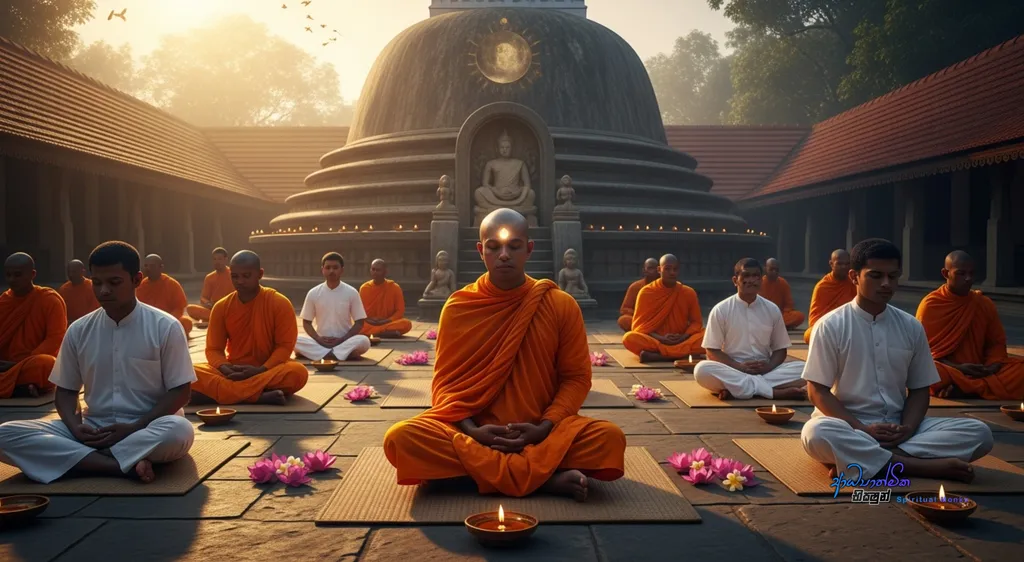
Understanding Sensual Desire: The First of the Five Hindrances
What do we mean by sensual desires, or kama in the Pali language? It refers to the pleasure we seek through our five senses: seeing, hearing, smelling, tasting, and touching. In our human lives, we experience these desires in many forms.
- Sexuality: This can be within the bond of marriage or attachments that go beyond it. Many people are deeply drawn to these experiences.
- Intoxicants: The use of alcohol and drugs is another facet of seeking sensual pleasure.
- Food: Consuming food in excess, simply to please the tongue, is also a form of sensual craving. While overeating doesn’t break a specific precept in the way other actions might, it is an over-indulgence in sensual desire, a gluttony that binds the mind.
These are just a few examples. The craving extends to our attachments to property, houses, cars, and money. Think about what you use the most, what you are most attached to in this worldly life. These very things become obstacles to your meditation. Your deep love for your parents, your spouse, or your children; your attachment to your property, your favorite foods, the movies you watch, and the songs you listen to, all of these can prevent you from developing Jhana and advancing spiritually.
Now, hearing this, a thought might arise: “Does this mean I have to stop my meditation? Do I have to leave my lay life behind?” Please, put that thought aside and continue reading this teaching to its conclusion. You will find a much clearer understanding.
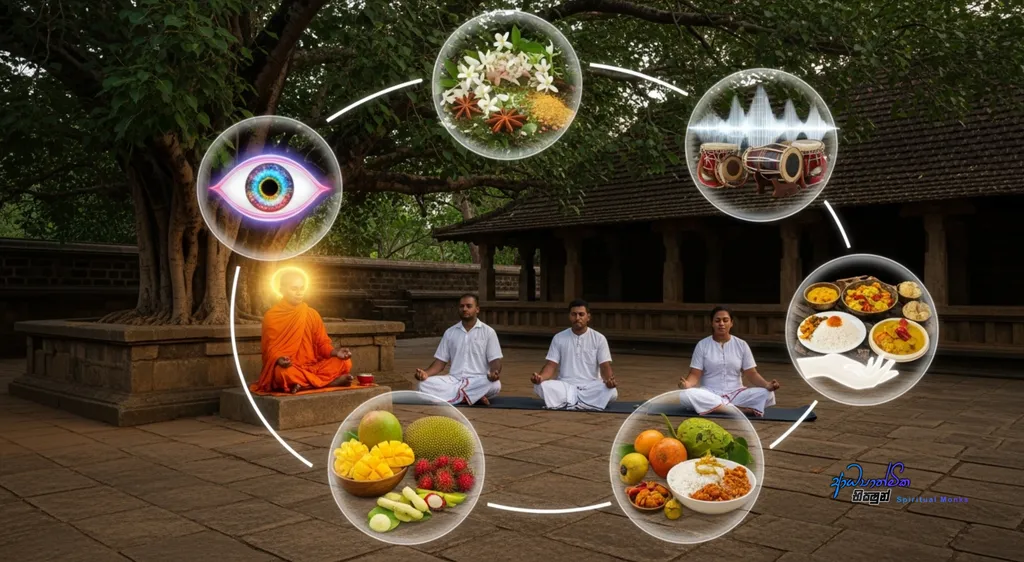
The Buddha’s Map of Obstacles: The Pañca Nīvaraṇa
The Buddha didn’t just point out these difficulties; he provided a clear map for understanding them. He categorized these mental obstacles into a group known as the Pañca Nīvaraṇa, or the Five Hindrances. These are:
- Kāmacchanda: Sensual desire
- Vyāpāda: Ill will or aversion
- Thīna-middha: Sloth and torpor (laziness and drowsiness)
- Uddhacca-kukkucca: Restlessness and worry
- Vicikicchā: Skeptical doubt
While you can find detailed explanations of these Pali terms from various teachers and resources, my goal here is to give you a practical, relatable understanding.
The purpose of tranquility meditation, or Samatha bhavana, is to cause these defilements, or kilesas, to be suppressed. It’s important to understand that this practice doesn’t eradicate them completely; it causes them to settle down. Imagine a murky, disturbed lake.
If you leave it alone, the mud and sediment naturally sink to the bottom, and the water becomes crystal clear. This is what happens to the Five Hindrances in a concentrated mind. For Jhana to arise, these hindrances must either be completely suppressed like the settled mud or entirely uprooted through wisdom. The primary hindrance for most people is the first one: sensual desire.
How the Five Hindrances Appear in Meditation
Let’s look at how the first of the Five Hindrances, Kāmacchanda, manifests. Imagine you are practicing the “To Brahma’s World” meditation. You focus on the point between your eyebrows and mentally repeat, “May the first Jhana arise, may my mind become one-pointed.” You must know that merely repeating words doesn’t create Jhana.
The words are a tool to help focus the mind. But as you sit, your mind wanders. If you are deeply attached to your son, thoughts of him will arise. If you are strongly attached to your spouse, sexual thoughts may arise. If you desire property, you will think of houses and land. If you are a student with an upcoming exam, you will worry about it. If you crave money, your mind will drift to finances. If you love food, your mind will be filled with thoughts of your favorite dishes, kottu, rice, seafood.
Let’s take the example of a food lover. You sit to meditate in a quiet place. You focus your mind and begin repeating your meditation phrase. For a while, your mind begins to settle. Thoughts decrease. You don’t even feel hungry. But the mind is tricky; it’s waiting for a moment of weakness.
You might even make a strong resolution: “Even if I think of food, I will not open my eyes.” That is a good and powerful determination. But after 15, 20, or perhaps 45 minutes, your initial energy fades. Your resolve weakens. In that moment, the hindrance of sensual desire strikes. A thought appears: “Okay, get up now. Go to the shop and get a kottu. I wonder what’s at home to eat.” The mind takes control, forces your eyes open, and pulls you from your meditation seat right to the kitchen or a restaurant. You have been defeated.

The Way Out Is Through Understanding, Not Force
When this happens, the effort you made for those 40 minutes is not lost; you gain merit (kusala) for your striving. But in that session, you were defeated by the hindrance. If this becomes a habit, you will be defeated again and again. This is how the Five Hindrances work. So how do we let go? We cannot force it. True letting go comes from understanding.
Imagine someone you love deeply. Your friends and family tell you this person has other secret relationships. You refuse to believe it. But one day, you see it with your own eyes and hear it with your own ears. You catch them in the act.
When this happens, the memory of that sight will arise again and again. The love you felt, no matter how strong, begins to crumble and is replaced by pain and eventually, aversion. You break the relationship because you have understood the true nature of that person. You don’t need to fall into the same pit twice.
This is how we overcome defilements. The Buddha taught us to use mindfulness (sati). As you practice, you begin to see clearly: “My craving for this food is an obstacle to my peace. My attachment to this person is causing me distraction.” As you see this truth directly, again and again, the attachment naturally begins to weaken. You don’t have to force it. This is why you must not have the foolish thought, “I must stop eating completely to meditate!” The goal is to continue practicing.
As the joy of meditation grows, you will naturally realize you need to eat less, or that your desire for certain pleasures is fading. You will also see the direct physical consequences of overindulgence, drowsiness, high cholesterol, sugar-related illnesses. Through this direct seeing, you change. Until then, you can still develop concentration (samādhi), but the deep states of Jhana will remain out of reach.
A Crucial Self-Check: Are You Truly in Jhana?
It is very important to be honest with yourself. I have met people, sometimes older women, who believe they are in the fourth Jhana while their minds are still filled with thoughts of food, family, and property. This is a form of self-deception. Here is a vital way to check your practice: A person who has truly entered Jhana does not want to leave it. If you make a determination to meditate for one hour, you can stay for the full hour without being disturbed.
But if you sit with the intention of meditating for an hour and find that after 40 minutes you are bored, restless, and want to get up, you must understand that you have not entered Jhana. You are still in the process of training the mind in concentration. This honest self-assessment is crucial for making real progress on the Buddhist spiritual path.
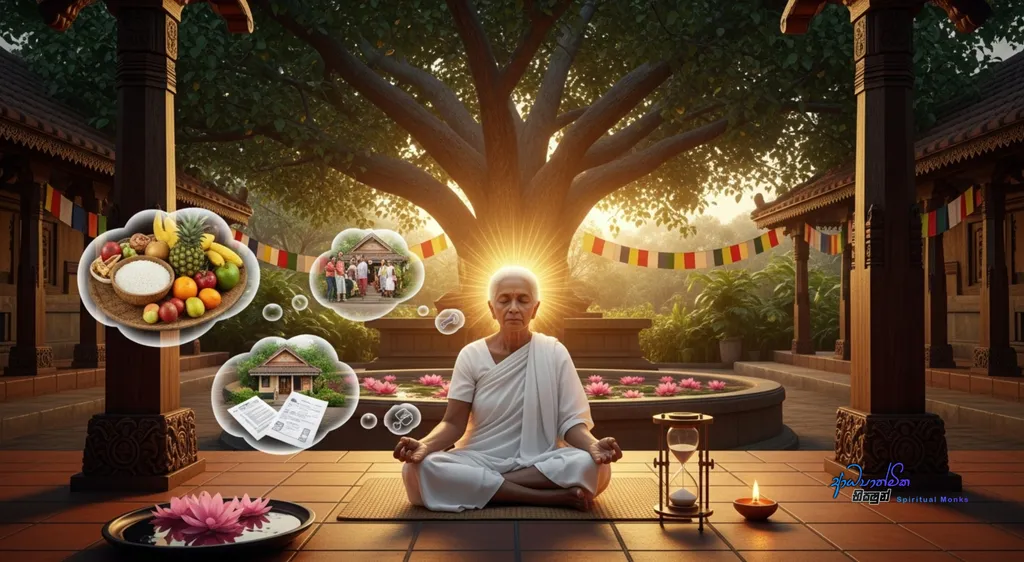
The Other Four Obstacles on the Path
The principles we have discussed using sensual desire as an example apply to all of the Five Hindrances.
- Ill Will (Vyāpāda): This is the second hindrance. If you have a lot of anger, resentment, or hold grudges against enemies, these thoughts will surely arise in meditation. Even a strong reaction to injustice can become a barrier. The practice of loving-kindness meditation (Mettā Bhavana) is prescribed to suppress this hindrance. It calms the anger, clearing the way for Jhana to arise.
- Sloth and Torpor (Thīna-middha): The third hindrance is laziness and drowsiness. This can be caused by overeating, but it can also be a mental habit. When you sit to meditate, the lazy mind will say, “You’ve sat long enough. Get up.” The antidote is to persistently practice every day, breaking the habit of laziness.
- Restlessness and Worry (Uddhacca-kukkucca): The fourth hindrance is a scattered and agitated mind. This is often fueled by worldly problems, financial stress, family conflicts, health issues. These worries make the mind turbulent and unable to settle.
- Skeptical Doubt (Vicikicchā): The final of the Five Hindrances is doubt. You might doubt the path, the teacher, or the practice itself. “Am I doing this right? Will this really work?” Sometimes, having too much intellectual knowledge from books can fuel this doubt, making your own knowledge a trap (a Māra). The practice is to not engage with these questions during meditation. Acknowledge them and return to your object of focus. If you get caught in answering the doubt, you have lost the battle for that session.

The Role of Virtue (Sīla) and Celibacy (Brahmacariya)
This is why the Buddha taught the importance of virtue (sīla). Living by precepts acts as a powerful support. For example, if you are a layperson struggling with lust, undertaking a period of celibacy (brahmacariya) can be transformative. When a sexual thought arises during meditation, the mind remembers, “I am upholding this precept.” In the beginning, this may be difficult, and you might fail. But with time, the precept becomes your strength, your power. The lustful thought arises, but it becomes an empty, powerless thought because of your resolve. This is how virtue clears the path for Jhana.
However, the Buddha also warned not to cling to virtue itself. Even monks can become attached to their precepts, and that very pride becomes an obstacle. Virtue is a raft to cross the river; it is to be used and then let go of. For a layperson engaged in a normal sexual life with a partner, attaining Jhana is very difficult and takes a very long time.
This is not wrong, but it is an obstacle. On the other hand, a layperson who lives in celibacy, even while wearing lay clothes,can attain Jhana with much greater ease, provided they are not attached to other things like wealth or fame. The other Five Hindrances can still block them.

A Note for Advanced Practitioners: Hindrances and Spiritual Abilities
These principles also apply to those who have developed spiritual abilities, like the “divine eye” or “third eye.” Such an ability arises from a certain level of concentration. However, if the person does not maintain their virtue and allows the Five Hindrances to grow, that ability will fade and disappear. Furthermore, some people mistakenly believe they are in a high Jhana state simply because they can perceive a sign associated with it, like seeing a vision of infinite space (the basis for the fifth Jhana).
But if they are still bothered by thoughts of their children, anger about politics, or drowsiness, they are not in Jhana. The hindrances are still active. True Jhana only arises when the Five Hindrances are completely suppressed. If you think you are in any of the eight Jhanas and a thought related to one of these hindrances arises, know for certain that you are not in that state.

Your Path Forward: A Compassionate and Patient Approach
After hearing all this, please do not fall into despair and think, “I have desires, I like food, I am in a relationship… I can never develop my meditation.” Do not underestimate yourself in this foolish way. What you should do is practice meditation consistently, for at least half an hour or an hour every single day. Maintain at least a state of concentration. By doing this, a day will come, at whatever age or stage of life, when you will understand the nature of these sensual pleasures and the Five Hindrances. You will be ready to reduce them or let them go, and because you have maintained your practice, you will be able to make swift progress.
Anyone who finds themselves stuck on the spiritual path is stuck because of one of these Five Hindrances. So, use this teaching to look at your own mind. Use mindfulness to identify your own obstacles. Then, with patience and persistence, work to gradually weaken them. It may take months or years. The time it takes is not important. What is important is that you continue to practice every day.
I trust this detailed explanation has been helpful. It is offered with compassion to help you honestly see where you are in your practice and to clarify the path forward. It is possible to make progress in lay life, but it requires understanding and diligence. May you all be able to comprehend these teachings, identify your own weaknesses among the Five Hindrances, and, with mindfulness and effort, gradually overcome them to advance on your spiritual journey.
We invite you to walk this path with us. Read our teachings, and most importantly, apply them practically in your own life. as you practice, questions will naturally arise. Please feel free to share your experiences and questions in the comments below, via email or contact form. I will do my best to offer guidance in future talks based on your progress. For now, begin this practice with an open heart and a mind free from expectation. Cultivate it correctly, and may you find the clarity and peace you seek.
Thank you for joining us. We hope this blog will be of great benefit to your spiritual journey.
May you all be well and happy.
May the blessings of the Triple Gem be with you all!


