


Categories: Dhyana: Practical Training
May the blessings of the Triple Gem be with you all!
Welcome. Today, we continue our spiritual journey together, hoping to offer you a clearer understanding of the First Jhana, a profound state of meditative absorption, especially for those of you developing your Samatha meditation practice. For your convenience, we have organized these teachings into a dedicated collection called “Let’s Learn About the Jhanas.”
If you are new to this path, we encourage you to explore that series to understand how to attain the First Jhana, progress to other Jhanas, and learn the practical steps of various meditation subjects, or karmasthana. We have clearly explained these methods, so if you are a beginner, please engage with those teachings to build a solid foundation for your practice. We have also addressed many common questions within those discussions.
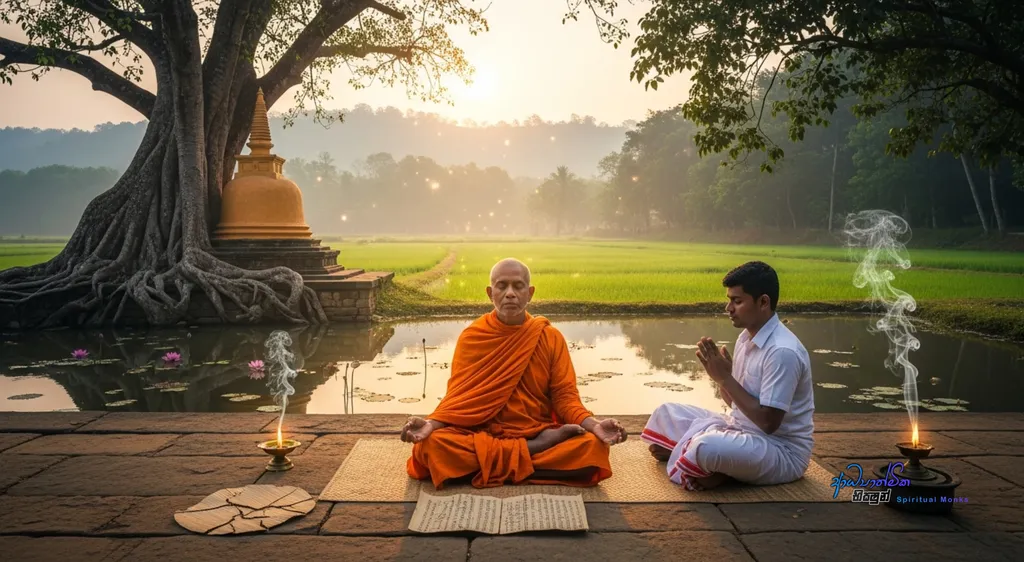
Finding Your Anchor: The Role of a Teacher and a Method
Some time ago, we introduced a specific practice under the name “Practical Meditations to the Brahma Worlds.” This is just one of many paths. There are numerous meditation methods and spiritual perspectives that can lead to the attainment of the First Jhana. The Buddha himself taught methods like Anapanasati, or mindfulness of breathing, which can be used to develop these deep states.
Beyond the Buddha’s direct teachings, there are also ancient techniques practiced by yogis for countless years. You are free to use any method that resonates with you if your goal is to develop Samatha meditation, which is a practice of calming the mind. However, if you choose to follow a teacher, it is valuable to know if that teacher has achieved the results they are teaching. The value of a good guide is that they can lead you forward based on their own direct experience.
You must find a reliable source to guide your understanding whether it’s a teacher, a dedicated series of teachings like this one, or even a book. If you learn from a book, you must make that book your teacher by reading it carefully and repeatedly. Otherwise, your study might not provide the clear direction you need. The best approach is to follow a structured teaching or practice under a guide. Of course, some people can succeed on their own, depending on their innate wisdom, a topic we have discussed before under the heading “Is a Teacher Necessary for Meditation?”
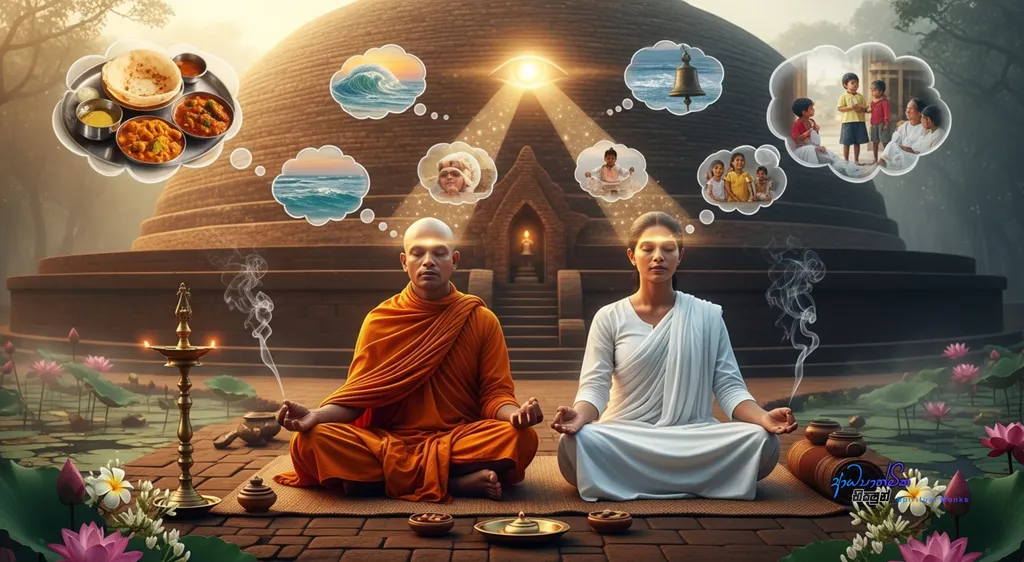
The Wandering Mind: The Universal Starting Point
Regardless of the method you choose, you must engage in the training. Today, I want to share some specific points about the First Jhana. Let’s use our “Practical Meditations to the Brahma Worlds” method as an example. In that guided meditation, which we have provided as a full one-hour session, we instruct you to focus your mind on the point between the eyebrows or the middle of the forehead. You then make a determination, a heartfelt resolution, three times: “May the First Jhana arise.” This is only a statement of intent; the state doesn’t arise simply because you say so, as we have clarified before.
Next, while keeping your attention on that point, you are guided to mentally repeat the phrase, “May my mind become one-pointed.” Again, repeating these words alone does not cause the First Jhana to arise. The purpose of this repetition is to help gather and unify the mind. We’ve explained this in detail in other teachings, so please refer to them if you are new.
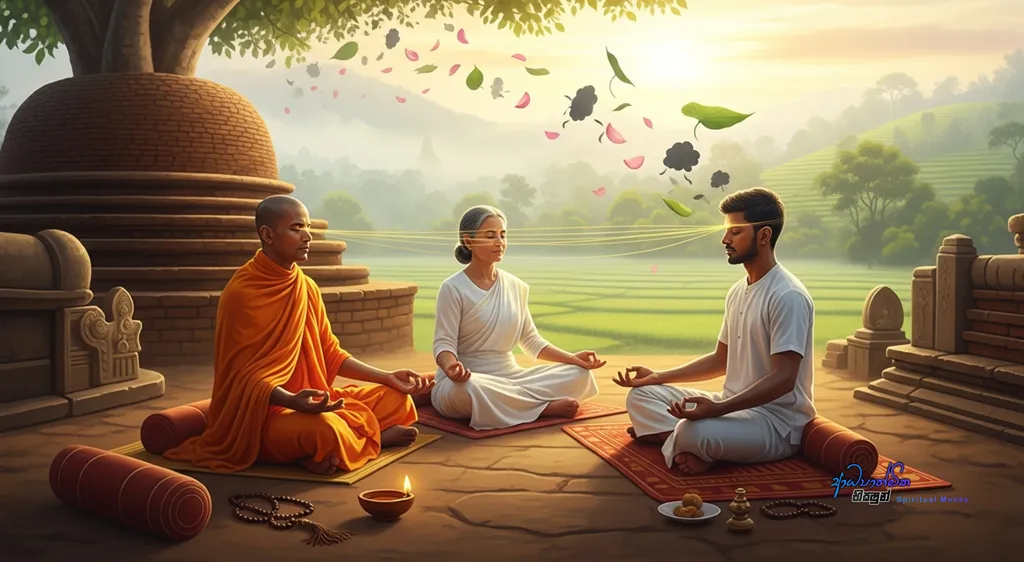
When you sit for meditation with your eyes closed, the nature of the mind is to wander. This is a universal experience. Your mind will drift to the past or race toward the future. Memories from your entire life might begin to surface. Your mind will travel through the five senses sights, sounds, smells, tastes, and physical sensations.
You might recall a sensual desire, the taste of a meal you ate yesterday, or a pleasant trip you once took. Joyful memories, sad memories, and moments of anger will all arise. This scattering of the mind is normal at the beginning of any meditation practice. No one’s mind becomes one-pointed instantly. If it does, it is extremely rare and usually indicates that the person has cultivated meditation in past lives. For most of us, this is not the case.
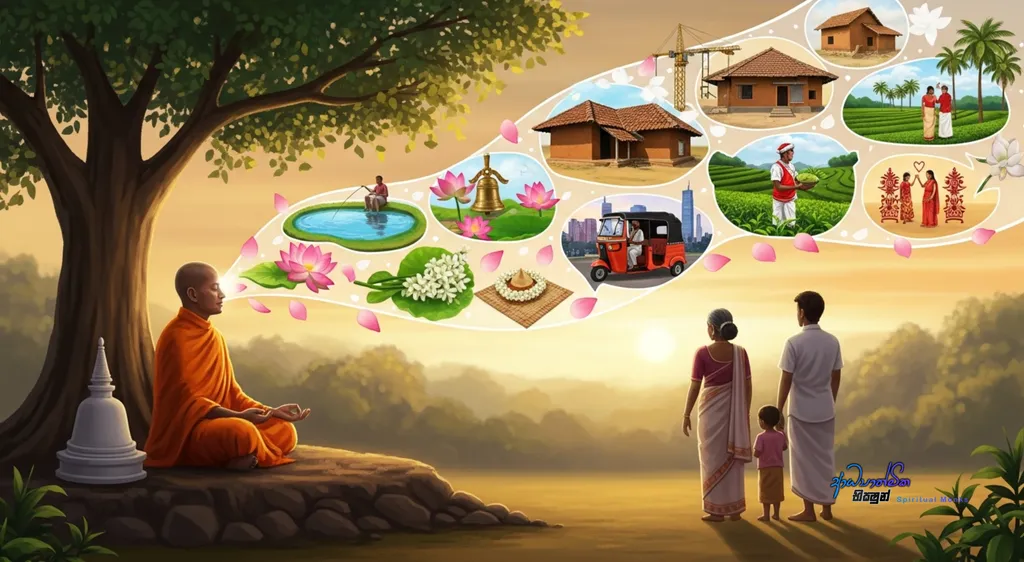
Navigating the Streams of Past and Future
The mind doesn’t just travel to the past; it also projects into the future. It fixates on future goals, things you plan to do, trips you want to take, and things you failed to accomplish. Perhaps you’ll remember a food you haven’t tasted yet, a place in Sri Lanka you haven’t visited, or a foreign country you wish to see. You might recall something you need to say to someone but haven’t yet.
Your future hopes and desires will surface: building a house, buying a vehicle, starting a relationship, having children, caring for your parents, or even plans for helping or harming someone. Any plan you have made will come to mind, making it difficult to concentrate.
The mind’s nature is to be scattered. As we have demonstrated practically in our teachings on mindfulness (based on the Buddha’s Satipatthana Sutta), the mind constantly runs towards objects in the present moment through the five senses. When there are no immediate sensory inputs, the mind turns inward to its database of stored information, memories, and data from the past and future. This is simply how the mind works, a reality we must understand and accept. In our teachings on Samatha meditation and the third eye, we have emphasized this point repeatedly.
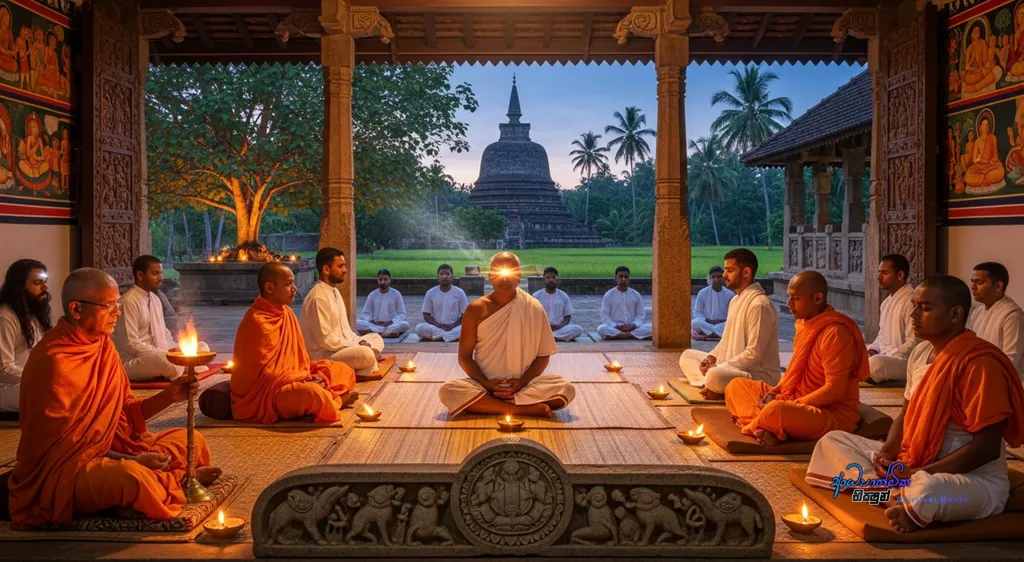
Techniques as Anchors for the Mind
Whether you are practicing the “Practical Meditations to the Brahma Worlds,” focusing on the forehead and repeating a phrase, or using a simple word like “Empty,” your mind will wander. We use a point of focus like the forehead or between the eyebrows for a specific reason. It serves as an anchor. It gives us a convenient place to bring the mind back to when it strays into the past, future, or gets caught up in present-moment sensations.
Let’s look at other Buddhist meditation techniques. In Anapanasati (mindfulness of breathing), we anchor the mind to the sensation of the breath at the tip of the nose. The goal is the same: to unify the mind. In recollection meditations, such as Devatanussati (recollection of celestial beings), we contemplate the happiness of devas to focus the mind.
In practices like Buddhanussati, Dhammanussati, and Sanghanussati, we focus on the virtues of the Buddha, the Dhamma (his teachings), and the Sangha (the community of noble ones) to achieve one-pointedness.
In all these methods, we choose an object either a point in the body or a constantly occurring process like the breath. Some, following the Burmese method taught by Ven. Rerukane Chandawimala Thero, focus on the rising and falling of the abdomen. There are also kasina practices, where one focuses on an external object, like a colored disc, to develop concentration. We have previously discussed how to use the fire kasina (tejo kasina) to awaken the third eye.
All of these are foundational tools. We must remember that once the First Jhana arises, these initial supports are no longer needed. Many people who have practiced with our teachings have successfully reached this stage or are very close to it, and they have shared their progress with us.
The Common Thread: Recognizing the Wandering Mind
No matter which method you use whether taught by the Buddha or from other traditions the universal experience is the mind wandering to the past and future. This scattering is the common characteristic. It happens in every meditation technique because it is the nature of the untrained mind.
To understand this nature, mindfulness practice is incredibly helpful. Non-Buddhist Samatha traditions do not teach the Buddha’s method of mindfulness (Vipassana), as this profound path was revealed to the world only by a fully enlightened Buddha. However, we have found that practicing mindfulness helps tremendously in developing Samatha. Why? Because mindfulness trains us to recognize thoughts of the past and future as they arise.
This recognition makes it easier to gently bring the mind back to our chosen meditation object, be it the forehead or the breath. This is why we encourage those developing Samatha to also train in mindfulness. As you cultivate mindfulness, it supports your concentration practice. At the same time, your insight (Vipassana) develops, which helps in abandoning mental defilements (kilesas). Our approach is to teach Samatha and Vipassana together, in a balanced, unified way known as Yuganaddha.
The Moment of Emergence: What the First Jhana Feels Like
Let’s return to our example. You are focusing on the forehead, repeating, “May my mind become one-pointed.” As you do this, your mind travels with the words into the past, the future, or towards a present sound or a sensation like an ant crawling on your skin. It gets caught in physical pain, the feeling of wind, or heat. When you realize you’ve drifted, you bring your awareness back. Sometimes the mind returns to the anchor point on its own. You re-establish your focus and continue repeating the phrase.
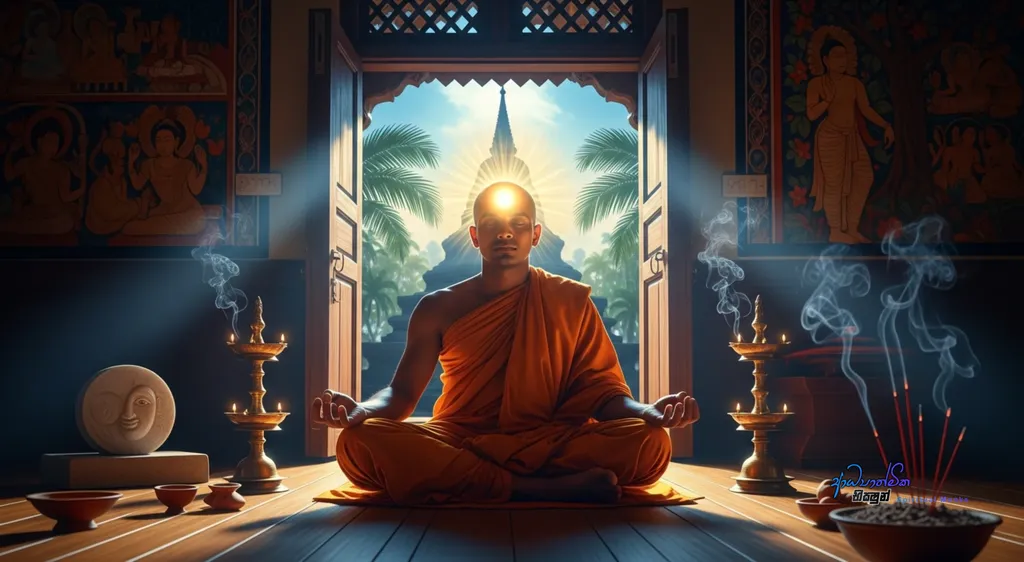
You continue this training, and then, suddenly, the First Jhana arises. There are preliminary signs, which we have discussed in our Jhana series. If you are new, I encourage you to review those teachings to practice correctly. But the arising itself is unmistakable. As you maintain focus, your mind suddenly feels empty. Thoughts stop. It feels as if thoughts related to the five senses sensual thoughts, memories of the past, plans for the future are completely blocked. There is no distraction by present sounds or bodily sensations. The arising of the First Jhana can feel like a sudden explosion or a blast it’s a strange and powerful awakening.
This experience might only last for a few seconds. You could be sitting perfectly still for an hour or more, with your back, neck, and head straight, but the First Jhana may only manifest for 30 seconds, or perhaps a minute or two at first. It happens suddenly and can be quite surprising.
The Qualities of the First Jhana: Freedom from the Hindrances
In that moment of sudden emptiness, you feel a strange sense of freedom. Your mind stays fixed in that state. This is what is known as vitakka-vicara the mind being directed and sustained on a single object, which in this case is the Jhana state itself. As I mentioned, thoughts are blocked. Specifically, the mental states known as the Panca Nivarana, or the Five Hindrances, are absent.
These hindrances are:
- Kamacchanda: Sensual desire
- Vyapada: Ill-will or aversion
- Thina-middha: Sloth and torpor (dullness and sleepiness)
- Uddhacca-kukkucca: Restlessness and worry
- Vicikiccha: Skeptical doubt
None of these are present. Even if you are meditating late at night or in the early morning, you will feel no sleepiness. Instead, for those few moments, you will feel incredibly refreshed and energized.
Remember this feeling. This experience is the First Jhana level. This is Jhana. However, at this stage, it has only appeared; it is not yet stable. This is the fruit of your spiritual practice the direct, practical result of the days, weeks, months, or even years you have spent training.
Stabilizing the State: From a Glimpse to Mastery
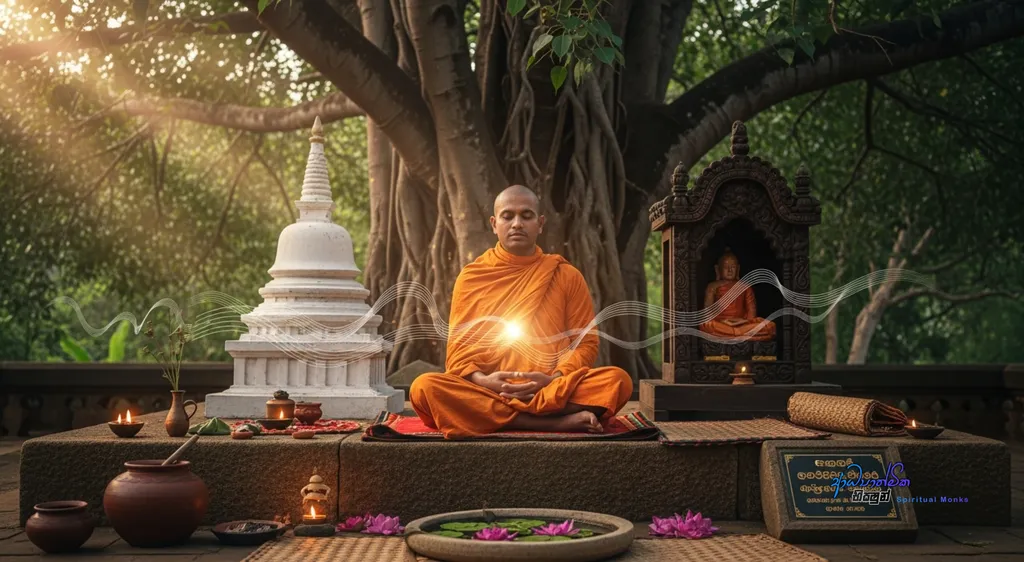
When you experience this state, even for a few seconds, we advise making a determination two or three times: “May this experience of the First Jhana grow stronger and last longer.” Making this resolution can help extend its duration slightly. If you have felt this, start making this determination today.
In the beginning, the state will disappear after a short time. This is normal. When it fades, you must return to your initial meditation object the forehead, the breath, or whatever you were using and continue your practice. After the First Jhana arises, it feels like waking up from sleep, or stepping from darkness into light.
I don’t mean this in the sense of seeing lights as in third-eye meditation; it’s an analogy for a sudden inner clarification. In that moment, you are not consciously repeating your meditation phrase. There is no need to. You are simply abiding in the state. The only mental activity should be the determination to prolong it.
During the First Jhana, your mind is not on your forehead or between your eyebrows. It is simply aware, looking straight ahead into the space you see with your eyes closed. You might or might not see lights or mental images; that is not important. Your attention is not even on the ‘screen’ in front of you. You are absorbed in the pleasant feeling that has arisen. Your attention on the breath also ceases. It feels as if you have turned to stone the body may feel rigid before becoming extremely light. We have discussed these physical signs in our other Jhana teachings.
A Crucial Clarification: Letting Go of the Anchor
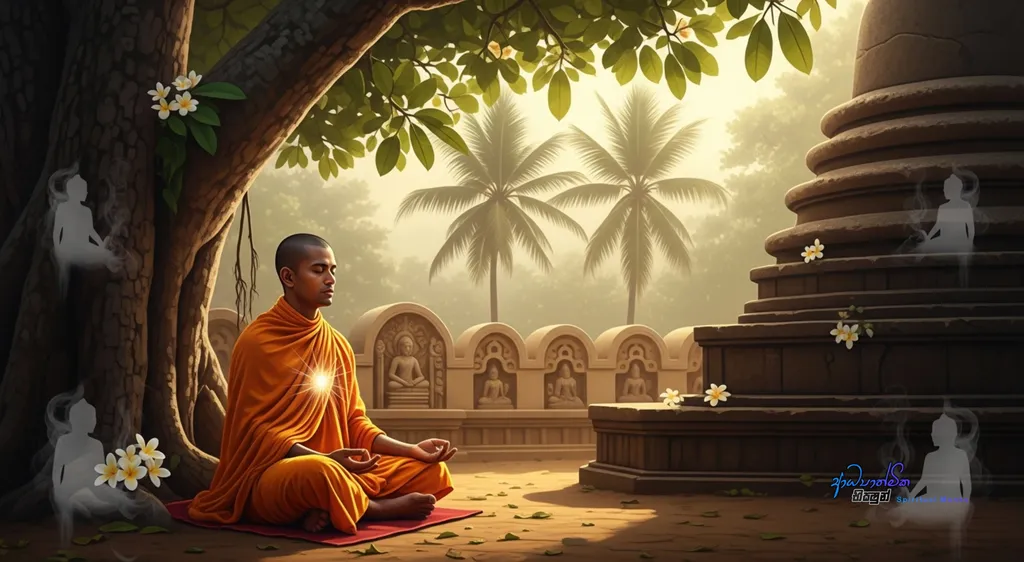
Please remember this key point: regardless of which Buddhist meditation technique you use to cultivate the First Jhana, when the state arises, your initial meditation object (the karmasthana) fades away. The practice you did to get there is left behind. Your mind will no longer be resting on a part of your body or an external object.
Many people mistakenly believe that during the First Jhana, their mind must remain fixed on the forehead, between the eyebrows, or on the breath. This is incorrect. Those objects are the launchpad. Once the mind becomes one-pointed through them, it enters the First Jhana and lets go of the launchpad. The mind is released from the breath and enters the Jhana itself. This is a point many practitioners do not understand due to a lack of practical experience.
This is why having a guide or a reliable teaching series is so valuable. Studying on your own can take a very long time to figure these things out. A teacher reduces that time. For those who use our teachings as their guide, we explain these practical points so you can understand them quickly. There are people who have had this experience.
Are You Training or Abiding? Knowing the Difference
Even when you have felt the First Jhana, remember that you have not yet mastered it. You cannot enter it at will. Mastery, or vasi-bhava, means you can remain in the state for as long as you decide. Until then, you must continue to practice diligently and consistently, every day. As we’ve said recently, the key is uninterrupted effort.
Initially, you only experience a feeling of the First Jhana. After it fades in a few seconds, you must go back to anchoring the mind on the breath or the forehead. You may sit for an hour or two, and the state might only arise for a minute or two in total. As you continue to practice without attachment or disappointment, the experience will begin to occur two or three times per session. Don’t crave for it to happen, and don’t feel sad when it disappears. Just keep practicing.
Over time, the duration will naturally increase. What was 30 seconds will become one minute, then two, five, ten. You will feel it coming under your control. You can then use your determination to extend the time. If you sit for an hour, you might spend the first part of the session using your meditation object to enter the Jhana, then abide in the First Jhana for 10 minutes, and then, because it’s not yet fully mastered, spend the remaining 50 minutes practicing with your object again.
As the time spent in Jhana grows, the time spent on the preliminary practice decreases. Eventually, you may be able to sustain the state for a full hour, then an hour and a half, two, or three hours. At that point, the First Jhana is well-established.
The Mark of True Attainment
In the First Jhana, thoughts of the sensual world your children, grandchildren, your job do not arise. They are blocked. You will notice this even in the brief, initial experiences.
So, to repeat the most important point in this teaching: when the First Jhana arises, your mind is NOT fixed on a specific location like the forehead. It doesn’t happen that way. The mind is freed from that anchor and abides in the Jhana itself. Many people, especially older or younger individuals who have read or heard things here and there without dedicated practice, argue about this. They speak as if they know. Do not be misled by their words. Experience this for yourself through practice. This is particularly common in lay society.
Do not let their talk become an obstacle to your spiritual life. If you have had this experience, we invite you to share your reflections in the comments to help others. Please be patient if we cannot respond to every message immediately; we receive many calls and messages and must balance them with our own spiritual duties. We will answer when we can, and often, the answers to your questions are already present in our previous teachings. If you are new, please explore the teachings from the beginning.
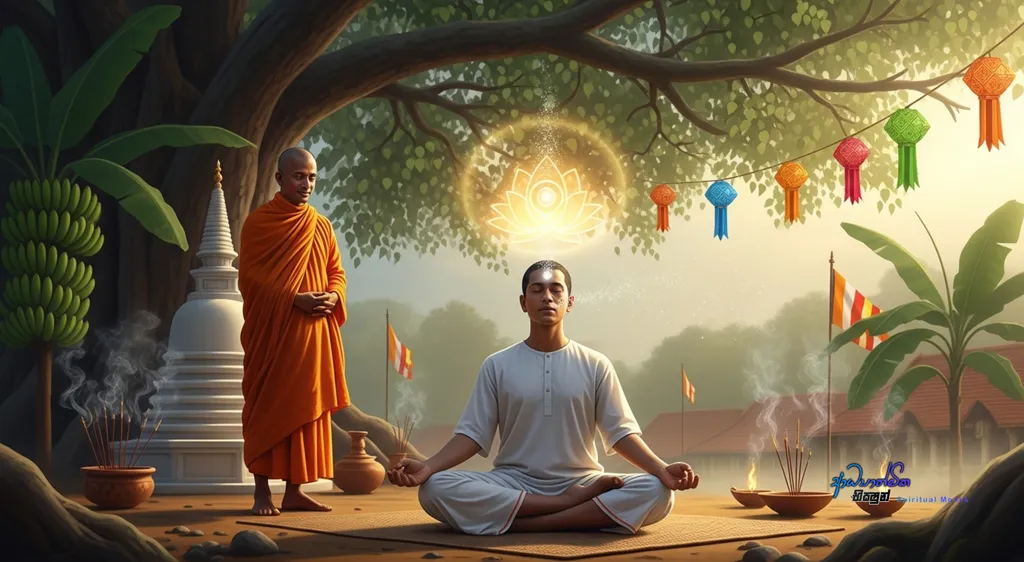
The mark of true attainment is this: if, as soon as you close your eyes in a meditation posture, your mind naturally enters the state I have described, then you have truly established the First Jhana. It is under your control. However, if you close your eyes and your mind still scatters, and you have to make an effort to bring it back to an object, then you are still in the training phase. You have glimpsed the goal, but you have not yet arrived. The task, then, is to continue practicing, without expectation or spiritual craving, which is a subtle form of greed. Simply do the work.
Practical Experience Over Theory
This is what spiritual progress means. These are not just theories; they are practical experiences we are sharing with you. Our channel is dedicated to practical teachings, not just repeating what is in books. We strive to explain the profound truths of the Dhamma in simple terms that anyone, of any age, religion, or nationality, can understand and practice. Whether the words are complex or in Pali, what matters is the training. The goal is to bring the mind to that state. As long as that happens, the method has served its purpose.
So, once more, for clarity: when the First Jhana is attained, the mind does not remain on the initial anchor points. You do not repeat meditation words like “Empty” or “May my mind be one-pointed.” Those thoughts do not arise, nor are they needed. The mind abides securely in the First Jhana. Those who have experienced this for even a few seconds will understand this perfectly.
Physically, as this happens, the sensation of the body often diminishes. The mind is so powerfully focused elsewhere that it pays no attention to the physical body or the five senses. As a precursor to Jhana, the body might feel rigid or tense, but this is followed by a sudden, profound lightness and ease (passaddhi).
Some who have only read books and lack practical experience may argue, “This is not in the scriptures!” But the Buddha spoke at length about tranquility and lightness. These are the felt experiences of a meditator. People who argue and cling to the literal words in a book, without practicing, are like insects eating the pages. They spend their lives debating and go nowhere. Do not fall into that trap. The Buddha taught the Dhamma to be practiced, to be lived. Your task is to realize this state for yourself.
The Path Forward
We have spent considerable time today providing this analysis of the First Jhana. In the future, we will continue to clarify these matters and discuss the subsequent Jhanas as needed. I trust that you have gained the necessary understanding of the First Jhana to proceed with your practice.
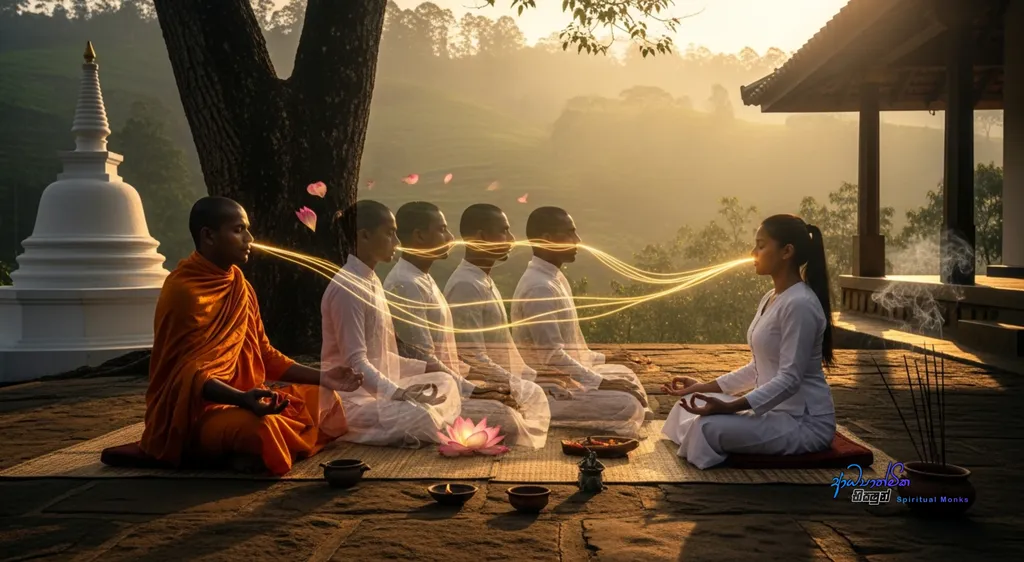
Remember, once you have mastered the First Jhana, the preliminary work of forcing the mind onto the breath or the forehead is no longer necessary. It becomes natural. Just as advanced practitioners who have awakened the third eye and cultivated the formless Jhanas (Arupavacara Jhanas) can enter those states simply by closing their eyes, so too will you be able to enter the First Jhana. Their minds are trained. They also had to put in the same effort you are putting in now to get their first breakthrough. You, too, can reach that point.
Act according to this understanding and engage in the practice, whether you use our “Practical Meditations to the Brahma Worlds,” Anapanasati, or any other method. Continue to practice diligently.
With these words, I conclude this teaching. Through the power of the Buddha, Dhamma, and Sangha the Triple Gem may you all gain the clarity to understand these points and the ability to put them into practice. May you achieve these states for yourself.
We invite you to walk this path with us. Read our teachings, and most importantly, apply them practically in your own life. as you practice, questions will naturally arise. Please feel free to share your experiences and questions in the comments below, via email or contact form. I will do my best to offer guidance in future talks based on your progress. For now, begin this practice with an open heart and a mind free from expectation. Cultivate it correctly, and may you find the clarity and peace you seek.
Thank you for joining us. We hope this blog will be of great benefit to your spiritual journey.
May you all be well and happy.
May the blessings of the Triple Gem be with you all!.


