


Categories: Maintaining Mindfulness
May the blessings of the Triple Gem be with you all!
Today, as we continue to explore the spiritual life together in a practical way, we delve deeper into the practice of mindfulness. Through the practical application of mindfulness meditation, moment by moment, you are beginning to gain a certain understanding of your own mind.
This is an understanding that can never be obtained from anything else, not from any external device or outside source. The only thing that has helped you achieve this is your own mindfulness, or what is called Sati in the Pali language. This is the heart of what the Buddha taught as the Four Foundations of Mindfulness (Satipatthana) or Insight Meditation (Vipassanā).
To realize Nibbāna, or ultimate liberation, is simply to understand this mind. Gaining a gradual, step-by-step understanding of this boundless, limitless mind is the path to liberation itself. And the one and only tool that helps you see this, to comprehend it, is mindfulness.
This is why the Buddha taught us this precious skill of Sati. We are so glad to see that many people, regardless of age, race, or religion, have benefited from these teachings, using them to build mental strength, overcome weaknesses, and in some cases, eliminate them entirely.
This has helped those with various mental vulnerabilities and even those who feel pressured by the constant fluctuations of their own minds. This is a true, practical Dhamma, a teaching not found elsewhere in the world. A Buddha must arise in the world to teach this method; otherwise, it remains unknown.
The more you engage with this practice, the more the meaning behind these words will become clear to you. Even someone from another faith can verify the truth of these words not by observing from the outside, but by applying them practically. The ability to confirm this for yourself comes only through practice.

The Initial Flood: What Happens When You First Meditate?
In this teaching, I want to clarify a particular nature of the mind that many have experienced but some may not yet understand. When we begin any kind of meditation, whether it’s a concentration practice like the ‘Third Eye’ or ‘Brahma World’ meditations we’ve discussed, or any other method you practice alone or with a teacher, we encounter a common phenomenon. This applies to any meditation technique, Buddhist or otherwise, that aims to calm and unify the mind, a practice known as Samatha.
From the very moment you start trying to concentrate the mind, you begin to see your thoughts. For some, a huge volume of thoughts appears, seemingly impossible to stop. Many try to force them to cease, but this is a struggle. We have discussed this before.
For others, the thoughts come in a countable number. For yet another, only one or two thoughts may arise. And for some, there is just a sense of emptiness. Even in a Samatha practice, where you might focus on a single word like ’emptiness’ and repeat it like a mantra, a certain level of mindfulness develops.
However, this is not the deep, powerful mindfulness the Buddha taught. In such a practice, the mindfulness is tied to that one word, but we are not practically engaging with the profound depth of Sati as the Buddha intended. Many people at this stage say, ‘I try to meditate, but I can’t concentrate because thoughts just keep coming endlessly.’ This is the very nature of the mind. It cannot be focused all at once. As we’ve shared in previous teachings, do not be in a hurry to concentrate the mind. This apparent increase in thoughts is a natural state.

Observation, Not Opposition: The Role of True Mindfulness
So, how do we work with this? As we gradually train the mind, we must bring in the element of insight, or Vipassanā. In a pure concentration (Samatha) practice, our understanding of mindfulness is often minimal. In fact, many who practice Samatha don’t even know what mindfulness is; they are only wrestling to concentrate the mind.
Often, a teacher who only teaches concentration will instruct you on how to unify the mind, but may not explain that this influx of thoughts is natural. They may not teach you how to use mindfulness to develop a deeper understanding of the mind’s nature.
Unless a teacher guides a student to cultivate Vipassanā alongside Samatha, following the Buddha’s method of the Four Foundations of Mindfulness, this crucial element is often missed. A concentration teacher typically focuses on forcing the mind into focus, blocking thoughts to attain meditative absorptions (Jhāna) or psychic powers.
They seldom help you use that moment to sustain mindfulness and understand the mind’s nature according to the Buddha’s path. This complete guidance is rare and often comes from a monk who has correctly practiced both methods, because practical experience cannot be replaced by knowledge from books alone.
Here, we guide you to develop both in a balanced way. When you first start practicing mindfulness, you begin to see the nature of your mind very clearly. A flood of thoughts seems to appear without end. However, in our practice of mindfulness meditation, there is no goal of stopping thoughts.
The intention ‘I will stop my thoughts’ is, itself, just another thought. Do you see? It is just one more thought arising in the mind. We simply watch that thought with mindfulness as well. We do not try to grasp it or push it away. The act of mindfulness meditation is simply to watch the mind.

The Dark Room of the Mind: An Analogy for Mindfulness
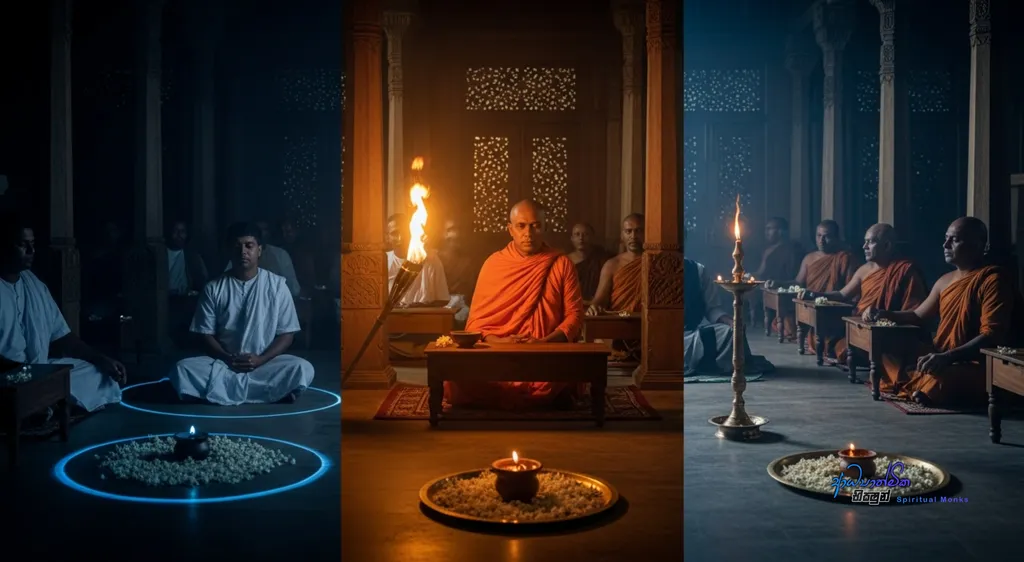
To illustrate this process, imagine you are placed in a pitch-black room. You were brought here, and you don’t know who or what is inside with you. You don’t know if there are tables, chairs, or other people. You are in total darkness. This is the state of our mind when it’s covered by delusion, or Moha. We have been living in this darkness for a long time.
Now, what if you find a tiny light, like a single LED bulb? With that small glow, you can’t see everything clearly, but you can surmise that you are not alone, there is *something* else in the room. This is the first stage of mindfulness meditation. It gives you just enough light to see that thoughts are present.
Then, imagine you find a torchlight. With its stronger beam, you can scan the room. ‘Ah, there are desks, chairs… and there are other people here, just like me!’ You start to identify the contents of the room. This is like when your mindfulness becomes stronger and more consistent.
Instead of just a vague sense of ‘thoughts,’ you clearly see them: thoughts of greed (lobha), aversion (dosa), and delusion (moha). You see past memories and future plans, wholesome (kusala) and unwholesome (akusala) mind-states. You see everything that was previously hidden in the darkness of delusion.
Finally, imagine a bright light illuminates the entire room. Now you see everything perfectly, the desks, the chairs, the other people. With this complete clarity, you can also see the door. You can see the way out. This is when your mindfulness meditation is highly developed. You see not only the thoughts but also your attachment to them, your aversion to them, and the entire structure of your mental world.
You see all the living and non-living things you hold in your mind, and your clinging or hatred towards them. This process of seeing is what happens as mindfulness is established. Many people mistake this stage, thinking, ‘This mindfulness is making more thoughts appear!’ But that is not what is happening. We are simply dispelling the darkness.
How to Practice: Watching Without Labeling
Let’s bring this back to your practice. Say you begin by silently watching the mind, as we have guided. Then, you start a Samatha practice like focusing on the space between the eyebrows while mentally repeating ’emptiness.’ On the very first day, you might experience a torrent of thoughts about the past and future: things you did, things you said, feelings of desire, anger, jealousy, both good and bad. A typical concentration practitioner would try to forcibly overpower these thoughts by repeating their mantra faster and faster: ’emptiness, emptiness, emptiness!’
However, we have taught you to establish mindfulness here. We guide you to understand, ‘This is the nature of the mind.’ We encourage you to watch closely as past thoughts arise, as future thoughts arise. In line with our teaching on ‘Silently Watching the Mind,’ we guide you to recognize: ‘A thought of the past has arisen.
A thought of desire has arisen. A thought of anger has arisen.’ We see wholesome thoughts of non-greed (alobha) and non-aversion (adosa) arise as well. But we do not do anything to them.
We have never told you to look at these thoughts and label them as impermanent (Anicca), unsatisfactory (Dukkha), or not-self (Anatta). We don’t ask you to repeat Pali or even Sinhala phrases. Why? Because these insights, these ‘Three Marks of Existence’, appear naturally as you sustain mindfulness. It’s like watching TV and an advertisement you like suddenly appears. You didn’t force it to show up; it happened randomly.
You don’t force yourself to watch ads on TV; that would become tedious. But when one appears unexpectedly, you might watch it. Similarly, the perception of impermanence arises spontaneously. The perception of not-self appears spontaneously. There is no need to force it.

The Gradual Emptying: How True Peace Arises
As you continue this practice, a wonderful transformation occurs. The things you see in the ‘room’ of your mind begin to disappear on their own. As you see the desks, chairs, and people, your attachments, aversions, and delusions, more clearly, they start to vanish. The more you understand them, the more the mind naturally lets them go.
What does it mean to ‘understand’ them? It means recognizing with wisdom, born of mindfulness: ‘Am I attached to this? Am I bound by greed and craving? Do I feel hatred towards this?’ As you recognize these patterns, your mind’s room begins to empty. This happens through a gradual process of abandoning.
First, there is a temporary abandonment (Tadanga Pahāna), where defilements are temporarily pushed aside by the presence of mindfulness. Then, as your concentration deepens alongside mindfulness, there is abandonment by suppression (Viskambhana Pahāna), where they are held at bay for longer periods. Finally, through the power of insight and sustained practice, there is abandonment by eradication (Samuccheda Pahāna), where they are uprooted completely.
This is a process that unfolds as you continue the practice, little by little, every day for the rest of your life. This is an experience you can realize for yourself, practically. So you can see, there is no new increase in thoughts during mindfulness meditation. What happens is that the thoughts that were always there, hidden in the darkness of delusion, are now being seen in the light of your awareness.

Conclusion: The Light of Awareness
With this understanding, I believe you now have the clarity needed to continue your practice without confusion. I will conclude this teaching on the topic of why thoughts seem to increase with mindfulness. May the power and blessings of the Buddha, the Dhamma, and the Sangha, the Triple Gem, help you all to comprehend these points, to cultivate them practically, and to develop your wisdom further and further.
We invite you to walk this path with us. Read our teachings, and most importantly, apply them practically in your own life. as you practice, questions will naturally arise. Please feel free to share your experiences and questions in the comments below, via email or contact form. I will do my best to offer guidance in future talks based on your progress. For now, begin this practice with an open heart and a mind free from expectation. Cultivate it correctly, and may you find the clarity and peace you seek.
Thank you for joining us. We hope this blog will be of great benefit to your spiritual journey.
May you all be well and happy.
May the blessings of the Triple Gem be with you all!


