


Categories: How to Concentrate the Mind?
May the blessings of the Triple Gem be with you all! Today, through our spiritual teachings, I wish to address a question that many of you have asked. After listening to our guided meditations and beginning your practice, a common challenge arises: how to concentrate the mind. We have provided practical instructions on how to meditate, but many people find they simply cannot make their mind stay focused.
The first thing to understand in our practical approach is that you should not try to forcefully concentrate the mind. We can never, ever control our mind through sheer force. It is an impossible task. This is the first truth we must grasp. Instead of fighting with it, our goal is to understand the very nature of our mind.
To do this, we need to develop a separate understanding of the mind and how it functions. I hope to offer a series of practical teachings dedicated to this topic, helping you understand the mind in your daily life. But for now, let’s explore a simple way to learn how to concentrate the mind, especially for those of you following our ‘Third Eye’ practical meditation series.
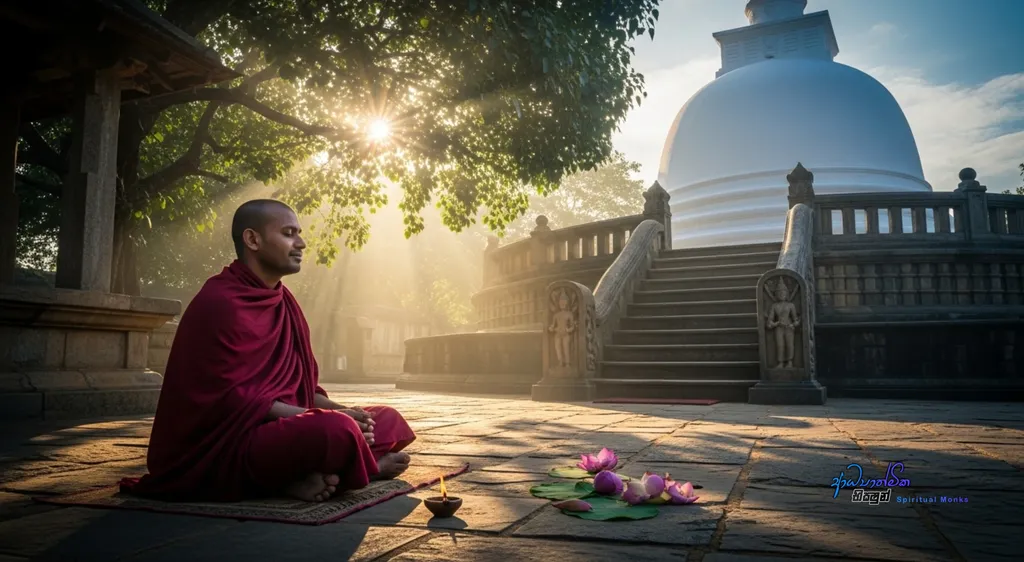
Why You Can’t Force Your Mind to Be Still
In that meditation guidance, I have instructed you to rest your attention between the two eyebrows, or in the middle of your forehead. A frequent question is, “Should I be looking at this spot with my physical eyes or with my mind?” The answer is that you must look with the mind. This focus, this observation, is done with the mind.
However, many of you report that even when you do this, the mind scatters. It runs here and there without end. This brings me back to my first point: that is the very nature of the mind. Its nature is to scatter and wander. After living for so long in a state of unmindfulness (a state we could call asihiya in the Buddhist tradition) we suddenly try to bring our awareness to a single point, and the mind resists. It simply won’t allow it.
Imagine being in complete darkness for a long time. If a bright light is suddenly shone on you, your eyes cannot bear it. The nature of the mind is similar. We have been living in the ‘darkness’ of unmindfulness. Even before you started exploring these teachings, you were in this state. Coming into mindfulness, into the ‘light’ of the present moment, is a difficult adjustment.
The Gentle Art of Acknowledgment: How to Concentrate the Mind by Letting Go
This state of unmindfulness, or asihiya, is present in your daily life, at the office, at home, talking with someone on the phone, watching TV, or traveling. In almost every moment, you are not fully present. You must come back to a state of awareness, or sati, which is a core mindfulness practice. This is what I explained in the teaching about the ‘Empty Present Moment.‘
So, when you sit for meditation, you must first return to this awareness. If you are placing your attention on the middle of the forehead as instructed in the first ‘Third Eye’ meditation, simply hold your mind there. Inevitably, your mind will go to one of two places: the past or the future. This wandering is natural. Let the mind go. However, you must be an observer. You must remain mindful.
When your mind travels to the past, simply recognize it: “My mind has gone to the past.” If it travels to the future, recognize that: “My mind has gone to the future.” This simple act of recognition is enough. It is the only thing that needs to be done.
Observing the Mind’s Journeys to the Past
When you recognize the mind’s journey this way, it will naturally return to the present moment. If your point of focus is the middle of your forehead, you will find your attention has returned there on its own. You can then continue to hold it there. But again, the mind will wander to the past. It will go to the future again.
Let’s look at the past. Your mind might bring up memories of your school days, university life, or childhood. It could be what you ate yesterday, a trip you took, happy moments, mistakes you made, or things you regret. All these memories from the past will surface. This is the mind’s nature, it tries to interrupt the meditation you are trying to do. Your task is simply to recognize it. “Ah, now my mind has gone to my university days. Now it is in my first-grade class. Now it is worrying about an exam. Now it is remembering a past mistake. Now it is recalling a good deed I did, or a bad one.”
Everything from yesterday to the moment just before you sat down to meditate belongs to the past. When any of it arises, just acknowledge, “My mind has gone to the past.” In that very moment of recognition, your mind returns to the present. It will settle again on your point of focus.
Watching the Mind Create the Future
The same principle applies to the future. When the mind wanders to the future, it creates scenarios. If you are unmarried, it might create images of getting married or finding a partner. It will generate desires: to buy a car, build a house, buy land, get a better salary, become wealthy, or decorate your home beautifully. It presents all sorts of worldly things. It might even create spiritual fantasies. When this happens, you see it and recognize, “Ah, my mind is creating the future. It is caught up in future plans.” The moment you recognize this, your mind naturally returns to the present.
These are the two main directions the mind travels. However, sometimes the mind does neither; it just chatters away in the present moment. It’s like an internal narrator that won’t stop talking. Recognize this state as well. You will notice this quality of your mind chattering on its own. By simply acknowledging it, you can find stillness.

Like a Lotus Flower: Rising Above the ‘Mud’ of Your Mind
This practice of learning how to concentrate the mind is not limited to your formal meditation sessions. You can apply it during all the moments I mentioned earlier: while you are working, doing chores at home, traveling, or even sweeping the yard. As we explored in the teaching on the ‘Empty Present Moment‘ maintain your mindfulness in every activity. When you practice mindfulness consistently throughout your day, you will find it becomes much easier to concentrate the mind during meditation.
Do not try to tame your mind with force. This advice is relevant for everyone, whether you are following our ‘Third Eye‘ meditation series or the ‘Journey to the Brahma Worlds‘ series. Both paths require this foundational skill. Please reflect on this teaching again and again, and practice concentrating your mind in this gentle way. Forcing focus will never work.
Concentrate the Mind: A Practical and Accessible Practice
The reason forcing it doesn’t work is like trying to empty a natural spring by bailing out the water. You can bail forever, but the spring will never run dry. You must understand the nature of the spring and adapt to it. In the same way, we must rise out of this swamp of mental chatter. Just as a lotus flower grows up from the mud to blossom beautifully above the water, we must do the same with our practice.
Please try to grasp this point. Many of you ask me about this, so I hope this explanation has brought you clarity. In the future, I have prepared more teachings on the nature of the mind and how to integrate these mindfulness practices into your daily life to support both the ‘Third Eye’ and ‘Journey to the Brahma Worlds’ meditations. I will make sure you all have the opportunity to explore them.
It is important for me to say again and again: all of these teachings are practical. You can do them from your own home, or from wherever you are. Whether you are in your home country or in a foreign land, you can engage with this practice. Do not try to tame the mind in some special way; it is an untamable thing. You can only guide it by understanding its nature. Come back to mindfulness again and again and recognize the way your mind behaves.
A Final Blessing for Your Journey
I believe this brief explanation has clarified how to concentrate the mind. I hope you have understood this principle. Please continue your practice in the way I have described. We will share more ways to develop your meditation in even easier ways in the future.
For today, I will conclude this teaching. By the grace and protection of the Triple Gem (the Buddha, the Dhamma, and the Sangha) may you all gain the ability to concentrate the mind by understanding its nature. May you maintain wisdom and mindfulness as taught by the Lord Buddha. May you develop these methods of Samatha (calm) and Vipassanā (insight) meditation. May you all receive the strength and courage to develop in every way. May the protection and energy of the Triple Gem be with you.
By weaving these three practices chanting, resolution, and loving-kindness into your daily life, you create a powerful support system for your spiritual journey. They will protect you, energize you, and help you cultivate the mental freedom and deep inner peace you seek. Nurture your path with this wholesome Buddhist daily practice.
We invite you to walk this path with us. Read our teachings, and most importantly, apply them practically in your own life. as you practice, questions will naturally arise. Please feel free to share your experiences and questions in the comments below, via email or contact form. I will do my best to offer guidance in future talks based on your progress. For now, begin this practice with an open heart and a mind free from expectation. Cultivate it correctly, and may you find the clarity and peace you seek.
Thank you for joining us. We hope this blog will be of great benefit to your spiritual journey.
May you all be well and happy.
May the blessings of the Triple Gem be with you all!


