


Categories: Divine Ear: Practical Meditation
May the blessings of the Triple Gem be with you all!
Welcome. In our spiritual journey together, we will continue exploring the profound practice of developing what is known as the divine ear. About a year ago, we began this discussion, and today, we will delve deeper, offering more clarity and refined guidance based on the experiences you have shared. So, what is this divine ear, or the “purified ear”? In essence, it is the ability to hear sounds beyond the normal range of human perception.
As your spiritual practice deepens through meditation, you’ll find that your senses become more refined and powerful than what we typically experience in the human world. This development, however, is primarily for those dedicated to meditation.
While great beings like Bodhisattvas may naturally possess such abilities due to their accumulated merits over lifetimes, and some who practiced meditation in recent past lives might experience it spontaneously, for most of us, this is a skill cultivated through dedicated practice. As spirituality grows, your senses become incredibly sensitive.
Your nervous system is stimulated in new ways, allowing you to perceive sounds that are normally inaudible, far exceeding the standard 20,000 Hertz limit known to Western science. This is a vast and wondrous area of experience, and it is something you can practically attain.
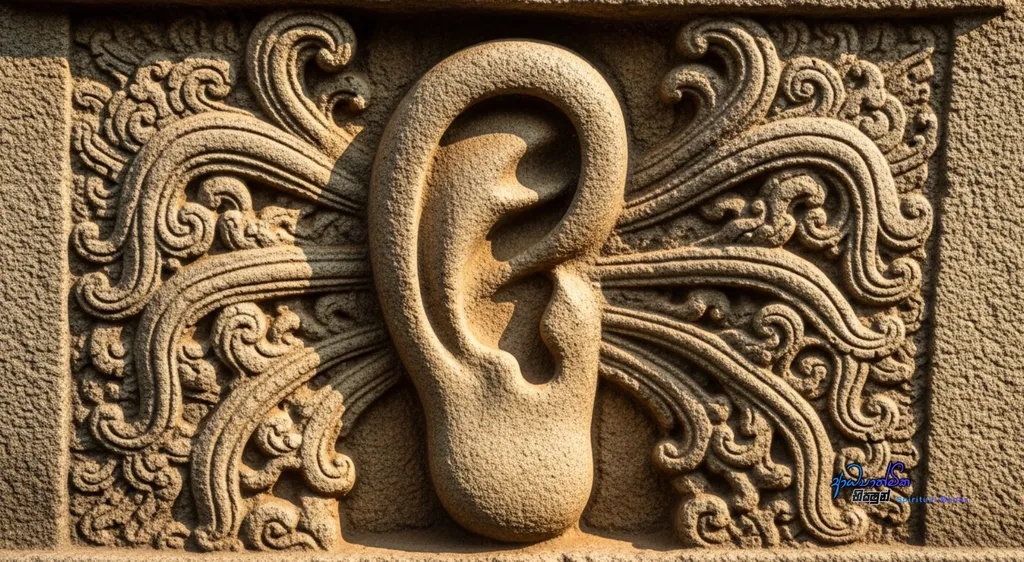
The Spectrum of Spiritual Sounds: What You Might Hear
In our first teaching on the divine ear, we mentioned the kinds of initial sounds you might perceive. Let me remind you of a few: a steady humming sound, like a radio wave; frightening or harsh sounds from non-human realms; and beautifully sweet, melodious sounds and voices from divine realms. As you begin to hear these, your mind starts to adapt. We previously discussed how you can train this ability by setting aside specific time for practice, allowing it to develop gradually.
Many of you have been practicing diligently and have asked for the next teaching, sending messages to us. We offer these teachings when the time is right, as this is a natural process that unfolds according to your needs. Some of you have reported that the divine ear is now very clear, especially during deep meditation, states of absorption known in Buddhism as Jhāna. In these moments of profound concentration, you have shared that you can clearly hear conversations from divine planes, spoken in melodious languages.
As you focus on these sounds, your concentration deepens, and the clarity of your perception increases. Conversely, you have also reported hearing sounds from the non-human planes that coexist with our human world. These are often harsh, disturbing, and filled with negativity.
The conversations revolve around manipulation, dependency, and control, how to dominate another being. Listening to these different sounds gives you a direct insight into the nature of these various realms of existence compared to our own.

Listening to the Brahma Realms: The Sound of Silence
Now, let’s consider the higher realms, such as the Brahma worlds. If you direct your attention there, you’ll notice an almost complete absence of sound. The beings in these planes, the Brahmas, are constantly absorbed in deep meditative states, or Jhānas. As the Buddha taught, they engage in very little conversation. They speak only when absolutely necessary. For example, a Brahma might simply state,“This item is needed,” without any further explanation of why, where it comes from, or what it’s for. There is no extraneous talk.
This is a key characteristic of spiritual advancement that you may have already experienced: as you progress, unnecessary chatter diminishes. You speak only what is essential. The Brahmas have perfected this.
They spend their time experiencing the profound bliss and peace of the meditative states they cultivated in their human lives. This is the inner peace that so many people in our world seek. We work jobs, manage families, and constantly face stress and pressure. The ultimate relief everyone desires is mental tranquility.
Once you taste this deep peace, you become less interested in worldly distractions that disturb it. Beings in the Brahma worlds are absorbed in the bliss of the eight Jhānas, so when you tune into their realms with the divine ear, you don’t hear chatter. Instead, you experience a profound calm, freedom, and an expansive emptiness.
It’s a subtle freedom contained within the silence itself. This becomes especially clear when you detach from sensory pleasures, known as kāma, and focus on your spiritual development.

Why the Brahma Realms Seem Silent: Understanding the Limits
Many practitioners become discouraged when they try to listen to the Brahma worlds and hear nothing. They think their ability has faded or isn’t working. The reality is that the sounds are incredibly subtle, and more importantly, the beings there rarely speak. Furthermore, these beings gather in assemblies, much like we have societies or associations. However, listening in on them is not always possible.
You need a form of permission from that Brahma group. If an outsider tries to eavesdrop, they can sense it. They can then create a protective shield with their mental power, making a resolution that no one from an outside frequency or plane may hear their conversation.
If they sense you are no threat to them or the universe, and that their words will not be taken out of context, they may grant you access. But such opportunities are rare. True communication often happens only if you develop a friendly connection with a Brahma being.
They might then offer you guidance on your own meditative states, asking “How is my Jhāna? How can I develop spiritually?” But remember, you cannot endlessly question a Brahma like you would a human teacher. They offer concise, wisdom-oriented guidance, something for you to contemplate and realize on your own.
They won’t provide constant explanations, because wisdom, or paññā, must blossom from within. They give you a key and allow time for you to discover the lock. Sometimes, a full explanation at that moment would be useless, as you may not be ready to understand it. They let time and your own practice reveal the truth. This is crucial to understand when you use the divine ear to explore the Brahma worlds.

Exploring Other Realms: From Formless Planes to Divine Worlds
Beyond the Brahma worlds accessible to the divine ear are the twenty Brahma realms in total. Among these are the Formless Realms (arūpāvacara) and the Realm of Unconscious Beings (asañña-satta). No matter how hard you try, you cannot hear any sound from these planes. Beings in the four formless realms, the sphere of infinite space, infinite consciousness, nothingness, and neither perception nor non-perception, are completely absorbed in their meditative state until their lifespan in that realm ends.
It’s like when you are utterly exhausted and fall into bed; you know nothing until you wake up. While this is just a simple analogy, Jhāna cannot be compared to sleep, it illustrates the deep absorption of these beings. You cannot converse with them. However, you can perceive an even deeper tranquility and stillness there than in the divine realms.
In contrast, the divine worlds, or deva lokas, are quite different. These realms are still part of the sensory world (kāma loka), just like the human realm, but the sensory pleasures are far more intense and refined. There is much singing, dancing, and joyful conversation. Because of this activity, the divine worlds are an excellent place to test and refine the clarity of your divine ear. You can resolve to listen to various levels of the six divine worlds and their inhabitants. However, even here there are limitations.
For example, if you try to listen to an important assembly led by Sakka, the king of the gods, you will likely find it impossible. Just as we might try to eavesdrop, they employ protective measures. Using their divine power, they place a shield around the meeting so no one without permission can listen in.
This is a security measure, especially to prevent beings like Mara, the embodiment of temptation, from overhearing their plans to protect humanity and the Buddha’s teachings, and then trying to sabotage them. Therefore, when you listen to the divine realms, you will most often hear the pleasant, everyday conversations and melodious sounds, not their most secret councils.

The Divine Ear in the Human World and Beyond
When you direct the divine ear towards the human realm, your capacity is vast. You can, with intention, listen to what your family discusses in your absence, what your relatives are planning, or what your friends and colleagues talk about at work or school. This allows you to understand people on a deeper level.
But how clearly can you hear? This is relative and depends on several factors: your accumulated spiritual merits from past lives (pāramitā), your diligence in meditation practice, and your current level of purity. The more you reduce your attachment to sensory pleasures, the desires of the eye, ear, nose, tongue, and body for things like music, romance, and sensual gratification, the clearer your hearing becomes. If your perception fades in and out, it is because one or more of these three factors needs development. Don’t be discouraged. It takes time and consistent practice to strengthen this ability in the human realm.
As for the non-human worlds, you will mostly hear unpleasantness: screaming, shouting, and conversations centered on base desires like consumption or expressions of pain. In simple terms, it’s mostly garbage. Within the animal kingdom, you will only hear the sounds characteristic of each species; nothing more. If you direct your attention to the four lower realms (apāya), the hells, the realm of hungry ghosts, and the realm of demons, you can hear the sounds of suffering.
From the hells (Niraya), you will hear endless, high-pitched screams of beings begging to be saved from unbearable agony. For someone who has developed both the divine ear and the divine eye (clairvoyance), this experience can be profoundly impactful, providing direct insight into the consequences of unskillful actions.

Cosmic Rules: Sages, Other Worlds, and Universal Law
Just as Brahmas can shield their conversations, spiritually advanced sages (Rishis) can do the same. If they are in an important discussion, they can sense if someone is trying to listen and will block the sound with their intention. Only if you are friendly, trustworthy, and worthy will they allow you to listen.
Many people today have a very superficial understanding of spirituality, thinking it’s just about playing a guitar in nature or having a philosophical chat. But it goes far beyond that, into realms of Jhāna, psychic powers (abhiññā), and even liberation (Nibbāna). True understanding comes only from proper guidance and dedicated practice.
What about listening to other planets or extraterrestrial beings? This is where it becomes very complex. Hearing sounds from other worlds is possible for some but impossible for most. Your past-life karma, meditation skills, and purity of mind are paramount. Generally, only fully enlightened beings like Buddhas, Paccekabuddhas, and Arahants can do this freely. For others, it depends on alignment with universal laws.
There is a cosmic governance, a kind of “universal council,” and only those who are members, who abide by its laws and are deemed harmless, are granted permission to listen to extraterrestrial communications. This restriction exists to prevent potential cosmic-level destruction. It’s like the internet: some websites are public, but sensitive government or military sites are locked.
Trying to force your way in will get you blocked or apprehended. The universe has similar security protocols. If you try to listen to another world and only hear a faint hum or a brief, unclear sound, understand that your divine ear is working, but you do not have permission to hear more.

Mastering Your Ability: Practical Control and Development
Once you have developed the divine ear, you can learn to control it. Like the divine eye or Third Eye, this ability can be active even when you are not formally meditating. If you find the sounds distracting while studying or working, you can make a firm resolution, an adhiṭṭhāna: “For the duration of my studies, may I not hear these external sounds through my purified ear.” This will temporarily suppress the ability, allowing you to focus. Through practice and the wisdom gained from these teachings, you will intuitively learn to manage your abilities.
It’s important to know that these abilities are not universal. Some may only develop the divine eye, others only the divine ear. Some may have both, but one is stronger than the other. The degree varies from person to person.
To develop these faculties further, you must consistently practice virtue (sīla) and make strong resolutions for your abilities to grow and become part of your spiritual perfections (pāramitā). As you do this, your nervous system is further stimulated and refined, deepening your understanding of these subtle sound frequencies.
The key to development is to listen without attachment or aversion. Do not crave the pleasant, melodious sounds or feel anger and fear towards the frightening ones. Remain centered in equanimity, or Upekkhā, a state of balanced neutrality that we speak of often. By maintaining this middle path, your spiritual faculties will naturally flourish, just as they have developed up to this point. With this understanding, you can proceed on your path without doubt.

Conclusion: A Path of Understanding
I trust that this second practical teaching on the divine ear has provided you with the proper understanding and knowledge you need. We have discussed why some realms are silent to you and what you can and cannot hear, to help you navigate this ability without confusion or self-doubt. With this clarity, you can continue your practice with confidence. We will continue to offer general teachings on this topic in the future to address any further questions that may arise, ensuring you can walk this path without uncertainty.
For today, we will conclude our discussion. Through the power and blessings of the Buddha, Dhamma, and Sangha, the Triple Gem, may you all grasp these points clearly and be able to apply them practically in your spiritual journey. May you find success in your practice.
We invite you to walk this path with us. Read our teachings, and most importantly, apply them practically in your own life. as you practice, questions will naturally arise. Please feel free to share your experiences and questions in the comments below, via email or contact form. I will do my best to offer guidance in future talks based on your progress. For now, begin this practice with an open heart and a mind free from expectation. Cultivate it correctly, and may you find the clarity and peace you seek.
Thank you for joining us. We hope this blog will be of great benefit to your spiritual journey.
May you all be well and happy.
May the blessings of the Triple Gem be with you all!.


