


Categories: Dhyana: Practical Training
Several practitioners have reached out with the same concern. They have been practicing Anapanasati meditation for a significant period, making the breath their primary object of focus. Inspired by teachings on developing higher mental states, such as the ‘Third Eye’ or states of meditative absorption called Jhana, they decide to try a new method. This new practice might involve focusing on the space between the eyebrows or the center of the forehead. However, they quickly find this incredibly difficult.
Why does this happen? The reason is quite simple and reveals a fundamental truth about our minds. When you practice focusing on the breath for a long time, your mind becomes conditioned. It develops a deep habit, a familiar groove. Think about your daily life; if you have a routine you follow every day, changing it suddenly feels awkward and challenging.
The mind works in the same way. It has become so accustomed to resting on the rhythm of the breath that when you try to direct it elsewhere, like the forehead, it naturally drifts back to what it knows best the breath. This is not a failure, but a sign of how deeply the mind has been trained.
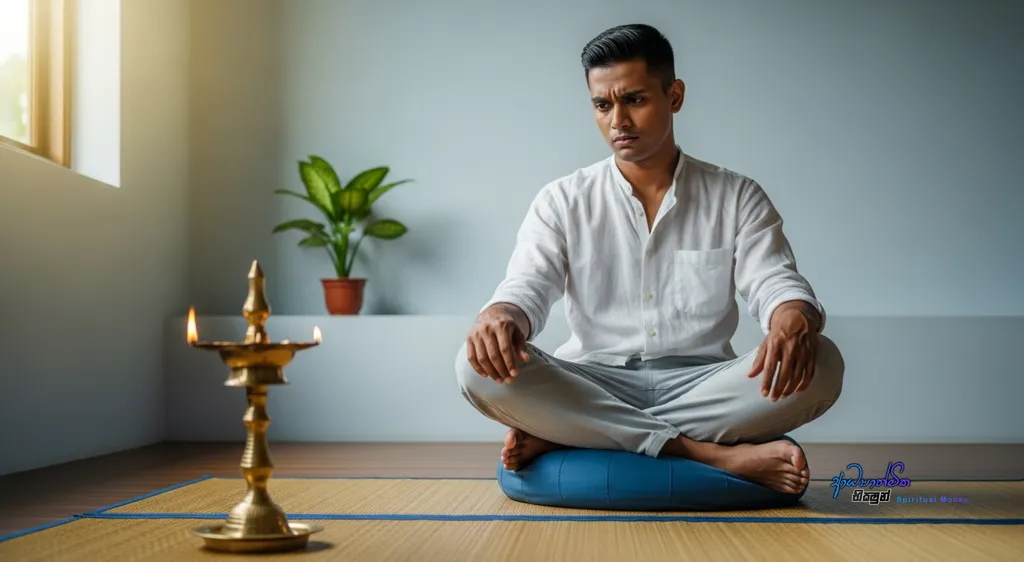
Two Paths Forward: Should You Switch or Deepen Your Practice?
So, what should you do if you face this challenge? The advice depends on your level of experience.
If you are relatively new to Anapanasati meditation and have only practiced for a short time, you might be able to switch your focus to the forehead or the space between the eyebrows. Your mind’s habits are not yet deeply ingrained, so you have more flexibility to explore a new meditation object, or kammaṭṭhāna.
However, for those who have dedicated a very long time to Anapanasati meditation, attempting to force this switch can be frustrating and counterproductive. For you, the guidance is different: continue with your practice of mindfulness of breathing. This is not a limitation.
In fact, your deep foundation in Anapanasati meditation is a great strength, and you can certainly continue to progress towards awakening the ‘Third Eye’ or other psychic abilities. We have previously taught that any meditation method that develops deep calm, known as Samatha whether it’s focusing on cosmic energy, Kundalini energy, or the breath can be a vehicle for this development. Therefore, you can, and should, continue with the practice you have mastered.
How to Weave Loving-Kindness (Metta) into Your Breath Meditation
This doesn’t mean you cannot cultivate other qualities, such as loving-kindness, or Metta. Many who are devoted to Anapanasati meditation find it difficult to practice Metta meditation because as soon as they begin to radiate thoughts of goodwill, their attention automatically snaps back to the breath. The solution is not to fight this tendency, but to integrate it.
Here is the guidance we offer: if you wish to practice Metta, do it in harmony with your breath. There is no conflict. As you breathe in, be mindfully aware, ‘I am breathing in.’ Then, with that mindful breath, silently repeat your phrases of loving-kindness. As you breathe out, be mindfully aware, ‘I am breathing out,’ and let that breath carry your feelings of Metta outwards, spreading to all beings in all ten directions, filling the universe.
In this way, you use the familiar rhythm of the breath as the vehicle for your Metta practice. You can apply this principle to any other practice you wish to develop. Your foundation in Anapanasati meditation becomes the stable ground upon which you build everything else.
The Strength of a Single Path: Why One Practice is Enough
With continued practice, your mind will become more pliable and skillful. In the beginning, it can be hard to manage two things at once, but for someone whose mindfulness is well-developed, the mind can be directed as needed. A highly trained practitioner can engage in Anapanasati meditation when they choose, and then, if they wish, shift to Metta meditation without the mind being pulled back to the breath. This ability comes from deep training and sometimes from past-life affinities, or what we call saṃsāric habit patterns.
However, it is not necessary to practice many different types of Samatha (calmness) meditation. It is far more effective to choose one and develop it fully. The Buddha taught Anapanasati meditation as a direct path to the ultimate goal of Nibbana, or liberation. But it is also a complete system for developing profound tranquility and can serve as the foundation for other goals, like the ‘Third Eye’ or attaining the state of Brahma.
We generally recommend practices like Metta for the purpose of protection and dissolving obstacles, not as a primary object for deep concentration. Choose one core practice. Once you master it and move to higher stages, you won’t need to keep revisiting the basics.
Embracing Your Unique Journey with Wisdom and Patience
There is no need to make this teaching longer than necessary. The essential guidance has been provided. We hope you now understand why it can be difficult for a practitioner of Anapanasati meditation to train in other methods and, more importantly, how to skillfully work with this reality. We encourage you to proceed with your practice according to this advice.
May the power and blessings of the Buddha, the Dhamma, and the Sangha the Triple Gem guide you in your efforts.
We invite you to walk this path with us. Read our teachings, and most importantly, apply them practically in your own life. as you practice, questions will naturally arise. Please feel free to share your experiences and questions in the comments below, via email or contact form. I will do my best to offer guidance in future talks based on your progress. For now, begin this practice with an open heart and a mind free from expectation. Cultivate it correctly, and may you find the clarity and peace you seek.
Thank you for joining us. We hope this blog will be of great benefit to your spiritual journey.
May you all be well and happy.
May the blessings of the Triple Gem be with you all!.


