


Categories: Maintaining Mindfulness
May the blessings of the Triple Gem be with you all!
Today, as always, I am here to support you on your spiritual journey. Many of you who follow our teachings are seeking to improve your practical lives, and often, you face questions and obstacles. I hope this discussion provides clarity, deepens your understanding, and strengthens your practice.
A question I frequently receive is whether our teachings explain the path to Nibbāna, or liberation. We have indeed addressed this through our series on cultivating mindfulness. In these teachings, we continuously remind you and offer guidance on what mindfulness is, how it should be practiced, and the process that unfolds within you. Our work initially began with a focus on Samatha, which is the practice of developing deep calm and concentration. We’ve explained this in our introductory talks about our purpose.
However, over time, we saw a need to address the path to liberation more directly. This was partly due to misunderstandings and teachings from others that were often impractical, limited only to what is found in books. For someone who genuinely tries to practice, the gap between theory and reality becomes obvious. We have a way of practicing, a way that is alive and ongoing.
About a year after we started, we launched the series on ‘Cultivating Mindfulness’ to share this practical path. The foundational teaching for this series is the one we encourage everyone to begin with: ‘Silently Watch the Mind.’ Although the title is simple, this talk explains the very mechanics of how to begin this practice.

Beyond the Words: Understanding Universal Experiences on the Path
Despite our detailed teachings on mindfulness, some still ask why we don’t discuss Vipassanā, or insight meditation. On the other hand, when we discuss topics like the ‘Third Eye,’ ‘Universal Energy,’ or ‘Kundalini Energy,’ some people have an allergic reaction. Not knowing the deeper meaning behind these words, they find them incompatible with their understanding and may even accuse us, asking, ‘Is this what the Buddha taught? Where is this in the scriptures?’
To those who practice, I have always said that these are just words; the inner process they describe is one and the same. This can only be understood by someone engaged in practical training. To anyone else, it remains incomprehensible. I invite those who are skeptical to engage in the practice for themselves.
A day will come when you will understand. You will immerse yourself in this process, and you will realize, ‘What the monk taught is true.’ You will see that whether we call it the ‘Third Eye’ or use another term, the underlying process experienced in meditation is identical for any spiritual person, especially in the context of developing calm. The experience of Samatha is universal, whether you practice within the framework of Buddhism or outside of it. Only the labels change. You will realize that the felt experience is the same.
I don’t wish to elaborate further on this, as we have dedicated entire talks to these topics which you can find and explore. Our teachings are offered out of compassion for you.
Beyond Blind Faith: The Crucial Role of Personal Practice
In any field, you will find people who talk more than they know, so-called ‘pundits.’ I don’t mean the wise sages mentioned in the Tipiṭaka (the Buddhist scriptures), but the kind of person you might mockingly call a know-it-all. They present themselves as experts on every subject, including Buddhism, claiming to know everything.
Truly learned and dignified people, however, never pay them any mind. An accomplished academic, like a professor, can immediately tell if someone discussing their field is speaking from genuine knowledge or from ignorance.
Set aside the spiritual path for a moment and look at the academic world. Truly educated individuals are often very humble. They are quiet within their field of expertise. These quiet experts can immediately spot someone who is just boasting, someone who has picked up a few things here and there, perhaps from a book or two, or maybe just from YouTube, and speaks with false confidence.
You can see such people everywhere, even leaving boastful comments and engaging in endless arguments in our comment sections, questioning if our teachings are authentic Buddhism. Their approach immediately reveals whether they are practical or not, whether they are just clinging to a word they picked up somewhere.
In our Buddhist community, both men and women face a related issue. They might listen to a monk’s teachings, become deeply impressed, and then take refuge in that person alone. While there is nothing wrong with respecting a teacher, we often say, ‘Do not take refuge in a person.’ The true refuge is the Triple Gem: the Buddha (the enlightened one), the Dhamma (his teachings), and the Sangha (the community of noble disciples). Make the scriptures your teacher.
When someone takes refuge in a single person, they may end up believing that only what that monk says is correct, even if that monk’s knowledge is purely from books. Our approach is to tell you to practice and realize the truth for yourself. But someone attached to one teacher may never even practice what is taught; they just cling to the words.
That teacher might only be explaining the limits of what is in the book, and the follower becomes confined to that, believing it is the only truth. Please do not try to settle for just the book’s account. I am not saying the Tipiṭaka or its commentaries are wrong. I am saying that to realize their truth, you must become practical.

Unmasking the Mind: Identifying the Defilements That Bind You
The central point I wish to make is this: by developing mindfulness, you can eliminate the mental defilements. These defilements, known in Pali as Kilesa, are the very things that drag us through Saṃsāra the endless cycle of birth, death, and rebirth. They are the forces of attachment and aversion that arise within us. What are they? From the perspective of the mind, they are thoughts, mental states that cause us to cling and to push away.
It is this mind, with its internal states of attachment and aversion, that propels us through Saṃsāra. These forces can lead to pleasant rebirths, where we experience worldly happiness, but they also lead to suffering realms, like the hells. This is the nature of the mind. When we accumulate actions driven by these states, we create kamma, intentional actions that shape our future.
So, what are these kilesa? Any attachment or aversion that arises in your mind is a defilement. If you love your son or daughter, that is a defilement. If you hate them, that is also a defilement. If you love your husband or wife, that is a defilement. If you hate them, that is also a defilement. A person walking the path to Nibbāna works to eliminate all of them.
You might wonder, ‘How can loving my spouse be a defilement?’ From a conventional, social standpoint, it is, of course, a good thing. However, on the path to liberation, one abandons both merit and demerit. This doesn’t mean you stop doing good deeds. It means you abandon the mental attachment to the results of those deeds.
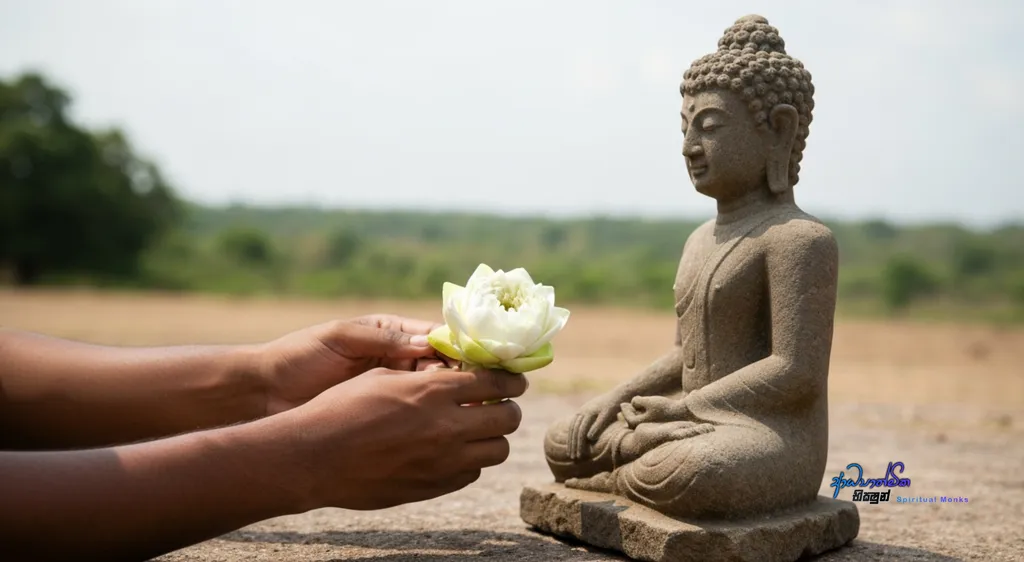
When you make an offering at a great stupa, you might do so with a deep-seated craving, ‘May I be reborn in a heavenly world,’ ‘May I receive beautiful things.’ There is a subtle desire within you. But when an Arahant, a fully enlightened being, pays homage to the Buddha with a flower, there is no desire for a future birth. There is only a joyful expression of gratitude to the teacher who showed the way. There is no attachment or aversion. You, however, generate these states. This is the very thing we come to understand by developing mindfulness.

Your Toolkit for Freedom: The Four Foundations of Mindfulness in Practice
When we begin to recognize these defilements, we do so through a systematic practice. The Buddha laid out this training in the Sutta (discourse) on the Four Foundations of Mindfulness, or Satipaṭṭhāna. This framework includes:
- Kāyānupassanā: Observing the body in the body.
- Vedanānupassanā: Observing feelings/sensations as they arise.
- Cittānupassanā: Observing the mind or consciousness.
- Dhammānupassanā: Observing mental qualities or phenomena.
This whole practice, whether you are observing your posture, a feeling, a thought, or your level of energy, is centered on your own mind. When you lift your arm, are you aware of it, or does your mind wander? You watch this with mindfulness. When you sit in one posture for a long time, a painful feeling arises.
This is a common obstacle in meditation. What does a person developing mindfulness do? They watch that pain. They observe it directly. ‘Am I creating aversion towards this physical pain?’ they ask. By recognizing any aversion, they simply keep their attention on it.
As we always say in our teachings on mindfulness, you don’t need to repeat any words or phrases. You just need a basic understanding of core concepts like dependent origination (Paṭiccasamuppāda) and the three marks of existence (Tilakkhaṇa).
As you watch the pain, you will see it for yourself: a painful sensation arose, and then it ceased. Now you feel a pleasant, comfortable sensation in that same spot. You realize, ‘Ah, it changed!’ You see that the feeling that arose has passed away. This is the direct experience of impermanence, or Anicca. This is the understanding the Buddha spoke of.
A wound on your body doesn’t last forever; it heals. Your body itself doesn’t last forever; it changes. You understand this universal truth directly by developing mindfulness. In this way, mindfulness helps you understand the changing nature of the body and your attachments and aversions to it.

As Your Mindfulness Grows: Navigating the Deeper Stages of Practice
As you continue developing mindfulness, you will also begin to see the arising of thoughts. There are pleasant thoughts you cling to, and unpleasant thoughts you resist. There are also neutral, equanimous thoughts. We have taught you to recognize all of them. You also start to notice your mental state.
Is your energy (viriya) low? We have talks on how to boost your energy. Are you feeling fear? You learn to recognize it. Laziness, hunger, low energy, we have explained how these are part of the ‘Ten Armies of Māra‘ that obstruct the path. We constantly remind you to watch these states.
I am explaining this at a high level today, as going into each part in depth would take a very long time. What is necessary is not more theory, but for you to realize these things practically. We often recommend reading the books of the venerable Rerukane Chandavimala Nayaka Thero.
As you practice, you will understand his writings more deeply. If you practice mindfulness for a few months and then reread a book, you will grasp things you missed the first time. Practice again for a few more months and reread it, and your understanding will be even deeper. Everything is practical.
This is why we say that as you engage in the practice, your defilements will be destroyed. When a person becomes equanimous (upekkhā) or neutral towards something, it means they have understood it completely. Through that understanding, the defilement is abandoned.
This happens little by little. Your practice of mindfulness will start in one way, continue, and evolve until the very end. The scope of your mindfulness will gradually broaden. If you can only maintain mindfulness for ten seconds at the start, with practice it will become twenty seconds, then thirty, and so on. You will realize for yourself, ‘My mindfulness is stronger and wider than before.’

Walking the Path at Home: Mindfulness Amidst Daily Responsibilities
When your mindfulness strengthens, anything that breaks your concentration will start to feel like a nuisance, a headache. A constant phone call or interruption from someone can feel like a direct obstacle to your spiritual life. In the beginning, this is aversion. But with practice, you learn to face even this with equanimity.
For those living a householder’s life, as you are developing mindfulness, you may start to see your worldly existence, your family life, job, education, as unpleasant, meaningless, and without substance. This is a common stage. If you are bound by the duties and responsibilities of lay life, our constant advice is this: Continue developing mindfulness.
Understand that household life is inherently stressful (dukkha) and unsatisfactory. However, while you are fulfilling your responsibilities, continue to develop your mindfulness alongside those duties.
Why? Because if you die in the middle of fulfilling these responsibilities without having cultivated mindfulness, you are bound to continue in the cycle of Saṃsāra. You will be reborn, likely find another husband or wife, have children, and live the same life all over again. In this cycle, the risk of falling into miserable states of existence is high.
That is why we urge you to practice, even a little bit, both calm (Samatha) and insight (Vipassanā). By doing so, you achieve a degree of success in your worldly life while also advancing your spiritual life. A time will come when you are free from your duties to your children and spouse, and you can dedicate yourself fully to realizing the path. By starting now, little by little, you prepare for that time.

Redefining Love: From Attached Affection to Pure, Liberating Compassion
As you can see, even the love within a family is a defilement (kilesa) from this ultimate perspective. All the love that arises in our hearts is, at its root, a form of attachment. You may have heard other teachers say that love is a wonderful thing. And from a conventional, social perspective, it is. But on the path to extinguishing the defilements, we eliminate even that form of love. This is Nibbāna. What remains in such a being is something utterly pure.
Consider this: when you show kindness (karuṇā) or loving-kindness (mettā) to a beautiful woman or a handsome man, it is often subtly tainted with lust (rāga). There is an underlying desire for a romantic or sexual connection mixed in with the kindness. Now, imagine an enlightened Arahant helping a beautiful person. In them, there is no such defilement. There is only the purest form of compassion.
This helps you understand the difference between the love spoken of at the social level and the state of a being who is realizing Nibbāna. Theirs is a pure love, a pure compassion, that does not lead to more becoming, more suffering, or another rebirth. Their journey through Saṃsāra is over. To grasp this fully, one may need to study the Abhidhamma (the higher teachings on the nature of mind and matter), but it is through practice that these texts come to life.
Your Path Forward: The Unshakable Power of Mindful Practice
You can apply this same mindfulness to any state of mind, even advanced ones. If you attain meditative absorptions (jhāna) or develop supernormal abilities (abhiññā), you can use mindfulness to see if you are attached to them or have aversion when you lose them. As you keep watching with mindfulness, you realize the truth about them.
As your mindfulness deepens, the number of things you understand increases. It is like digging deeper and deeper into the ground. There are many more truths to uncover. To reach these depths, you must diligently develop mindfulness from this foundational level.
In the beginning, you will taste the freedom and lightness it brings. But then, a time might come when you feel aversion to the practice itself. You must see that too. Feeling aversion means there is resistance. Feeling attachment to the peace it brings is also a subtle defilement. This does not mean you should stop practicing. It means you must observe that attachment with mindfulness.
We encourage you to practice Samatha and attain jhāna, but always watch: are you getting attached? The only way to know this is by developing mindfulness. Without it, you cannot realize any of these truths.
Ultimately, we must all strive to walk the path of insight (Vipassanā-dhura) alongside the path of calm (Samatha-dhura). As you know, insight is a great help in developing calm. So when people accuse our channel of teaching only one thing, be it ‘fringe’ topics that they find ‘allergic’ or only calm meditation, they have not studied our teachings from the beginning.
If they did, and if they practiced, they would see that we have taught the way to end the journey of Saṃsāra. We are showing the path to final liberation, and we will continue to explain it practically.
So, do not be disturbed if someone tells you this path is wrong. Anyone who has practiced from the beginning will understand. For others, I encourage you to listen to our teachings in order, from the start. It will provide the proper understanding and foundation for your practice.
I trust that these points have given you a clearer understanding of how developing mindfulness can eliminate the defilements. I will not prolong this talk further. I urge you to begin practicing today.
May the power and blessings of the Triple Gem, the Buddha, Dhamma, and Sangha, help you realize these truths for yourself through your own practical efforts. May the blessings of the Triple Gem be with you all!
We invite you to walk this path with us. Read our teachings, and most importantly, apply them practically in your own life. as you practice, questions will naturally arise. Please feel free to share your experiences and questions in the comments below, via email or contact form. I will do my best to offer guidance in future talks based on your progress. For now, begin this practice with an open heart and a mind free from expectation. Cultivate it correctly, and may you find the clarity and peace you seek.
Thank you for joining us. We hope this blog will be of great benefit to your spiritual journey.
May you all be well and happy.
May the blessings of the Triple Gem be with you all!.


