


Categories: Dhamma Discussions
May the blessings of the Triple Gem be with you all!
When we speak of meditation, we often picture someone sitting in silence. But there is another powerful, dynamic form of practice known as walking meditation. In the Pali language, this is called Sakmana. It is a way to cultivate mindfulness, or Sati, in accordance with the Four Foundations of Mindfulness. There is a systematic way to develop this practice, but let’s begin with the simple, foundational steps.
Some practitioners choose to do walking meditation with their eyes closed to help focus the mind. While this is a valid technique for some, it is not necessary for everyone, especially when you are starting. A more straightforward way to begin is to keep your eyes open. Find a clear path, perhaps thirty or forty meters long, and simply walk back and forth. You don’t need to force a pace; walk at a speed that feels natural to you, not too fast, and not too slow. The key is to keep your attention directed inward, observing your own mind as you move.
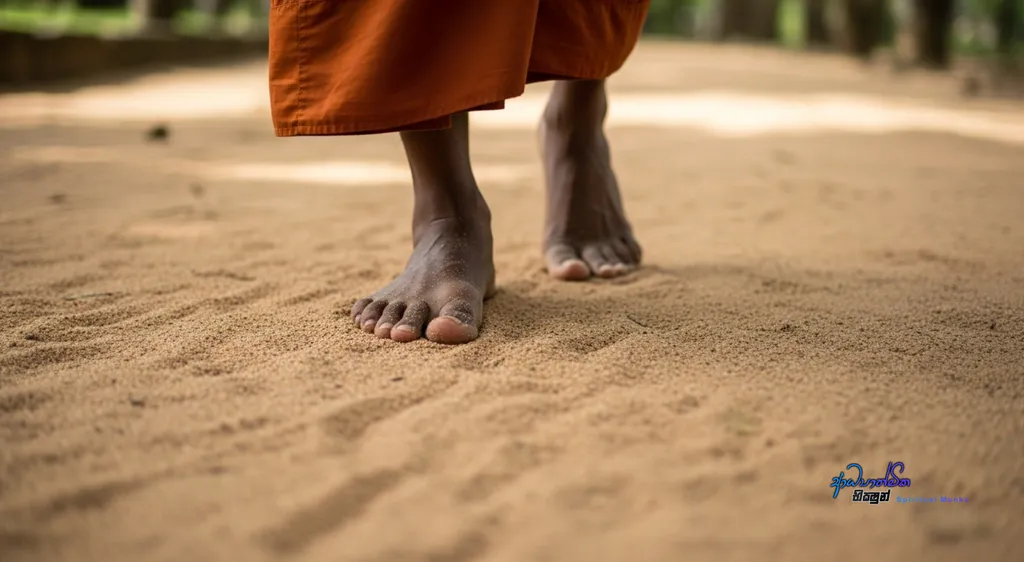
The Four Foundations of Mindfulness in Motion
The true depth of walking meditation is revealed when we apply the Four Foundations of Mindfulness. The primary tool we use here is the body itself, specifically our legs and feet.
1. Mindfulness of the Body (Kayanupassana)
As you walk, the mind initiates the action. It sends the command: ‘lift the foot.’ Then, ‘move it forward.’ And finally, ‘place it down.’ This happens with incredible speed, so fast that at first, you might not even notice the distinct steps in the process. Then the mind gives the same instructions to the other foot: lift, move, place. This direct observation of the body in motion is Kayanupassana, or mindfulness of the body.
2. Mindfulness of Feelings (Vedananupassana)
As your foot touches the ground, you feel various sensations. Perhaps you feel the hardness of a stone or the softness of sand. These sensations give rise to feelings, which in Buddhism are called Vedana. This isn’t just about emotion; it refers to the raw feeling-tones of experience: pleasant, unpleasant, or neutral. You might feel a pleasant sensation as your foot meets the cool earth, or an unpleasant one if you step on something sharp. Recognizing these feelings without judgment is Vedananupassana, mindfulness of feelings.
3. Mindfulness of the Mind (Cittanupassana)
You are also observing the mind that directs the movement, the intention to lift, move, and place the foot. Are you not seeing that mind in action? This is the beginning of Cittanupassana, or mindfulness of the mind. You are watching both the physical action and the mental intention behind it. You are also watching the feelings that arise and seeing how the mind reacts to them. This whole process is what you practice, over and over.
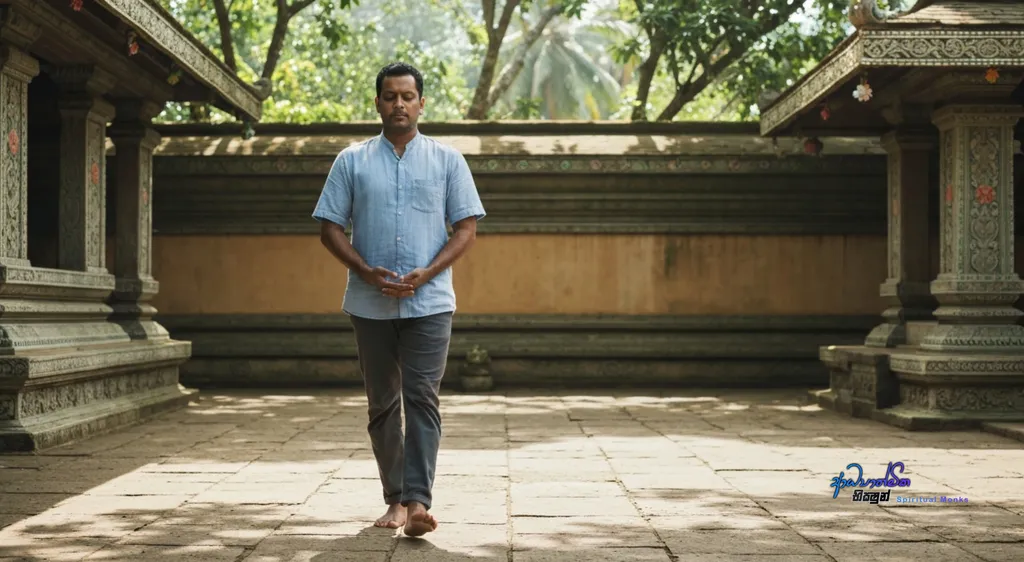
When the Mind Wanders: A Moment to Pause
Just like in sitting meditation, it’s impossible to keep the mind perfectly focused on the walking meditation forever. After some time, you will notice your mind begins to wander. It might drift to the past or race toward the future. Mental objects, or Dhammarammana, will start to appear. You’ll find yourself lost in a thought about something that happened yesterday or planning what you’ll do tomorrow.
This is a critical moment in your practice. The moment you realize your mind has wandered from the sensation of your feet, stop walking. Just stand still. Acknowledge the thought: ‘Ah, a thought of the past has arisen.’ You recognize this through Cittanupassana. Once you have acknowledged where the mind went, gently guide your attention back to your feet. Only then, after reconnecting with the present moment in your body, do you begin walking again. Do not continue walking while your mind is lost in thought. Pause, return, and then resume. This is the training.
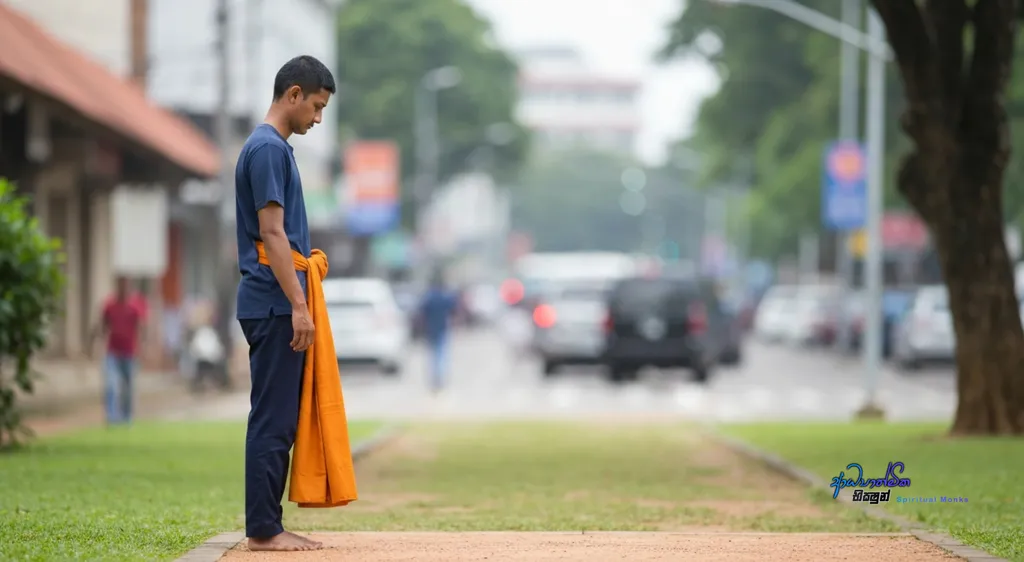
Confronting the Hindrances: Mindfulness of Mental Objects (Dhammanupassana)
As you continue your walking meditation for fifteen or twenty minutes, something else will likely arise: resistance. You might feel tired, hungry, or simply bored. This is the emergence of the Five Hindrances, or Nivarana, which are mental states that block our progress. You might experience sensual desire (Kamacchanda) or ill will (Vyapada), but a very common one during this practice is sloth and torpor, known as Thina-middha.
This isn’t just sleepiness; it’s a heavy, lazy feeling, a mental state that says, ‘I’ve had enough, I want to stop.’ This hindrance weakens our energy and resolve (Viriya). Recognizing this state for what it is, ‘Ah, sloth and torpor is present in me now’, is the practice of Dhammanupassana, mindfulness of mental objects. The moment you identify it, you have already created distance from it. Once you have recognized it, simply return your attention to your feet and continue the walking meditation. The act of acknowledging the hindrance and consciously returning to the practice is how you overcome it.
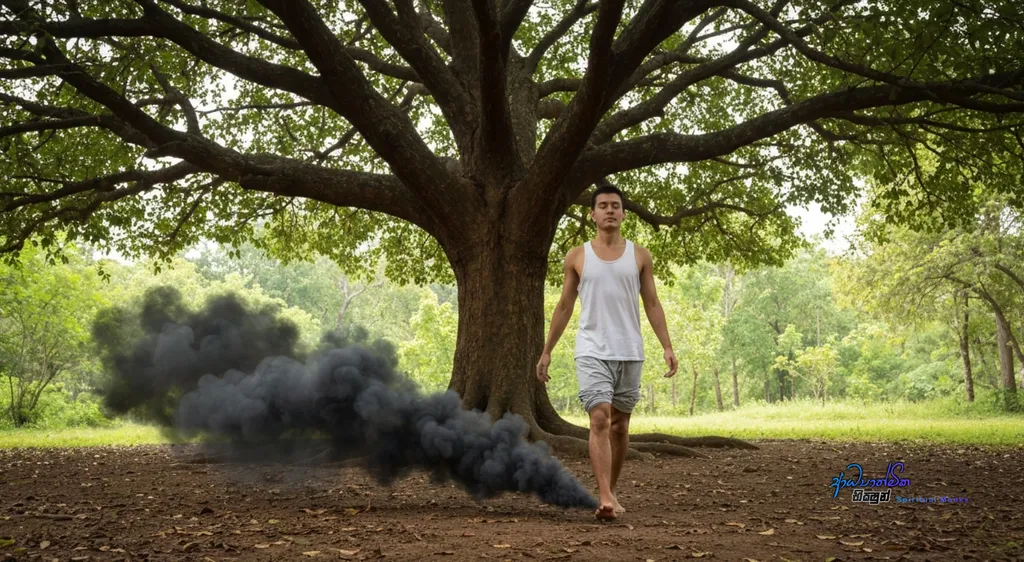
From Walking to Stillness: The Emergence of Jhana
With consistent practice, your ability to sustain this walking meditation will grow. At first, you may manage ten or fifteen minutes. Soon, that will become twenty, thirty, forty minutes, and eventually an hour or more. Through this very practice, it is possible to attain liberation, Nibbana, and to develop deep states of meditative absorption, known as Jhana.
As your concentration deepens, you can reach the first Jhana even while standing. You will feel your mind become completely unified and focused. At that moment, you may feel a natural inclination to close your eyes. As you do, the first Jhana arises, accompanied by a profound sense of joy and rapture (Piti). When you are in such a state, the posture no longer matters. You could be standing for an hour, and it would feel effortless. We have seen people stand completely still for an hour and a half, something that is impossible for an ordinary person to do without the support of a Jhanic state. It is the deep concentration that makes this possible.
Stories of Deep Absorption
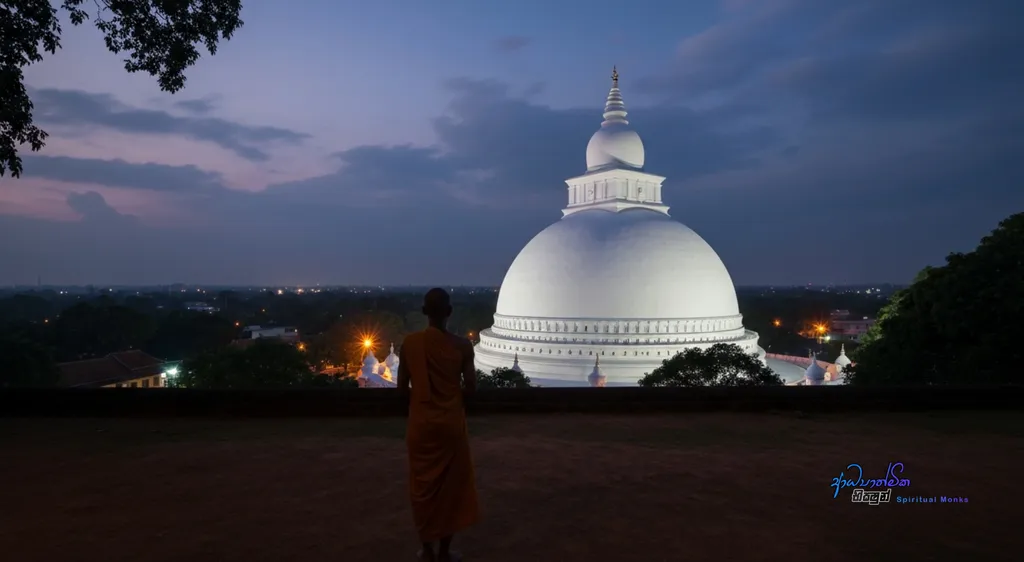
There are living examples of this. Near the great Ruwanwelisaya stupa in Sri Lanka, there was a monk who would stand in meditation for hours on end. We have seen him and recognized that he was in a state of Jhana. He even had a sign asking people not to offer money.
There was an older monk who practiced this way and has since passed away, and now a younger monk continues the same practice, standing motionless, robed in an orange-brown color, with his eyes often turned upward. How else could someone stand for hours, exposed to the sun and rain, without being disturbed? They are in Jhana. When one is absorbed in such a state, the outside world fades away. You are not bothered by who is around you, by the heat, or by the rain. Even the sting of an ant goes unnoticed.
The Natural Protection of the Dhamma
There is a natural law, a principle of the universe known as Dhammata, that protects one who is absorbed in deep meditation or has realized a stage of enlightenment. At such times, one is generally safe from harm. Even if a snake were to crawl over your body, it would not bite. We hear stories of yogis and sages in the Himalayas, where tigers are plentiful. Yet these animals do not harm the yogis, and sometimes even become tame in their presence. This protection is a real phenomenon.
This does not mean a practitioner is immune to all harm at all times. If there is a strong past kamma (intentional action) ripening, harm could still occur, though it is extremely rare, a 99.9% chance of safety. The harm might happen when one has emerged from meditation and is engaged in other activities. But during the practice itself, unseen forces that might wish to obstruct you are counteracted by forces that protect you. Even nature itself provides a kind of assistance.
The figure of Mara in Buddhism represents these obstacles. But Mara cannot cause you physical harm. Mara’s power is in creating mental disturbances, fear, and delays. Imagine you need to catch a bus at 8 a.m. Mara’s influence would be to create a delay that makes you miss it. The goal of such forces is to slow you down, not to hurt you. Therefore, practice with confidence. Trust that you are safe in your practice.
Your Path Forward in Walking Meditation
So, this is how you practice walking meditation. Remember that deep states of concentration and insight can arise. If you experience such things, it is good to seek guidance to know how to proceed. Realization does not come from only one posture. Once you have developed mastery, you can even enter Jhana from a lying-down posture. Sometimes people ask if they should start their practice lying down.
As you can imagine, for a beginner, this is not practical, sleep would be the most likely result! But for an advanced practitioner, any posture can be a gateway. We have known people who, after a long day at work, would begin their evening chanting and immediately enter Jhana. Such is the power of dedicated practice.
Continue your walking meditation with this understanding and trust. Each step is a step toward clarity, peace, and wisdom.
We invite you to walk this path with us. Read our teachings, and most importantly, apply them practically in your own life. as you practice, questions will naturally arise. Please feel free to share your experiences and questions in the comments below, via email or contact form. I will do my best to offer guidance in future talks based on your progress. For now, begin this practice with an open heart and a mind free from expectation. Cultivate it correctly, and may you find the clarity and peace you seek.
Thank you for joining us. We hope this blog will be of great benefit to your spiritual journey.
May you all be well and happy.
May the blessings of the Triple Gem be with you all!.


