


Categories: Third Eye: Practical Meditation
May the blessings of the Triple Gem be with you all!
Today, we continue our practical exploration of the spiritual life, focusing on a method many of you have asked about: how to open the third eye through Metta meditation. In our previous discussions, we explored how to develop calm and approach the divine eye, or Dibba-cakkhu, through various practices.
We touched upon developing concentration, known as Samatha, through methods like mindfulness of breathing (Anapanasati), contemplation of the Buddha (Buddhanussati), fire meditation (Tejo Kasina), and even contemplation of the body’s impurities (Asubha Bhavana).
Many of you who are practicing these techniques have asked for further guidance on reaching meditative absorptions, or Jhana. We will certainly explore these topics at the appropriate time. However, a recurring request has been to explain how Metta meditation, the cultivation of loving-kindness, can also be a path to developing deep calm and opening the third eye. Today’s teaching is for those who have been waiting for this guidance.
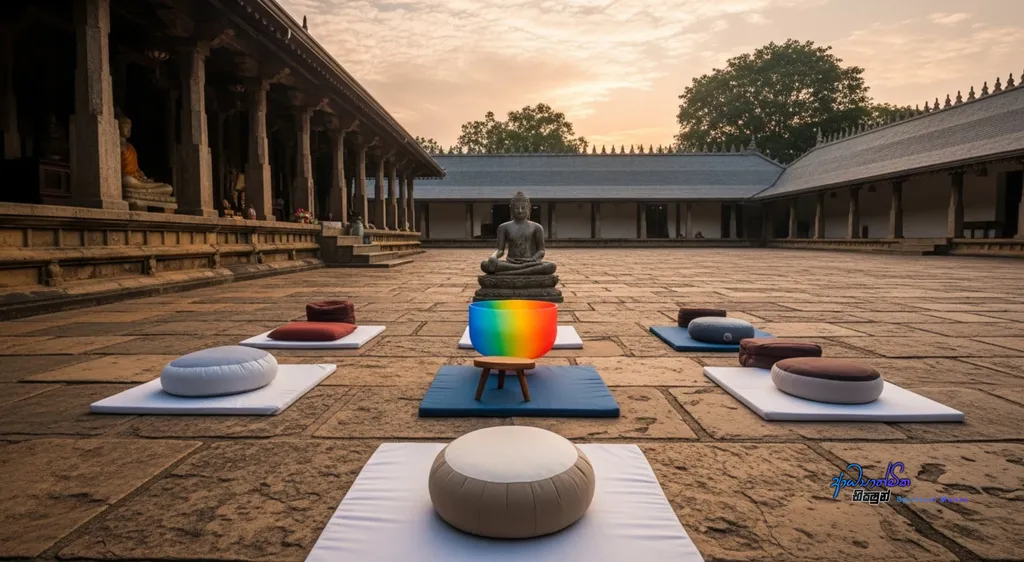
What is True Loving-Kindness (Metta)?
It is indeed possible to open the third eye using Metta meditation. But first, we must understand what genuine loving-kindness is. True Metta is a feeling that arises from the very bottom of your heart, a perception of loving-kindness that goes far beyond mere words. It is more profound than any phrase you might murmur or mentally repeat.
The most profound form of this quality, Great Compassion or Maha Karuna, is possessed only by a fully enlightened Buddha. No one can compare to a Buddha in this regard. Arahants (fully liberated disciples) also possess great compassion and loving-kindness, as do those on earlier stages of the path like Stream-enterers (Sotapanna), Once-returners (Sakadagami), and Non-returners (Anagami), though to a lesser degree. For ordinary individuals, true, unconditional Metta is much rarer.
Many people practice what they call Metta meditation, but I invite you to look at your own practice honestly. Do you feel the same loving-kindness for your family as you do for your enemy? Do you radiate the same Metta towards someone you are jealous of? When you reflect on this, your own shortcomings become clear. If you are someone who sits cross-legged with eyes closed, repeating the words, check if the genuine feeling is truly there.
The thought of Metta should be universal and equal for all beings, without fluctuation or preference. As one progresses to higher states of mind, like that of an Arahant, this quality becomes naturally equal for everyone. While reaching such a state is difficult, the practice itself is what matters. Those who have realized Nibbana reached that state by gradually cultivating these qualities. This understanding is crucial before we begin.
The Universal Power of Calm (Samatha)
Now, some might think that by discussing the third eye, Kundalini, or universal energy, we are straying from the Buddha’s teachings. To those, I want to clarify a point we often make: you can practice any method of developing calm, or Samatha, whether it’s found within Buddhism or outside of it, and you will inevitably encounter the phenomena I am describing. It’s a universal principle.
You know that Nibbana, the ultimate liberation, is found only within the Buddha’s teachings. The way we cultivate Samatha in Buddhism is unique. Likewise, methods outside of Buddhism are different from ours. However, while the training methods may differ, the resulting states of calm and the experiences that arise from that calm are one and the same.
Therefore, the experiences and events you face are universal. This is why you can have these experiences, such as opening the third eye or attaining the Dibba-cakkhu, through the path of Metta meditation, just as you can with the other methods we have taught.
The reason we teach various meditation techniques is to allow you to find one that resonates with your heart, one that feels easy and natural for you to build your foundational practice. You who follow these teachings know that these foundational methods are only necessary until the groundwork is laid. Once we move to the next steps, we don’t need to stagnate in these preliminary stages. This basic understanding is vital as we explore how Metta meditation can lead to the opening of the third eye.
A Practical Guide: The Single-Phrase Metta Meditation
In our very first teachings on the third eye, we mentioned a practice of radiating Metta in the ten directions. The method we will use now is different; we do not mentally repeat all those phrases. Instead, we use only one single phrase. We do this for two reasons: firstly, to develop mental unification and calm (Samatha), and secondly, because it becomes a powerful signal that protects our practice.
In a previous talk, we explained that Mara (the embodiment of obstruction) fears mindfulness and loving-kindness. By emitting this single thought of Metta, we create a protective field. If any non-human entities or agents of Mara try to disturb our meditation, this powerful signal prevents them from approaching.
However, please do not stop your regular Metta meditation practice of radiating loving-kindness to the ten directions for half an hour or an hour a day. This is very important. We are only borrowing one phrase from that practice to use as a tool for developing deep concentration. The phrase is: ‘Siyalu sathvayo suwapath wewa’, which means, ‘May all beings be well and happy.’
As we’ve instructed before for developing Samatha, you must choose a point of focus to hold your mind. This is typically a spot on the midline of the face, from the center of the forehead down to the tip of the nose. Most people choose the center of the forehead or the point between the eyebrows. Close your eyes and try to keep your mind fixed on this chosen point. In our other programs, we introduced the perception of ’emptiness’ at this stage.
But for those who wish to proceed via Metta meditation, you don’t need to practice that. Instead, after fixing your mind on the point between your eyebrows, begin to mentally repeat, ‘May all beings be well and happy.’ Repeat it, then remain silent for a few seconds. Repeat again, then silence. Continue this repetition while keeping your awareness fixed on your point of focus.

The Sign of Progress: Experiencing the Light (Aloka Sanna)
As you continue this practice, external influences will greatly diminish. The Metta thought you radiate, according to the strength of your own mind, creates a protective energy in your environment. Again, I must emphasize: continue your daily half-hour or hour-long practice of radiating Metta in all directions. We are simply using one of its phrases here to develop deep calm.
Those of you who have followed our teachings know the next step: the stage of the light sign, or Aloka Sanna. This does not appear for everyone, and for those it does, the timing is relative. It might appear the moment your forehead feels a pressure, or the next day, or it may take several days. We cannot say how long it will take for any individual.
These light signs appear in various colors, white, yellow, blue, and other colors we know. The color itself is not important; what matters is that a light sign appears. It can also manifest in different shapes, a circle for one person, a square for another, or perhaps like a line drawn in front of you. It may appear small at times and large at others.
Whatever form it takes, when you see a colored light appear in the darkness behind your closed eyes, that is your new object of focus. Shift your attention to that light and, while looking at it, continue to repeat, again and again, ‘May all beings be well and happy.’
Exploring with the Divine Eye (Dibba-Cakkhu)
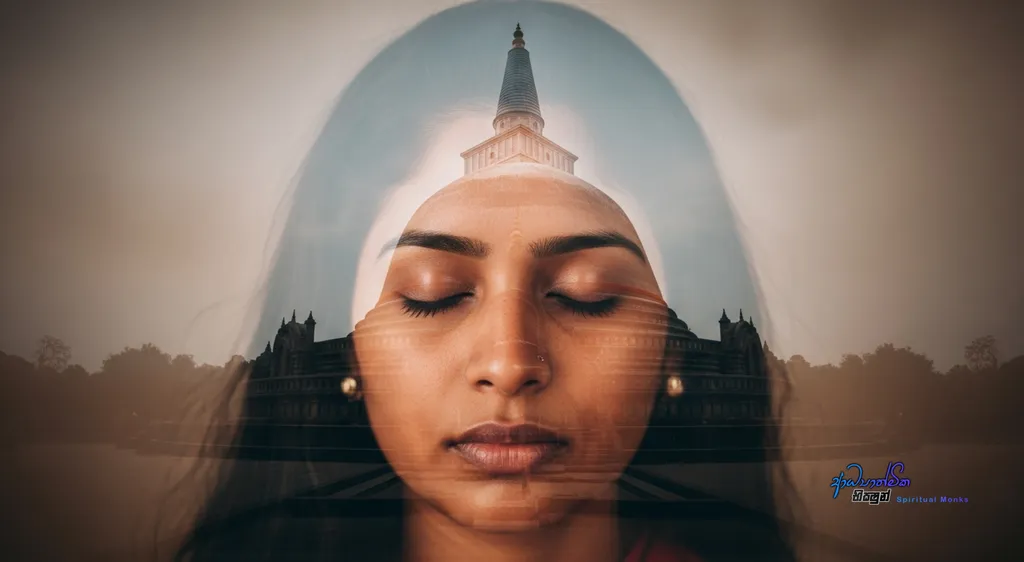
Once the third eye opens and you can see the light, you can begin to explore. You can use resolute determination, known as Adhiṭṭhāna, to direct your vision. For example, you can make a determination two or three times: ‘May I be able to see inside the relic chamber of the Ruwanwelisaya stupa.’ We have described in other teachings how to travel with this mind-made vision. As this psychic journey occurs, you can continue to repeat the phrase ‘May all beings be well and happy.’
While observing these things with your divine eye, or Dibba-cakkhu, you can simultaneously practice the Metta meditation. Once you know your third eye is open, you simply need to make the determination to see things like the great Ruwanwelisaya stupa and travel into its relic chamber. You can continue to see these things while repeating, ‘May all beings be well and happy.’
We have mentioned many other places you can visit with this ability: the ancient rock fortress of Sigiriya, the sacred mountain of Sri Pada (Adam’s Peak), the holy sites in India (Dambadiva), and even the celestial realms to meet various deities (devas). You have the ability to make the determination and see these planes of existence, all while maintaining the perception of ‘May all beings be well and happy.’
When the Practice Flows into Daily Life
Once this phrase becomes truly established in your mind, you will notice it begins to repeat itself automatically, even after your formal meditation session ends. As you go about your daily life with your eyes open, the phrase ‘May all beings be well and happy’ will continue to echo in your mind. This is the nature of this practice.
To give you an example, think of a new song you like. After hearing a beautiful part of it over and over, it gets stuck in your head. You find yourself humming it in the bathroom, while you’re trying to study, or while doing some other work. Sometimes you might even say the words aloud or find your body moving to the rhythm. It is the same with this practice.
When a mental object becomes very familiar, it naturally arises on its own. You don’t need to be alarmed or worried about this. It is a normal and positive sign, which is why I used the everyday example to help you understand.

Connecting Metta to Deeper Meditative States (Jhana)
When your Metta meditation practice reaches this level, where the phrase is constant and stable, it means you possess a preliminary level of the first meditative absorption, or Jhana. This can be developed further by focusing specifically on the path to the Jhanas.
Furthermore, when you are able to see the sky or space with your third eye, it opens the door to the formless absorptions (Arūpāvacara Jhanas), such as the sphere of infinite space (Ākāsānañcāyatana), the sphere of infinite consciousness (Viññāṇañcāyatana), and so on. We have given clear, practical instructions on how to enter these states in other teaching series. You can follow those instructions to proceed.
However, it is important to understand that if you wish to enter those specific Jhanas, you will no longer need to repeat ‘May all beings be well and happy.’ You must use the specific perception or sign associated with that particular Jhana, as instructed in those teachings. This is a crucial point to remember.
Patience and Consistency: Your Keys to Success
So now, I have explained how to take a single phrase from Metta meditation and use it to develop your concentration and advance spiritually. You now have a method you can practice, especially if you are someone drawn to the path of loving-kindness.
If, after some time, a person does not reach the stage of the light signs or the subsequent steps through this Metta meditation, do not be discouraged. In a future teaching, we will explain how to approach the Jhanas from a different angle for those individuals. But I must give you this advice: commit to one meditation technique for a consistent period, at least three to six months. Unless you have a physical ailment that prevents it, always practice meditation in the cross-legged posture (Baddha Pariyanka).
We have already covered the basics in our initial talks, the correct postures, the best times to meditate, whether to keep the eyes open or closed. People still ask these questions, but the answers have been given. Therefore, I will not repeat those details here. Please proceed with the understanding you have gained from all the teachings.
I will now conclude this teaching on opening the third eye through Metta meditation. For anyone who wishes to develop calm and progress on the path through loving-kindness, please feel free to explore this method. May you all have the strength of the Triple Gem, the Buddha, the Dhamma, and the Sangha, to understand these matters clearly and put them into practice.
We invite you to walk this path with us. Read our teachings, and most importantly, apply them practically in your own life. as you practice, questions will naturally arise. Please feel free to share your experiences and questions in the comments below, via email or contact form. I will do my best to offer guidance in future talks based on your progress. For now, begin this practice with an open heart and a mind free from expectation. Cultivate it correctly, and may you find the clarity and peace you seek.
Thank you for joining us. We hope this blog will be of great benefit to your spiritual journey.
May you all be well and happy.
May the blessings of the Triple Gem be with you all!.


