


Categories: Can Meditation Drive You Mad?
May the blessings of the Triple Gem be with you all!
Today, we will explore a challenge many of you face: the difficulty of discussing meditation and spiritual matters in our current social climate. It seems the world has changed so much that speaking about Bhavana, the Buddhist term for meditation or mental cultivation, can be nearly impossible. Many people have told me that when they try to talk about the Dhamma, the Buddha’s teachings, or the truth about this world and the path to liberation, or Nibbana, they are met with confusion and concern from friends, family, and loved ones.
This article aims to provide clarity on why this happens and offer guidance on how to continue your spiritual practice in modern society. We have previously touched upon related topics, such as the myth that meditation can make you go crazy. If you are new to these teachings, I encourage you to explore those discussions as well. For those committed to practical application, it is beneficial to engage with these teachings sequentially to build a solid foundation.

The Modern World’s “Allergy” to Spiritual Truth
A common experience is that when you share deep truths with friends, family, or relatives, they might conclude that you have some sort of mental illness. If you speak too passionately about the Dhamma or meditation, some may even try to refer you to a psychiatrist. This is the unfortunate reality, even here in Sri Lanka, the heartland of Theravada Buddhism. Why has this happened?
The root cause is a lack of genuine understanding about what authentic Buddhism is, the practical application of meditation, and the profound experiences that arise from a deep spiritual life. Our society is not always a fertile ground for these conversations. When you try to discuss these ideas, learned from articles, books, or online teachings, with someone consumed by worldly competition, jealousy, and mental defilements, or kilesas, they simply cannot comprehend it.
Their focus is on financial gain and nourishing worldly pursuits. If you suggest that having just enough money is sufficient and that excessive wealth can erode our spirituality and the preciousness of this human birth, it’s almost like an allergic reaction to them. The idea just doesn’t sit right.

Chasing Shadows: The Driving Force of Craving (Tanha)
Modern society often encourages us to follow the models of wealthy foreigners or scientists, bombarding us through media with worldly goals. The primary pursuit is money, followed closely by the accumulation of material goods. People desire new cars, bigger houses, and all sorts of things that fuel their craving, a deep, persistent thirst known in Buddhism as Tanha.
Now, this isn’t to say you shouldn’t have these things. There is a necessary amount of material comfort for human life. However, when desire becomes excessive, it leads to the destruction of the individual and society. Look at the wars happening today, driven by an excessive accumulation of weapons.
Only those who have experienced such destruction firsthand, like those who lived through the war in Sri Lanka, can truly understand its gravity. A person with wisdom and insight, however, can comprehend this danger without having to suffer through it directly.
Unfortunately, in a society that doesn’t see this, if you speak of spiritual truths, you risk being labeled. While not all mental health professionals are the same, some who are heavily biased towards Western thought may diagnose someone deeply engaged in the Dhamma as mentally ill. We must be aware of this.
Thankfully, there are also wise, intelligent doctors who have studied both Western psychology and Buddhist philosophy. They can rightly discern whether a person has a genuine mental illness or is on a profound spiritual journey, and offer appropriate guidance.

The Age of Insatiable Appetites
In ancient times, societies were nourished by spirituality and lived in harmony with the universe and nature. People took only what they needed; their hearts were not overburdened with excessive Tanha. Their craving was less.
Today, technology and consumerism constantly present us with new things, fueling endless desires. We are surrounded by things that promise to please our five senses, sight, sound, smell, taste, and touch. We want instant gratification, like foods with artificial flavors.
It is now difficult to find a piece of fruit with its natural, tree-ripened taste because many are chemically treated to meet high demand. As human craving for taste increases, so does the demand for instant satisfaction. This is why producers try to create an artificial taste quickly, rather than letting nature take its course.
Consider the poultry industry. The high demand for chicken has led to birds being raised in a short time with various drugs. This is a direct result of increased demand. It’s known that such meat can cause health issues, like early puberty in girls. This is how craving, or Tanha, gradually increases.
As the Buddha taught, when people’s desires grow, their downfall follows. The reason for this is the loss of spirituality and the absence of meditation in their lives. A force the Buddha called Mara. a personification of temptation and the lord of illusion, works to make spirituality disappear from society, allowing craving to flourish.

The Buddhist View on Materialism: Use, But Do Not Be Used
So, what can you do when you are surrounded by people who only want to talk about things that increase craving, what to buy, what new products to find? People often don’t understand their own limits, and this lack of understanding leads to their destruction. In the past, communities knew that going beyond their needs would lead to ruin. They knew this because their lives were nourished by spirituality. Today, that spiritual nourishment is gone.
Living in such a world, you cannot easily discuss spirituality or meditation at your office or workplace. The other person won’t understand because they are on a different path, following the current trends. If your friend’s goal is to buy a new car, and you tell them, “That car is impermanent, it’s meaningless, why are you buying it?” you will only create negativity. We are not saying don’t buy the car. The Buddhist teaching is: understand the nature of the car.
Recognize the sorrow you will feel if it gets damaged or lost. That is the essence of the Dhamma. Also, understand that one car will never be enough. You will soon want a better one. This is Tanha. Your mind will never be satisfied; it will always seek something new to experience. The Buddha never said not to own vehicles. He taught us to acquire and experience things, but then to understand their limits and turn towards the spiritual path, towards Nibbana, meditation, and the Dhamma.

Jealousy Dressed as Wisdom: A Common Pitfall
We must also be careful of another trap. Sometimes, a person who is spiritually inclined but not yet practically developed may feel jealous of a friend’s worldly success. Out of this envy, they might preach about impermanence, saying, “Oh, that car is impermanent, suffering, not-self; it’s useless.” Please do not do this. This is using the Dhamma to mask your own jealousy.
The correct approach is to encourage them: “Yes, get the car. Experience it. Understand it. And then, notice how your mind wants another, better car.” This is the nature of reality you should teach. Don’t tell them not to use things or that they are worthless. This mistaken way of teaching has led many young people today to see Buddhism as a negative or pessimistic philosophy. The truth is far from it.
When you have used enough phones and have enough money to buy any model you want, you might find that even the newest phone no longer interests you. After you have experienced all that money can buy, you may find yourself naturally turning towards the spiritual path. That is why we should not condemn these experiences.

The Freedom to Experience, The Wisdom to Let Go
You have a right to experience life. Buddhism never says you should not. However, it does teach about the consequences, the kamma-vipaka, that arise from experiencing life in unwholesome ways. If you choose a harmful path, the damage you do is to yourself, a harm that echoes across your journey through lifetimes, or samsara.
This is not for anyone else but you. There are many teachings available from venerable monks, in books and online, that explain this. I encourage you to read the Tripitaka, the Buddhist scriptures, and the commentaries, and study the works of great masters like the Venerable Reerukane Chandawimala Nayaka Thero to deepen your understanding.
Given this context, it’s true that you often cannot talk about these things openly. Many people tell me they can only discuss meditation with their one closest friend. This is because, as I’ve explained, most people are traveling on a different road.

Navigating Your Path with Wise Silence and Perfect Timing
My constant advice is this: do not discuss the Dhamma, meditation, or spiritual matters with unsuitable individuals. It is fruitless. However, if you feel that sharing something might help someone turn toward the path, you can try once, like testing the waters. If they show a genuine inclination, then you can help them further. But if there is no receptivity, do not persist. Do not keep talking about meditation with them.
What you should do is wait. Because you planted a single seed, a day may come when reality dawns on them. On that day, they will seek you out. That is the time to help. Everyone has their own time for their wholesome qualities, or kusala, to ripen. Until then, their unwholesome tendencies, or akusala, may be dominant. We must allow time for that to subside or be exhausted. When that person is ready, you can speak about meditation. Understanding this about society is crucial for your spiritual practice in modern society.
Living Skillfully: Balancing Your Inner and Outer Worlds
In today’s world, those who search for and discuss meditation are a minority. The majority are on the path of craving that I have described. We cannot make them understand by simply telling them to stop. They lack the foresight and faith in concepts like kamma and samsara. Therefore, you must be skillful. While living a lay life, you should strive to be successful in your worldly affairs. Help your children, spouse, parents, and friends to succeed in their lives. Be a source of support.
However, you must inwardly understand the nature of things. You must hold the awareness that this worldly life can change at any moment; it can be lost. You must have a clear understanding of the Tilakkhana, the Three Marks of Existence that the Buddha taught: Anicca (impermanence), Dukkha (unsatisfactoriness), and Anatta (not-self). You can train your mind in this practical awareness by following teachings on mindfulness.
The Loneliness of the Path and the True Companion
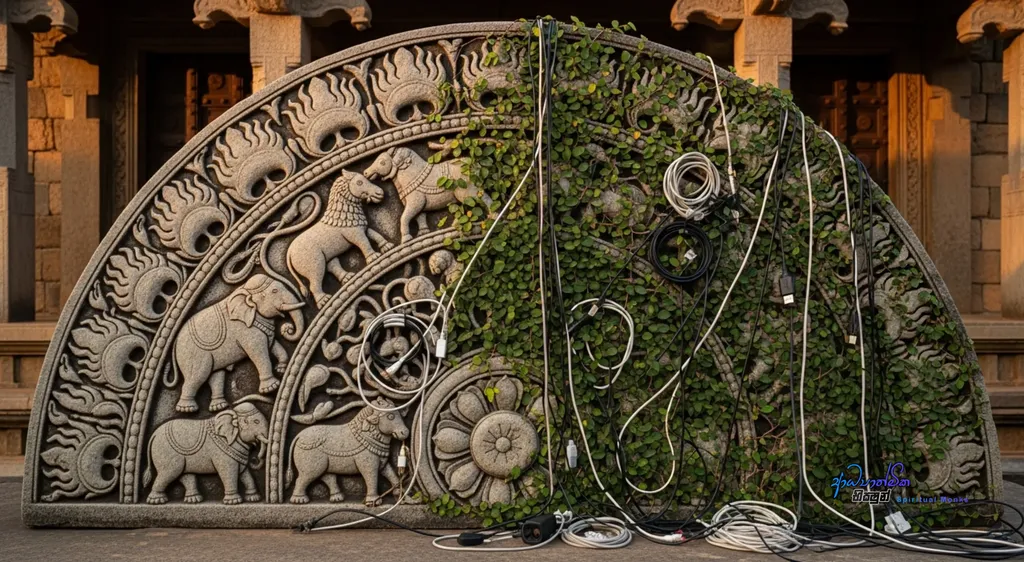
As your spirituality develops, your desire for worldly things will naturally decrease. At this point, you might feel like you are being ostracized by society. You may no longer feel the urge to associate with old friends. At the same time, because you are on a different path, they may find you incompatible and distance themselves. Many people feel negative at this stage, thinking, “I’m losing my friends, I’m losing my community.”
In such moments, remember this: your friends are not as important as your journey through samsara. If you are born into an unfortunate existence, a lower realm, or a hell state, your friends cannot save you. Therefore, have faith in your own journey and walk it with clarity. You don’t need to worry about them. One day, they might arrive where you are now. It is often said that a non-drinker feels like an outcast among drinkers. This has become the trend in society. This is the nature of the world we live in.
Mara’s Influence: How Technology Blinds Society
Mara systematically increases people’s craving through modern technology and endless products. By amplifying worldly desires, he makes people forget the Three Marks of Existence and pushes spirituality away, directing them toward destructive paths. Consequently, desires for sensual pleasure, sexuality, and tastes of all kinds are constantly amplified. Once people become addicted to these things, they cannot escape, nor do they want to. They don’t even see it as a problem. This failure to recognize the harm in excessive indulgence is what Buddhism calls delusion, or Moha.
This is how Mara works, and it is a major reason why Buddhism, meditation, and spirituality are disappearing from public discourse. In ancient times, even when they created advanced technology like irrigation systems, they did so in a way that did not harm nature, the universe, or other beings.
Today, many of our technological advancements are harmful. Consider the radiation from a phone or a signal tower; how many tiny creatures die because they cannot withstand the frequencies? We enjoy the conveniences of modern technology, but we also suffer from new ailments, like weakened eyesight from staring at computers. The ancients knew of these dangers and used technology in harmony with all life.

When Spirituality is Mistaken for Illness
As craving increases, concepts like Nibbana, spirituality, and meditation become buried, turning into mere history without any practical application. Children born today are handed a smartphone, not introduced to spirituality. They are exposed from a young age to violence, falsehood, sexual content, and addiction to games. How can you talk about spirituality in such a society? They won’t understand, and as mentioned, they will label you a madman.
Even some doctors who don’t understand this will perceive you as mentally ill. From a certain Western psychological perspective, if you don’t desire sex or worldly pleasures, it’s seen as a mental weakness. This is why it’s crucial to understand both sides.
A doctor who has studied both Buddhism and Western thought will understand. But one who is dogmatically fixed on a Western viewpoint will not grasp it. They might see celibacy, or Brahmacharya, as a symptom of a mental disorder. Then all the monks living a holy life, developing their spirituality on the path to Nibbana, would have to be considered mentally ill. Is that so? Of course not.
The Greatest Healer and Your Quiet Strength
In truth, the greatest psychologist who ever lived was the Buddha, who brought an end to all suffering in samsara. We study his teachings to end our own suffering and develop the unknown spiritual dimensions within us. Young people tell me that when they try to talk about meditation with their friends, they are asked, “Are you crazy? Did you lose your track?” This atmosphere exists in universities, workplaces, and even at home, where parents might secretly worry and consider taking their child to a doctor.
This is why, as I said at the beginning, my primary advice is to avoid discussing these topics with unsuitable people. Stay silent. Live alongside those who chase worldly and material things. The time to offer help, advice from the Dhamma and meditation, is when they are mentally broken.
This doesn’t mean you should wait for their downfall out of jealousy because you haven’t reached their level of worldly success. It means you should help them either when they have achieved everything and found it empty, or when they have failed on their path and collapsed. That is the proper time. Only then can we guide them onto this path and give them the tools to cross over samsara.

A Final Blessing for Your Journey
The society of today is not the one of the past. As we’ve discussed, the world is changing, and human virtues are eroding. Competition and jealousy are increasing, even among schoolchildren. In the past, children were taught about the law of kamma, that if you harm another’s learning, you might be born unable to learn in a future life. Today, with parents and teachers often unaware of these principles, the environment is different.
In such a challenging environment, even practicing meditation can be difficult. Some who live in shared housing, like dorms, say their roommates drink, party, and make noise, making it hard to meditate. They ask if it’s okay to meditate lying down. My advice is to always try to sit in a formal posture if you can find a quiet place. But if you cannot, then it is better to meditate lying down than not at all. That effort is never wasted; it becomes a perfection, a paramita, for your journey. And know that disturbing someone in meditation creates very heavy negative kamma.
Please understand these dynamics of the world you live in. By acting with wisdom and patience, you can protect your spiritual practice in modern society without any hindrance. According to the Buddha, all beings who have not realized a stage of awakening are, in a sense, unhinged. If they don’t understand this, then everyone, including the doctors who judge, falls into this category. I have explained all that is necessary. The key is to be silent, wait for the right time, and continue your practice with diligence.
May the power of the Buddha, Dhamma, and Sangha, the Triple Gem, give you the strength to understand these matters well and to walk this path in practice, with quiet determination.
We invite you to walk this path with us. Read our teachings, and most importantly, apply them practically in your own life. as you practice, questions will naturally arise. Please feel free to share your experiences and questions in the comments below, via email or contact form. I will do my best to offer guidance in future talks based on your progress. For now, begin this practice with an open heart and a mind free from expectation. Cultivate it correctly, and may you find the clarity and peace you seek.
Thank you for joining us. We hope this blog will be of great benefit to your spiritual journey.
May you all be well and happy.
May the blessings of the Triple Gem be with you all!.


