


Categories: Eradicate the Fear of Meditation
May the blessings of the Triple Gem be with you all!
In our exploration of the practical spiritual life, we often encounter unique experiences. Today, we wish to provide some clarity on a specific phenomenon that some, but not all, people experience as they develop their spiritual practice. It’s important to understand that there is no requirement to have this experience, nor is there a requirement to avoid it. Our primary goal here is to help you walk the path fearlessly. Meditation is a practice open to anyone, regardless of age or background, and these teachings are here to support you in that journey.

The Sensation of a Presence: What is Happening?
When you begin to engage practically with spirituality, whether through tranquility meditation, known as Samatha, or insight meditation, known as Vipassanā, you may encounter strange sensations, especially in the early stages. This topic has been raised by many recently, which is why we felt a collective clarification was needed.
Let’s take the example of Samatha meditation. As a person practices, some individuals, particularly those who may have a natural sensitivity or what is sometimes called an awakened ‘third eye’ (Dibba-cakkhu), a form of clairvoyant knowledge, might perceive beings from unseen realms. These can range from spirits and ghosts (Pretas and Yakkhas) to deities (Devas) and celestial beings (Brahmās). This ability to see into other dimensions through psychic sensitivity has been discussed in our teachings on the ‘third eye’.
Common Experiences: The Feeling of Being Watched
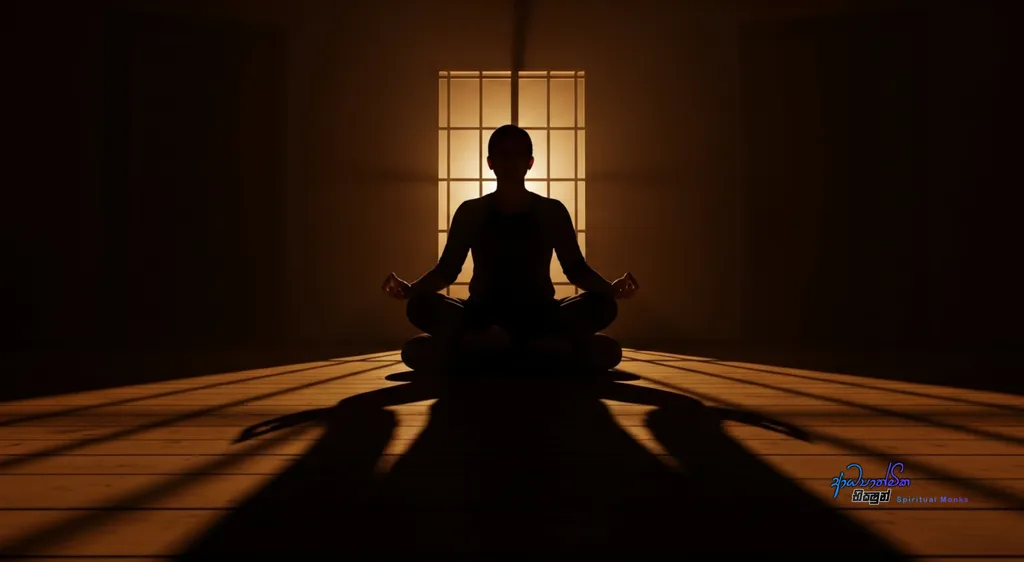
However, most people who experience these sensations have not had a dramatic awakening of any psychic sight. Yet, they report distinct feelings during their practice. They say it feels as if someone is walking in front of them while they meditate in their room. Others feel as if someone has come and sat down nearby. Some feel a persistent gaze, as if they are being watched. Still others report the sensation of a presence leaning in close or standing just behind them.
These experiences can be unsettling. Gripped by this feeling, many people open their eyes, their meditation disrupted. The unease makes it difficult to continue, and some even abandon their practice altogether out of this powerful fear in meditation.
The Trap of Fear: An Obstacle on the Path
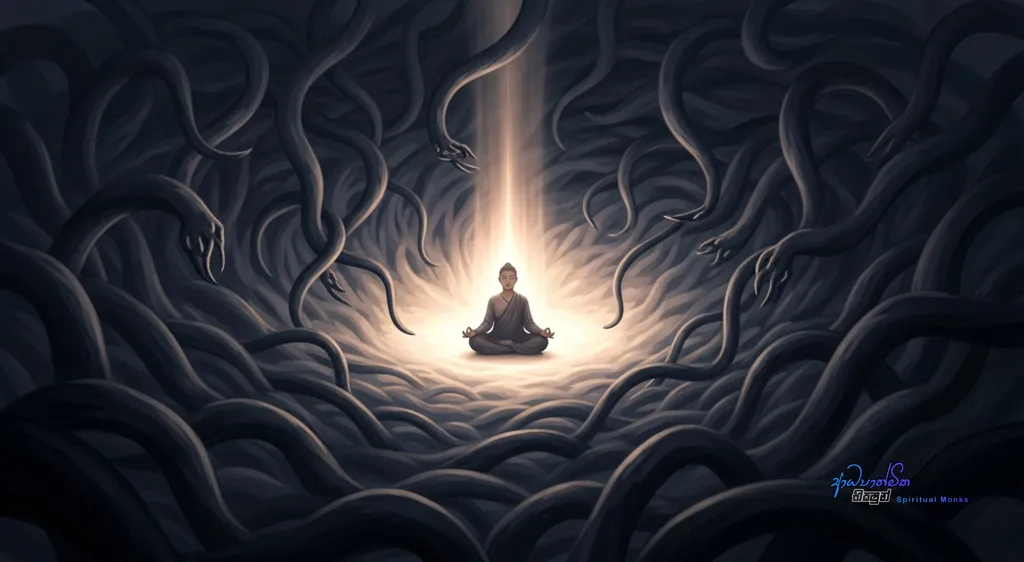
It is crucial to understand this: we must not be afraid of what we see, hear, feel, or understand during meditation. We must remain seated and continue to develop our practice. Fear is a significant obstacle. In Buddhist teachings, it is considered one of the ‘ten armies of Māra’ (Dasa Māra Senāva), hindrances that prevent spiritual progress. Fear blocks the development of both tranquility (Samatha) and insight (Vipassanā).
At its core, fear is just a thought. It is a mental defilement, or kilesa, an unwholesome state of mind (akusala). The only way to overcome it is to face it directly. This understanding is vital. We have provided a whole series of teachings on eliminating the fear in meditation, and we encourage you to explore them for further support.

Where Does This Fear Come From? The Power of Suggestion
So, why does this intense fear in meditation arise? A primary cause is the vast collection of incorrect ideas and myths about meditation that circulate in society. Even people who boast of being fearless find themselves scared when they sit alone, close their eyes, and enter the inner world. This fear is often planted by others.
Think about the things you may have heard from:
- Parents or elders who have no personal experience with meditation.
- Friends, family members, or partners sharing secondhand stories.
- Colleagues at work or school who have no spiritual knowledge.
These individuals, often with no malice, repeat frightening tales they have heard. Their words can settle in your mind. You may have also absorbed these ideas from sensationalized YouTube videos made by inexperienced people, or from reading books and articles that aim to scare you away from practice. These external inputs create a powerful mental conditioning.
The Mind’s Creation: How We Project Our Own Fears
These stored ideas directly impact your meditation session. Imagine you sit down to meditate today. If you have absorbed the idea that ‘meditation makes you see ghosts,’ your mind will start working on that script. As soon as you begin, the thought arises: ‘There is a non-human being near me. Something is watching me.’ This is a mental fabrication, a phantom created by your own mind.
It is based on the data you’ve collected, from conversations, stories, and movies. In reality, if someone with a developed ‘third eye’ were to look, they would likely see nothing there. If you open your own physical eyes, you will see nothing either. And yet, the mind insists that someone is nearby, walking or watching. This is the trick. It is a feeling generated entirely from within, based on absorbed falsehoods.

The Danger of Spreading Fear and the Law of Kamma
Look at how we foolishly sabotage ourselves. We allow the nonsense spoken by inexperienced people to create an unwholesome state of fear (akusala), and then we abandon the very practice that can lead to our liberation. This is a dangerous outcome.
Those who spread these fears, even unknowingly, create negative intentional action, or kamma, for themselves. We strive to teach you how to walk this path fearlessly, even alone. The potential is within you. When others frighten people away from meditation, they accumulate a heavy karmic debt.
If they ever try to meditate in a future life, on their own path to liberation (Nibbāna), they will experience a fear ten times greater than what they inflicted on others. This is the unfortunate consequence of such actions. As teachers of this spiritual path, our duty is to help you build the courage to proceed without fear, whether on the path of insight or tranquility.

The Bodhisatta’s Method: Face Your Fear Directly
Let me offer another perspective on how to deal with the feeling of a presence. We have spoken before about the obstacles that arise in the spiritual life, including external hindrances. The figure of Māra, the Tempter, represents the personification of these obstacles.
When such forces arise, the antidotes are simple and powerful: the cultivation of loving-kindness (Mettā Bhāvanā) and the maintenance of mindfulness (Sati). We’ve taught that Māra fears mindfulness and loving-kindness. If you face such a disturbance, this is all you need to do. There is nothing else required.
Consider the example of the Bodhisatta, the being who would become the Buddha. Before his enlightenment, when Prince Siddhartha was practicing, he also experienced moments of fear. The scriptures, found in the Tripitaka or Pali Canon, tell us that if he heard a branch break while meditating in the forest, he wouldn’t freeze in fear. Instead, he would get up and walk directly towards the sound to investigate.
He would go to see what caused it, and he would discover it was merely an animal, perhaps a large eagle or an owl taking flight. By confirming the reality of the situation, the fear vanished. The Buddha taught us this method of becoming fearless: face the experience and investigate it directly.

From Fear to Equanimity: The Maturing Mind
As you practice this investigation, your mind changes. After you’ve checked and realized that these sounds and feelings are just natural phenomena, an animal, the wind, or your own mind, you begin to develop a profound stability. In the future, as you continue your spiritual development, you might hear a chair fall over. It won’t bother you.
You won’t even give it much attention. Your mind will automatically conclude, ‘It was probably an animal,’ or ‘It’s just a natural process.’ Even if you consider the possibility that it was a non-human being, it still won’t matter. The experience will not generate even a trace of fear.
Your mind becomes equanimous (upekkhā), or neutral. If you practice mindfulness as we teach in our spiritual series, this balanced state is an inevitable outcome. This is the practical result. After some time, you may even laugh at yourself, thinking, ‘It’s a shame I stopped meditating back then because of such silly fears.’ If you let these phantoms lead you to abandon your practice or, worse, seek solutions in occult rituals, talismans, or other religious paths, I can say with 100% certainty that you will never develop your meditation.

Mindfulness: Identifying the Poison Seed of Thought
So, be honest with yourself. When you feel that presence or hear that sound, ask with mindfulness: ‘Is this feeling real? Or is it something I have put in my own head?’ Watch your thoughts carefully. ‘Did someone tell me this would happen?’ Often, people grab onto the most sensational parts of a teaching, ignoring the foundational explanations. That is why I am re-emphasizing this first point at the end.
The thought that someone planted in your mind acts like a poison seed. If an inexperienced person told you something frightening about meditation, that thought will arise every time you close your eyes. The moment you sit, it comes: ‘Ah, there’s a spirit near me. It’s watching me. It’s sitting beside me.’ Recognize this pattern. If you look closely with mindfulness, you will see that it is the thought planted by your mother, your father, or your friend that is now activating.
By identifying it with mindfulness, ‘Ah, this is just a thought, placed there by so-and-so’, and practicing this recognition consistently, as taught in the Four Foundations of Mindfulness (Satipaṭṭhāna), the thought will lose its power and eventually disappear.

The Ultimate Solution: Let Go and Move Forward
It’s important to emphasize that as you develop correctly on the spiritual path, the obstacles you perceive around you will begin to fade. As you learn to ignore them and continue your practice, they dissolve. They are eliminated. They are destroyed.
Our topic was the feeling of a presence during meditation. I wanted to clarify that this can be a real, external event or, more often, a mental phantom created by things others have told you. In either case, the method for dealing with it is the same: the fearless, mindful approach we have discussed.
If you commit to these steps, this entire issue will vanish from your practice. You will become accustomed to stillness, and these things will no longer bother you. Once your mind reaches this state, you can proceed without any problems to the furthest shores of the spiritual path. This was the message we wished to deliver.
Trust the Path, Trust Yourself
You must have confidence that as you develop your meditation and spirituality, you will encounter these kinds of fearful events at the preliminary stages. If you make an effort to face them fearlessly, again and again, it will be a great help for your spiritual journey. That is why I repeat: you must fulfill this part of the practice. This trust is the strength that will carry you forward.
We have given you all the necessary knowledge regarding this topic. As we offer teachings on many different aspects of the path, we will conclude this particular discussion on feeling a presence during meditation for today. We offer our blessings that you may correctly discern and understand these teachings from the right perspective.
We invite you to walk this path with us. Read our teachings, and most importantly, apply them practically in your own life. as you practice, questions will naturally arise. Please feel free to share your experiences and questions in the comments below, via email or contact form. I will do my best to offer guidance in future talks based on your progress. For now, begin this practice with an open heart and a mind free from expectation. Cultivate it correctly, and may you find the clarity and peace you seek.
Thank you for joining us. We hope this blog will be of great benefit to your spiritual journey.
May you all be well and happy.
May the blessings of the Triple Gem be with you all!.


