


Categories: Path to the Brahma Realm: Practical Meditation
May the blessings of the Triple Gem be with you all!
Welcome. In this third article (Meditation Joy) in our series, “A Practical Path to the Brahma Worlds,” we will explore the beautiful and profound state of Pīti, or what we can call spiritual joy. This teaching is a continuation of our journey together, building upon the foundations we have already established.
This series was created specifically for those who practiced our previous “Third Eye Meditation” program for over a month but did not yet experience the preliminary signs, such as lights, images, or other visual phenomena. If you felt that you were not getting results, this path is designed to offer a different, yet powerful, approach to deepening your practice. We will begin with a brief summary of what we have covered to ensure we are all on the same page.
Recap: Building the Foundation of Concentration
In the first two articles of this series, we laid the essential groundwork for this practice. You may recall that these teachings are focused on developing deep states of concentration, known in the Buddha’s teachings as Jhāna. Jhāna refers to a state of meditative absorption where the mind becomes exceptionally calm, unified, and powerful.
We discussed:
- How to Begin: The method for starting the meditation, including how to focus the mind and make a clear intention or resolution (adhiṭṭhāna).
- The Point of Focus: I explained that you should rest your attention in the area between your eyebrows, the center of your forehead, or along the bridge of your nose, wherever your mind settles most easily. Many of you found the spot between the eyebrows to be the most natural point.
- The Initial Resolution: Before beginning, we make general resolutions, like inviting the wholesome energies of the universe to support our practice. During the meditation itself, once the mind settles on its focal point, we made the specific resolution, “May the first Jhāna arise,” repeating it three times.
- Deepening Concentration: We then practiced gently repeating the phrase, “May my mind be concentrated,” every few seconds. When the mind wandered, we would re-establish our focus and repeat the resolution for the first Jhāna to arise. This process, practiced for thirty minutes to an hour, helps to unify the mind.
If any of this is unclear, I encourage you to revisit the first two teachings in this series. They are available for you to explore at your own pace.
The First Signs of Progress: Mind and Body Unifying
As you continue with this Buddhist concentration practice, certain physical and mental signs begin to appear. I described these in our last discussion, and many of you have shared that you are now experiencing them. These are signs that your concentration is deepening.
Mentally, you may feel:
- A sensation of pressure or tightness in your chosen point of focus.
- A feeling as if your mind is being pulled toward that spot, like a magnet attracting iron.
- A state where thoughts fade away, and the mind becomes powerfully fixed on that single point.
Physically, you might experience:
A sensation of the body becoming heavy and solid, like stone or concrete. This can start from the soles of your feet and move up, or from the crown of your head and move down, until part or all of the body feels completely still and immovable.
These experiences are normal and are positive indicators of progress. Whether you followed the step-by-step instructions from the articles or used the guided meditation recording I provided, you may have already felt these states. Today, we will explore what comes next. For those who have stabilized this feeling of profound stillness, a new, remarkable state of meditation joy is waiting to unfold.
The Emergence of Pīti: An Introduction to Causeless Joy
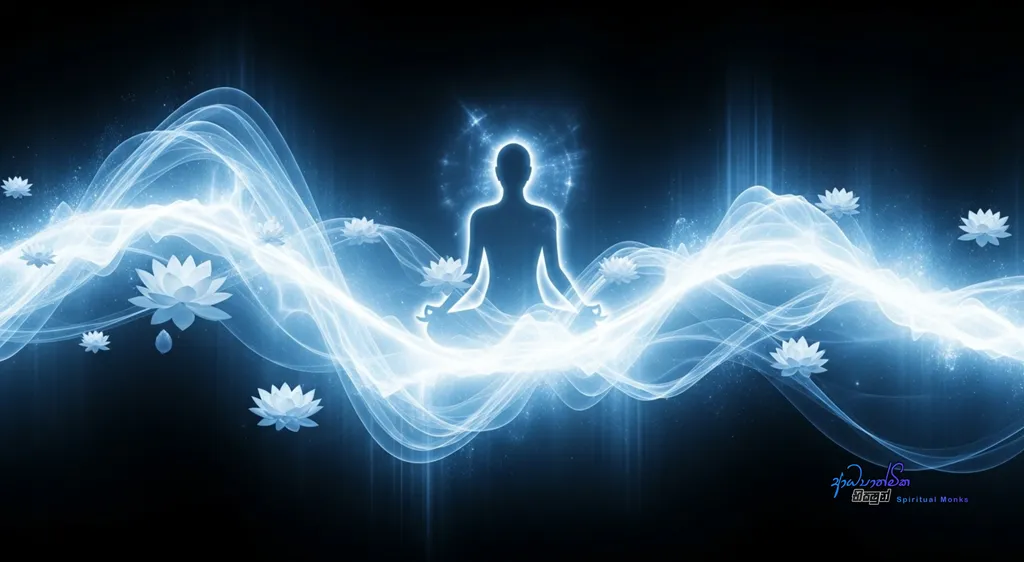
After the mind and body become deeply still and concentrated, something truly wonderful can happen. A powerful feeling of happiness arises, seemingly from nowhere. This is the state we call Pīti, which translates to rapture, bliss, or profound meditation joy. Some of you are already experiencing this, while for others, it is the next natural stage.
It’s important not to develop a craving or expectation for it. If you anxiously await this experience, it will not come. As I always advise, let go of expectations and simply practice. This meditation joy is a natural result of a calm and purified mind; it cannot be forced.
This state is technically associated with the second Jhāna, but I want you to forget that label. If you start thinking, “I have attained the second Jhāna,” a sense of pride or ego can arise, and this will cause your progress to decline and vanish. Simply know it for what it is a natural unfolding and remain humble. This bliss arises on its own when the conditions are right; we cannot command it into existence.
What Does Spiritual Bliss Feel Like?
So, what does this meditation joy feel like? It is a happiness unlike anything you have ever experienced in your ordinary life. It’s an intense bliss that has no external cause. In our day-to-day lives, happiness is always linked to a reason. a person, a possession, an achievement. This is the happiness of the sensory world, the kāma loka.
The bliss of Pīti, however, is completely different. It arises from within as the next step in your meditation. Your body feels light, your mind is filled with an indescribable delight, and a coolness might spread through your entire being. Goosebumps may appear, with the hair on your body standing on end. It is a profound, powerful meditation joy.
When this state arises, all your worldly problems simply disappear. Worries about your job, your finances, your family, the state of the country all of it fades away. This happens because Jhāna meditation is a temporary stepping away from the sensory world (kāma loka) and into the world of pure form (rūpa loka). To enter this higher plane, the concerns of the lower plane must naturally, temporarily, be left behind. Your mind enters a state of such profound peace and happiness that worldly issues cannot touch it. This is the power of true meditation joy.

How to Cultivate and Deepen Meditation Joy
Once you begin to experience this causeless meditation joy, how do you work with it? From this day forward, when that incredible bliss arises, you should gently change your inner reflection. As you feel the joy, begin to repeat in your mind:
“My mind is joyful.”
Repeat this every few seconds, gently and without force. You can also simply repeat the word, “Joyful… joyful… joyful…” or “Happy… happy… happy…” The words are interchangeable; they point to the same experience. Settle into the feeling and acknowledge it with this simple reflection.
Your next task is to extend the duration of this state. If the meditation joy lasts for twenty minutes, see if you can gently sustain it for thirty. Gradually, you can extend it to an hour, an hour and a half, two hours, or even three. The more you rest in this state, the more familiar it becomes. You will find yourself becoming ‘addicted’ to this bliss, but in a wholesome way. It is like the happiness I once spoke of in a teaching about states more blissful than drugs.
When someone experiences this, any attachment to harmful worldly pleasures naturally falls away. It becomes your new refuge, and a person who is truly addicted to this state will rarely, if ever, give up their meditation practice.
The Transformative Effects of Deep Meditation Joy
This state of profound meditation joy can be so powerful that it may lessen your desire for worldly things, even marriage or other sensual pursuits. This doesn’t mean you cannot live a balanced lay life.
You can absolutely continue with your work and family responsibilities while cultivating this inner bliss. It does not lead to an impairment of your daily life; in fact, it can enrich it by providing a stable, inner source of happiness.
You may also notice a reduced desire for food. You will eat what is necessary to maintain the body, but the craving for excessive or indulgent foods often fades, because the happiness you experience is far more satisfying. You eat to sustain your physical health, not for pleasure, because you have found a much higher pleasure within.
As you practice frequently you may notice other physical sensations. Don’t be alarmed by these:
- Your mouth may close firmly, and your tongue might press against the upper palate, making speech feel unnecessary.
- Your mouth might stretch to the sides, as if you are smiling broadly, an outward expression of the inner bliss.
- Your breathing may become deep and audible.
- External sounds may begin to fade or disappear entirely.
These are natural signs of deep absorption. Do not be afraid. These are experiences that many before you have passed through. Remember them, but do not anticipate them. When they arise, you will know what they are.
Integrating the Practice: Entering and Exiting at Will
For someone who has practiced this diligently, the state of meditation joy becomes very accessible. You no longer need to go through all the preliminary steps of resolving, “May the first Jhāna arise.” Your mind is now trained. You simply have to sit down, close your eyes, and the mind will go directly to that blissful state because that is where it is most powerful and familiar. Your only job then is to rest there and reflect, “My mind is joyful.”
This state can even be accessed outside of formal meditation. Imagine you are on a bus. You can be sitting, or even standing, and by simply closing your eyes, you can enter this state of bliss. You can also learn to exit it just as quickly when needed. With enough practice, you might even be able to remain in this state with your eyes open, though you will likely feel no desire to speak. If you have practiced this in past lives, this ability may come to you very quickly.
Setting a Mental Alarm and Exiting the State:
If you have a busy schedule, you can train your mind. Let’s say you need to leave for work at 7:30 AM. You can sit to meditate at 7:00 and make a clear resolution: “May I remain in this state of joy until 7:30, and may I awaken from it precisely at that time.”
After making the resolution two or three times, you will find that your mind naturally emerges from the meditation at the appointed time. It is like an internal alarm clock.
To exit the state at any time, simply make the resolution: “May I be released from this joy,” or “May I be released from the second Jhāna.” Think this three or four times. Your mind will gradually return to the first Jhāna level, and then back to your normal, worldly consciousness. When you come out, do not force your eyes open. Allow them to open naturally when they are ready. Your mind has been in a very powerful, elevated state, so be gentle with its return.
Conclusion: Your Path Forward
What I have shared with you today is a simple, practical path. There is nothing overwhelmingly complex here; it is an experience to be cultivated and felt. Your ability to access this profound meditation joy depends on your past positive actions (your kusala) and your diligence in this life. This state of Pīti is the second Jhāna, but as I’ve said, let go of the labels and simply practice.
Continue to cultivate this state. If you have questions or as new experiences arise, know that there are further stages on this path, which we will explore in future teachings. For now, your work is to engage with this practice and experience it for yourself.
With that, we conclude today’s practical teaching on Pīti, the third part of our series on the practical path to the Brahma worlds. May the power and blessings of the Buddha, the Dhamma, and the Sangha grant you the wisdom and mindfulness to continue your practice. May you realize these truths for yourself. May you have the good fortune to engage with these teachings again and again.
We invite you to walk this path with us. Read our teachings, and most importantly, apply them practically in your own life. as you practice, questions will naturally arise. Please feel free to share your experiences and questions in the comments below, via email or contact form. I will do my best to offer guidance in future talks based on your progress. For now, begin this practice with an open heart and a mind free from expectation. Cultivate it correctly, and may you find the clarity and peace you seek.
Thank you for joining us. We hope this blog will be of great benefit to your spiritual journey.
May you all be well and happy.


