


Categories: Third Eye: Practical Meditation
May the blessings of the Triple Gem be with you all!
Welcome. This article marks our 50th spiritual teaching, a milestone we have reached together. Over this time, we have explored many aspects of the spiritual path. For these teachings to reach you in this clear and accessible format, we owe a great deal of gratitude to one person. It is Mr. Chathura who carefully edits and prepares them for our ‘Spiritual Monks‘ Website. He is the reason you can read, reflect, and apply these practices to find mental peace and tangible results.
I must begin by expressing my heartfelt appreciation for him. His dedicated work helps people in Sri Lanka and around the world, regardless of age or background, to develop their spiritual lives. It is through his efforts that you have the opportunity to engage with these teachings.
In this 50th article, it is my duty to acknowledge this kindness. We will continue to work together to bring you more guidance. May this meritorious service further strengthen his own spiritual energies and abilities, allowing him to help even more people find inner peace. With this blessing, let us begin today’s teaching.
What Does the Third Eye Truly See?
Today, for our 50th teaching, we will explore a topic that is a cornerstone of our practice: the ways of seeing with the third eye. We started our journey with this subject, and it feels right to mark this milestone by delving deeper into it. Many of you from different age groups, nations, and even religious backgrounds are meditating with us. A significant number have shared that their third eye has begun to open.
In Buddhist philosophy, this is sometimes called Dibba-cakkhu, the divine eye. You have shared your experiences through comments and private messages, noting the results and the shifts in your perception.
So, a natural question arises for everyone: When the third eye opens, what exactly does one see? How does it appear? In what way? And how much is visible? I want to explain this in a simple way that anyone can understand, based on both timeless teachings and direct experience.
The Spectrum of Spiritual Vision: From Arahants to Us
The first thing to understand is that the capacity of the third eye is not the same for everyone. What one person sees can be vastly different from what another sees. This variation depends on two main factors: your accumulated past actions, known as kamma, and the depth of your meditation practice throughout many lifetimes.
The scope of this spiritual sight exists on a vast spectrum. For instance:
- The Buddha: Having perfected all virtues (the Pāramī) over countless eons, a Buddha possesses infinite knowledge (ananta-ñāṇa) and can see limitlessly into the past and future.
- The Chief Disciples: Great Arahants like Sariputta and Moggallana could see an immense number of pasts lives a quantity described as an asankheyya, or an incalculable number but it was still finite.
- Other Enlightened Beings: The 80 Great Disciples, other Arahants (fully enlightened ones), and Paccekabuddhas (solitary Buddhas) each have their own capacity for vision, determined by their journey.
- Stream-Enterers and Meditators: Similarly, those who have attained other stages of awakening (Anāgāmi, Sakadāgāmi, Sotāpanna) or those who develop deep meditative states (jhāna) without yet reaching these stages, all see according to their unique spiritual development.
This is the nature of things. The strength of your spiritual faculties is a direct reflection of your past efforts. If you wish to read more on the technical aspects of this, you can explore the Abhidhamma texts, such as the works of Ven. Rerukane Chandawimala Thero or Amaradasa Ratnapala.
However, I encourage you to read for understanding, not to turn knowledge into an obstacle. As we’ve discussed before, absorb the knowledge and then let it go, focusing on your direct experience.
A Practical Example: Seeing Devas at a Sacred Site
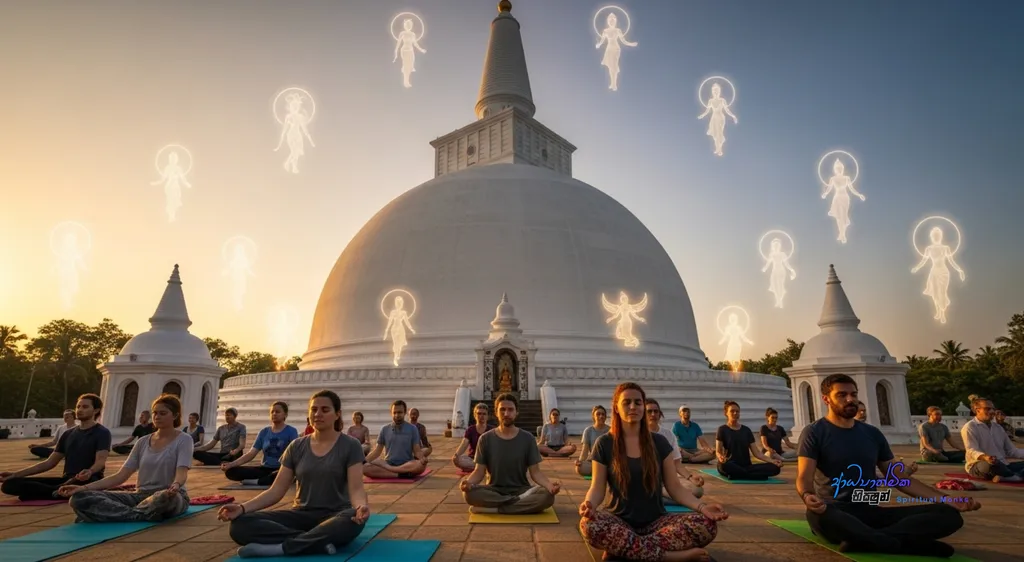
Let’s make this clearer with a practical example. Imagine ten people, all of whom have successfully opened their third eye through dedicated meditation. They go together to a sacred place, perhaps a site with holy relics like the Ruwanwelisaya, which we’ve practiced visualizing.
Now, let’s say 100 celestial beings, or devas as they are called in Buddhism, arrive at this sacred site to pay homage. All ten meditators can perceive their presence, but what they see will vary greatly.
- One person, due to their immense positive kamma and past practice, might see all 100 devas clearly.
- The second person might see only 95, or perhaps 90. Five or ten are invisible to them.
- Another might see 80. Another, 50.
- This can continue all the way down to someone seeing only 20, 10, five, two, or even just a single deva.
Why the difference? It is because each person’s capacity is shaped by their unique journey the wholesome actions they’ve performed, the perfections they’ve cultivated, and the meditative skill they’ve honed over lifetimes. The same principle applies if they were looking at unseen spiritual structures, like celestial stupas. Some might see all ten if they exist, while others see nine, eight, and so on. The quantity and clarity of what your third eye perceives is directly related to your spiritual maturity.
The Purity of Mind: How Defilements Cloud Your Vision
Beyond your accumulated practice, the clarity of your third eye vision in any given moment depends on the purity of your mind. We must constantly cultivate mindfulness, which in Buddhism is called sati. If the mind is clouded by mental defilements, or kilesa, the vision becomes weak and unreliable.
For example, imagine the person who could see all 100 devas. If, at that moment, a strong thought of lust or craving (rāga) arises in their mind, that defilement acts like a veil. Because of that impurity, their vision could instantly weaken, and they might only be able to see 50 devas, or even fewer. The defilements obscure the faculty of seeing. This is why maintaining a pure, mindful state is essential for anyone practicing with the third eye. This is a deep topic I will explain more fully in a future teaching.
The Two Worlds: Seeing with Eyes Open and Closed
As you progress, you will find there are two primary ways of seeing with the third eye.
1. Seeing with Eyes Closed
This is usually the first stage. When you close your physical eyes in meditation, the unseen world can appear as clearly as if it were daytime. You can direct your attention to a sacred place like Sigiriya, Sri Pada (Adam’s Peak), or Bodh Gaya in India, and see what is there.
2. Seeing with Eyes Open
After a period of dedicated practice, this ability can integrate with your normal sight. With your eyes wide open, you begin to perceive the unseen world layered over the physical one. You will see ordinary people, but also separately perceive non-human beings (amanussa) and celestial beings (devas). Looking at the sky, you’ll see the clouds and airplanes, but you may also perceive the heavenly realms (divya loka) and, for some, even the Brahma worlds beyond. The two realities coexist in your field of vision.
Glimpses into the Unseen: Spirits, Funerals, and Sacred Places
This ability to see the unseen with your third eye provides insight into many situations. Here are a few examples:
- At Funerals: Sometimes, a person who lived what seems like a good life never harming anyone, living peacefully can be seen as a ghost or spirit (an amanussa or bhūta, though in Buddhism all are classed as amanussa) lingering in their home. Why? Because even if they were good, they were not enlightened. If their final thought at the moment of death (the cuti citta) was one of strong attachment to their land, money, or family, that clinging can cause them to be reborn right there in that state of craving.
- At Shrines (Devalas): You can discern the nature of the beings present. Are they true deities? Earth-bound spirits? You can perceive the reality behind the rituals.
- At Musical Shows: In places where people indulge heavily in alcohol and sensual pleasures, you can see restless spirits (amanussa) drawn to the energy. They may even enter the bodies of intoxicated people, drinking through them and dancing. A person might find they can drink an entire bottle when they normally can only handle half, because the spirit is consuming it too. These unseen beings are drawn to and feed on these energies.
- In Sacred Places: At sites like the sixteen sacred places in Sri Lanka (Solosmasthana) or the Sri Maha Bodhi tree, you can perceive the righteous, benevolent deities (sammādiṭṭhika devas) who reside there. Under a Bodhi tree in a temple, you might see the celestial palaces that tree-deities from the Cātummahārājika realm have manifested.
- At Archaeological Sites: It is even possible to see hidden treasures. However, I must give a strong warning: do not pursue this. These treasures are often protected by fierce guardian spirits (Bhairavas), and attempting to interact with them can lead you astray. It is a power to be aware of, but not to be misused.
You don’t need to be afraid of these beings; they cannot harm you if your mind is protected. This ability simply reveals the complex layers of existence all around us.
How to Manage Your Spiritual Sight: Turning the Third Eye On and Off
For some, especially in the beginning, constantly seeing the unseen world with the third eye can feel overwhelming. It might be particularly distracting when you are trying to sleep. Seeing bright lights or scenes with your eyes closed can make it hard to rest. It’s like trying to sleep with the lights on.
If this becomes a problem, you have a solution. You can temporarily ‘turn off’ this faculty. It works like a password or a switch. You simply make a firm resolution, known in Pali as an adhiṭṭhāna. You can say to yourself with clear intention, “May my third eye be temporarily closed until I awaken from sleep.” Repeat this a few times, and the visions will cease, allowing you to rest in natural darkness.
When you wake up, you can make another resolution: “May my third eye open again now.” It is a skill you can control. Over time, however, most people adapt. They learn to live harmoniously with both the seen and unseen worlds, using wisdom to distinguish between them. This ability also opens the door to communicating with these unseen beings, but that is a vast topic for another day.
Your Path Forward: Embracing the Journey of the Third Eye
Today’s teaching has offered you a map of what to expect as your third eye awakens. We have explored why vision varies, the different ways of seeing, and what you might perceive. For those of you whose third eye has already opened through our practices, these points may resonate with your own experiences. You may be nodding in recognition right now. For those of you on the path, this serves as a guide for what lies ahead.
For both groups, the journey is the same: continue to practice, to experience these truths for yourself, and to use these abilities not for worldly gain, but for the development of your spiritual life. These are not the final goal, but rather fruits that appear on the path to greater wisdom and liberation.
Final Blessings and Acknowledgment
As we conclude, I wish to once again express my deep gratitude to Mr. Chathura for his invaluable work in bringing these 50 teachings to you. May his spiritual life continue to flourish, and may his wholesome actions bring great blessings to him, his parents, and all his relatives. May they all enjoy health, happiness, and long life.
And to you, who have read this teaching, may you too succeed in your practice. May you open your third eye, develop states of deep concentration (jhāna), cultivate mindfulness (sati), awaken your inner energies like Kundalini, and draw upon universal energy. By listening with a clear mind and applying these teachings practically, may you gain direct experience and its profound results. May the blessings and protection of the Buddha, the Dhamma, and the Sangha be with you always on your journey.
We invite you to walk this path with us. Read our teachings, and most importantly, apply them practically in your own life. as you practice, questions will naturally arise. Please feel free to share your experiences and questions in the comments below, via email or contact form. I will do my best to offer guidance in future talks based on your progress. For now, begin this practice with an open heart and a mind free from expectation. Cultivate it correctly, and may you find the clarity and peace you seek.
Thank you for joining us. We hope this blog will be of great benefit to your spiritual journey.
May you all be well and happy.


