


Categories: Dhyana: Practical Training
May the blessings of the Triple Gem be with you all!
Today, through our spiritual teachings, I wish to explain a new methodology: how to solve problems from within a state of deep concentration. We will explore how to practically apply this state, known in Buddhism as Samadhi, to develop your mind, enhance your intellect, and awaken your wisdom.
This technique can be a powerful tool for worldly success inspiring new inventions, advancing in education, and bringing creative solutions to any field. This article will simply explain the technique so you can begin to use it.
However, it’s important to understand that this method is accessible only to someone who has already cultivated a degree of meditative concentration. For a person who does not practice meditation, applying this technique will be difficult because the foundational mental calm is not yet established. But for those who do practice, using this method will only enhance and develop their abilities, never leading to decline or destruction.
I will explain this technique in a very simple way, so that anyone, of any age, race, or religion, can understand it and use it to benefit themselves, their country, and their community. With this in mind, let’s explore how to solve problems from a state of Samadhi.
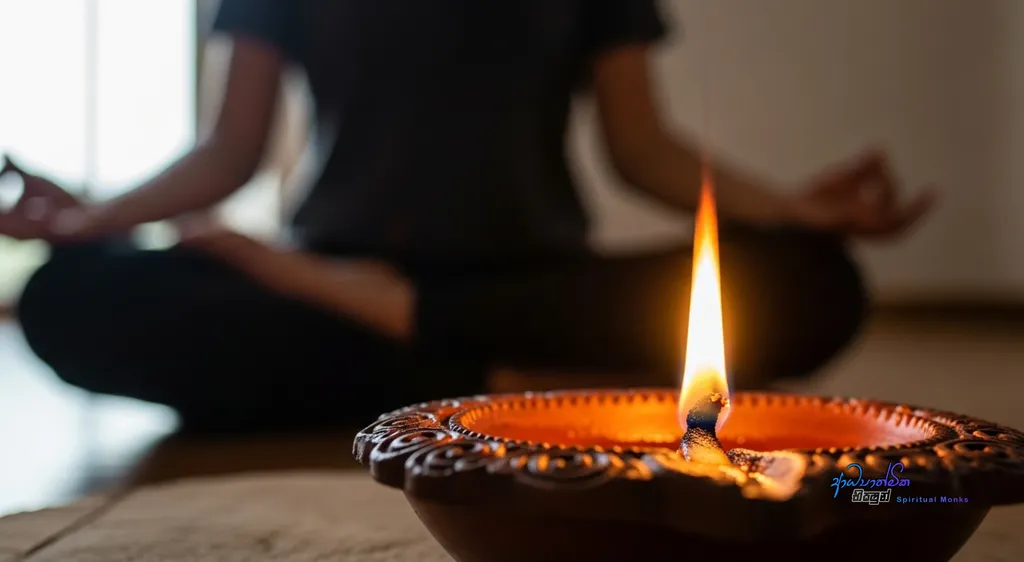
The Creative Mind and the Power of Concentration
From our previous teachings, many of you have gained a practical understanding of what Samadhi is. We have defined it and explained it, and through your own direct experience, you know whether you are in a state of concentration, a deeper meditative absorption known as jhana, or another state of mind. You know this because we have taught you how to recognize these states.
Now, let’s consider an innovator someone who creates or discovers new things. This could be a man or a woman, and such people exist all over the world, including here in Sri Lanka. They may be students at universities or schools or working in creative institutions.
When these innovators are trying to create something new, they think about it intensely, almost constantly. They think about it while eating, drinking, or bathing, always asking, ‘What’s the next step?‘ They build mental pictures and run through scenarios in their minds. This initial idea, or concept, often arises from a societal need or a desire to make life easier, faster, or more enjoyable. This is how the technology we use today was born.
These creators conduct experiments and draw up plans, all stemming from their power of thought, their ability to think. This cognitive power is what allows an innovator to bring something new into the world. I’ve explained this simply to set the stage for understanding how Samadhi can be a tremendous help to such individuals.

Harnessing the Tangible Results of Your Practice
Innovators and businesspeople are always thinking. A businessperson constantly contemplates, ‘How can I grow my business? What’s the next step? How can I innovate?‘ This is the nature of a dedicated mind. They find solutions by thinking and thinking. Similarly, many who follow our teachings are also creators, artists, inventors of new machines, and more. Some have shared their creations with me. This teaching is for all of you, to help you develop your innate abilities even further.
Many of you, from the youngest to the eldest, have already developed some level of Samadhi through your meditation practice. You have felt its comfort, both physically and mentally. This is a direct, tangible result experienced in this very life. In the Buddhist teachings, this is related to the concept of Dittadhamma-vedaniya Kamma, intentional actions that bear fruit within one’s current existence. The peace you feel is a direct result of your practice. Now, let’s see how to use this result.

The Core Technique: Thinking from Within Samadhi
Here is the technique. When you sit down to meditate, you adopt your usual posture. After entering the state of Samadhi, you will notice your mind has a powerful ability to reflect. At this point, you can bring your problem to mind.
Let’s return to our example of the innovator. Normally, this person thinks about their creation all the time. But if this innovator has cultivated Samadhi through meditation, they can enter this state and then begin to think about their project. Sometimes, the state of Samadhi can become so deep and blissful that the mind doesn’t want to think about anything at all. The sense of physical and mental ease is so pleasant that you just want to remain in that peace.
In that case, you should continue with your regular meditation, using the meditation phrases or objects we have taught you.
However, to solve a problem, you must set aside a separate time. It doesn’t require a special place or posture; you can be sitting or even lying down. Enter the state of Samadhi as you normally would, but instead of focusing on your meditation object, focus on your creation or your problem.
Do not try to ‘meditate’ in the usual way during this session. Simply establish your mind in Samadhi and, from within that state, begin to think: ‘What do I do next? How do I build this? How do I create the next part?‘
When you do this, you will find that ideas, new thoughts, and creative insights will come to you rapidly, flowing effortlessly. This happens because your mind is firmly fixed on a single purpose, supported by the power of Samadhi. You are already an innovator, so your mind is naturally inclined toward finding solutions.
The Samadhi acts as a power-booster for this natural ability. The scattered thoughts you had while eating or bathing are now channeled through a focused, meditative power. Sit with your eyes closed, perhaps focusing your attention between the eyebrows, and while experiencing the calm of Samadhi, contemplate your creation. Ideas will flow. This is a technique we have used in practice ourselves.
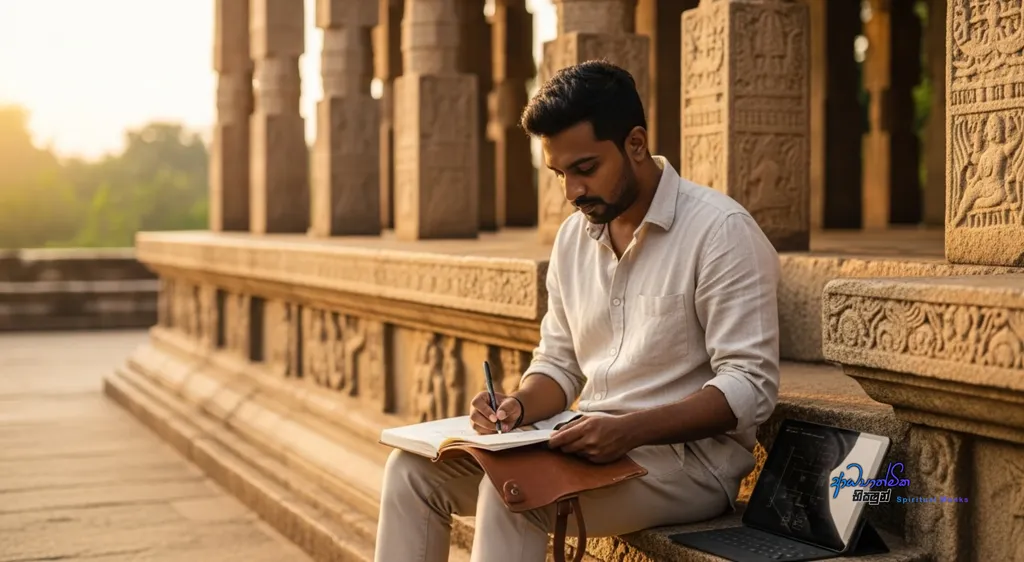
Practical Applications: From Art and Science to Spiritual Study
This is the technique, the methodology. You can continue thinking for as long as your state of Samadhi lasts be it forty minutes or an hour. This is a way I have taught to bridge your secular life with your meditation practice for worldly development. Please, try it and see. It can be incredibly helpful for your progress.
I have previously promised to help those working on new technologies by showing how meditation and Samadhi can be utilized, and this is the fulfillment of that promise. This method extends to many fields:
Artists and Musicians: For those with artistic talents, Samadhi is a place from which to draw new ideas. Some people I know have even developed their ‘third eye,’ a kind of heightened spiritual intuition, and can draw the beautiful things they see in their meditations. But even without such advanced experiences, the calm, empty, and spiritually powerful state of Samadhi is incredibly useful for generating new paintings, musical melodies, or songs.
Students and Academics: This is an excellent method for improving focus while studying. For those tackling difficult subjects like science, mathematics, or engineering, Samadhi provides a clear and stable mind. When you try to solve a complex math problem from an ordinary state of mind, your focus might be what we call Mithya Samadhi or ‘wrong concentration.‘ It’s a type of worldly focus, but it’s often mixed with desire or stress, and the mind remains scattered.
However, when you approach the problem from a state of true Samadhi, your mind is clean and pure. With this clarity, solutions to problems, even difficult equations, will arise naturally. If you know the question well, your mind in Samadhi will focus exclusively on it, and the answers will simply come.
Spiritual Scholars: Even those studying complex Buddhist philosophy, like the Abhidhamma, can use this. If you have a question about a difficult doctrine, you can take that question into Samadhi, and insights and answers will emerge. This is a special ability that comes with a concentrated mind.

A Universal Tool for All Professions and a Word of Caution
You can now see how valuable our meditation practice is for our worldly lives. However, we must be careful. We should not practice meditation with the sole expectation of worldly benefits. That would be counterproductive, as it would hinder our ability to develop deep meditation in the first place.
This state of Samadhi also greatly helps with memory. If you meditate before studying, your ability to retain information will be stronger. If you meditate after studying, it helps to firmly embed the knowledge in your mind. Modern science might say it’s stored in the brain, but I say it is established in the mind, and Samadhi is a great aid in this process.
This technique is for everyone, no matter your profession:
Businesspeople can enter Samadhi to contemplate how to grow their business and plan their next steps. New ideas will flow.
Farmers engaged in agriculture can take their problems related to crops or techniques into Samadhi. Based on their own experience, and from this state of deep calm, new solutions and independent ideas will emerge. It may even raise new questions, leading to further discovery.
This is the support that Samadhi can provide you.

Practical Steps and Final Encouragement
I have now shown you the technique for people in various fields: arts, commerce, science, and more. For anyone looking to create something new for the benefit of their country, community, or religion, you now have a method. You can use it.
To be clear about the process: you must set aside a specific time for this practice. Use your regular meditation time to focus solely on developing your meditation, without letting these problem-solving thoughts interfere. Otherwise, you won’t be able to deepen your spiritual practice. Then, at a separate time, sit in your meditation posture, enter Samadhi, and use that state to work through your worldly problems. This separation is key to making both endeavors successful.
I encourage you to try this technique and share your experiences by reflecting on them. This sharing can be a help to others, and in that way, you perform a meritorious act by exchanging ideas. This technique is simple and can be done freely by anyone, from a small child to an elder. Try it and see for yourself.
This is how your own Samadhi, cultivated through your dedicated practice, can be harnessed to bring success to your worldly life and to increase your knowledge, wisdom, and intelligence. I have explained the technique and its different facets simply. There is no need to discuss it further in a more complicated way. The only thing required is to follow the method and see the benefits for yourself. It brings us happiness to see you benefit from it.
Conclusion: Your Path to Insight
I believe this is sufficient on the topic of solving problems from a state of Samadhi. You can take any problem from your worldly life, contemplate it from within this state, and you will find answers. That is the final, short summary.
Now, I will conclude this teaching. By the power of the Buddha, the Dhamma, and the Sangha, may you all gain the ability to solve your problems and challenges through your own cultivated abilities, and may you be able to do good work for your country, your people, and your tradition.

We invite you to walk this path with us. Read our teachings, and most importantly, apply them practically in your own life. as you practice, questions will naturally arise. Please feel free to share your experiences and questions in the comments below, via email or contact form. I will do my best to offer guidance in future talks based on your progress. For now, begin this practice with an open heart and a mind free from expectation. Cultivate it correctly, and may you find the clarity and peace you seek.
Thank you for joining us. We hope this blog will be of great benefit to your spiritual journey.
May you all be well and happy.
May the blessings of the Triple Gem be with you all!


