


Categories: Maintaining Mindfulness
May the blessings of the Triple Gem be with you all. Welcome. In our ongoing series of practical teachings, we address a question that many of you have sent us through WhatsApp, a question that touches the core of our shared human experience: “Venerable Sir, why is it that the very thing I try hardest to let go of is the thing that comes back to my mind again and again?”
I want to affirm to you that this experience is the truth of the mind. As you develop mindfulness, you begin to see a pattern. If there is something in your life to which you are strongly attached, a person, an object, a memory, and you are now trying to release it unwillingly, it will persist. This is the central challenge in the practice of letting go of attachment.

The Pain of Forced Detachment: Understanding Lobha
Imagine you are fond of a person or an object, but for some reason, that connection is now causing you harm. You still feel a deep fondness, a powerful pull towards it, but you know you must let go. You have to give it up reluctantly. In this situation, you are not letting go with understanding or wisdom. You are not releasing it because you have deeply reflected on its drawbacks, its potential for destruction, or the harm it causes you. Instead, you are letting go with a heart full of fondness, a heart that is still clinging.
When we force ourselves to let go like this, perhaps due to external pressure or a painful necessity, the mind doesn’t truly release its grip. Because the desire is still there, the memory of that person or thing will surface repeatedly. In Buddhism, this clinging, this deep-seated desire, is called Lobha. In the Sutra and Abhidhamma collections of the Buddha’s teachings, this word points to what we might call craving or greed in a worldly sense.
We use many words for it: love, passion, desire, fondness. When this Lobha is present, the object of our desire will inevitably keep returning to our minds. Why? Because we didn’t let go because we were tired of it; we let go while still wanting it. If we had truly seen its nature and become disenchanted, it would still arise in the mind, but with far less frequency and pain.
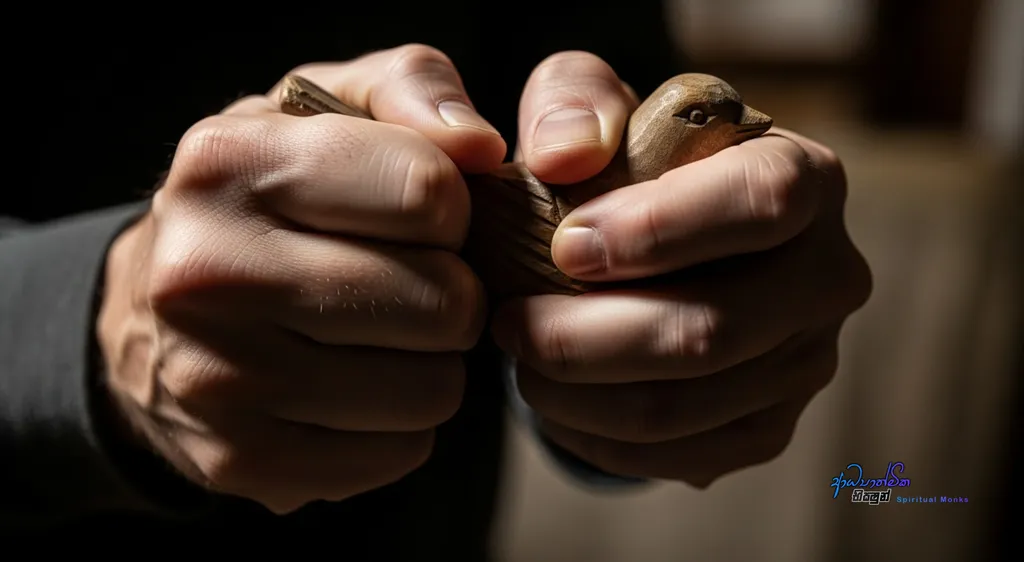
From Childhood Toys to Lifelong Bonds: The Universal Roots of Attachment
This tendency of the mind is not unique to you. It has no basis in nationality, caste, or religion. It doesn’t matter if you are male or female, on Earth or another planet, in Sri Lanka or any other country. This is a universal principle, the very nature of the mind.
Observe the stages of life:
- A small baby is most attached to its mother. The infant cannot bear to be separated from her.
- As the child grows, they become attached to toys. They cry if they can’t have them, and if a toy is lost or hidden by an adult as a joke, the child weeps with the fear of loss.
- In adolescence and young adulthood, we form relationships, friendships and romantic bonds. When these connections break, the pain can be difficult to bear. For some young people who haven’t developed mental resilience, this pressure can lead to tragic decisions, like self-harm, born from a lack of understanding of the cycle of existence (samsara).
- As we mature into adulthood and old age, our attachments shift to houses, vehicles, land, and then to our children, grandchildren, and great-grandchildren. We become intoxicated by this possessiveness, this Lobha. We become attached to money, property, and gold.
We become so entangled in this web of desire that we find ourselves unable to mentally let go of anything. This is the fundamental nature of an untrained mind.

The Dangers of Clinging: A Karmic Perspective on Letting Go
This deep-seated craving has consequences that extend even beyond this life. At the moment of death, during the final thought-moment, known in Buddhism as cuti-citta, if our mind latches onto an object of our attachment, our next existence can be shaped by it. We might be reborn in a state of suffering, like the realm of ghosts or spirits (pretas), lingering near the people or possessions we couldn’t release. One could even be reborn as a louse in a grandchild’s hair or a wood-boring insect in the beams of one’s own house.
During the Buddha’s time, a monk passed away. It was customary then, as it is today, for the deceased monk’s belongings, such as robes and bowls, to be distributed among the other monks. However, the Buddha, who was alive at the time, instructed the Sangha not to touch that monk’s possessions for seven days. He explained that the monk had died with a strong attachment to a particular robe. At the moment of death, his mind grasped that robe, and he was reborn as a woodlouse living within its very fabric.
The Buddha knew that if the other monks took the robe, the new-born insect, in its anger and distress, could fall into an even lower realm. After seven days, the insect’s short lifespan ended, and the monk was reborn in a favorable state. The Buddha was there to see this and guide the others. But today, the Buddha is not physically present. If this happens to us or our loved ones, there is no one to intervene. This is why understanding the danger of not letting go of attachment is so crucial.

The Two Great Chains: The Grip of Aversion (Dosa)
It’s essential to understand that craving is not the only force that binds us. Don’t make the mistake of thinking that only the things we desire come back to haunt us. The mind also clings powerfully to what it hates. If you hold intense aversion, which we call Dosa (hatred, anger, ill-will), towards a person or a group, that too is a form of clinging. It is a collision, a friction in the mind. That too, we cannot easily let go of.
So, the two things that return to the mind most forcefully are:
- The things we are most attached to: through craving, love, passion, and desire.
- The things we most collide with: through hatred, anger, resentment, and aversion.
When you try to let go of either of these, they will inevitably surge back into your awareness. This is a natural law of the mind.

A Higher Perspective: The Mind of a Bodhisatta
This struggle is part of the human condition. Even great beings who are fulfilling the perfections to become a Buddha, known as Bodhisattas, experience these thoughts. The difference is that they, through developed mindfulness and wisdom, recognize these thoughts and are able to subdue them. It’s helpful to compare our minds to theirs. A Bodhisatta is always ready to give anything away because they are fulfilling the perfection of generosity (dāna pāramī) over countless lifetimes. They see the freedom and joy in giving.
Most of us listening to this are not Bodhisattas. This doesn’t mean you should misunderstand this teaching and give away things that are essential for your or your family’s survival. That would be unwise. But you can practice generosity with a portion of what you have. The point of this comparison is to see the vast difference between an untrained mind and a mind highly trained in letting go of attachment. This understanding can inspire our own practice.

The Practice of True Letting Go: A Buddhist Mindfulness Guide
So, what should we do when these thoughts arise again and again? The Buddha taught a path of practice, outlined in the Four Foundations of Mindfulness (Satipaṭṭhāna), that gives us a way forward. When a thought about something you are trying to release, whether with fondness or anger, comes up, observe your mind with clear mindfulness.
You will notice it feels endless. It just keeps coming. Trying to forcibly stop it is like trying to dam a powerful river with your bare hands; the water will find a way through. You cannot block it by force. The key is to change your approach.
Do not try to stop the thought. Do not try to block it. Do not try to run away from it or distract yourself.
Instead, allow the process to unfold naturally and simply watch it with awareness. Let the thought come. Let it stay. Observe what it does. Understand that the thought arises with an intensity proportional to your attachment or aversion. It comes day and night, when you wake up, when you bathe, when you travel, when you work. This is the nature of the mind.
When you are busy with external tasks, the thought may fade temporarily, but it resurfaces the moment you are idle. Many people try to cure this by becoming workaholics, but this is only a temporary fix. The true practice is to watch the process without resistance.

From a Year of Pain to Six Months of Healing: Building Mental Resilience
As you observe, ask yourself: What is this thought doing to me? You might notice that it crushes you mentally, makes you lose your appetite, makes you forget your responsibilities, and prevents you from focusing. See this clearly. With the help of mindfulness (sati) and clear comprehension (sampajañña), understand with wisdom (paññā): “This is happening because of my deep attachment to this animate or inanimate object. This is the result of my own clinging.”
When you do this, you start to understand your own mind. If you truly comprehend the process with one particular attachment, you gain insight that will help you with all future attachments. You can anticipate, “This new attachment could also end like the last one.” This builds mental fortitude.
This practice won’t yield 100% results overnight. You are not yet at the stage of Nibbāna (liberation), where craving is fully extinguished. But it brings gradual progress. If, without this practice, you would have suffered from a loss for a year, with this practice, you might reduce that suffering to six months. The next time it happens, the period might be even shorter. Your mind becomes stronger each time. This is what we call spiritual maturity.

Healing from Hatred: Applying the Same Mindfulness to Anger
This exact same method applies to thoughts of hatred and aversion. When a memory of someone who wronged you arises, bringing with it a surge of anger, watch it. Don’t try to suppress it. Observe what the anger tells your mind to do. Notice the physical and verbal impulses it creates.
Does it want you to use your hands and feet, to pick up a weapon, to use harsh words? See how your mind prepares to engage in hateful physical or verbal actions. By simply observing this process with mindfulness, you gain a clear understanding of it. The power it has over you begins to diminish.
Like with attachment, this process is gradual. It takes time. But with consistent practice, you will find that the time it takes to recover from an incident that provokes your anger becomes shorter and shorter. You gain experiential wisdom on how to face these states of mind. This is how we gradually work on letting go of attachment and aversion.

Your Path to Inner Freedom: Don’t Fall in the Same Pit Twice
The only way to achieve this is through the combination of mindfulness (sati) and wisdom (paññā). There is no other way. This is the path to spiritual maturity. When you understand that a thought keeps returning because your thirst, your craving (taṇhā) for it has not yet faded, you can work on it with patience. As you continue to understand its nature, the craving itself begins to diminish.
The results of this practice are certain. You will gain profound mental peace. As you continue to live your worldly life, you will face losses and conflicts, but you will be able to meet them with strength. However, try not to be foolish. Do not make the same mistakes over and over, as they say, do not fall into the hole at night that you already fell into during the day. Strive not to get entangled in the same patterns again.
The entire practice comes down to this: watch your mind with mindfulness and understand the process. When you do this, your mind becomes incredibly strong and resilient. I hope this extensive explanation helps you understand why the very thing you try to let go of keeps returning. The solution lies not in fighting, but in seeing. By understanding these principles taught by the Buddha, may you develop the strength to walk this path.

Final Blessing
By the power and grace of the Buddha, the Dhamma, and the Sangha, the Triple Gem, may you all be able to understand these matters well and put them into practice.

We invite you to walk this path with us. Read our teachings, and most importantly, apply them practically in your own life. as you practice, questions will naturally arise. Please feel free to share your experiences and questions in the comments below, via email or contact form. I will do my best to offer guidance in future talks based on your progress. For now, begin this practice with an open heart and a mind free from expectation. Cultivate it correctly, and may you find the clarity and peace you seek.
Thank you for joining us. We hope this blog will be of great benefit to your spiritual journey.
May you all be well and happy.
May the blessings of the Triple Gem be with you all!.


