


Categories: Maintaining Mindfulness
May the blessings of the Triple Gem be with you all!
In our shared spiritual journey, we have often explored the path of practical application. We have delved into various meditation techniques, focusing on how to maintain mindfulness and observe the mind to understand its true nature. Many of you have discovered the landscape of your own mind through this direct, practical work. A spiritual teaching is not meant to be a static belief; its purpose is to be lived, to be experienced directly.
The Buddha himself taught that practical application must come first. Without it, we cannot walk the path He showed us. We cannot live in harmony with nature, understand the universe, or comprehend our own minds. Without practice, we can never hope to pacify the defilements, or kilesas, that cloud our hearts. You will find it impossible to recognize your thoughts or perform any of these vital inner tasks if you lack a practical foundation. We have consistently emphasized the importance of this hands-on approach.
As you engage in this practice, whether it is Samatha (calmness) meditation or Vipassana (insight) meditation, there is a universal experience that arises, regardless of age, race, religion, gender, or background. It is a thought that every single one of us has known: the thought of fear.
This feeling of fear has grown within all our minds. In one sense, this thought is a mental defilement, a kilesa. I have often explained that as long as fear is present, we cannot move forward on our spiritual path. In a previous teaching, I explained how to journey through a spiritual life without fear.
Today, I want to show you how to use mindfulness, the simple act of paying attention, to investigate this very fear. By identifying it practically within yourself, you can discover what this experience of fear truly is, what is embedded within it, and how we can bring it to an end. By understanding its nature, you will see how it disappears. You can learn what chain of thoughts it belongs to and how we have managed to live with this feeling for so long. Through the practice of mindfulness, every aspect of fear can be understood.
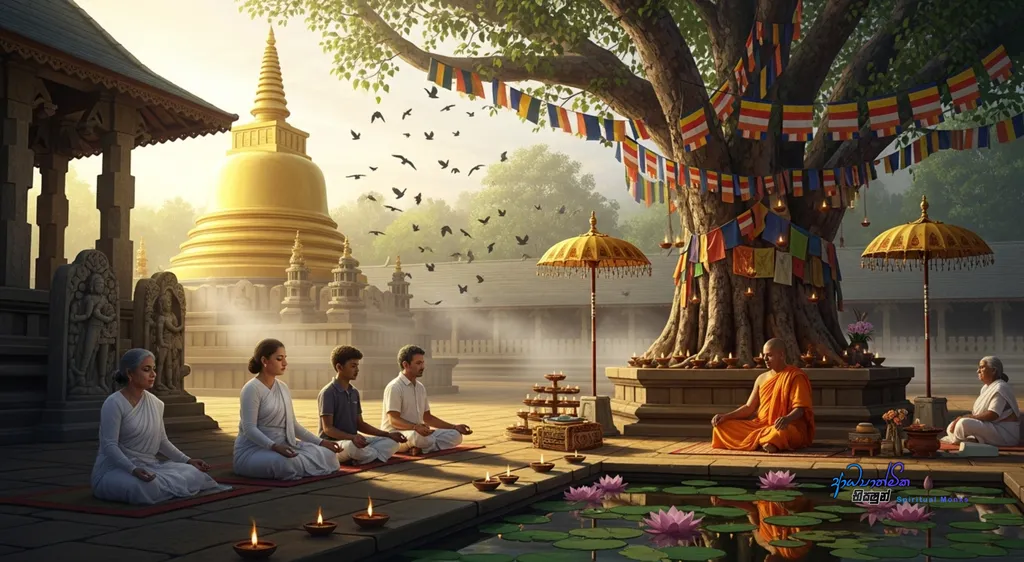
Anatomy of Fear: A Mindful Investigation into Thought and Body
Consider your daily life,while you are at work, doing chores at home, or engaged in meditation. Perhaps you’ve heard stories about non-human entities (amanussa) and feel a sense of dread at night. In all these cases, fear is nothing more than a thought that cripples you and halts your progress. When we practice mindfulness, we recognize a fundamental truth: our minds are filled with a stream of thoughts. These thoughts are what dominate and control us. However, as long as we remain mindful and aware, these thoughts lose their power to rule us. This is a truth you can discover for yourself through the simple act of being present.
Fear, you see, is just another type of thought. This is a crucial point to understand, and you can verify it through your own experience. If you are afraid of the dark or of spirits at night, let’s use that as our field of investigation. Imagine you are someone who becomes afraid of the dark at 6 PM. Many people, including young men and women, experience this. As I said, fear knows no boundaries of age or background. This moment, when darkness falls and fear arises, is a perfect opportunity to develop your spirituality.
Instead of resisting it, use this moment. As 6 PM approaches, and nature’s light begins to fade, a sense of fear may enter your mind. We have previously taught how to silently watch the mind. Use that technique now. Settle into mindfulness as you normally would, but with your attention directed at the mind itself.
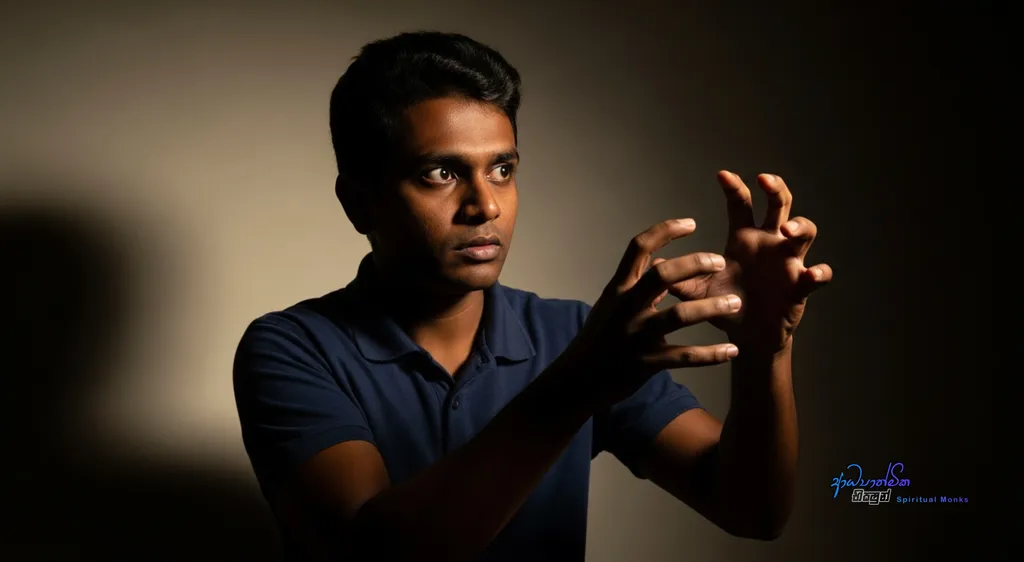
As you watch, you will begin to see the thoughts of fear appearing, one by one. You will notice this thought arise again and again, and you’ll observe its physical effects: the hair on your body standing on end, your heart rate increasing.
You can witness how a single thought, operating in the mind, sends a signal to the brain that impacts the entire body. Your blood pressure might rise, your body might begin to tremble. All of these internal and external events, shaking hands and feet, a churning stomach that might even make you feel you need the toilet, are happening because of this one thought. You might even notice your digestion speeding up. Observe the immense pressure and shock a single thought of fear creates within you. This is the first step in overcoming fear: seeing it for what it is.
The Illusion of Control: What Fear Teaches Us About Not-Self (Anatta)
Now, turn your attention from the physical sensations back to the mind itself. Watch the mental turmoil and pressure. Notice the sheer speed of your thoughts. The thought of ‘fear’ is arising, persisting, and ceasing over and over again. You will be able to clearly see this process, what in Buddhism is called uppāda, ṭhiti, bhaṅga,the birth, existence, and dissolution of mental moments. It happens incredibly fast. Just watch how long this cycle continues. Through this sustained mindfulness, you simply observe this chain of thoughts.
It doesn’t matter what your trigger is. Whether you feel fear at midnight, in the early morning, in a lonely place, a dark cave, a forest, an abandoned house, or on a road rumored to be haunted by spirits. Whether these spirits exist or not is irrelevant to our practice. What matters is the fear that arises in your mind because of these external factors. This is what you must identify.
Look closely at how your mind is shaken by an external cause,whether it’s a person you can see or a presence you cannot. Over time, this reaction has likely intensified. Perhaps you first learned about spirits when you were ten years old. At that time, a seed of fear was planted. As you grew to 15, 20, and 30, that signal of fear was reinforced, growing stronger until you might be someone who avoids going outside at night altogether. Why does this happen? That initial signal has been cultivated and conditioned in your mind. It has become ingrained. You are clinging to it, and there is also aversion. That thought has taken control of you.

Here, you can directly understand a profound truth: the thought of fear is controlling you. This is a gateway to understanding Anatta, or not-self. For so long, you have believed that you control your body and mind. But I am not talking about a spirit controlling you; I am pointing to how your own mind, your own thoughts, are controlling you. It is this very mind that carries us through samsara,the cycle of birth and death,propelling us to heavens, hells, and human or animal realms. You can see in this small example of fear how completely the mind controls us.
Think about this: if that mind was truly yours, if that thought was truly under your command, why would you choose to be afraid? You dislike fear; you are averse to it. So why does it arise? Shouldn’t you be able to instantly dismiss the thought and remain fearless? Shouldn’t you be able to stay in any cemetery, any forest, for months on end? But you cannot. Why? Because from this moment on, if you truly practice this, you will realize that we operate according to what the mind says. The only beings who do not act according to the whims of the mind are Buddhas, Pacceka Buddhas (silent Buddhas), and Arahants (fully enlightened beings).
Those who have gradually tamed the mind are the Noble Ones on the path the Sotāpanna, Sakadāgāmī, and Anāgāmī. Those who have understood and tamed it to some extent are the sages and ascetics who practice calmness meditation. We must fully comprehend these distinctions. When you see how helplessly you are swayed by your mind, you understand the extent of its control. This realization is itself a form of wisdom an understanding of the nature of mind, the nature of reality, and the nature of yourself.
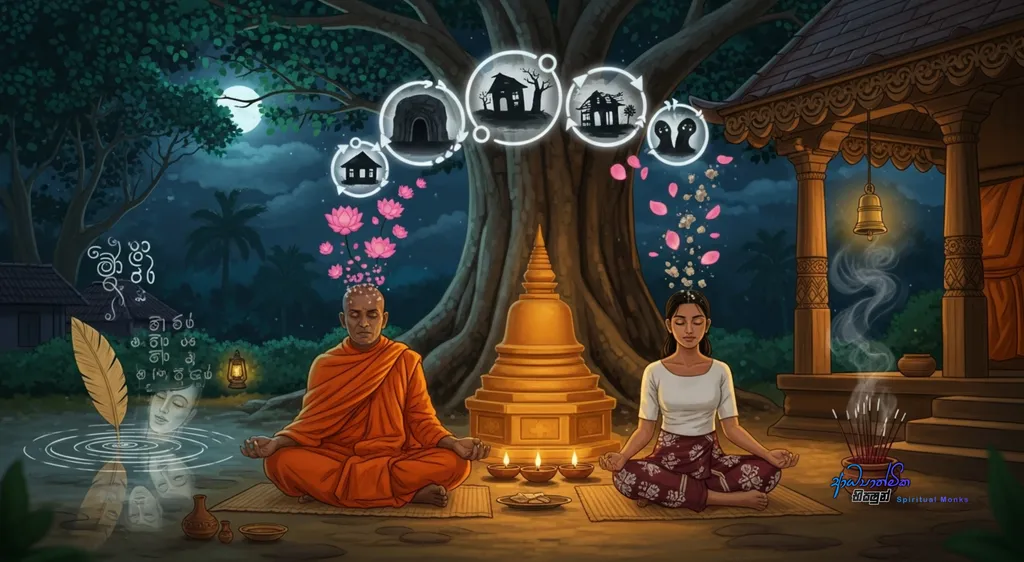
Deconstructing Terror: Tracing Fear Back to Its Mental Blueprint
As you continue this practice, you begin to uncover a fundamental truth about this fear. Is it a real, solid fear, or is it a false one? As someone who experiences fear, perhaps while riding a motorcycle or driving a car at night, you must simply watch your mind in that very moment.
You will see how the thought comes, captures you, and frightens you by presenting all sorts of suggestions: ‘A demon will come through that door now!’ ‘A spirit is on the roof!’ ‘It’s behind you!’ ‘It’s in front of you!’ ‘It’s on your left, on your right, on your shoulders, or even inside your body!’ ‘It’s on top of that tree!’
The mind creates countless illusory pictures. When I use the term ‘illusory pictures’ here, I am not referring to visions from the ‘third eye’ developed through calmness meditation. Please do not confuse the two. I am referring to the delusions created by our own thinking process.
These thoughts subject us to immense fear. But as you watch them, ask yourself: ‘Aren’t these just thoughts that I have accumulated since birth in this very life?’ Reflect on the books you’ve read, the movies you’ve watched, the stories you’ve heard. Aren’t these fears simply the result of information you’ve fed into your mind from various sources since you were born?
If, as in our earlier example, you first learned to fear spirits at age ten, that initial thought has been developed, solidified, and compacted over the years. It has become like a dense block of ice or a formidable mountain. The practice is to mindfully watch this thought every single time it arises.
This applies whether your ‘third eye’ is open or not; this is relevant for everyone. Even for those who can see non-human beings, this practice is essential for overcoming fear. When you see a distorted face, the fear you feel doesn’t come from the external image itself. Even in the human world, due to past unwholesome kamma (intentional action), there are people with distorted faces.
Look at your mind when you see them with your physical eyes. The image enters your mind, and then you can watch the thoughts that your mind builds around it. It is the same process. Whether the ‘spirit’ is at the corner of your door or just a memory from when you were ten, you will see that it is these old thoughts, now magnified and developed, that are appearing in the present. In truth, you have likely never even seen a spirit.

From Foe to Friend: How Everything Becomes a Teacher on the Path
On the other hand, let’s consider someone whose ‘third eye’ or divine eye (dibba-cakkhu) has opened through calmness meditation. When they see a non-human being, they don’t feel a strange fear. Why? Because they understand that the issue lies within their own mind. No matter how grotesque the being’s face is, the fear is generated internally.
Just as you have seen people with distorted features in the human world and can speak with them and smile, you can do the same with a non-human entity once you understand this principle. The fear is a reaction in your mind to its appearance; it is not a fault within the being itself. When you realize this, you can even smile at a spirit.
This is why I have structured this teaching to be suitable for everyone, for those developed in calmness meditation, those undeveloped in it, and those practicing insight meditation who can frame this within the context of mindfulness. What we are doing here is eliminating a defilement (kilesa). Gradually, this fear will diminish, and you will realize that you are no longer a fearful person.
You will find that you can leave the office at 8 PM and walk past a cemetery without any fear or panic. In fact, you might even find yourself mindfully observing your surroundings, looking around calmly, becoming a person who is truly present. Of such a person, we could say, ‘There is someone who could build a house in a cemetery without fear.’
Then, you will see how everything in your environment, the society around you, the visible and invisible beings,has helped you develop your wisdom (paññā) and your mindfulness. This is why in Buddhism, the Buddha taught that everyone and everything can be a support for our understanding.
Any monk who practices meditation correctly knows this. Enlightened monks know that everything is a great help for our practice. So, cultivate this gradually. Then you will have the freedom to go anywhere you wish. This is the practical path you need.

Beyond Chants and Mantras: Applying True Mindfulness to All of Life’s Fears
I have explained many things about this practice of overcoming fear. I’ve also shown you how to apply it practically. In a previous talk, I explained how to deal with fear for those who have various experiences during calmness meditation, but that was a different method.
This method, watching the mind, is from the perspective of insight (Vipassanā), a meditation method for ending the cycle of suffering. We’ve also spoken about being mindful 24 hours a day. Therefore, you can apply this advanced technique when fear arises during your calmness meditation as well. With this, the thought of fear will never arise in the same way again.
Those with an open ‘third eye’ will no longer be afraid of spirits if they use this method. They will be able to speak to them, smile, and share merits without fear. This is how it should be. Otherwise, you can never develop calmness meditation, nor can you ever attain the fruits of the path or reach enlightenment, because fear will always be an obstacle.
Understand this and act accordingly. The person who has supremely understood fear is perfectly equanimous and neutral. Fear is not even a concept for them; they live as if they have forgotten it. They are not bothered by it. They can travel freely and live anywhere, in any way.
Now, apply this same method to everything else. Look at the things you are most afraid of losing: your possessions, the person you love most,your girlfriend, boyfriend, husband, wife, parents, family, or even your beloved pets. Look at the material things you are attached to: land, property, vehicles.
Apply this method systematically to your fear of losing them. To understand the mind is to investigate its thoughts, to comprehend their behavior. What I have taught you about fear is precisely this: to observe its behavior. That is what we are watching.
This is why, in such moments of raw experience, simply chanting calming verses, like the Itipiso Gatha, is not the ultimate solution. When you are walking past a lonely place, chanting that verse provides temporary relief. We think that by reciting these Pali words, the spirit cannot come near us. There is a function to that, but it is a different kind of task. We need to be more advanced than that; our mentality must be elevated.
I taught you this method to help you reach that higher level of understanding. When you simply watch the mind, you begin to see what is really happening. By applying this to all your attachments, you can watch the behavior of all your thoughts with mindfulness. What we call ‘mindfulness’ is that which helps us understand the behavior of thoughts. It is a process of seeing and understanding, not of suppressing or forcing.
It is useless to try and understand by simply repeating words like ‘impermanence, impermanence,’ ‘suffering, suffering,’ ‘not-self, not-self,’ or ‘name-and-form, name-and-form.’ That is just chanting. I have said before that if you just chant the principles of Dependent Origination (Paṭiccasamuppāda), you will only develop calmness, not insight. It becomes a concentration practice. You can take any word from it, focus on it at your forehead, and you will start to see lights and develop psychic powers. But understanding the mind and chanting about the mind are two different things.
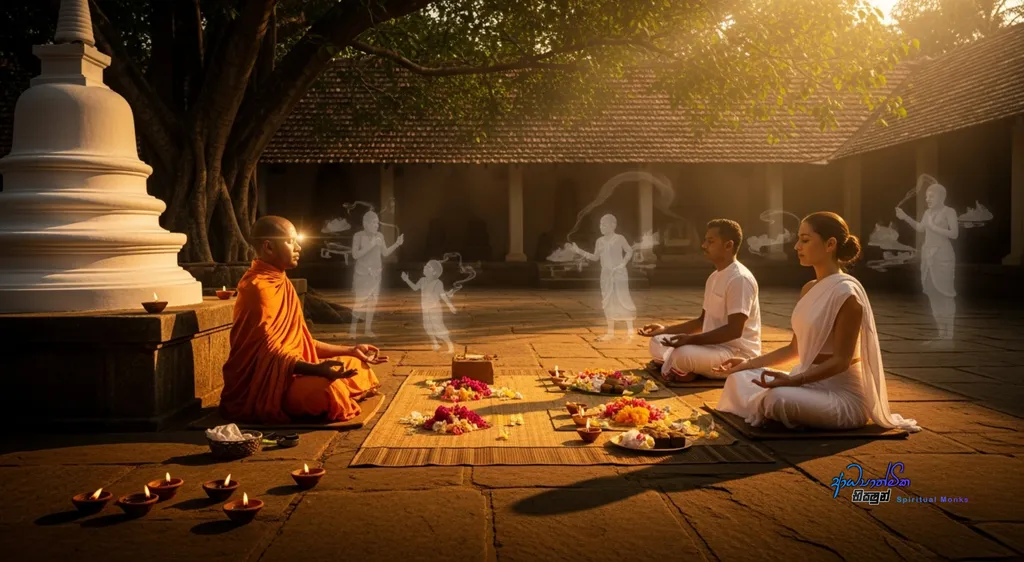
The Path to Freedom: Realize the Emptiness of Fear and Find Peace
I have given a separate teaching on the difference between Samatha and Vipassana meditation where this is explained clearly, for those who wish to explore it further. If you resort to chanting in these moments, you will live in fear forever. You have been born in this existence as a man or a woman, and you will face life’s challenges,in meditation, with unseen beings, with family and financial struggles.
When fear arises from these various sources, do not live with it every day. To become a free person who faces these things with happiness, you must move away from mere chanting and engage in the practical method taught by the Buddha 2500 years ago, a method taught by all Buddhas.
Engage with this practice and realize its truth for yourself. When you realize it, when you understand it, you will eventually think to yourself, ‘I have been afraid of this empty, useless thought for so long.’ There will be no strange laughter or excitement, but a settling into equanimity and neutrality. You will simply see, ‘This happened to me because I did not understand.’ This is what is necessary. Please, do this work.
I have spoken at length because we have a great deal of experience with these matters and could analyze them further, but I believe this is enough to explain how to eliminate fear through mindfulness. This practice is beyond all divisions of race, caste, or creed. Anyone, of any age or status, can understand it. I trust that you do understand. So please, apply this in your life.
You can share the results of your practice and the experiences you gain in the comments. I don’t say this for my own sake, but because by sharing the results you have obtained, you help another person in their understanding. This act itself brings you merit and helps you to develop your own spiritual life. If there are fearful people around you, let them read this teaching. Help them to walk this path by introducing them to these practical principles of mindfulness taught by the Buddha.
I will not speak further today. I now conclude this teaching on overcoming fear through mindfulness. By the power of the Triple Gem, the Buddha, the Dhamma, and the Sangha, may you all grasp this matter well. May you have the strength to face your fears with mindfulness, to identify the thought of fear, and to practically and completely remove it. May you have this ability.
We invite you to walk this path with us. Read our teachings, and most importantly, apply them practically in your own life. as you practice, questions will naturally arise. Please feel free to share your experiences and questions in the comments section below, via email or contact form. I will do my best to offer guidance in future talks based on your progress. For now, begin this practice with an open heart and a mind free from expectation. Cultivate it correctly, and may you find the clarity and peace you seek.
Thank you for joining us. We hope this blog will be of great benefit to your spiritual journey.
May you all be well and happy.
May the blessings of the Triple Gem be with you all!


