


Categories: Be Happy 24 hours
May the blessings of the Triple Gem be with you all!
On our spiritual journey together, one of the most vital teachings we have shared is the importance of observing your own mind. This is not just a concept to be understood intellectually, but a practical skill to be developed. We have often spoken of sati, or what is commonly known as mindfulness. The goal has always been to move beyond simply listening to these teachings and to apply them directly in your daily life.
It is clear that many of you have taken this to heart. You are no longer just listeners but active practitioners. Through this direct application, you have begun to gain profound experiences regarding your own mind. You are learning to recognize what your mind truly is and to identify the nature of your thoughts, distinguishing between those that are wholesome and those that are unwholesome.
This very act of gaining insight into the mind is what it means to elevate the mind, to cultivate a higher consciousness. This understanding is the very thing that helps us turn away from our unskillful actions. In simple terms, this is how we begin to destroy the mental defilements.

Understanding the Goal: Uprooting Defilements and Ending Rebirth
This developing awareness is what ultimately frees us. It is this understanding that unravels the defilements, causing them to fade away and disappear completely. Furthermore, it is this same insight that has the power to stop the cycle of rebirth, the endless wandering in samsara (the cycle of birth, death, and rebirth).
The suffering we see in the world the conflicts, the attachments, the anger arises from a lack of this understanding. People are trapped by the three unwholesome roots: raga (greed or lust), dvesha (aversion or hatred), and moha (delusion or ignorance).
As we walk this path and work to diminish greed, aversion, and delusion, their opposites naturally begin to shine forth: alobha (non-greed or generosity), advesha (non-aversion or loving-kindness), and amoha (non-delusion or wisdom). Don’t feel overwhelmed by these Pali words. The key is to realize that as you engage in the practice of mindfulness, the profound truths mentioned in the Tripitaka (the Buddhist scriptures) begin to manifest within your own mind. You don’t need to be a scholar to experience this.
To see this for yourself, occasionally read a sutta (a discourse of the Buddha) from the Tripitaka and then reflect on how its teachings relate to your own direct experience. In a future teaching, we will explore more deeply how to map the scriptures to the landscape of your own mind.

What is Mindfulness? The Light of Awareness, Not Mystical Vision
Today, I want to emphasize that you must give priority to mindfulness. Mindfulness, or sati, is the quality that illuminates the mind, dispelling the dark corners of ignorance. Now, when I speak of ‘light,’ I am not referring to the psychic lights that can arise in samatha (calm-abiding) meditation, sometimes associated with the ‘third eye.’ This is a different kind of light. I want to be very clear to avoid confusion.
Someone new to this might hear ‘light of the mind’ and think it refers to a mystical vision. A person with developed wisdom, however, understands that the light I am speaking of here is the clarity of awareness. It is the ‘light’ that allows you to see your own thoughts as they are.
The ‘darkness’ is the state of being unaware, of being mindless. So, please understand this distinction clearly as we proceed. The practice of mindfulness is about this inner illumination of understanding, not a physical or psychic phenomenon.
A Tool for Seeing: Mindfulness as a Mirror, a Lens, a Weapon
Mindfulness is something we already possess; it is always with us. Our task is to bring it to the forefront, to use this instrument again and again. To make it simpler, think of mindfulness as a tool. You can think of it as a weapon to cut through confusion, or a mirror to see your true face. Perhaps it’s like a pair of eyeglasses that corrects your vision, allowing you to see clearly what was once a blur.
You can use any metaphor that feels right for you, any image that makes the concept ‘click’ in your mind and feels light and easy. The best metaphor is the one that resonates deeply, the one that, as we say, hits you like a staff to the head in a way that brings sudden, undeniable clarity. This is the right way.

Seeing from All Sides: The Mind as a House to Be Explored
When we give priority to the practice of mindfulness, it begins to help us. It actively assists us in identifying the various things happening within our own minds. In previous teachings, we have discussed watching the mind in silence and explored different ways to apply mindfulness. When a person truly commits to this practice, they begin to see the mind from the various angles we have described.
Imagine there is a house. You want to understand this house completely. To do this, you must look at it from all sides. The view from the front gate is different from the view from the right side. The view from the back is different again, and the view from the left side is also unique. Each perspective reveals something new: the number of windows, the placement of doors, the overall shape.
This is precisely what we are doing with the mind. I am showing you how to look at your mind from different angles through the practice of mindfulness, so that the darkness of your unawareness can be dispelled and the light of your own inner wisdom can emerge. Until now, you may have been living like a blind person.
A person without mindfulness is, in a way, blind. If you pause for just a few seconds and apply mindfulness, you can see how much of the world around you your family, your colleagues, your friends lives in this state of unawareness. You can see how much mindlessness pervades society.

Practical Mindfulness: The Five Senses and the Plate of Food
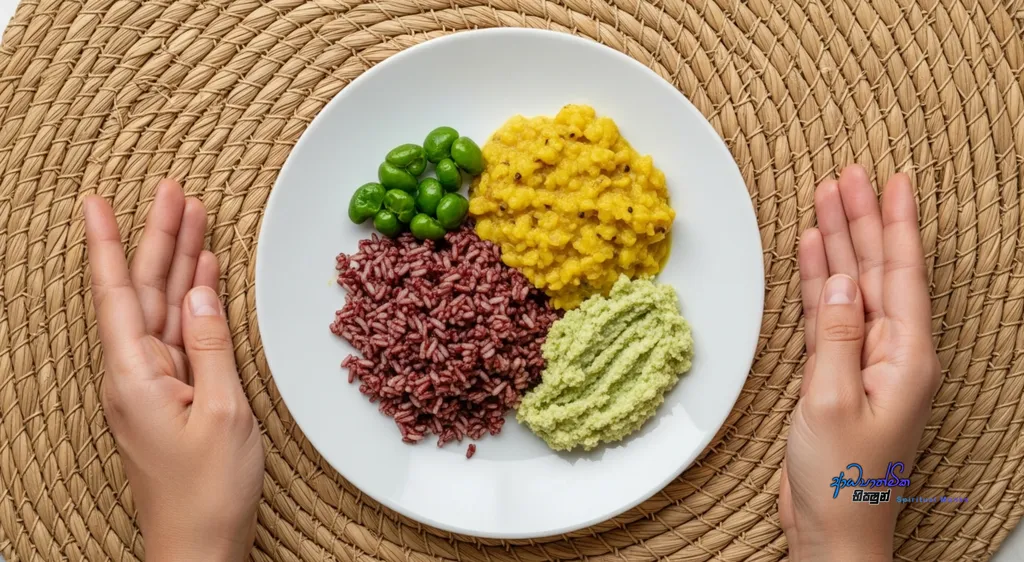
So, how do we apply this in a very practical way? Let’s take the simple act of eating. Normally, when you get a plate of food, your attention goes directly to the food itself the taste, the different curries. If you have a plate of rice with dhal and a coconut sambol, your focus is entirely on those three things.
Your eyes see it, and your mouth begins to water. Your sense organs the five senses of eye, ear, nose, tongue, and body take the lead. They are in charge.
But when we bring the practice of mindfulness into this, something changes. We begin to shift the priority. Yes, the eye sees the food. But for someone who didn’t know mindfulness, seeing the delicious food would immediately trigger a chain of thoughts: ‘Wow, what a great meal! I can eat two whole plates of this!’ This thought arises and takes over, but in your previous state of mindlessness, you wouldn’t even notice it as a thought. It would just feel like a direct reality.
Now, with your practice, you have a new skill. As the information from your eyes, your tongue, and your nose reaches the mind, you can directly see the stream of thoughts that arises from within. You can observe, ‘Ah, now thoughts related to this food are forming in my mind.’

A Step-by-Step Guide to Mindful Eating
So, for those who have been practicing, and for those to whom this is new, let’s try this. From now on, when you see that delicious plate of food perhaps with rice, sambol, dhal, and some fried fish notice how your senses leap forward to take charge. As your mouth waters, use your mindfulness to see that sensation of watering.
As your eyes look at the food, give priority to the act of seeing. Acknowledge, ‘Ah, the eye has taken the lead here. Now it is telling me I must eat a lot. I should take this much fish, this much dhal. I am going to eat until my stomach is bursting.’ Observe these thoughts as they arise.
Then, as you serve yourself and begin to eat, change your approach. Normally, we eat with a kind of greediness. You can still eat until you are full, that is not the issue. But with each mouthful, be mindful. Notice the movement of your hand as it goes to the plate. Observe it mixing the rice and curries. Watch as your hand brings the food to your mouth. Pay attention as you place it inside your mouth.
Then, carefully observe the process of chewing. Notice the flavors emerging on your tongue. Feel the sensation of swallowing, and how the food travels down your throat. With enough practice, you might even feel it arrive in your stomach. Just watch this entire sequence.
You don’t have to be perfect. Like learning to drive a car, the process will be jerky at first. You will be mindful for a moment, then lose it, then regain it. This is perfectly normal. The key is to keep practicing.

Observing Your Reactions: What Happens When There Isn’t Enough?
When you practice like this for some time, an interesting thing happens. You become more sensitive. You can clearly tell if the food is too spicy or not spicy enough, too salty or not salty enough. You can distinguish the individual flavors with incredible clarity. Mindfulness is that powerful. To use another analogy from modern science, in the beginning, your mindfulness is like a simple magnifying glass.
As you practice, it can become as powerful as a light microscope, or even an electron microscope, revealing finer and finer details. It can also become like the Hubble telescope, seeing things from a great distance. These are just metaphors to help you understand. So, start with this simple eating exercise.
Now, take the exercise a step further. Watch the thoughts that arise about the food the desire for it, the craving to eat more. And what happens if there isn’t enough? Imagine you are on a trip, and the food is delicious, but there’s only enough for one plate when you wanted two. The rice is gone, the curries are finished. Observe the feeling of sadness that arises in your mind. Watch the sorrow and displeasure.
Does anger follow? Do you feel the urge to blame or shout at the person who cooked? These kinds of thoughts can arise in anyone. The training is to be able to see them when they do. This is the crucial part. After seeing such a thought, notice how long it bothers you. How long do you dwell on thoughts like, ‘They didn’t cook enough!’? Do you see how your mind can escalate to the point of wanting to lash out? This is the importance of the training.
From Self-Observation to Liberation: Turning Your Focus Inward
The more you look at these mental states, the more you will understand your own mind. You can apply this level of awareness to everything you do, in all four postures: sitting, standing, walking, and lying down. Maintain this mindful attention throughout your day.
When you do this, your time becomes dedicated to investigating your own mind. You naturally give priority to your mind and your mindfulness. As a result, you become a person who is no longer interested in looking for faults in others.
This is the transformation that must happen. You will start to realize it on your own. If you were someone who used to enjoy gossiping and criticizing others, you will begin to think, ‘What a waste of my precious time in this cycle of existence. I have only been harming myself and prolonging my journey in samsara.’ This thought will arise independently, from your own wisdom. You will reach this level yourself. You will understand this if you commit to this investigation.

Conclusion: Your Path to Freedom Through Mindfulness
This short teaching was offered to show you another angle, another way to gradually eliminate the defilements and understand your own mind. The most important tool to help you in all of this is the practice of mindfulness. Please don’t make it a big, complicated problem. Just proceed in this simple, practical way. Through this, you will gain a great understanding that allows you to realize your journey’s end. This practice can truly bring you to the completion of the path.
With that, we will conclude today’s teaching on giving priority to mindfulness. May you all have the strength to put these teachings into practice.
We invite you to walk this path with us. Read our teachings, and most importantly, apply them practically in your own life. as you practice, questions will naturally arise. Please feel free to share your experiences and questions in the comments section below, via email or contact form. I will do my best to offer guidance in future talks based on your progress. For now, begin this practice with an open heart and a mind free from expectation. Cultivate it correctly, and may you find the clarity and peace you seek.
Thank you for joining us. We hope this blog will be of great benefit to your spiritual journey.
May you all be well and happy.
May the blessings of the Triple Gem be with you all!


