


Categories: Other Meditation Teachings
May the blessings of the Triple Gem be with you all!
Today, let us explore a vital question together: Why do we truly need the Dhamma, the teachings of the Buddha, in our lives? We live for a certain span of time, perhaps fifty, sixty, or seventy years, maybe even a hundred if we are fortunate, though that is rare. Throughout this journey, problems and challenges inevitably arise. This isn’t something that affects only one type of person; it transcends wealth, poverty, race, age, and religion. Everyone, without exception, faces difficulties.
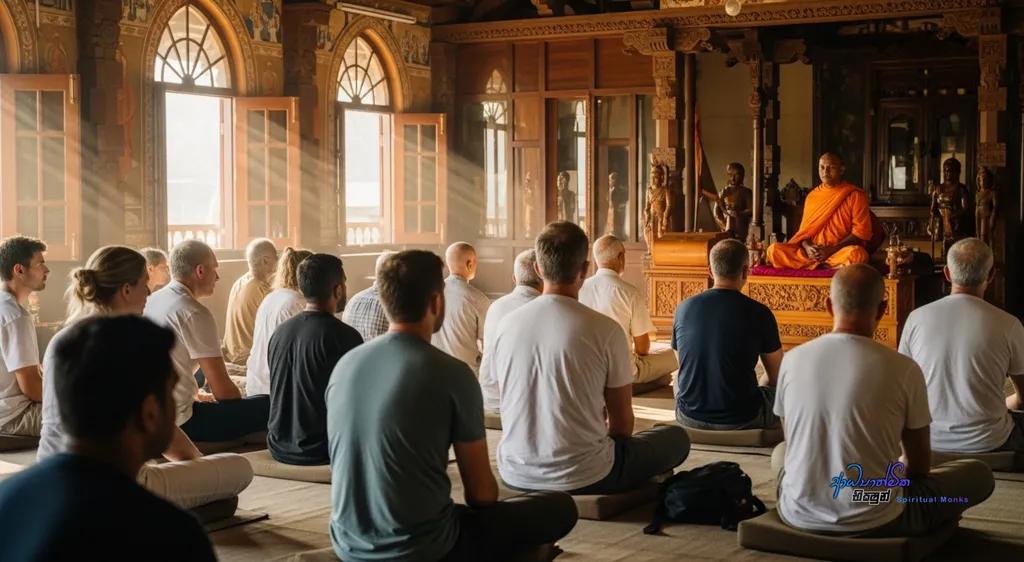
The Inescapable Nature of Life’s Challenges
Consider a wealthy person. They may not have financial worries, but perhaps they face turmoil with their spouse, children, or employees. Now, think of someone with little money. They might have a peaceful family life but struggle with economic hardship, unable to make ends meet.
And some, of course, face both kinds of problems. These challenges appear everywhere: in our studies, at university, within our families, and at our workplaces. This stream of problems never ceases. From the day we are born until the day we die, they are a constant companion. This is the nature of existence.
Look at the elderly people in your own family, your grandparents or even your parents. You will see that they are still navigating problems. Some are tasked with looking after grandchildren, either out of a lingering desire and attachment, which we call taṇhā or ‘thirst,’ or because of circumstances, like their children being unable to afford help.
Whatever the situation, if you pause and reflect on your life, whether you’ve lived thirty years or eighty, and look back honestly, what do you find more of? Moments of genuine happiness or moments of difficulty and stress? This feeling of pervasive unsatisfactoriness is what Buddhism calls Dukkha. It’s not just overt pain, but a fundamental tension and stress inherent in life.

The Clarity of a Meditative Mind
To truly see this reality, a calm and concentrated mind is immensely helpful. This state of mental stillness is known as samādhi, or concentration. When your mind is settled through a practice like mindfulness of breathing, you can reflect with profound clarity. We can use this focused mind to investigate the reality of our own lives. Think back through your past: your childhood, your school days, your higher education, your career, your marriage, the process of building a home or raising children. Recall the challenges you faced at each step.
As you reflect with this clarity, a practice we call Yoniso Manasikāra, or wise attention, a realization will dawn: ‘Just as it is for me, so it is for others.’ You’ll begin to see that the seven billion people on this planet, from all cultures and religions, are experiencing this same fundamental reality. Think of expectant mothers, newborn babies, the elderly. See how everyone is caught in this same cycle. Whether you are a domestic worker abroad or an executive in a high-rise office, the core experiences are shared. This reflection helps you grasp the true nature of life and what we are all doing here.
The Cycle of Striving and Fleeting Pleasure
You will begin to notice that we are endlessly repeating the same patterns. We work incredibly hard, enduring family problems and immense stress, all to carve out moments of pleasure, a vacation, a party. But why do we seek these escapes so desperately? We use alcohol, drugs, sensual indulgence, and entertainment to numb the underlying mental pressure. From a state of meditative calm, you can investigate this pattern and understand why we are so drawn to these fleeting, sense-based pleasures, known as kāma. By exploring the nature of your mind, you can uncover these truths for yourself. This is the first step to elevate the mind.
The Intoxicating Grip of Youthful Love
For young people, ‘love’ often enters life as a powerful, new experience. It is a fresh and potent kind of pleasure, or āsvādaya. For those who haven’t experienced it, it can feel as thrilling as receiving a long-desired toy as a child. This new attachment can become their entire world, fueled by what Buddhist teachings identify as craving (taṇhā), sensual desire (kāmāsava), and greed (lobha) or passion (rāga). These are different words pointing to the same clinging energy.
When this happens, a young person’s focus can be completely consumed. They may lose interest in their studies, constantly preoccupied with their relationship. While some manage to find balance, many become intoxicated by this new feeling. With modern technology, this connection is constant. This is because the mind at this age, not yet fully mature in wisdom, is naturally drawn towards pleasure.
This is not about the physical brain, but about the ‘mind’ (manas) in a spiritual sense. This vulnerability is why young people are often targeted by those who exploit them, from drug dealers to extremist groups. They are easily swayed by the promise of a new pleasure, lacking the life experience to discern right from wrong.

The Dark Path of Heartbreak and a Warning from the Buddha
When someone is so intoxicated by a relationship, they can lose sight of their own life path, their ambitions, their education, their very identity. If that relationship then breaks, the pain can be unbearable. The other person may move on and succeed, while they are left with nothing, failing in love and in their personal goals. Tragically, some cannot handle this pressure and choose to end their own lives.
The Buddha taught that taking one’s own life is a heavy unwholesome action, a serious akusala kamma. This is because, in the final moments before death, a powerful hatred towards oneself arises. Those with developed insight, what some call the ‘third eye’ or the divine eye (dibba-cakkhu), have seen, as the Buddha taught 2,500 years ago, that such an act often leads to rebirth in a state of great suffering, one of the four lower realms (apāya).
They may be reborn as unhappy spirits, still experiencing the agony of their death. For example, those who hang themselves are seen as spirits still suffering the torment of strangulation. Death is not an escape or a relief. Believing it is comes from not seeing the invisible realities of existence. Please, have faith in the law of cause and effect, the law of kamma, and never consider harming yourself. The suffering that follows is far worse.

The Deception of Material Wealth
This intense suffering extends beyond youthful heartbreak. It appears in divorce, job loss, and the pain caused by social gossip and slander. It is crucial to remember that life in this sensual world (kāma loka) contains more suffering than happiness. This is an undeniable truth. Even the wealthiest billionaire on Earth has problems. Look closely, and you will find it. Money cannot solve every issue. There are many things it cannot buy. Despite having all the gold and jewels in the world, there will be something that torments their mind. Only the unwise believe that money eliminates all problems; it only solves economic ones.
Imagine you have all the money in the world, but you lose the person you love most. Can you eat? The grief is so overwhelming that even the most delicious food becomes tasteless. This is the reality. There are groups, some identifying as ‘secularists’ in Sri Lanka, who promote a message of ‘just eat, drink, and have fun,’ often criticizing Buddhism for focusing on suffering.
They misrepresent the teaching, claiming it denies happiness. This is a distortion. The Buddha never told people not to enjoy their lives. He encouraged us to understand the true nature of reality to find a happiness that is stable and does not lead to more pain. To elevate the mind is to see this truth.
The Timeless Refuge of the Dhamma
When life’s challenges become overwhelming, we need the Dhamma. Many in Western countries pursue sensual pleasures to their absolute limit. By thirty, they have experienced everything, sex, drugs, parties. What is left? They are often left feeling empty, and without a deeper purpose, some fall into self-destruction. This is where the Buddha’s teachings, delivered over 2,500 years ago, are still perfectly valid today and will be in the future. This is why the Dhamma is called Akāliko, timeless. It is relevant in any place, at any time, down to the very second. It can save our lives.
I have met so many people who were on the verge of ending their lives but were saved by encountering these teachings. Today, the authentic Dhamma is accessible through many channels. By listening to correct teachings, not distorted versions, and putting them into practice, countless people have rescued themselves. This is when we discover our need for the Dhamma. It becomes our true support.

The Modern Erosion of Patience
Today’s technology, while connecting us, also creates a new problem: a profound lack of patience. Everything is becoming faster. We demand instant results. In the past, people had the patience to wait for a letter to arrive. Now, we can’t even tolerate a few moments’ delay for a WhatsApp message. Look at the youth today. Many are addicted to short, seconds-long videos on platforms like TikTok. They find it difficult to watch a video that is even five or ten minutes long. This signifies a drastic decline in our capacity for patience. We crave instant, bite-sized stimulation.
This environment makes it incredibly difficult to endure life’s real challenges, which is another reason why many young people give up when faced with adversity. Yet, even on these fast-paced platforms, a short clip of a monk’s teaching can sometimes be the very thing that saves a person’s life. While technology can be used for harm, stirring up lust and hatred, it can also be a vessel for good, if we choose to use it wisely.

The True Purpose: To Elevate the Mind
Reflect on your own life. Think about the troubles and pressures you have faced. It is likely that by listening to the Dhamma, you have managed to rebuild and strengthen yourself. The teachings you have heard have helped you change your path. This is the Dhamma coming to your aid. It has helped you to heal your mind, your heart. It has helped you to elevate the mind.
This is the central purpose of the Buddha’s teachings. It is not about achieving worldly success, making money, or gaining status. Those things can be by-products, but they are not the goal. When we use the Dhamma to elevate the mind, we begin to understand the true nature of the universe and our place in it. This higher understanding gives us the strength to navigate the secular world with wisdom and clarity.

A Practical Tool: Meditating on Death
For example, the Buddha taught a meditation practice called Marāṇānussati, the recollection of death. For those who are ready to face this reality, practicing this meditation yields a profound result. When you lose a loved one, a parent, a child, you cry with intense pain. This practice helps to lessen that agonizing grief. How? Think about attending the funeral of a stranger. You might feel a slight sadness or offer condolences, but you don’t weep uncontrollably. Why? Because there is no attachment, no clinging fueled by greed or passion. You don’t feel ‘this person is mine.’
When you master the recollection of death, your mind reaches such an elevated state of wisdom that you perceive the death of your own loved one with a similar detachment. The pain is not as sharp. This is not because your heart has turned to stone; it is because you have realized the universal truth of death. You see reality as it is. There are many stories from the Buddha’s time of people who gained this fruit. They did not wail and grieve excessively because their minds were grounded in this profound understanding.

Resilience in the Face of Loss
A person who practices the Dhamma and has begun to elevate the mind possesses incredible resilience. Imagine an ordinary person, what Buddhism sometimes calls a puthujjana, who loses their entire business in a fire or a landslide. They would be mentally crushed, devastated for a long time.
But the person who knows the Dhamma understands this event differently. They see it through the lens of impermanence and the law of kamma, the universal law of cause and effect, where our actions from past lives can ripen in this one. This wisdom prevents them from breaking down mentally. At that moment, the Dhamma is their strength. The Buddha, the Dhamma (teachings), and the Sangha (community of practitioners) become a true refuge, precious like three jewels.
Listening to the teachings is the foundation, but it is not enough. You must put them into practice. This is how you truly follow the Buddha. As you practice, you will change. Your mind will reach a different state, a higher state. You will become a different person.
The Great Compassion That Brought Us This Path
This Dhamma exists for us because of the immense, selfless service of great beings known as Bodhisattas, like the one who became our Buddha. For countless lifetimes, they perfected virtues (pāramī) and faced life’s hardships with wisdom, all for the goal of rediscovering this path and sharing it with the world.
The teaching they established has survived for 2,500 years. It is our duty to protect it for the next 2,500 years. This is a task supported not only by monks but also by unseen benevolent forces, gods (devas) and celestial beings (brahmās) with right view, who work to preserve the Dhamma for a world in need.
The entire structure of the Dhamma is designed to help you in your moments of helplessness. It is here to show you how to face your own vulnerability with strength and wisdom.
Your Determination, Your Path Forward
Therefore, make a strong determination (adhiṭṭhāna) often. Resolve: ‘May I find refuge in the Dhamma. May I elevate the mind through the Dhamma. May I overcome the roots of suffering, greed (lobha), hatred (dosa), and delusion (moha), and purify this mind.’ When you make such a resolution through your good deeds and meditation practice, the positive energies of the universe align to support you. Nature itself will help you on this path.
When you see this, you may realize that the problems in your life are not just obstacles. They are messengers, guiding you towards the right path. They are the catalysts that help you turn away from the endless cycle of rebirth and towards true liberation. As you sit in meditation, with a calm and concentrated mind, reflect on these truths. Beautiful, insightful understandings will arise from within you. These insights will help you move forward and, most importantly, to elevate the mind.
With this, we conclude today’s teaching. May all of you be able to elevate the mind through the Dhamma.

We invite you to walk this path with us. Read our teachings, and most importantly, apply them practically in your own life. as you practice, questions will naturally arise. Please feel free to share your experiences and questions in the comments below, via email or contact form. I will do my best to offer guidance in future talks based on your progress. For now, begin this practice with an open heart and a mind free from expectation. Cultivate it correctly, and may you find the clarity and peace you seek.
Thank you for joining us. We hope this blog will be of great benefit to your spiritual journey.
May you all be well and happy.
May the blessings of the Triple Gem be with you all!.


