


Categories: Third Eye: Practical Meditation
May the blessings of the Triple Gem be with you all!
Welcome. In this article, we will explore the next step in our series: ‘Third Eye Practical Meditation 12: Natthi.’ For those of you who have followed these teachings from the beginning, you have already built a significant understanding of the mind and the meditative path.
You have a good grasp of the stages of this practice and what to expect as you progress. It brings me great joy to see the positive results of your efforts, and this joy inspires me to continue sharing these teachings.
Our goal is to help you cultivate the happiness and peace that already exist within you. Seeing the positive trend in our community’s practice has encouraged me to continue guiding you further. This teaching is a part of that ongoing support, designed to help you discover the profound tranquility that lies right here, within your own heart and mind.
An Important Warning: Who Is Ready for This Practice?
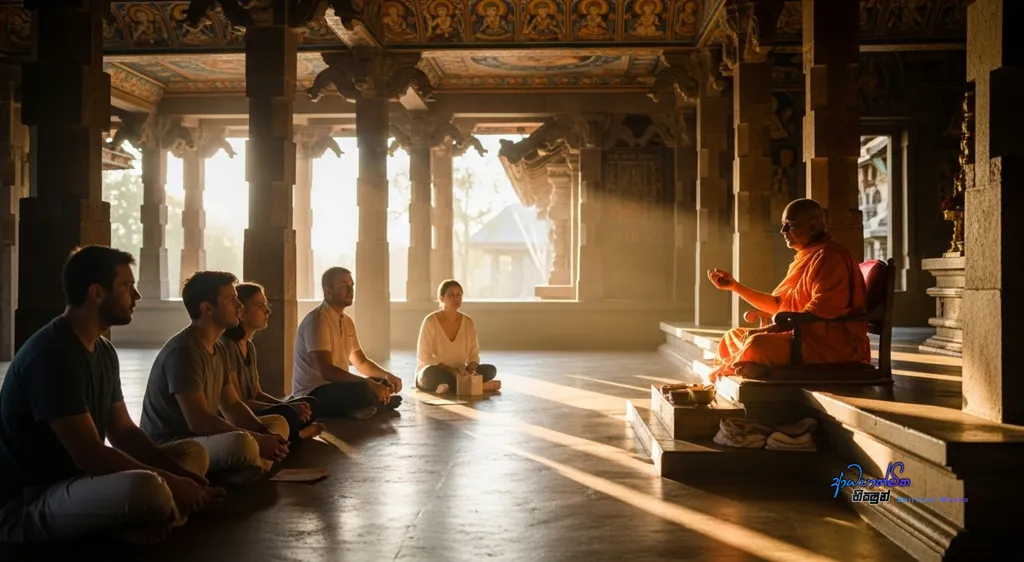
Before we proceed, it is crucial to offer a word of caution. The Meditation on Nothingness, or ‘Third Eye Practical Meditation 12,’ is not for everyone. It is specifically for practitioners who have already met certain prerequisites:
- The Third Eye Must Be Open: This is the foundational requirement. You must have already experienced the opening of the third eye.
- Mastery of ‘Infinite Space’: You must have successfully practiced and stabilized the perception of ‘Infinite Space’ (known in Pali as Ākāsānañcāyatana). This is the stage where you meditate on the boundless sky until that perception becomes steady.
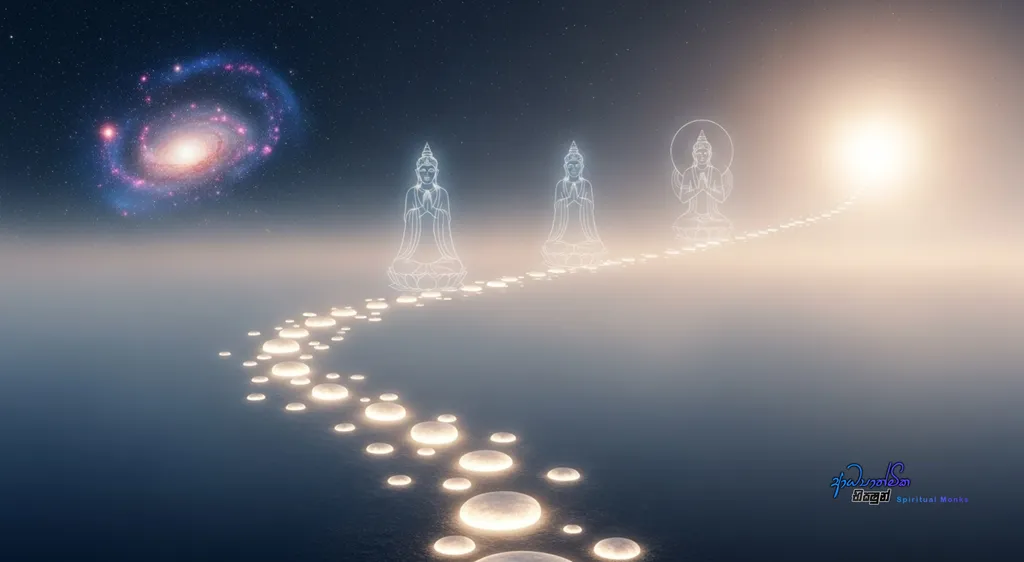
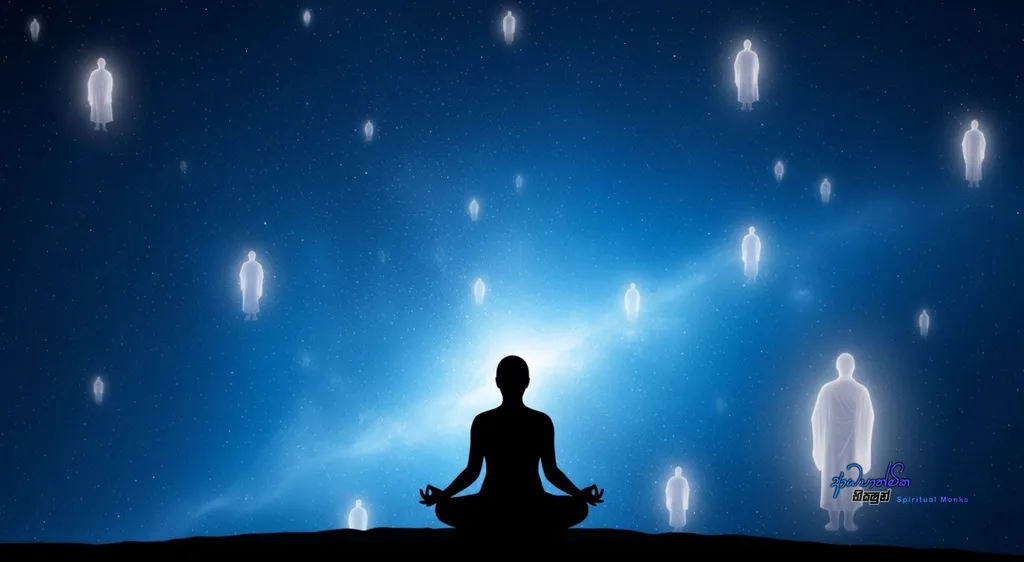
- Mastery of ‘Infinite Consciousness’: You must have moved beyond infinite space to the next meditative level, ‘Infinite Consciousness’ (Viññāṇañcāyatana). In our previous teaching, we explained this as contemplating ‘all beings are infinite.’ This stage is marked by the clear perception of celestial beings, or Brahmas, appearing in meditative postures within your mind’s eye.
Only those who have firmly established the perception of ‘Infinite Consciousness’, seeing these celestial beings with the third eye are ready to naturally progress to this next step. This journey depends on your past practice, karmic merit from previous lives, and meditative diligence. Please do not be discouraged if you are not yet at this stage. Everyone’s journey has its own timing. Be patient with yourself.
Understanding ‘Natthi’: The Concept of Nothingness
So, what is this state we call Natthi?
The word ‘Natthi’ is from the Pali language and simply means ‘there is not’ or ‘nothingness.’ In Sinhala, we use the word ‘his,’ which means ’empty.’ This meditation, therefore, is the cultivation of the perception of emptiness or nothingness.
You may recall that in earlier stages of our Third Eye practice, we worked with a different form of ’emptiness’ meditation while focusing between the eyebrows. However, the practice at this advanced level, this deep meditative absorption, or dhyāna is entirely different. The way you cultivate the mind here is unique to this stage. While anyone can read these teachings to gain understanding, please do not confuse this practice with earlier ones. It is vital to have reached this step naturally.
Anyone with a clear mind can understand the steps of their own mental progress as we describe them. This isn’t about being educated or uneducated; it’s about wisdom (paññā). Some highly educated people may lack this inner wisdom, while some uneducated people possess it deeply. If you find it difficult to recognize these states within yourself, I encourage you to read the teachings again and again until clarity arises.
For now, understand that Natthi refers to a profound state of emptiness.
The Experience: When the Universe Disappears
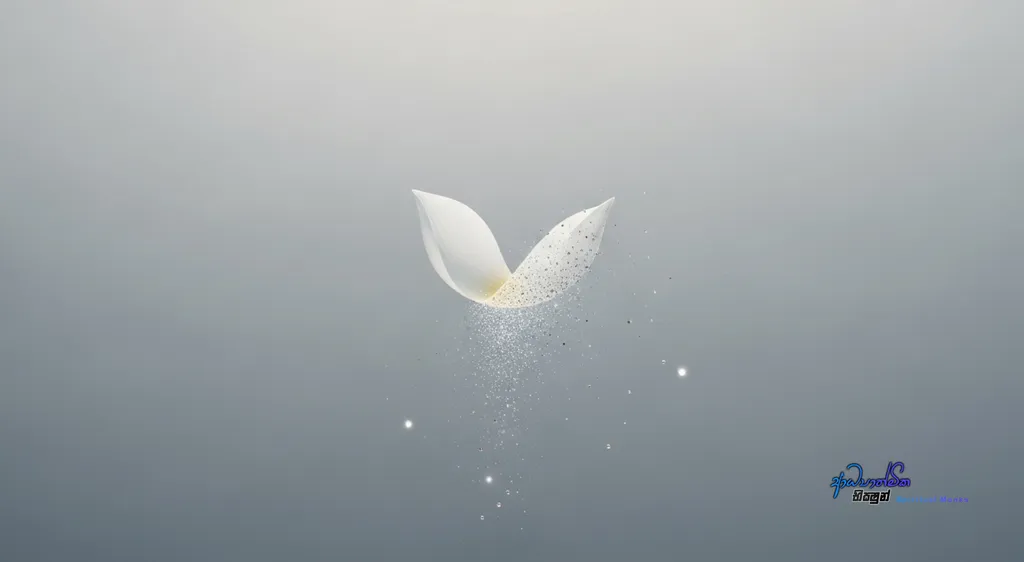
As you continue meditating on ‘Infinite Consciousness,’ seeing the celestial beings (Brahmas) and repeating ‘all beings are infinite,’ a profound shift will occur. Suddenly, and without warning, everything will vanish. The sky, the Brahmas, the visions in your third eye, all of it will disappear, as if your third eye has closed. But it hasn’t closed. Your mind is transitioning into a deeper dhyāna.
In this moment, your mind becomes completely blank. It becomes utterly empty. There are no thoughts of the sensual world, no thoughts of children, family, work, or financial problems. Nothing. It is a darkness, but unlike the ordinary darkness behind closed eyes, this void is free from thought. You enter a state of unimaginable peace and freedom.
The pressure in your head dissolves. Your mind, your brain, feels completely liberated from all mental stress. It’s a strange and wonderful freedom that words cannot adequately describe. You may have already experienced this spontaneously. It’s a happiness you have never felt before, a peace that cannot be bought with billions of dollars. All worldly things are forgotten, and an incredible joy arises. This is the state where the Meditation on Nothingness begins.
The Practical Technique: How to Cultivate ‘Natthi’
When you arrive at this state of profound, thought-free emptiness, the practice is very simple. You must begin to cultivate the sign of nothingness.
You can choose the word that you are most comfortable with:
- The Pali Word: Gently and softly, with a peaceful mind, repeat to yourself, ‘Natthi, Natthi, Natthi…’
- The Sinhala Word: Or, you can use the meaning and repeat, ‘His, His, His…’ or ‘Empty, Empty…’
Contemplate the word slowly. For example, mentally say ‘Natthi,’ then rest in that peaceful silence for two or three seconds before repeating it. Don’t strive too hard. The peace of this state is so profound that even the meditation word itself may fade away.
That is perfectly fine. You are basking in a happiness that surpasses any worldly pleasure, even the highest sensual pleasures. It is an indescribable bliss. In this state, continue to gently bring your mind back to the perception of ‘Natthi’
A Note on ‘Armchair Pundits’: There may be those with only book-knowledge who will try to give different interpretations of these states. Please pay them no mind. We are speaking from direct, practical experience. While there are ways to map these states to the cognitive processes of the mind, which we may discuss in the future, for now, it is enough to simply follow this practical path. Focus on the direct experience, not on intellectual debate.
The Profound Benefits: Healing the Mind and Body
The peace experienced in the Meditation on Nothingness is not fleeting. It brings about profound and lasting changes.
- Complete Eradication of Mental Stress: In this state, all worries disappear. For anyone suffering from academic pressure, work stress, or any form of anxiety, this practice brings total relief. Even someone on the verge of insanity could find their sanity restored. All illnesses rooted in mental pressure, as identified by medical science, will definitively fade away.
- Radiant Appearance: Your mind becomes light and serene, which reflects outwardly. Your face becomes pleasant and radiant. Your body feels light and joyful. Your mind becomes habituated to happiness.
- Changes in Physical Sensations: In earlier stages like ‘Infinite Space,’ you may have felt a sensation of floating or rising upwards. Here, that feeling is much less pronounced. The body itself seems to disappear; you feel almost bodiless.
This is a state of deep cleansing. Just as you service your car, this dhyāna services your mind and spirit, purifying your spiritual faculties. If you have abilities like spiritual healing, reading minds, or seeing past lives, they will be clarified and strengthened. This practice cleanses you and paves the way toward ultimate liberation, or Nibbāna.
Guidance for Deep States: Entering and Exiting Safely
When you are in such a deep and concentrated state, it is important to emerge from it correctly. The outside world will seem very distant; someone could speak to you from nearby, and you would barely hear them. If you need to exit the meditation suddenly, do not just open your eyes.
Instead, form a gentle intention: ‘May this concentration lessen, may it lessen.‘ Feel yourself gradually descending, as if coming down in an elevator. Wait until you can clearly feel your physical body again. Only then should you slowly and mindfully open your eyes. Opening them abruptly from a deep dhyāna can cause a burning sensation or a feeling of them being ‘stuck.’ Those of you who have already developed strong concentration know this feeling.
When your spiritual energy for the session naturally wanes, you will feel yourself returning to the ordinary world. The mind will reconnect with the body. When this happens, you can open your eyes. Carry the mindfulness from your meditation into the rest of your day.
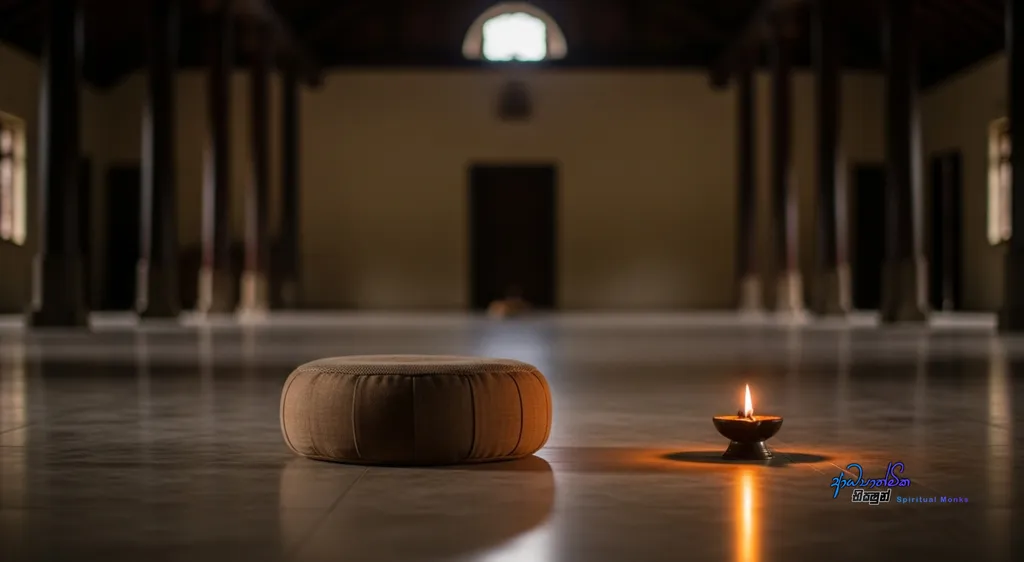
Integrating Peace into Daily Life
The profound peace of this dhyāna does not vanish when you open your eyes. The lightness in your body and mind will remain with you for hours. Others may notice a pleasant, happy radiance about you. You might find your appetite decreases, as your mind and body are sustained by a different kind of nourishment. Even if you are a large or small person, you will feel an incredible physical lightness as you go about your daily tasks.
The mind does not become defiled easily. Upon returning to the ordinary mental state, sensual thoughts do not rush back in as they used to. The strength of your mental energy creates a protective buffer. It takes time for the worldly mind to reassert itself. This gives you a precious window of clarity and peace in your everyday life.
Essential Advice for Your Advanced Practice
As you progress, remember these crucial points:
- Don’t Force It: If you have experienced this state of nothingness once but can’t get back to it, do not struggle. Let it go completely. Return to the previous stage, meditating on the Brahmas and ‘Infinite Consciousness.’ When your mind is ready, it will shift into the state of nothingness naturally. At that moment, you will remember this teaching and know what to do. Striving and craving are the biggest obstacles.
- The Mind’s Natural Groove: Once your mind becomes proficient in a certain meditative state, it will return there automatically. Just as those who practiced focus on the forehead feel pressure there as soon as they close their eyes, your mind will jump to its highest attained level. Someone accustomed to the Meditation on Nothingness will enter that state almost instantly upon closing their eyes, whether sitting, standing, or even lying down in the ‘lion’s posture.’ You won’t need to go through the earlier stages of ‘Infinite Space’ or ‘Infinite Consciousness’ anymore. Those stages are like software that is now fully installed.
- Respect Your Body’s Rhythm: Do not practice these deep absorptions back-to-back without a break. If you meditate for an hour starting at 4 AM and emerge at 5 AM, do not try to sit again at 6 AM. Your body needs time to recalibrate. Give it at least three to five hours. A good rhythm might be to meditate early in the morning, and then again after your morning meal, perhaps around 10 AM. This allows your spiritual energy to replenish, and your sessions will be deeper and more sustained. However, if you can remain in a single, unbroken session for many hours, that is perfectly fine. The key is not to have short, frequent sessions close together.
Do not be afraid of these experiences. Many people have spontaneous entries into these states due to past-life practice, become frightened because they lack a guide, and abandon their meditation. This is a great loss. Understand that this is a natural progression.
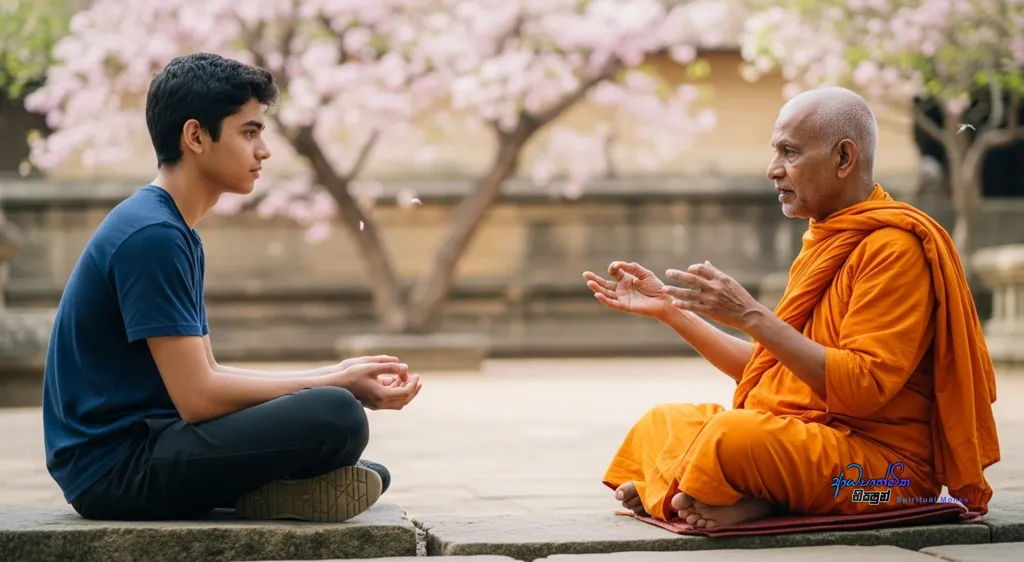
Conclusion: Embracing the Path with Wisdom
I have now explained the meaning of Natthi, how to practice it, who is ready for it, and the mental and physical experiences associated with it. I’ve covered how the mind habituates itself to these states and the proper timing for practice. With this complete understanding, for those of you whose minds have naturally arrived at this stage, your path is clear.
Do not be agitated. Agitation and impatience can cause your meditative skill to decline. Trust the process. I believe these instructions are sufficient for you to proceed with confidence. Know that there is another stage beyond this one, which we will explore in a future teaching. If you find yourself spontaneously moving into an even deeper state, do not be afraid.
May all of you who are practicing diligently soon reach these peaceful states. May the power of the Buddha, Dhamma, and Sangha bless you on your journey. May you attain these fruits swiftly.
With this blessing, we conclude our teaching on ‘Third Eye Practical Meditation 12: Natthi.’
We invite you to walk this path with us. Read our teachings, and most importantly, apply them practically in your own life. as you practice, questions will naturally arise. Please feel free to share your experiences and questions in the comments below, via email or contact form. I will do my best to offer guidance in future talks based on your progress. For now, begin this practice with an open heart and a mind free from expectation. Cultivate it correctly, and may you find the clarity and peace you seek.
Thank you for joining us. We hope this blog will be of great benefit to your spiritual journey.
May you all be well and happy.
May the blessings of the Triple Gem be with you all!


