


Categories: Eradicate the Fear of Meditation
May the blessings of the Triple Gem be with you all!
Today, through our spiritual teachings, I wish to clarify something very important for all who practice meditation: Do not stop meditating out of fear of the sensations and visions that may arise. I hope to explain this simply and clearly. I have offered a teaching on this topic before, explaining why you shouldn’t try to analyze, fixate on, or be afraid of the things you see, feel, or understand during meditation. Some of you may have explored that teaching, while others may be new to it. If you haven’t, I encourage you to seek it out and reflect on its message.
Today, I want to approach this topic again, but from a different angle. I know that many of you, people of all ages, are now practically engaging with meditation through our guidance. For those who are part of our community, you might encounter these teachings at different points in your journey. Some may hear a single teaching and decide to start meditating right away, without having followed the progression from the beginning.
Others might start without a structured approach. While there are no inherently harmful results from this, you will still gain benefits and negative effects are not a concern, there is a certain order to our programs. Following this sequence builds a much deeper knowledge, understanding, and store of experience. It prepares you to face various stages of practice because you have learned the path from the ground up.
Because some people may not realize this, they begin their practice after encountering a teaching in the middle of the path. My message to them is to please, start from the foundational teachings. This will help resolve many of the issues we are about to discuss.
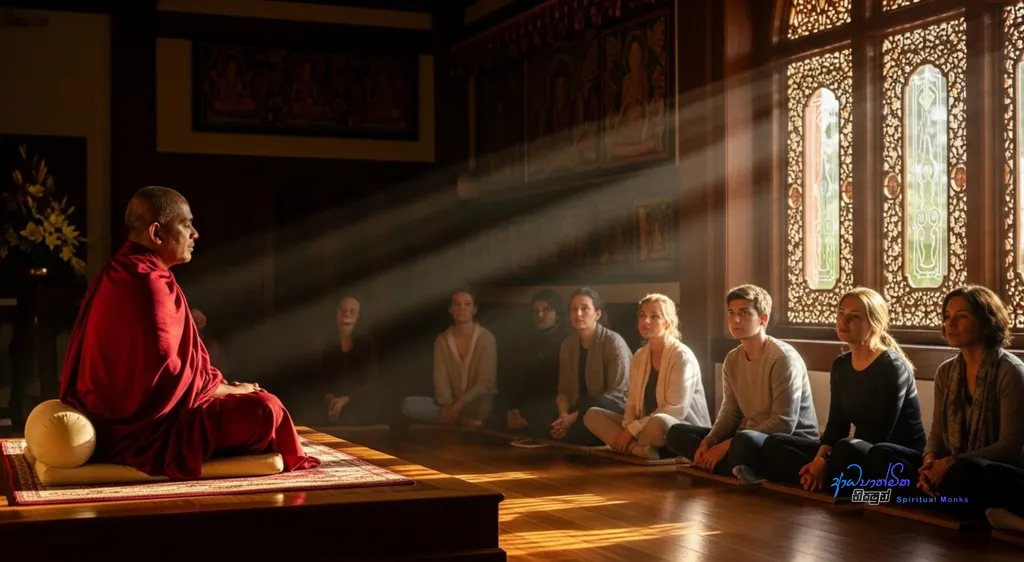
When the Mind Opens: Common Yet Frightening Experiences
The central issue for those who begin meditation without the foundational context is the sudden onset of powerful experiences. When they follow a teaching and start to practice, many things can begin to happen. I receive messages about this on WhatsApp all the time, even from young people. They start meditating, and midway, they begin to feel various things.
For example, some practitioners feel a distinct coolness in the middle of their forehead, or a sensation of the entire body being constricted and cooled. Because of their past karmic dispositions from previous lives (Saṃsāra), and because they begin without any specific expectation or desire, their mind can enter a state of profound concentration. They are new to the subject and don’t have many preconceived ideas. They are in what I call the ‘don’t know’ mind, which is the exact state I encourage everyone to cultivate. Be like a baby, a small child. Even if you have knowledge, adopt this beginner’s mind.
However, for those who jump into the middle, this ‘don’t know’ state is genuine, they truly don’t know what to expect. And this is precisely why they become frightened. When a sudden surge of energy arises. whether you call it universal energy or Kundalini energy their mind, which is momentarily pure and concentrated, encounters a new milestone in their practice. As the Buddha taught, ‘Pabhassaraṃidaṃ bhikkhave cittaṃ,’ which means ‘Luminous, O monks, is the mind.‘ The mind is inherently pure at its core. In that moment of practice, you connect with this purity.
But because this is a completely new experience, it can be terrifying. This isn’t limited by age. Many people message me, saying they are scared of this state. They feel like their head is about to shatter or that their ‘mind-made body’ (the manokāya, a subtle body) is about to leave and not return. They are gripped by meditation fear. This is just one example, but as soon as this fear arises, they either stop meditating completely or immediately force their eyes open.

The Trap of Fear and Craving
Just the other day, a young person told me they reached a state of such deep concentration that their body felt completely constricted, and they couldn’t even open their eyes. This is actually a very good sign, a step toward deep concentration (samādhi) and absorption states (jhāna). I myself have faced this step in my own life, and I will share how I dealt with it. But when people encounter this, they get scared. And the moment fear takes hold; they force their eyes open. This is the very thing I urge you not to do.
After they’ve opened their eyes and the state has vanished, they send me a message. Once I explain what happened, they are filled with regret. ‘What a shame,‘ they think. Then, a new problem arises. They try to meditate again, but this time with a powerful desire to get that experience back. They are no longer meditating with a pure, open mind, but with craving (taṇhā). And because their mind is now working with that memory and that desire for the feeling or the vision, perhaps a vision of light (āloka saññā), it will not come again. That is the nature of the mind. Once you are expecting it, it eludes you.
To get it back, you have to return to the state you were in just before the fear hit. You must put aside the fear and the subsequent craving and return to that light, effortless state of being, like a baby. If you can do that, the experience will naturally arise again. This is the lesson to learn. I hope you understand this point.
The ‘Virus’ of Social Myth: Does Meditation Cause Madness?
But why does this meditation fear happen in the first place?
It’s not entirely your fault. This is a tragedy created by our own society. Our parents, our grandparents, our ancestors, they were often confined to the written scriptures, like the Jātaka tales (stories of the Buddha’s past lives), without being taught practical meditation. This lack of practical guidance is an injustice. It has led to a widespread, damaging myth: ‘meditation makes you go crazy.’
People say that when you do practices like chakra or Kundalini meditation, strange things happen that you can’t handle, that you’ll lose your mind. I can tell you these are false stories, complete fabrications. I will address this in a separate teaching. If it were true, I wouldn’t be sitting here perfectly fine. It doesn’t happen like that. You just need to prepare the mind to be able to handle these experiences. And preparing the mind is not some monumental task; it’s simply about changing your pattern of thinking.
The Buddha himself attained his infinite knowledge and vision through meditation, not from reading books or from a teacher’s instruction. It was through developing his own mind. We must do the same. The Buddha taught us the path, and now we must use this computer, this software of our own mind, to develop ourselves. To do that, we must first eliminate fear. If you have fear, you can’t do anything, even in the ordinary world. I receive messages from young people who are terrified to speak in front of an audience, trembling with fear. You see? Fear paralyzes us.
In Buddhism, fear is considered a mental defilement (a kilesa). From the perspective of the Abhidhamma (the higher teachings), it is a form of aversion (dvesha). It is an unwholesome state of mind. We must not entertain it. You must meditate with the majesty of a lion. Only then can you truly progress.

Breaking the Frame: A Lion’s Courage in Practice
Our minds have been poisoned by these societal attacks. We’ve been told by both laypeople and even some monks that meditation leads to madness. I am trying to create a new wave, a new understanding, to show that such things do not happen. It’s not mentioned anywhere. These are lies. Madness occurs when someone experiences something powerful in meditation, becomes afraid, gets agitated, and then obsesses over it, unable to let it go. It’s the same mechanism that causes some people to have a breakdown after a romantic breakup. They can’t stop thinking about the relationship.
Why is it only meditation that gets blamed for causing insanity?
There are countless ways people experience mental distress, due to family life, children, parents, or romantic relationships. Madness does not come from meditation itself. It comes from an inability to handle the experience with the right technique. The technique is simple: experience it fully in the moment and then let it go. If you cling to it, if you are unable to bear it and you keep thinking about it, that is when the mind gets tangled and goes off in different directions. If you visit a mental asylum, you will find people who think they are presidents, enlightened beings (Arahants), or even Buddhas. People go mad for many reasons. It is not because of meditation; it is due to their inability to understand their own mental state.
So, grasp this technique. There is nothing to fear. Just let it go. Meditation causes no harm or violence. As we develop our mind with this technique, different parts of our body and mind evolve in various ways. The neural pathways in the brain develop. There are ways for the mind and body to feel these changes. These feelings are just like tasting a new kind of food. Imagine you’ve never had a pizza or a piece of KFC or lasagna in your life. Facing a new experience in meditation is like tasting one of these strange, new, flavorful dishes for the first time.
Shattering the Mental Cage of Fear
This is where the ‘virus’ of social conditioning does its damage. If a person meditating has their head full of ideas like, ‘Will I die? Will my life end? If my mind-made body leaves, will it not come back?’, then they have already corrupted the process
These ideas, perhaps planted by family, relatives, or even misinformed monks, create a mental virus. That whole clan might have this virus, believing that meditation makes you crazy. So, when a new practitioner is on the verge of a profound experience, what thought comes to mind? It’s that virus: ‘Will I go mad? Can I handle this? Will I exit the world or the universe? Will my mind-body leave and not return?‘
These ideas flood the mind. Instantly, you tense up. The meditation is over. Everything is over. Then, after I explain it, you feel regret. I have spoken before about breaking free from mental frames and limits. You must understand that this meditation fear is just such a frame. This fear exists because of a traditional, limiting belief that has been imposed upon us. So, remove that traditional frame. Throw out that box. When you remove this limit, this frame, the feeling of fear disappears.
Let go of what your parents, ancestors, relatives, or any monk might have told you about meditation leading to madness. Remove that part completely. When you discard that traditional framework, the mental factor of fear vanishes. Then, whatever you feel in meditation is no longer a problem. You can face it.

Advanced States: Handling Psychic Gifts Without Panic
Once you have this foundation, even if chakras awaken and intense phenomena occur, it won’t matter. You understand the mind. You can bear anything. Let me give you another example.
Let’s say someone suddenly awakens their Kundalini energy and gains the ability to read another person’s thoughts. If you haven’t been taught how to handle this, you might panic. But there is nothing to fear. You simply have to test it. When things like this happened to me, I didn’t get scared; I tested them.
If you gain some kind of psychic power (adhimānasika bala) or attain a meditative absorption (jhāna), you must face it without fear. You can test it directly. There’s no need to be scared. Stay neutral. Don’t get too attached to it, but don’t reject it either. Just remain in the middle, in a state of equanimity (upekkhā), and test it. This is how you verify the abilities you gain. The same goes for reading someone’s mind. Some people receive another person’s thoughts, can’t handle it, and their minds get into trouble. They get stuck on it, like being lovesick after a breakup, and that weak mental state can lead towards obsession or madness. There is no need for this. You can face this part, too. If you find yourself reading someone’s thoughts, test it.
This brings me to my next point. When you receive these kinds of gifts from meditation, you might feel an urge to tell someone, and this can lead to agitation and panic. This panic is what weakens your mind. So here is the second rule: Do not panic or become agitated. Let it go. It’s also not a useful thing in itself. There is no need to tell anyone. Bear it yourself, and then release it. Forget about it. It’s useless to keep it in your head. It is just an experience, nothing more. It might remain as a memory, like things from childhood, useful only if you need to teach someone else. You can say, ‘Ah, that happened to me, too,‘ just as I am teaching you now. So, the first point was: don’t be afraid. The second is: don’t panic. If you absolutely must tell someone, find a suitable, wise person. Do not go telling unsuitable people. They will just call you crazy and try to drag you to a psychiatrist. Please, understand these points well.

The Spider-Man Principle: Equanimity in the Face of Power
Let’s take another example. Suppose you gain the ability to move objects with your mind. Imagine you can look at a glass on your table and, with your mental energy, make it shake, fall, or even shatter. Such mental powers exist. If this happens, do not panic and do not be afraid. Instead of getting scared, if you can secretly break one glass, get another glass from the house and see if you can do it again. Don’t panic. Think, ‘Wow, this is amazing!‘
You have probably seen the Spider-Man movie. What happens to him? After he is bitten by the spider, he initially panics. But later, he becomes equanimous (upekkhaka), identifies his abilities, creates a suit, and ends up saving his city. I use this movie as an example to make a point. When you receive an ability, do not panic and do not fear. Become equanimous. Be neutral. Come to the middle. Just keep watching your own mind. When you do this, you become balanced. You are not panicked, and you are not afraid.
In every moment, simply recognize the thought of fear or the thought of panic as it arises. The moment you identify them; they are brought under control. There is no problem.
Then, no matter what result you get from meditation, no matter what psychic ability you receive, you will not be afraid or agitated. Whatever you feel physically or mentally during your practice, you will not react with meditation fear or panic. You must build this within your own mind.
From the Cushion to the World: The Ultimate Practice
This skill isn’t just for meditation; it’s for life. If you have to speak in front of a crowd, you can watch your mind. What comes up first? Fear. Then, agitation. Then, perhaps, self-doubt (vicikicchā). Can I do this properly or not?’ By identifying these thoughts, you can manage them. This practice of observing the mind is the key. In every moment of your spiritual life, identify the thoughts that arise in your mind.
Likewise, in your worldly life, whenever you face a situation that brings fear or agitation, do the same. Some people can’t even carry a tray because their hands tremble. In that moment, even if your hands are shaking, it’s not a problem. Let them shake. This is the worldly application. Keep watching your mind. As you watch your mind, it becomes strong. This is what it means to be equanimous and neutral. Your mind becomes powerful as you identify its thoughts. Eventually, whether your hand trembles or not is no longer an issue. And in the end, the trembling will stop on its own.
Please understand these points. You can use them to succeed in your worldly life and your spiritual life. Ultimately, this very practice leads toward liberation (Nibbāna). I have spoken for quite a while on this topic. Please grasp these points and continue your practice. I could say much more, but I will end this teaching here for today. If it is necessary in the future, I will offer more teachings on this theme of not stopping meditation due to fear. However, I believe this is sufficient for you to understand deeply. Reflect on this teaching again and again, grasp the points I have made, and use them to develop your spiritual life.
Today, I will conclude this teaching. By the power of the Triple Gem may you all understand the points I have shared today. May you develop your meditation without fear, without panic, and without doubt. May you have the strength and courage to move forward on the path.

We invite you to walk this path with us. Read our teachings, and most importantly, apply them practically in your own life. as you practice, questions will naturally arise. Please feel free to share your experiences and questions in the comments below, via email or contact form. I will do my best to offer guidance in future talks based on your progress. For now, begin this practice with an open heart and a mind free from expectation. Cultivate it correctly, and may you find the clarity and peace you seek.
Thank you for joining us. We hope this blog will be of great benefit to your spiritual journey.
May you all be well and happy.
May the blessings of the Triple Gem be with you all!


