


Categories: Eradicate the Fear of Meditation
May the blessings of the Triple Gem be with you all!
For those of you walking the spiritual path, engaging with both calming meditation (Samatha) and insight meditation (Vipassanā), you already hold the practical experiences you’ve faced. And for those who have not yet had these experiences, this sharing is for you as well. The journey of meditation begins with a first step, and the challenges of that initial attempt are universal. This experience is common to me and to anyone who first tries to cultivate their mind.
I am sharing this teaching with you today because understanding this initial phase can provide profound insight into the nature of your own mind. It is also an invaluable guide for anyone new to meditation. Let this article be a helping hand, offering support and clarity as you begin.
The Hopeful Beginning: Setting the Scene for Your First Sit
Imagine you decide to begin. You might be starting on your own, under the guidance of a teacher, or perhaps by following the teachings offered here in our spiritual community. Many are drawn to practices that sound intriguing, like the ‘Third Eye Practical Meditation’. A desire, a form of spiritual thirst or taṇhā, arises to awaken this perceived ability. With this motivation, you choose your practice.
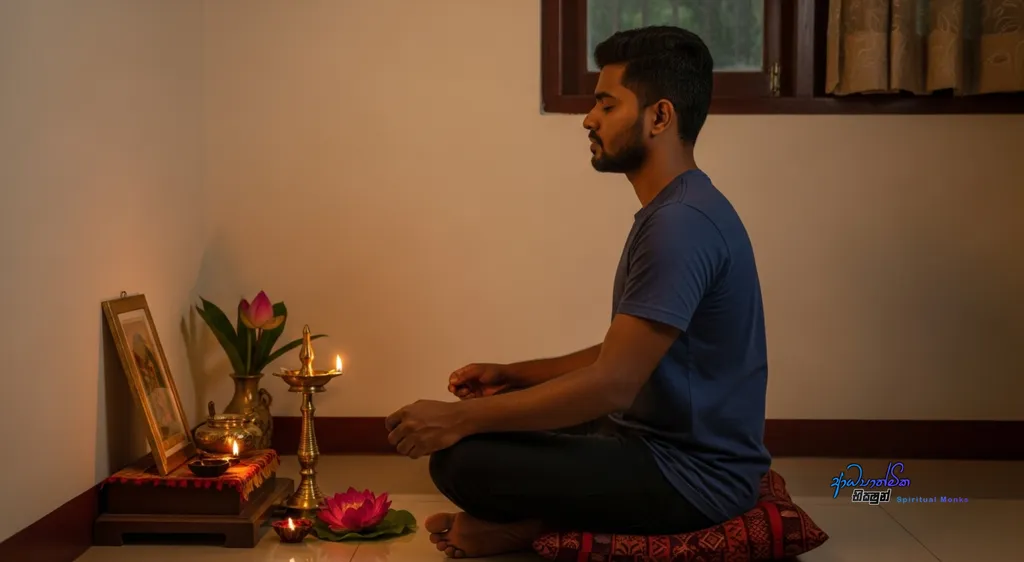
You find a quiet place perhaps in front of your home’s shrine, on your bed, on the floor of your room, or in a peaceful spot in your garden surrounded by nature. You choose a place that feels free and comfortable. This is a very appropriate first step.
Next, you select a posture. It could be the full lotus (Padmasana), half-lotus, or simply sitting cross-legged (what we might call Eraminiya Gothagena). If you’re new, you might even lean against a wall to keep your spine straight. You sit down, filled with eagerness and positive expectations, ready to begin your very first session.
The Initial Calm and the Sudden Storm of Thoughts
You close your eyes. You focus your mind on your chosen meditation object perhaps the space between your eyebrows as instructed in a particular practice. For a brief moment, maybe a few seconds or even a minute, you might experience a sense of concentration. The mind seems to settle.
But then, something shifts. The dam breaks. Thoughts begin to flood your mind, making it impossible to focus on your meditation object. You may have heard of mindfulness, or sati, but even without knowing the term, a part of your awareness is now active, and for the first time, you are truly *seeing* the chaos of your mind. You don’t interpret this as ‘seeing thoughts’; you interpret it as, ‘What on earth is this? I can’t concentrate at all! There are so many thoughts!’
What kind of thoughts appear? Everything.
- Academic and career stress: Worries about exams, university assignments, problems at your job.
- Economic anxieties: Financial pressures and concerns about the state of the world.
- Family issues: Problems concerning your children, spouse, parents, or other relatives.
- Social conflicts: Disagreements or tensions with friends.
Every unresolved issue from your life rushes to the surface. This is the raw, unfiltered reality of the untrained mind, and it is a fundamental part of the first day meditation experience.

From Mental Noise to Physical Pain: The Body’s Protest
This experience is universal, regardless of your age, nationality, or religious background. After the mental onslaught, the body begins to protest. Remember, for many, this is the first time in this entire human life that you have sat still like this. The aches begin.
First, your legs start to hurt. Then your arms. Your back begins to ache. Your mind, already a noisy city of thoughts, is now joined by a chorus of physical complaints. Thoughts are coming from one direction, while pain signals arise from another. The focus on your meditation object is completely gone. There is no peace, just an endless stream of mental and physical discomfort. It can feel like you are sitting in a pile of garbage, a messy, unpleasant heap of sensations. This relentless barrage is a key part of what you face on your first day.

The Final Hurdles: Drowsiness and Discouragement
As if the thoughts and pain weren’t enough, other obstacles arise. You might suddenly feel hungry. And then comes the most common visitor of all: drowsiness. In Buddhism, this is known as thīna-middha, or sloth and torpor, a mental hindrance that feels like a heavy fog. Your eyelids become heavy, and your head starts to nod and fall forward. You are overcome with sleepiness.
The person who sat down with the noble intention of meditating for an hour or more, hoping for a profound spiritual ability on the very first day, now faces a crushing reality. It is with sadness that I say, you might only last five, ten, or maybe fifteen minutes. You have to stand up, stretch your legs, and abandon the session.
You might feel that an hour has passed, but when you open your eyes and check the time, you see it has only been five minutes. This leads to a deep sense of frustration and disappointment, the feeling that, ‘This whole thing is useless, it won’t work for me.’ This is the climax of the first day meditation experience for so many.

The Crucial Mistake: Why You Can’t Force a Quiet Mind
Here we arrive at the most critical point. Many beginners believe the goal is to stop thoughts. You try to force them away, to create a blank mental slate. This is a fundamental misunderstanding. You can never eliminate thoughts entirely. Even fully enlightened beings like Buddhas and Arahants have a minimal stream of consciousness.
Their minds are free from defilements like greed and hatred, but thoughts still arise. The complete, temporary cessation of thought only occurs in very deep states of concentration called Jhāna, and this is not something to expect on day one.
Furthermore, your intellectual knowledge can become your greatest enemy. Imagine a professor, someone who has read the entire Buddhist canon the Tripitaka, the commentaries, and the histories. When they sit to meditate, their theoretical knowledge doesn’t help. Practice is a completely different domain. That very knowledge can become a barrier, adding another layer of complex thoughts to the existing storm. The theory in the book is just a map; the journey is something you must walk yourself.

A Compassionate Path: The True Goal of Your First Session
So, what should you do when faced with this overwhelming first day meditation experience? The solution is profoundly simple.
Let go of all expectations.
- Do not expect to concentrate your mind.
- Do not expect to reduce or eliminate thoughts.
- Do not set a time limit. Don’t decide to sit for five minutes, or thirty minutes, or an hour.
Your only task on the first day is to just sit down to meditate. That is the victory.
Sit in your chosen posture. If your back hurts, it is okay to lean against a wall. A helpful tip is to leave a small gap, about an inch, between your back and the wall. When the pain becomes intense, you can lean back for a moment to release the pressure. When it subsides, straighten your spine again, away from the wall. You must learn to get up by falling and rising again, just like a small child learning to walk. This gentle, persistent effort is how you overcome this first stage.

Building a Lasting Practice: Patience, Consistency, and Self-Compassion
Do not overthink what happens during your sit. When your mind wanders to the past or future, when your knowledge becomes a hindrance, don’t make a big deal out of it. Simply recognize, ‘This is the nature of the mind.’ Do not expect great results on the first day. Any profound experience that does occur is likely due to strong habits from past lives, from practice done within Samsāra, the long cycle of rebirth.
But you, too, are gaining a new experience: a direct understanding of your own mind. The key is to continue without being discouraged. Sit down with the simple attitude of, ‘Whatever happens, happens.’ Don’t worry about the time. Just sit for as long as you can manage without creating more stress for yourself.
Make a determination (adhiṭṭhāna) to meditate every single day until the day you die, whether you get results or not. Even if you are incredibly busy, commit to a session, perhaps an hour or half an hour. As you do this, day after day, your mindfulness will strengthen.
You will begin to understand your mind, and with that understanding, concentration will naturally develop. Thoughts will lessen, the mind will scatter less, drowsiness will fade, and you will learn to endure physical pain. You will develop the ability to sit with a straight back, strong and stable. All of this comes little by little. It cannot be achieved all at once.
Conclusion: Your First Step is the Entire Path
I trust this simple teaching has given you a clear understanding of what to expect from your first day meditation experience, how to face it, and how to continue your journey forward. These initial challenges are not signs of failure; they are the curriculum. They are the first, most fundamental experiences on the path.
If you have already walked through this fire, please consider sharing your own early experiences in the comments for the benefit and progress of others. Your story can help newcomers realize they are not alone. And for those of you just starting, I hope you now feel prepared to face these challenges with wisdom and compassion.
Today, I will conclude this teaching here. By the power and blessings of the Buddha, the Dhamma, and the Sangha the Triple Gem may you all gain the wisdom to understand these matters clearly and face your practice with true comprehension.
We invite you to walk this path with us. Read our teachings, and most importantly, apply them practically in your own life. as you practice, questions will naturally arise. Please feel free to share your experiences and questions in the comments below, via email or contact form. I will do my best to offer guidance in future talks based on your progress. For now, begin this practice with an open heart and a mind free from expectation. Cultivate it correctly, and may you find the clarity and peace you seek.
Thank you for joining us. We hope this blog will be of great benefit to your spiritual journey.
May you all be well and happy.
May the blessings of the Triple Gem be with you all!


