


Categories: Maintaining Mindfulness
May the blessings of the Triple Gem be with you all!
Today, we will explore a question that arises for many who are on a spiritual path, especially those who practically investigate the mind through mindfulness. For those of you who are trying to maintain awareness and apply these teachings in your daily life, you may have noticed something specific, something a majority of practitioners encounter. My hope is that through this teaching, you will gain some understanding and a practical way to face this phenomenon.
As you investigate the mind, maintain mindfulness, and identify your thoughts, you may notice something after practicing for a while: it feels as if your own mind is talking to you. It’s just as the title of this reflection suggests. Your own mind seems to look at you and ask you questions. It asks, ‘What are you doing?’ It asks if you’ve eaten. It gives you orders about what you should do next. It does so many things. You may have seen how the mind chatters on and on without a break, just rambling endlessly. This is the nature of the internal or inner dialogue.

Like a Speeding Train: Why This Inner Chatter Isn’t a Sign of Weakness
Ordinarily, when you practice mindfulness, you see thoughts simply arising and passing away. They come, they exist for a moment, and they vanish. But this experience is different. This inner dialogue is like a long train, just chugging along, endlessly speaking. At that moment, many people think, ‘My mind is talking to me,’ or they notice this non-stop chatter.
This rapid, continuous stream of words is an experience you may have seen. It often becomes more pronounced in those whose mental state is a bit fragile. However, please do not jump to the foolish conclusion, ‘My mind chatters like this, so I must be mentally weak.’ If you think this way, you prevent yourself from being able to train in this area and move forward on the path. This is precisely why I want to clarify this for you.

The Mind’s Movie: Understanding the Source of the Chatter
This inner dialogue can feel like a vine wrapping itself around a tree, twisting and turning, seemingly impossible to stop. The speed is immense, often faster than ordinary thoughts. Yet, what you are experiencing is still just a collection of thoughts. The difference is that these are things flowing out from the depths of your mind.
They might be things we did in the past, or unexpected things. The mind takes these past thoughts and uses them to construct a future, playing out like a continuous movie as you watch with mindfulness.
When I say ‘watching with mindfulness,’ please understand this is not about looking with a ‘third eye’ or the type of concentration developed in calm meditation, which we call Samatha. For those new to these teachings, this might be confusing. Looking with divine sight or special knowledge is a different faculty.
Here, we are speaking from the perspective of insight practice, or Vipassanā. By maintaining mindfulness and clear comprehension a state known in Buddhism as Sati Sampajañña we begin to notice this chattering quality of the mind.

A Glimpse of ‘Not-Self’: What the Inner Dialogue Reveals
It is in this very experience the feeling that the mind is talking to you that you can grasp a fundamental truth: the concept of not-self, or Anatta. It feels as if someone else is doing the talking, doesn’t it? This reveals that there is no solid ‘me’ or ‘mine’ in charge. But in truth, it’s not another person doing it either.
Simply put, what is happening here is the universal law of cause and effect, which we call Paticcasamuppāda, or Dependent Origination. It is an impersonal process that is simply unfolding naturally. And so, it feels as if your own mind is having a conversation with you. This is a natural state of the untrained mind, but you have the ability to gain control over this inner dialogue.
The Tyranny of Thought: When the Mind Gives Orders
As we develop mindfulness, as taught by the Buddha, this facet of our mind becomes clear. As I mentioned at the beginning, it asks if you’ve eaten or had a drink. It commands you: ‘You must do that task this way.’ It orders you: ‘Now you must cry,’ or ‘Now you must eat,’ or ‘Now you must take a shower.’ It tells you what to do.
Furthermore, it sometimes presents things you dislike as questions, forcing you to engage. If you don’t provide an answer, the mind relentlessly throws more and more questions at you until it gets a suitable response. This can leave you feeling distressed, causing headaches and tension in your temples. It can drive you to a state of helplessness where you feel you must rub oil on your head, take a painkiller, or just sleep to make it stop. Your own mind makes you helpless.
Now, reflect on this. If your own mind can make you this helpless in this very moment, imagine how helpless it must have made you throughout the vast, long journey of rebirth, which we call samsara. If the mind is this uncontrolled now, think about how helpless we will be in the future if we do not understand and practice the teachings of the Buddha and the enlightened ones who followed him. This is something to seriously consider.

The Breaking Point: Mental Pressure and the Path to Healing
This aspect of our mind can be, in a way, a dangerous facet. But it is not something to be afraid of. This intense inner pressure is often at the root of what modern medicine calls various conditions arising from mental stress: migraines, depression, and even more severe states like schizophrenia. These are the kinds of labels given in Western medicine for illnesses that arise from the mind.
When we don’t understand these natural mental processes, they can escalate. The cause is often an inability to cope with life’s challenges: failures, the loss of relationships, family breakdowns, financial difficulties, or not getting what we want. When the mind cannot bear these pressures, it is like a water pipe system. Imagine you pump more water into the system than it was designed to handle. If the engineers did not build it properly, what happens? Unable to bear the pressure, the pipes burst, and water leaks out.
In the same way, whether you think of it as the brain from a medical standpoint or the mind as the Buddha taught, it has a limit to what it can bear. When that limit is exceeded, we can no longer bear it. This is when headaches, depression, and migraines arise. If it goes even further, it can lead to conditions like schizophrenia, turning people into what society might call ‘mental patients’ or ‘insane.’ I am explaining this to give you some context.
But even for people experiencing these states, if they learn to investigate their mind with mindfulness, they have the ability to free themselves from these ailments. By following this guidance properly, it is possible to reach a point where you no longer need medication, because you have understood the mind for yourself.

Intrusive Thoughts and Unwholesome Urges: You Are Not Your Thoughts
So, how do we respond? No matter how many questions your mind throws at you, no matter what it says, you are you. You are not someone who needs to act according to what your mind says.
For example, I’ve had people tell me this: a person goes to drink water. Their body only needs one glass. But the mind commands, ‘Drink another glass of water, or you will die!’ or ‘You will be dragged down to hell!’ The mind creates thoughts like these. See how the mind controls and captivates you in such moments? These situations are very common.
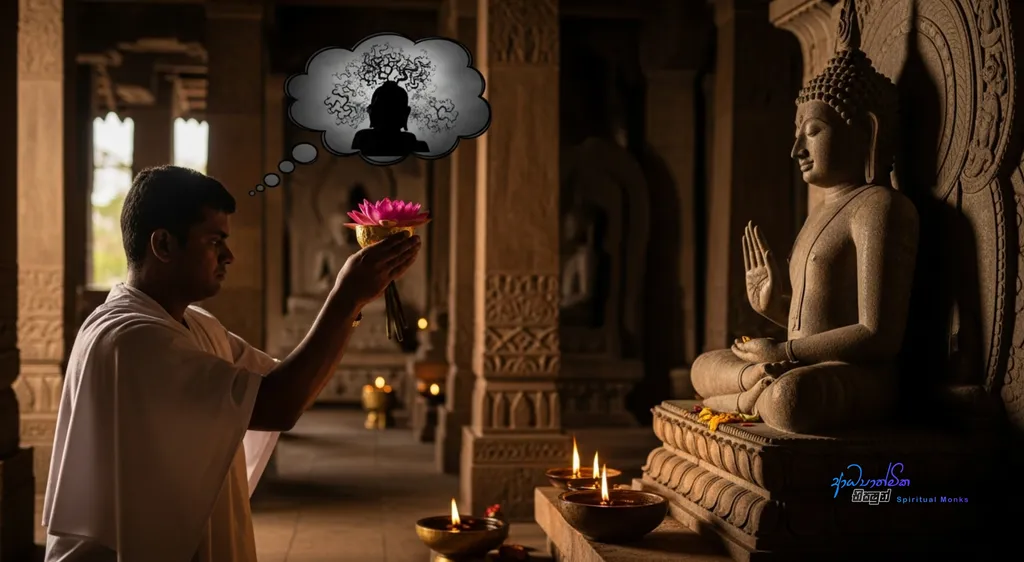
Another type of thought arises as people advance in their practice, though it can happen to anyone. Imagine a truly devout person. They are looking at a Buddha statue, chanting, making offerings of food and tonics, and paying respects. Suddenly, a thought arises: ‘I feel like picking up the Buddha statue and smashing it on the ground.’ Or they feel an urge to curse at the Buddha using foul language.
People ask me, ‘Am I accumulating bad karma for this?’ Do not worry about the sin or demerit here. Why? Because you never acted on it. You never once tried to carry out that action. Where did all this happen? In the mind. These kinds of thoughts can come to anyone, regardless of age, race, religion, gender, or appearance. This is the nature of the mind that we must understand. No matter how many evil, bad, or unpleasant thoughts arise, we must recognize, ‘This is simply the nature of the mind.’
Breaking the Cycle: Why Answering Your Mind Only Makes It Stronger
If your mind chatters at you like this, making unwholesome suggestions to lead you toward negative actions, or if it tires you out with endless questions, you might feel that only by giving the ‘right’ answer can you find relief from the mental pressure. But you are not obligated to answer your own mind. Why would you bind yourself to such a thing? There is never a need. It is a foolish process.
You are not bound to answer it. And what do you gain by answering? Absolutely nothing. The mind keeps you in fear, making you feel you must answer its questions. This is a common state, especially for those under various forms of mental pressure, whether from education, private-sector jobs, or government work. People have all sorts of mental issues because they haven’t understood their own minds. That is why we teach this with compassion, from our own experiences and training, to show you how to practice this practical Dhamma.
So, what should you do? Never try to answer your mind. There is no point.

The Beggar at the Door: A Practical Analogy for Handling Your Mind
Imagine a beggar who is perfectly healthy and able to work. But he comes to your door every day to intimidate you into giving him money, like an extortionist. You get into the habit of giving him money just to make him go away. You start thinking, ‘If I don’t give him money, this man will cause me trouble, become a nuisance, or curse at me.’ This is a rule you have imposed on yourself. Stop thinking about it.
What you must do is stop giving the beggar money. He might come for a few days. Just close your doors and windows and stay inside. He will come, and then he will leave. He might shout and curse, maybe even throw a stone at the house. But eventually, he will get tired of it and stop. He will go away. You must do the same thing with your mind. Every thought that comes, whether it’s the fast-flowing stream or the one asking you questions like an interviewer, treat it this way.
When the mind asks questions, do not answer. Remain silent and mindfully watch the question itself. It may ask again and again. Just keep watching. Do not reply. Even if you think, ‘No, if I give this fitting answer, I will get some relief,’ do not give that answer. There is no point. If an answer arises naturally from your mind on its own, just let it be released. Let it go. But do not forcefully try to answer. It is not something you should do.

The Practice of Watching: How to Respond in the Moment
Just watch it well. As you practice this over time, something will happen. The duration is relative to each person; I cannot give a specific number of days. But as you continue this training, your mind will reach a state where it no longer asks you questions. Whether it takes a year, six months, three months, a few days, a few sessions, or even a few hours, for a person who correctly grasps this method and practices, this result will definitely occur.
You must apply this mindfulness at the moment your mind is asking the question. Do not plan beforehand, thinking, ‘This is what I will do.’ When the problem arises, when your mind presents an issue, you must face that specific event with mindfulness. Just watch this stream of events like you would watch a TV, or like you’re sitting in a chair watching a dam break, or like you’re watching cars pass by on the road. You simply witness the network of events.
By doing this, the thought that questions you, the thought that scares you into drinking a second glass of water, will disappear.
Facing Your Fears: Mindful Observation of Scary Thoughts
Let me also mention a supernatural aspect. Sometimes, your mind might present an idea: ‘There is a non-human entity (amanussa) in the corner of the door.’ Or if you are showering, ‘Look, there’s someone at the bathroom door.’ If you have watched various horror or zombie movies, your mind will conjure up these images, especially if the environment is conducive, like at night. Many people get scared at night because they have an idea ingrained since childhood that ghosts, demons, and spirits come out. When such thoughts arise, they also come as questions and suggestions from your mind.
In all these situations, you must never respond to any suggestion your mind presents. Do not answer its questions. Do not act on them. Just watch them with good mindfulness. When you watch with mindfulness, you will understand. Over time, relative to your practice, you will begin to feel this inner dialogue gradually fading away. You will notice it clearly. Through this, your own liberation, your own peace, will arise within you through your practical training. This is the event that you need to make happen practically.

Finding Sanctuary: The Path to a Peaceful Mind
Through this practice, the rushing thoughts I mentioned at the beginning the ones that flow like a train, even faster than usual will also gradually reduce. The sense that the mind is talking to you, asking questions, or telling you stories will also fade away as you watch it with mindfulness. Eventually, your mind becomes a sanctuary, a peaceful home where you want to dwell. It becomes a peaceful mind, a mind without defilements (kilesa), a mind with few thoughts.
You can never completely stop thoughts. Many people ask if it’s possible. Truly, you cannot. They are only temporarily blocked in deep states of calm meditation, known as jhana. This is a brief answer to a common question. Our goal in insight practice is to eliminate the clinging and aversion to thoughts. Even fully enlightened Buddhas and Arahants have thoughts. The difference is that they neither cling to them nor push them away. They have a minimum number of thoughts and mental factors. Understand this briefly, as it’s a common query.
So, engage in this practical training, continuously. Your questions will be answered, and you will be free from this problem. This is a practical matter. For everything, practice the principle of watching your mind with mindfulness. I believe this practical teaching is sufficient to provide an understanding. I will continue to discuss this from other angles in future teachings.
Understanding this, please engage in this practice as taught by the Buddha within the Four Foundations of Mindfulness. I will conclude this teaching for today.
May the power and blessings of the Triple Gem the Buddha, the Dhamma, and the Sangha give you the ability to apply this teaching practically and realize it for yourself within your own mind. With this blessing, I conclude. May the blessings of the Triple Gem be with you all!
We invite you to walk this path with us. Read our teachings, and most importantly, apply them practically in your own life. as you practice, questions will naturally arise. Please feel free to share your experiences and questions in the comments section below, via email or contact form. I will do my best to offer guidance in future talks based on your progress. For now, begin this practice with an open heart and a mind free from expectation. Cultivate it correctly, and may you find the clarity and peace you seek.
Thank you for joining us. We hope this blog will be of great benefit to your spiritual journey.
May you all be well and happy.
May the blessings of the Triple Gem be with you all!


