


Categories: Be Happy 24 hours
May the blessings of the Triple Gem be with you all!
Welcome. Today, I hope to offer some clarity on a matter that touches us all. In our modern world, we face problems from every direction. We see them in society at large, within our own families, at our workplaces, and in our financial lives. These issues often arise from simple things, like words.
A word spoken is not always heard as it was intended; misunderstandings create friction and conflict. We also see problems emerge from a sheer lack of understanding and mutual respect, these essential virtues are fading, and as they do, societal problems grow.
A particularly worrying trend is the rise of provocation and anger, a situation that seems to be worsening, especially among the youth. Young people, even those fifteen or sixteen years old, are becoming increasingly volatile. In the past, it took time for technology to reach younger generations. Today, technology is an instant part of education and life, but this has also fueled a rise in aggression, anger, and hatred. This escalating nature of conflict is not a good sign for our society; it could lead to great destruction. Understanding this is the first step.
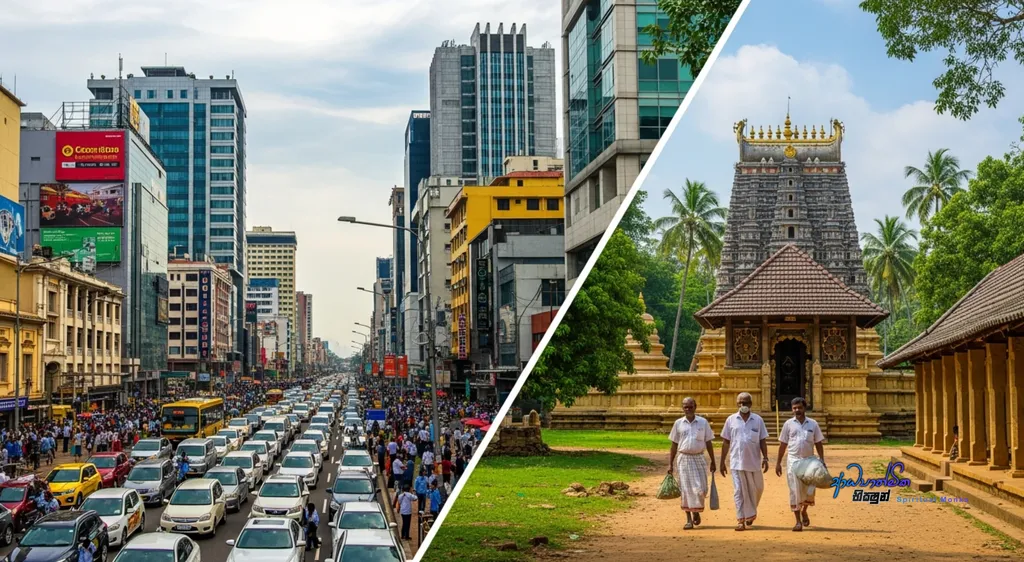
The Illusion of Happiness and the Limits of Wealth
Amidst this turmoil, there are those who wish to live peacefully, who do not want to engage in constant conflict. But they are a minority. The majority seem drawn to friction. For those seeking peace, a question arises: is there no refuge for us in this world? In their search for answers, they often turn to others, a relative, a friend, a confidant, sharing their deepest troubles.
Sometimes, the person they confide in offers a helpful perspective. But often, something more sinister happens. The listener may seize upon the vulnerability, the ‘fault’ you have exposed, and use it for their own advantage, causing even more harm. This is a dangerous and painful reality many have experienced.
We see this duality play out on social media. People post photos of themselves eating, drinking, and traveling, projecting an image of pure joy. But if you look deeper into the lives of the majority, you’ll find they are wrestling with immense problems. They show one face to the world while hiding another inside. We look at them and think, ‘They must be truly happy.’ They may have money or social status, but you should never judge anyone by their outward appearance. Inside, they too have their struggles.
Money does not solve all problems. If it did, why would wealthy people feel so desperate that they harm themselves? Why would they experience such despair and sorrow? If money alone brought happiness, they would never feel pain. Many young people today naively believe that money is the answer to everything.
Do not fall into this simplistic way of thinking. Earn money, enjoy life, be happy, but also understand that this kind of happiness is not permanent. Understand that money alone cannot erase the deep-seated reality of suffering, what we call Dukkha. Imagine you have all the wealth in the world, but you develop a disease like cancer. What use is all that money if it cannot cure your illness? Reflect on this.

The Poison of Jealousy and the Roots of Our Conflicts
These troubles I mentioned earlier, the conflicts and obstacles, take many specific forms. We see them between mothers-in-law and daughters-in-law, between parents and children, teachers and students, and between bosses and their employees. In the world of business, it appears between competitors.
It arises when a powerful person sees someone else rising, threatening to surpass them. All of these conflicts are rooted in jealousy, or Issā in the Pali language. And if you look closely at jealousy, you will find its core is anger and aversion, what the teachings call Dosa. According to the Abhidhamma, the higher teachings of the Buddha, this is a fundamental truth of the mind.
You may be feeling exhausted and disillusioned by these very situations. As I mentioned, many are disheartened. When they turn to others for help and receive none, or worse, are betrayed, they eventually seek a different path.
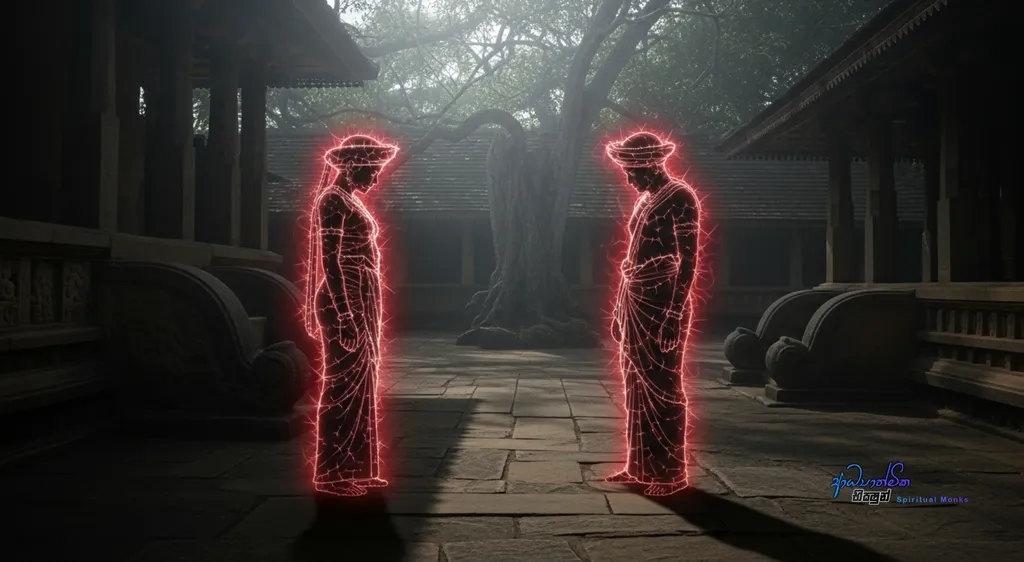
From Disappointment to Dhamma: Finding a True Refuge
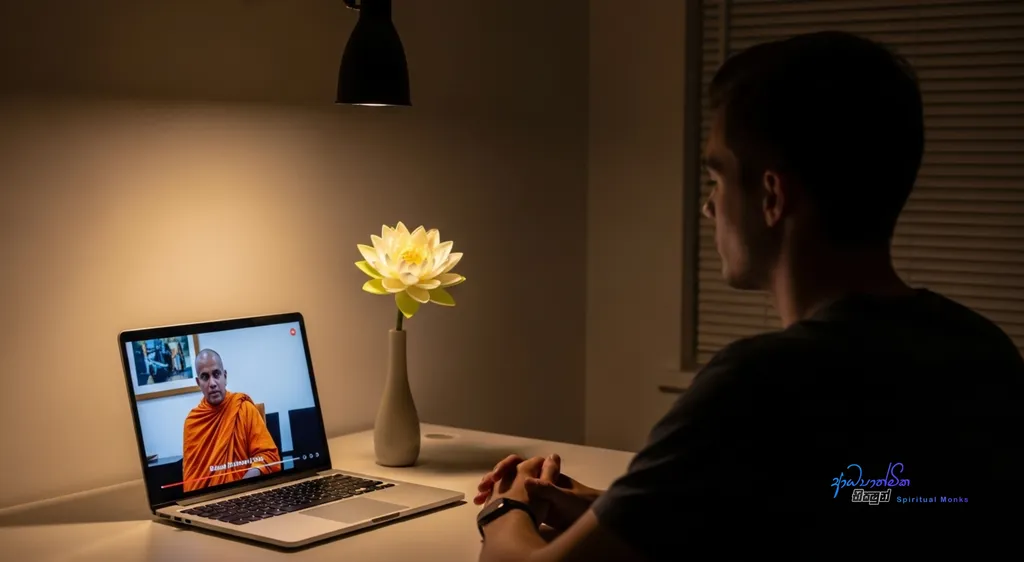
It is at this point, after experiencing such deep disappointment, that many people, both men and women, living in Sri Lanka and abroad, discover a strong probability of turning toward the Dhamma, the teachings of the Buddha. They begin exploring, perhaps by listening to Dhamma talks from various monks on platforms like YouTube. They tell us, ‘Venerable Sir, it is only after listening to these teachings that we can compose our minds. It brings a sense of relief.’
Remember, when faced with such problems, many people take a different turn. They chase after drugs, alcohol, or the fleeting distractions of clubbing and other unwholesome activities. They might listen to sad songs or try to escape by watching the very social media influencers who project a life of constant travel and enjoyment. But this brings no real upliftment to the mind.
It doesn’t lead to an ‘update’ in your understanding. You remain stuck in the same place, day after day. In contrast, when you listen to the Dhamma, you absorb something profound into your mind and heart. This leads to a genuine understanding and a higher mental state. You begin to elevate yourself.
Two Paths of Practice: The Outer Offering and the Inner Journey
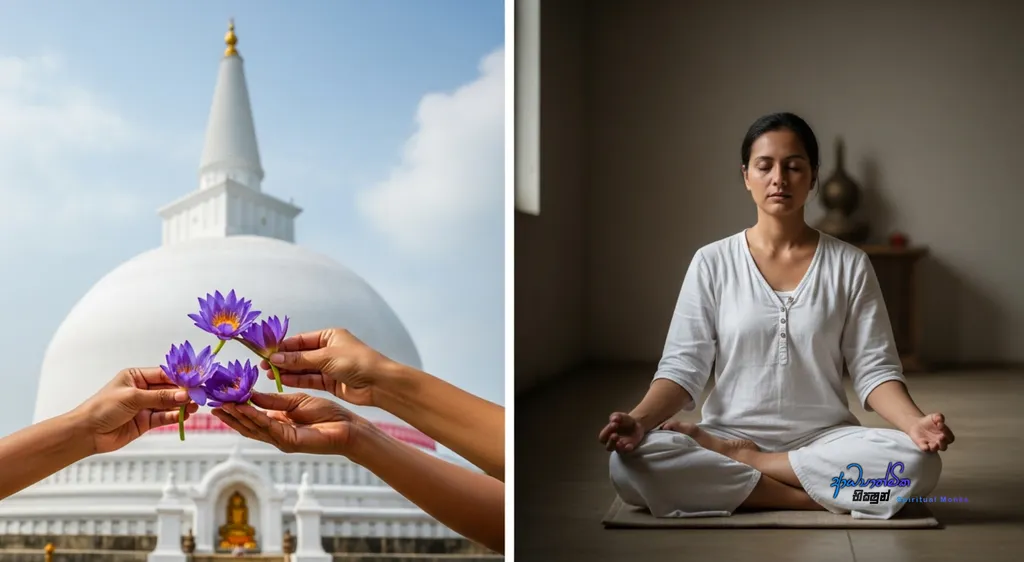
When people first turn to the Dhamma due to suffering, they often begin to understand that their problems might be the result of past unskillful actions, what is known as Kamma. In response, they engage in acts of devotion. They might offer flowers at great stupas like the Ruwanwelisaya or make offerings to sacred Bodhi trees. This type of offering, based on material things, is called Āmisa Pūjā. Engaging in these acts brings a certain satisfaction and happiness, and according to the Buddha’s teachings, it certainly generates wholesome merit, or Kusala.
However, some people do not stop there. They feel compelled to go further. The very problems that brought them to the Dhamma push them towards the path of practice, or Patipatti. They begin to explore meditation, or Bhāvanā, developing both calm (Samatha) and insight (Vipassanā).
Their goal shifts to developing their inner spirituality. They are no longer content to remain limited to material offerings. Once they begin to meditate, they gain a deeper understanding and realize that while offerings brought some peace, that is not the final destination. So, they continue with both: they practice meditation while also making offerings. The problems are still there, but now they face them with a far greater understanding than before.

The Transformative Power of Meditation and Mindfulness
People who follow our teachings and engage in this practice send us messages. They say that, compared to before, they now deal with life’s problems with much more understanding. They never had this clarity in the past. By practicing the teachings, especially those in our series on mindfulness (what is called Sati), they develop their awareness. They begin to understand: ‘Who am I? What is the nature of my own mind? Are not the minds of others just like mine?’ Through this, they gain various levels of insight.
This mental elevation brings tangible results. They report that while they used to break down mentally when faced with problems, that has significantly decreased. If they once experienced a 100% collapse, now they have the strength to bear 50% or even 75% of it without breaking.
Imagine: if you can become so mentally strong by practicing a portion of the Buddha’s teachings on mindfulness, how powerful would you become if you perfected this practice? This is why we encourage everyone, whether you have problems now or not, because problems can arise at any time, to cultivate this understanding. Develop your meditation practice, develop your inner spirituality. Don’t remain only at the level of material offerings. Do them, but dedicate more time and effort to the path of practice, the Patipatti.
The Buddha’s Highest Praise: Why Practice Outweighs Offerings
The Buddha himself declared that he values the person who practices for insight more than the person who only engages in material offerings. He said that one who practices insight meditation, even for a single second, is more praiseworthy than one who spends their whole life making offerings to any sacred place, even the Ruwanwelisaya. Therefore, you should strive to reach that state. Do not get stuck only in the realm of Āmisa. There is a higher mental level beyond it.
No matter how many offerings you make, to realize the ultimate freedom of Nibbāna, you must either listen to the Dhamma with a concentrated mind as if before a Buddha, or you absolutely must meditate. Remember this: no one has ever become an Arahant, a fully enlightened being, without meditating. Whether it was the great disciples like Sariutta and Moggallana or any of the eighty great disciples, they all attained liberation through meditation. You must understand this essential point. The topic I wanted to highlight today is that your problems can become the very gateway to the Dhamma and meditation.
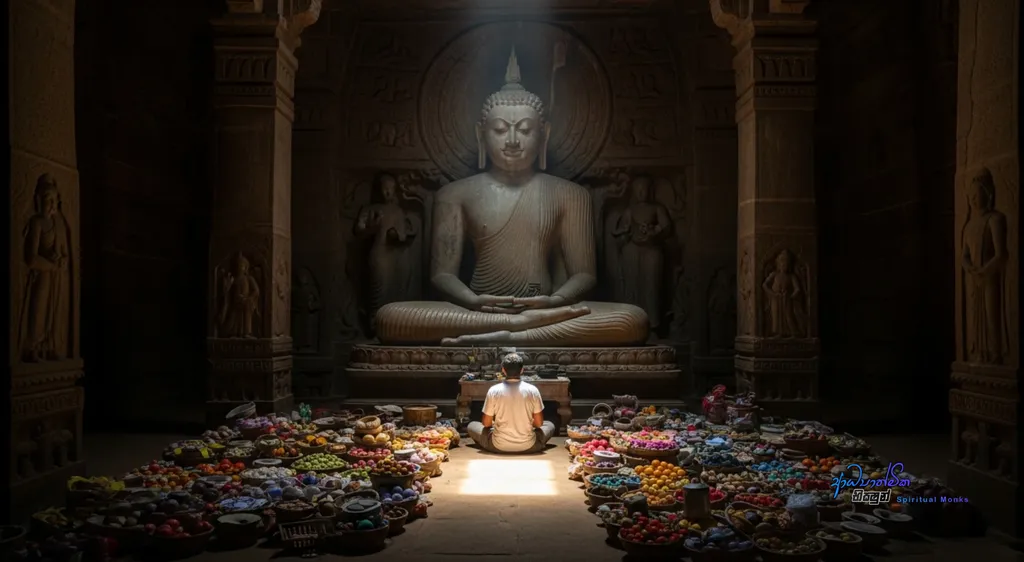
Dhammaṁ Have Rakkhati Dhammacārī: The Dhamma as Your Ultimate Protector
There is a saying in the Pali scriptures: ‘Dhammo have rakkhati dhammacārī.’ This means, ‘The Dhamma itself protects the one who lives by the Dhamma.’ What is this Dhamma? It is the universal law of nature. The Buddha taught us this natural order. Therefore, the one who lives in accordance with it is inevitably protected by nature itself.
We have received messages from people in difficult domestic situations, such as conflicts between a husband and wife or a mother-in-law and daughter-in-law. They tell us that as they engaged in chanting, veneration, and meditation, they felt protected by the Dhamma, even amidst constant problems. They have witnessed this protection with their own eyes. You may have such personal experiences too.
Remember this and continue to protect your practice. If you observe the Five Precepts, the Eight Precepts, or the Ten Precepts (Sīla), continue to do so. As you develop further with meditation, you will be protected. And this protection doesn’t only come from the law of nature. You also receive the protection of righteous celestial beings, or samyak drishtika deviyo. This is what you need to understand. If you have had such experiences of finding protection through the Dhamma, feel free to share them to inspire others.
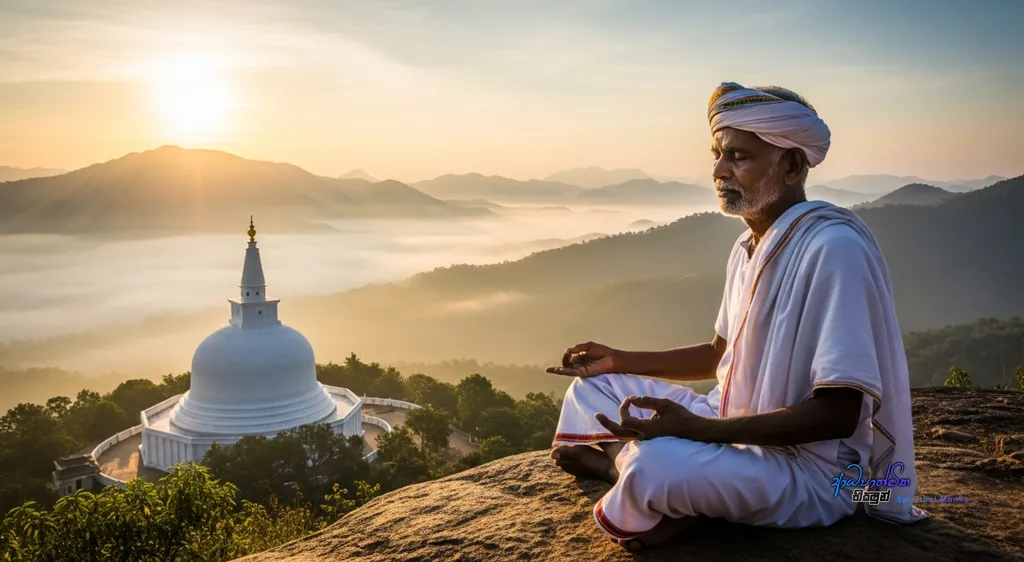
A Lifelong Commitment: Facing Life’s Storms with a Joyful Heart
Young people who were once addicted to drugs and alcohol have told me that through meditation, they were able to leave those habits behind. In our own spiritual work, we started from the very foundation: morality (Sīla), rituals of veneration, and chanting. We always encourage people to protect these practices. Many are now practicing Loving-Kindness meditation (Mettā Bhāvanā) and other forms of calm-abiding meditation, including specific practical methods we’ve taught. Many are also practicing mindfulness as the Buddha taught.
Make a determination to continue this practice for your entire life, right up to the moment of death. Whether you came to this path because of problems or not, continuous training is what is required. There is no other way to walk this path. Understand that problems will come to you until the day you die; they will never end.
What is necessary is to face them without being entangled, without suffering, crying, or lamenting over them. The goal is to face the problem with a happy mind, detach from it, and continue joyfully on the path. In short, you must learn to face challenges with happiness.
As I mentioned at the start, many people, especially women, are drawn to the Dhamma because of overwhelming problems. Men, too, are increasingly finding this path, particularly young men. This is not a safe time we are living in; it is a dangerous one where anger is on the rise, leading to more harm. Therefore, train yourself according to these principles as much as you can. This teaching will help elevate your mind and bring you understanding. Grasp these points well and put them into practice.
May the power of the Buddha, Dhamma, and Sangha, the Triple Gem, give you the strength to understand these matters well and act accordingly.
We invite you to walk this path with us. Read our teachings, and most importantly, apply them practically in your own life. as you practice, questions will naturally arise. Please feel free to share your experiences and questions in the comments below, via email or contact form. I will do my best to offer guidance in future talks based on your progress. For now, begin this practice with an open heart and a mind free from expectation. Cultivate it correctly, and may you find the clarity and peace you seek.
Thank you for joining us. We hope this blog will be of great benefit to your spiritual journey.
May you all be well and happy.
May the blessings of the Triple Gem be with you all!.


