


Categories: Other Meditation Teachings
May the blessings of the Triple Gem be with you all!
Today, through our spiritual teachings, I have decided to answer a few common questions that many of you ask. These answers are intended to help you develop your meditation practice and see progress very quickly. I will provide brief answers for now, as I believe even these short explanations will be enough for you to understand and overcome any obstacles these questions may have created in your mind.
If needed in the future, I hope to offer more detailed explanations. For now, let’s explore these practical points to help you elevate your meditation practice swiftly. These tips are for those of you who are sincerely interested in starting meditation.
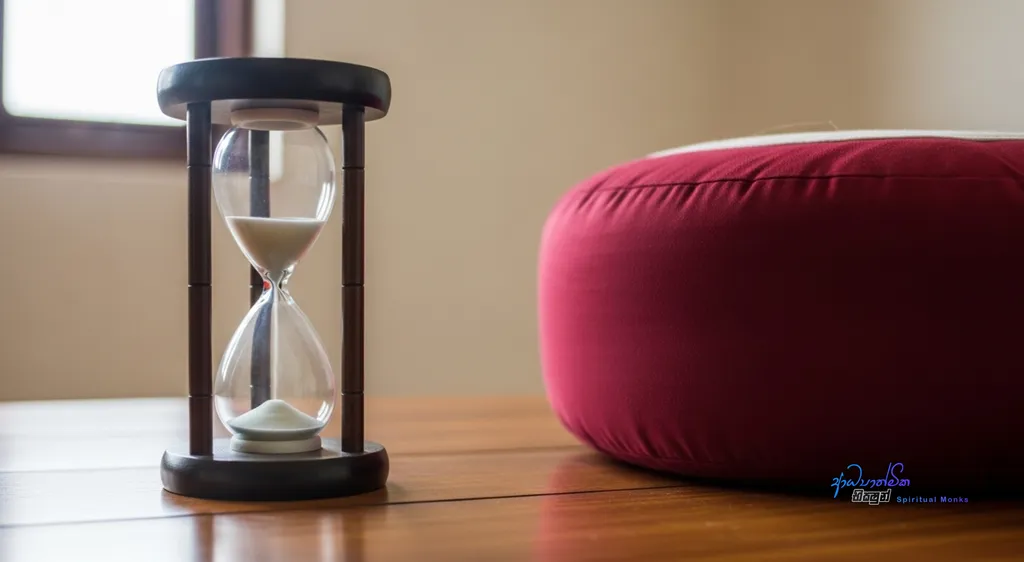
1. How Long Should I Meditate Each Day?
One of the most frequent questions we receive is, ‘How long should I be starting meditation for each day?’
My direct answer is to meditate for the maximum time you are able. However, I would encourage you to make it a habit to meditate for at least one hour a day. This is a minimum goal to work towards.
When you first begin practicing after exploring our practical programs, you might only be able to sit for five, ten, or fifteen minutes at a time. This is normal. Your body may start to ache, your legs might hurt, or you may feel tingling sensations.
However, if you have enthusiasm, desire, and dedication, you can build upon this. If you can meditate for ten or fifteen minutes today, you can add another five minutes the next day, or even in your very next session. Someone who meditates for 20 minutes can progress to 25. The one who sits for 25 minutes can extend to 30, and then to 35, 40, and 45 minutes. Increase your time gradually in this way.
But be mindful of this: while you are increasing the duration, do not sit just for the sake of passing time. Don’t think, ‘I must sit for this long.‘ During the time you are seated, maintain the practical mindfulness we teach. Otherwise, this can become a problem where you get used to sitting on the cushion for an hour but haven’t learned to develop your mind. Please learn to balance these two aspects. Don’t let the posture become a burden, and don’t let the duration become a burden. And likewise, don’t let developing the mind become a burden either.
Without making it a chore, you can gradually increase your time to an hour and a half, two, or even three hours. Meditate for the maximum time you can. But I want to emphasize that you should train yourself to be able to sit for at least one hour. Anyone can achieve this incrementally, so practice it step by step.
2. Meditation Posture: Should I Sit on the Floor or a Chair?
The second common question is, ‘Should I meditate sitting on the floor or on a chair?’
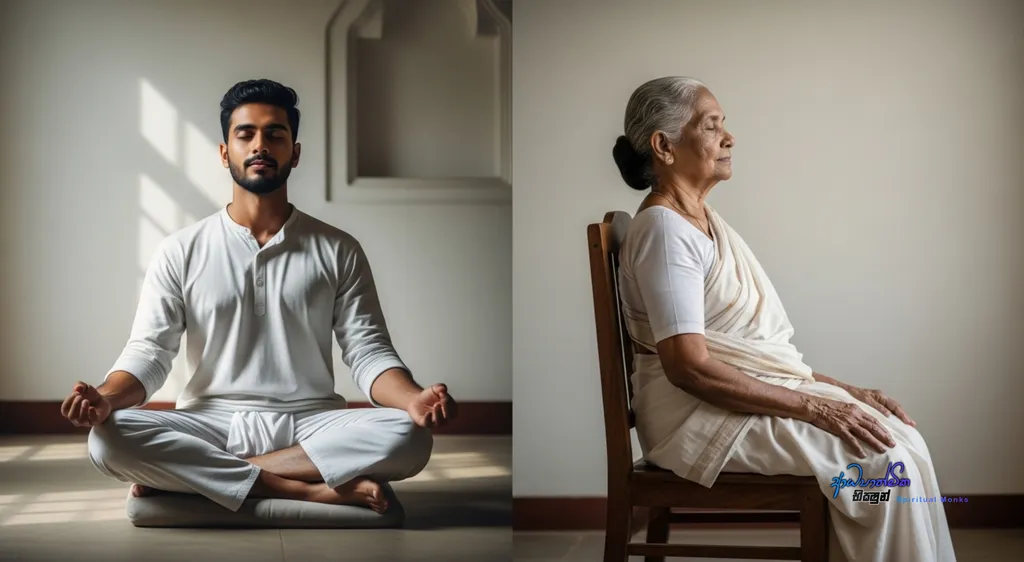
For this, my advice is as follows. Let’s consider an elderly person who cannot sit comfortably in a meditation posture on the floor. It is perfectly fine for them to get used to sitting on a chair. However, if they are able to sit on a cushion, that is even better.
Only the elderly or those with specific physical difficulties should need a chair. For young people and anyone who can sit in a proper meditation posture, it is essential to sit on a cushion on the floor. You can sit in what is called Padmasana (the full lotus posture) or Baddha Pariyankasana (a locked cross-legged posture), or simply cross your legs in a way that is comfortable for you. You can do this on the floor or even on your bed.
Whatever you do, the most important elements are practicality and mindfulness, which in the teachings is called Sati. It is this moment-to-moment awareness that allows the practice to progress. Please understand this point well. Use a chair only if you are elderly or have back problems. Otherwise, do not get accustomed to using chairs for starting meditation.
3. Dealing with Back Pain: Is It Okay to Lean Against a Wall?
This leads to a third, related question many people ask: ‘Should I lean against something while meditating?’
You now have part of the answer. When you are just starting meditation, it’s common to experience back pain, and this isn’t related to being young or old. In the beginning, you can sit on the floor or your bed and lean against a wall. After some time, you will realize, ‘Ah, I don’t need to lean against the wall anymore.‘ Then, try to move away from the wall, perhaps just an inch forward, and sit without support. Only lean back against the wall if the back pain becomes too strong. Practice like this.
After practicing this way for a while, a natural feeling will arise where you no longer need the wall’s support. At that point, you can come forward and meditate anywhere, sitting upright. Try to start your practice by keeping your back straight, just as you see in photos of people meditating. This is how you gradually get used to the meditation posture.
4. Is There a Right Age to Start Meditation?
As a fourth question, many ask, ‘Is there an age limit for starting meditation?’
To this, I would like to say that if you can understand the things I teach in this program series, then age is irrelevant. If even a person born today could understand, there would be no problem at all. We never know if we will pass away tomorrow or the day after. Therefore, anyone can practice meditation. Age is not a factor at all.
5. Do I Have to Meditate Near a Buddha Shrine?
For the fifth question, people often wonder, ‘Do I need to meditate in front of a Buddha shrine?’
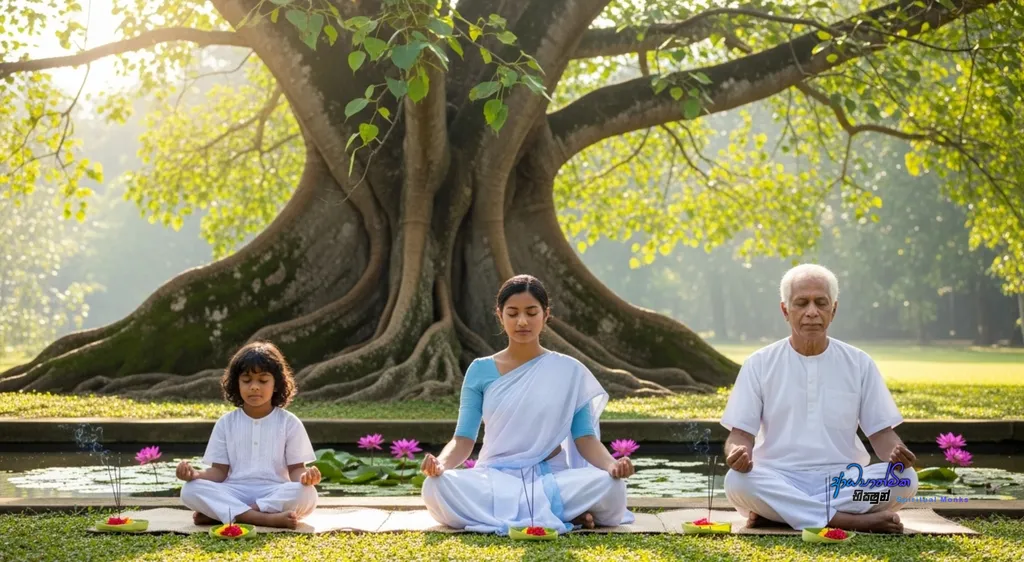
I do not prescribe such a rule. Anyone who wishes to can meditate near a Buddha shrine. Anyone who wishes can meditate on their bed. You can go to a temple, a forest monastery (known as an aranya), a quiet and free place, or even the top of a mountain. You can go to any peaceful place in your own home and meditate there.
6. Is It Okay to Meditate in My Bedroom?
The sixth question follows from the last: ‘Is it not good to meditate in my room?’
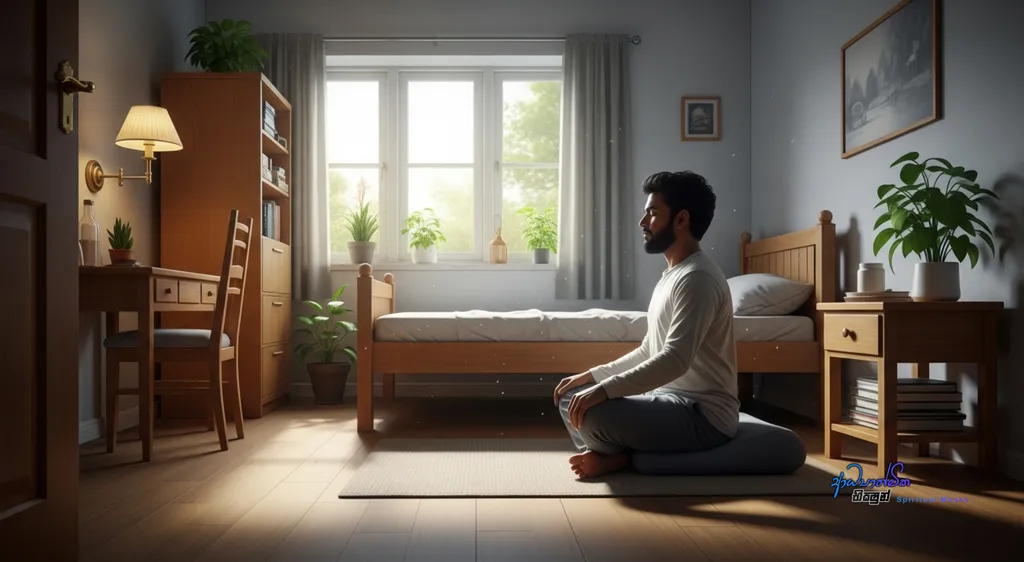
The previous answer already addresses this. There is no such rule that it’s bad to meditate in your room. Anyone can meditate anywhere. There is no ‘this place’ or ‘that place.’ To put it briefly, the Lord Buddha has taught us to go to a charnel ground (a cemetery, or sohona) and meditate. If it is good to meditate in a cemetery, why would it be bad to meditate in your room?
Therefore, you can meditate anywhere. If you could meditate in hell (apaya), you should meditate there. If you can do it in the heavenly realms (divya loka), you can do it there. And you can certainly meditate anywhere in the human world.
This is what it means to develop the mind. This is the practicality of our mind. We should be able to meditate anywhere. We should be able to meditate in a crowded city with a hundred thousand people, as well as in a forest where there are no people. So, there is no issue with meditating in your room. There is no ‘good’ or ‘bad’ place. Please remember that.
7. Finding Time: How to Manage Your Schedule for Meditation
For the seventh question, people ask, ‘How do I manage my time for starting meditation?’
When people ask about time management, I can give this general advice. Imagine you are a person living at home. Just as you wake up early to do your work, try to wake up and meditate for half an hour or an hour. If you wake up at 5:00, or 4:30, or 6:00, use that early morning time. Even 15 minutes is beneficial.
After finishing your work, if you have free time during the day, don’t waste it, meditate. Meditate in the evening as well. There is no set number of sessions per day. Meditate whenever you can, for as long as you can. Whether it’s for an hour, two, or three, meditate for the maximum time your situation allows. There is absolutely no problem with this. You can meditate at any time.
Therefore, you must decide how to manage your time according to your life’s schedule. However, I make this one thing mandatory: you must meditate for at least half an hour to an hour every day. Otherwise, it is difficult to develop the mind. We need to engage in these practices of tranquility meditation (known as Samatha Bhavana) practically every day. I also started a program called ‘Living Happily for 24 Hours‘ to practice being mindful (sihiya) throughout the day. Please use that method as well, as it is a great help in developing these concentration meditations. So please remember these points well.
8. Can I Meditate If I’m Married and Have a Family?
The eighth question is something many people ask: ‘Is it okay for married people to meditate?’
This is something that could be discussed at length, but I can give a short answer here. Marriage is not an obstacle to meditation at all. Please do not make this an issue. It doesn’t matter if you are married or unmarried, have children or don’t, or if you are taking care of your grandchildren. Even your job is not an issue. Nothing in your personal, worldly life (laukika loka) is a problem.
You should meditate. You should do the practice of meditation to develop your mind. What we need is mental relief, the development of tranquility meditation (Samatha Bhavana), and to create happiness in our minds 24 hours a day.
For this, it doesn’t matter if you are married or unmarried. Because even if you are married, if you die in the next moment, you have to leave everything behind, your spouse, your children. A wife must leave her husband, a husband must leave his wife, and they both must leave their children and relatives. Therefore, being married is not an issue for starting meditation. Please understand this matter as well.
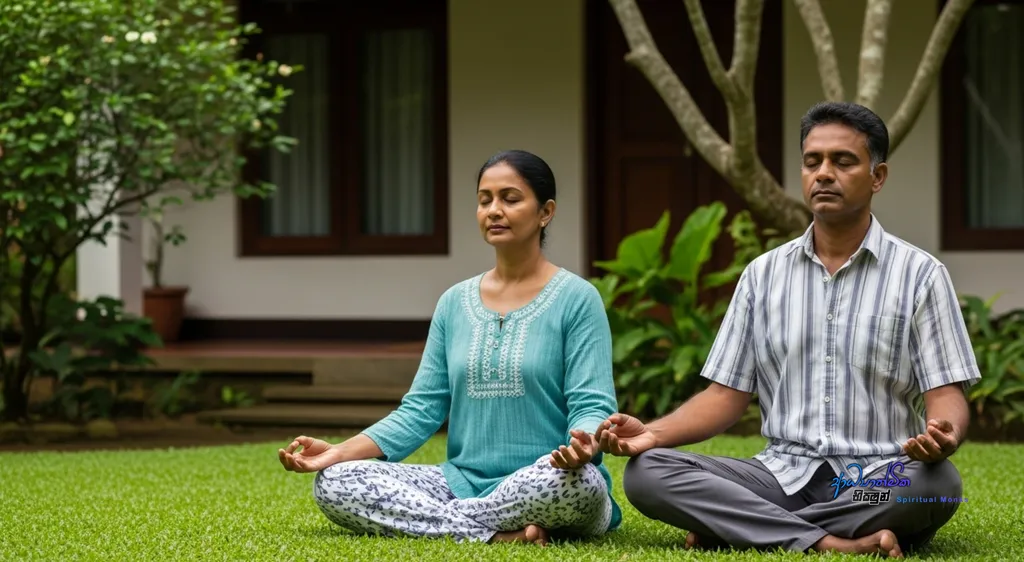
9. A Student’s Guide: Can Meditation Help with Studying?
As a ninth question, students often ask, ‘Is it good for people who are studying to meditate?’
My dear child, there is absolutely no problem. You can meditate in any way you like. In fact, your memory power will develop. Your mind will become more focused. If you can, meditate three or four times a day as I teach. Then, in the next moment, start studying. You will find that you can remember things very well. Your memory will improve significantly.
So do not be afraid at all. Create a schedule, a timetable, and manage your time to incorporate both your studies and meditation. You will be able to develop your mind very well.
There are students with various talents, in science, mathematics, and the arts. In the future, I hope to explain how these students can use meditation to develop wisdom (prajna) and improve their skills in their respective fields. I will teach that at a later time. But for now, I can say briefly: you will remember things well and be able to study better. So, without fear, practice any meditation method we teach after listening carefully to the instructions.
10. Is This Meditation Only for Buddhists?
The tenth question many people ask is, ‘Can a person of any religion practice meditation?’
Here too, I will give the shortest possible answer. Religion, nationality, or caste, none of these things are relevant to the teachings of the Buddha. Therefore, you can meditate without any fear.
Even now, I have Muslim students who practice meditation and speak with me about it. There are Christian children and even adults who practice meditation and tell me about their experiences. Many Tamil people also call me to say they are practicing. So, do not be afraid. Caste, nationality, and religion have no bearing on this. Anyone, from any religion or any race, can practice meditation. Remember this and continue your practice. There is no issue at all.
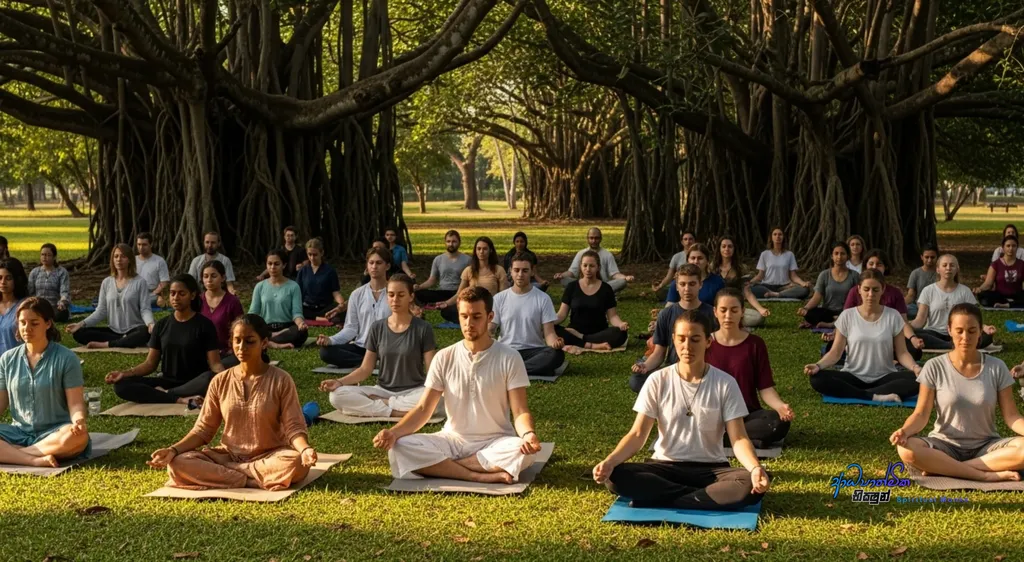
Embrace Your Practice Without Fear
I believe I have now answered a few of the questions that many people commonly wanted to ask. As I mentioned at the beginning, if needed in the future, I can discuss each of these questions separately and provide answers in dedicated teachings. However, I think even these brief answers will be sufficient for you to resolve the questions you had and to now proceed with your meditation practice.
Therefore, what I have to tell you is this: practice meditation now without fear. You have the answers to your questions. Do not let these questions be an obstacle any longer.
I wish for you the powerful energy of the Triple Gem to understand all wisdom (prajna), to increase your intelligence, and to develop your meditation practice practically, not limiting it to just words or listening. May you receive the strength, courage, protection, influence, and universal energy of the Triple Gem to develop your meditation and your mind very well.
We invite you to walk this path with us. Read our teachings, and most importantly, apply them practically in your own life. as you practice, questions will naturally arise. Please feel free to share your experiences and questions in the comments below, via email or contact form. I will do my best to offer guidance in future talks based on your progress. For now, begin this practice with an open heart and a mind free from expectation. Cultivate it correctly, and may you find the clarity and peace you seek.
Thank you for joining us. We hope this blog will be of great benefit to your spiritual journey.
May you all be well and happy.
May the blessings of the Triple Gem be with you all!


