


Categories: Lost Your Meditation Spark?
May the blessings of the Triple Gem be with you all!
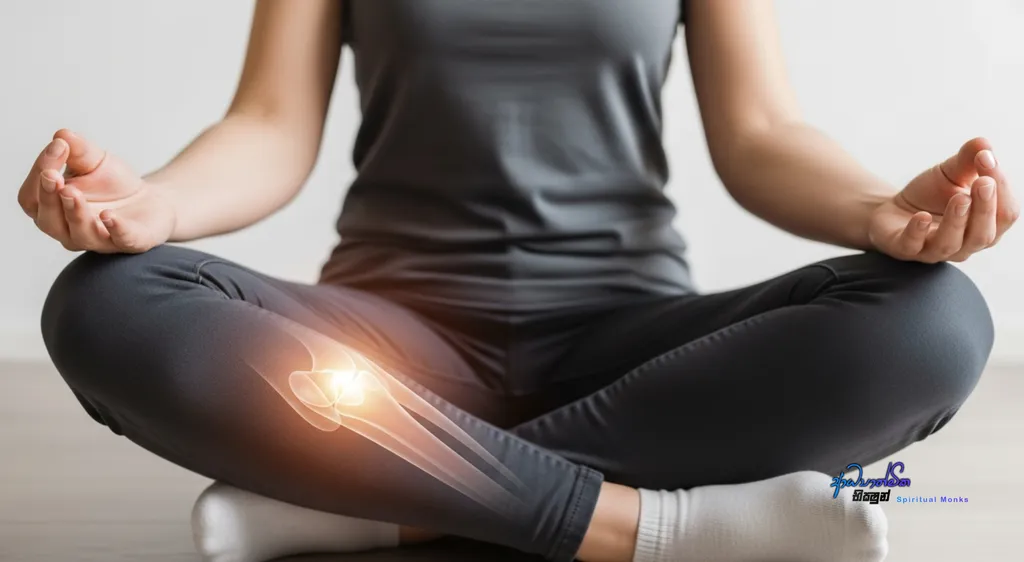
Today, through our spiritual teachings, I wish to explain a very common experience that almost everyone encounters when they begin a spiritual path and start to practice meditation: the challenge of meditation leg pain. This is something that confronts nearly every person who engages in this practice, so it is essential to understand it.
The reason this happens is that during meditation, we hold our body in a single posture for an extended time. We might call this sitting cross-legged, or in the more formal Buddhist tradition, the Baddha Paryankaya (full lotus) or half-lotus posture.
We often choose this position because it is the one we see in statues of the Buddha in deep concentration, or samadhi. This posture naturally helps the mind become very concentrated and is considered the easiest and most effective way to develop both tranquility meditation (Samatha) and insight meditation (Vipassana).
However, when you hold this posture for a while, especially if you are not used to it, the body begins to protest. You might feel an ache, a tingling numbness, or outright pain in your legs. This discomfort arises for a simple reason: we haven’t trained our bodies in this posture before.
While we may have practiced meditation in past lives throughout our journey in samsara (the cycle of birth and death), our body in this life is unfamiliar with this discipline. This is the primary cause of meditation leg pain.
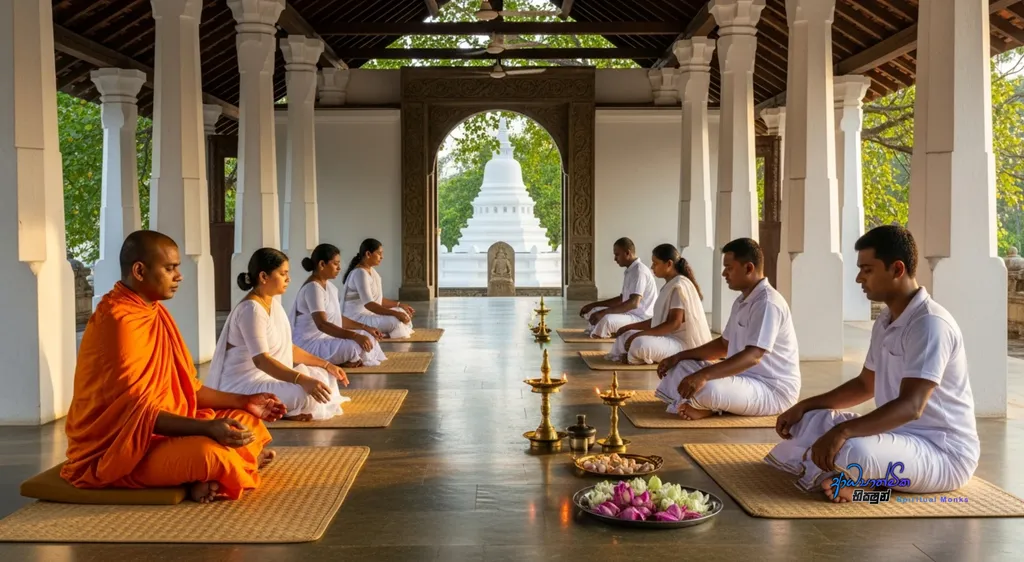
Your Body’s Story: Physical Factors and When to Adjust
To overcome this, a period of consistent practice is necessary. As you practice over time, your body will adapt. Some people are able to sit for half an hour or even an hour straight away, but for many, it is not so easy. Physical factors play a significant role.
If a person is overweight or has a larger stomach, they might experience cramps when sitting in the meditation posture. Older individuals may feel back pain, and for those with weaker bones, the meditation leg pain can arise very quickly. These bodily weaknesses become a factor.
However, I want to emphasize that no matter the ailment, the practice is possible. Of course, for someone who is in a wheelchair or unable to get out of bed, this posture is not feasible. Likewise, for those with severe, chronic back conditions, it is too difficult. For these individuals, I recommend meditating while sitting in a chair, perhaps with back support.
But for everyone else without these severe physical limitations, I strongly encourage you to use the traditional meditation posture. Even if you have minor issues, it is important to train yourself. In our other teachings, we’ve noted that for the elderly or those with specific injuries like broken bones or spinal damage sitting in a chair is the correct adaptation. All others should endeavor to use the traditional posture.
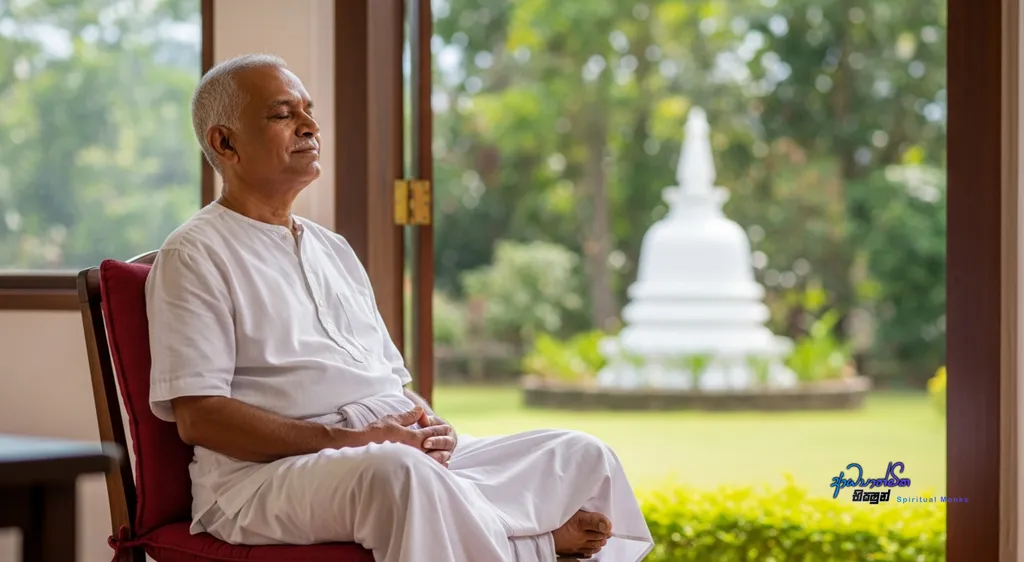
The 20-Minute Wall: Your First Great Test of Patience
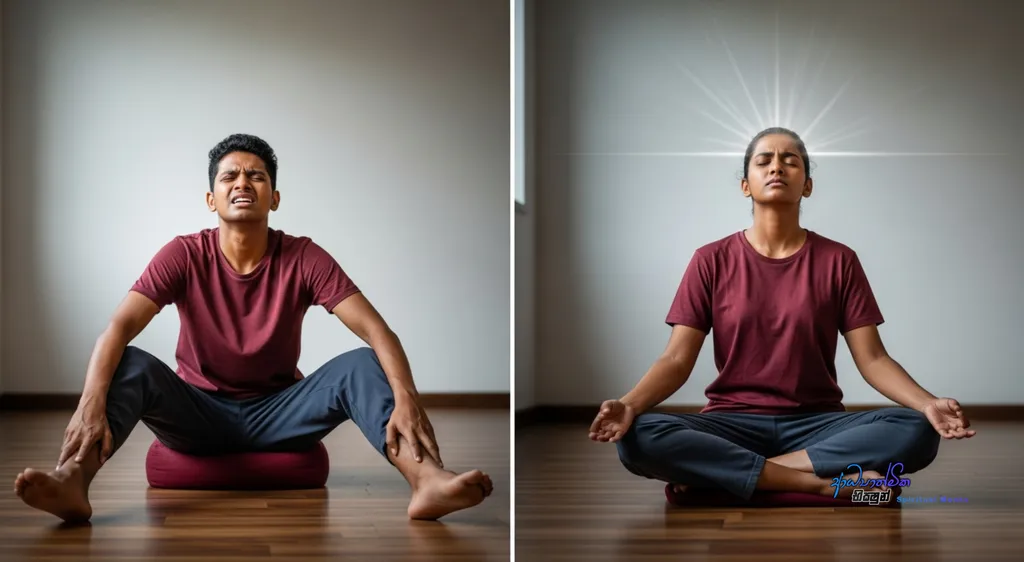
Let us address the core of your question: what do you do when the meditation leg pain arises? How do you face it? Imagine you begin your meditation, close your eyes, and settle into the posture. For many, after about 20 minutes of good concentration, the pain will arrive. It can be an ache, a throbbing, or a tingling numbness. When it comes, it feels very difficult to stay seated. The mind begins to scream, “Get up! Stretch your legs! Open your eyes and stop meditating!” Your mind will start giving you these commands.
This is the critical moment. If you are practicing meditation daily, perhaps for an hour in the early morning, what you must do when this 20-minute pain arrives is not flee from it. The common mistake is to immediately give in, stretch the legs, open the eyes, and abandon the session. Please do not make this mistake. If you do this, you will train your mind and body to stop at the 20-minute mark every single day. Your system will become conditioned to that limit, and you will never attempt to go beyond it because the mind has been taught to quit. So, do not make that error.

Don’t Run from Discomfort – Lean into It
No matter how sharp the ache is at that moment, you must understand that it will not cause you any real physical harm or damage your bones. You must face it without fear. Remain in the posture, endure the sensation, and you might even metaphorically “clench your teeth” to get through it.
At this time, also watch your mind. See what it is telling you. Only if the pain becomes truly unbearable should you briefly stretch your legs. Otherwise, do not do it. Endure for as long as you possibly can.
Why is this so important?
Because if you endure today, when you sit for meditation tomorrow, you will have the strength to endure the pain at 20 minutes and sit beyond it. The next day, you will be able to do it again. But if you avoid it on the very first day if you run from it out of fear or an inability to bear the sensation you will avoid it the next day, and the day after that. You will establish a pattern of avoidance.
Therefore, whether the pain comes at 20 minutes or half an hour, try your best to endure it. As I said, if it becomes absolutely impossible, you can briefly stretch your legs and then return to the posture. But my primary advice is to remain seated and still.
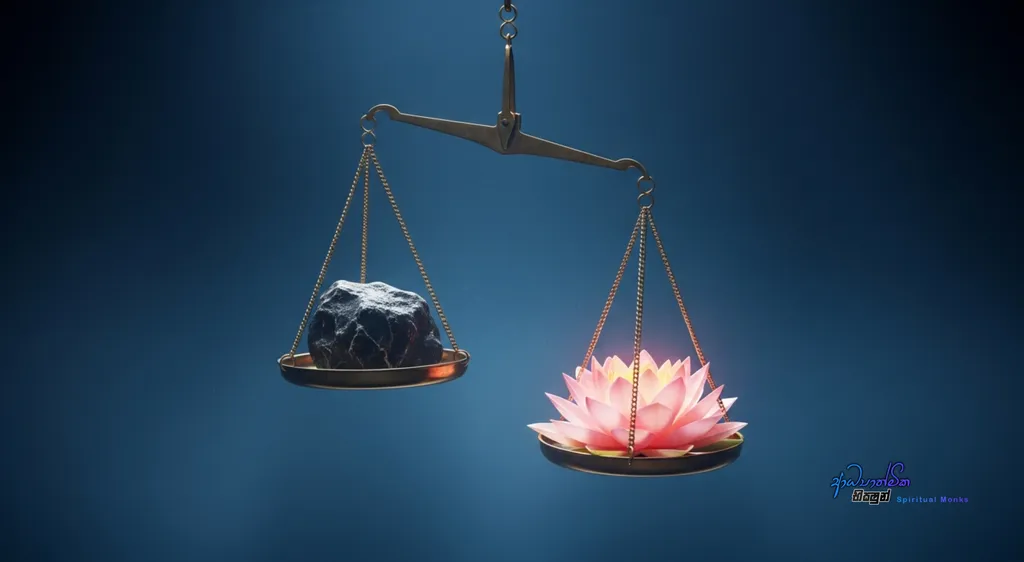
The Scale of Awareness: When Concentration Outweighs Pain
As you sit with the pain, watch your mind. You will notice that your concentration (samadhi) is also weak at that moment. This is because if your concentration were strong, you wouldn’t feel these physical pains so intensely. If you were in a deep meditative state, a dhyana, you would not notice such things. It is like a balancing scale.
I invite you to picture this in your mind. If the physical pain becomes ‘heavier‘ than your level of concentration, your samadhi weakens and can almost disappear. Sometimes you might feel a faint trace of concentration, and other times it feels completely gone. This is because your mind has gone to the sensation of pain, which has become so powerful in the body the tingling or the ache in the legs.
The mind always goes to the strongest experience. Think of it as being drawn to the extremes: the greatest pleasure or the greatest pain. In this case, if the pleasure of your concentration is stronger, the mind will stay there, and you won’t be bothered by what is happening in the body.
But if the pain in your leg becomes even a fraction ‘heavier’ than the peace of your samadhi, the mind will rush to the pain. Then, you will start struggling with it, wrestling with it, and thoughts of frustration will arise: “What is this nuisance? This is an awful pain! I’m so fed up!” This is the nature of the mind.
From 20 Minutes to Two Hours: Building Your Sitting Endurance
Let’s say you endure the pain at the 20-minute mark. You will then find you have the ability to sit for another five, ten, or fifteen minutes longer. The next wave of meditation leg pain might not come until the 40 or 45-minute mark. When it does, you apply the same principle I described for the 20-minute pain.
You face it, endure it, and only stretch if it’s absolutely necessary. By getting used to this, the next time the pain might only come after an hour. Step-by-step, by patiently enduring these pains and numbness, you can overcome them. After facing it in this way, you can develop the ability to sit for two or three hours.
Your capacity to sit for longer and longer periods of meditation will definitely increase, born from your patience and your training. This is what we call practical training.
This is not a huge problem. With time for some it takes a week or two, for others a month or two, and for some just a day or two you will get used to it. It is a relative process that depends on each person’s ability to adapt, practice, and understand. What is required is this practical application, daily, just as I have described.
A Technique for Transformation: Watching the Pain with Mindfulness
I will give you another technique. When the tingling or pain arises, and you notice your concentration is low and your mind is drawn to the pain, watch that sensation with clear mindfulness. As you observe it with steady attention, you will see the mind change. At times, the mind will be completely entangled with the pain.
At other times, it will shift to a neutral state, an attitude of, “It’s okay, this is just a feeling.” You will see this equanimous, neutral thought appears in your mind. Then, you will see it get caught up in aversion again. You will start to see the mind itself flicker and change right there. Watch this. By doing so, you will develop the ability to endure the pain.
Let me repeat: when the feeling arises, watch it with clear awareness. You will see the reactive thoughts: “What is this nonsense? I’m so sick of this!” You will see these kinds of aversive thoughts arise. Then, at another moment, you will see a thought of equanimity (upekkha in Pali), a balanced acceptance, a willingness to endure the pain without any story.
Both of these states will occur. By observing this, your patience and your ability to be with pain are trained right there in your meditation. This will be a great help in developing and cultivating your spiritual path.
A Journey of Patience, Not a Problem to Be Solved
The more we sit and endure, the more we become accustomed to these sensations. It is like getting used to a mosquito bite and being able to ignore it. We get used to the tingling, the numbness, and the bone-deep ache. As we get used to it, it no longer bothers us.
If we make a habit of fleeing every day getting up, stretching our legs we never get accustomed to the sensation; we only get accustomed to running away. But if we get used to enduring it, then the next day, when the numbness comes, it will be of no consequence to us.
This is what is cultivated through patience in meditation. This patience is upekkha, or equanimity a state of balance. Once that is established, nothing can bother us. No matter what physical pain arises, our mind does not go there.
Explore this for yourself. We have given teachings on watching thoughts and maintaining mindfulness; apply those here as well. You will gain a great understanding of your mind and these physical pains. Don’t make the meditation leg pain a big issue. It is a common experience for everyone, from a small child to an elderly person.
Using a thin cushion or mat can help, as the nerves get pressed against a hard floor, but some people who are very practiced don’t even need that. The main reason for this pain is simply that we have not accustomed our bodies to this posture in this lifetime. But through practice, and as our latent habits from past lives of meditation re-emerge over time, we gain the ability to face these things.
I believe there is no need to say much more on this topic. If you have different experiences or ways, you have faced these challenges with meditation leg pain, we invite you to reflect on them for the benefit of others. With this, I will conclude today’s teaching on dealing with pain in meditation.
May the powerful blessings of the Buddha, the Dhamma, and the Sangha the Triple Gem be with you. May you have the strength to face this challenge practically, gain the experience of enduring it with equanimity and balance, and overcome this obstacle on your path.

We invite you to walk this path with us. Read our teachings, and most importantly, apply them practically in your own life. as you practice, questions will naturally arise. Please feel free to share your experiences and questions in the comments below, via email or contact form. I will do my best to offer guidance in future talks based on your progress. For now, begin this practice with an open heart and a mind free from expectation. Cultivate it correctly, and may you find the clarity and peace you seek.
Thank you for joining us. We hope this blog will be of great benefit to your spiritual journey.
May you all be well and happy.


