


Categories: Dhyana: Practical Training
May the blessings of the Triple Gem be with you all!
Today, through our spiritual teachings, we hope to explain to you how to practice a powerful meditation in a very practical way. In our series on awakening the third eye, we have shared various understandings, not as theoretical knowledge confined to books, but as wisdom gained through direct, practical experience. We have never been interested in sharing things limited to texts.
The understanding, the experience, and the knowledge we have gained, we offer to you humbly and generously. We offer this as a help for you to develop your own spirituality, to heal your mind, and to learn things you may not have known before. As you engage with these practices, you will begin to gain your own understanding of spirituality, which is essential for your progress. This direct, practical experience is what builds true faith, or saddhā, a deep-seated confidence, and trust in the spiritual path.
From Breath to Buddha: Contextualizing the Practice
In a previous session, we explained how to awaken the third eye through Ānāpānasati (mindfulness of breathing) by developing deep states of calm, known as samatha. It is important to understand the original context of these teachings. The Buddha did not teach these methods specifically to awaken a third eye. He taught practices like the Four Foundations of Mindfulness (Satipaṭṭhāna) to be used for Vipassanā, or insight meditation, which leads to the ultimate goal of Nibbāna (liberation).
However, as we cultivate these practices, we can also derive benefits from the side of samatha, or deep concentration. For some people, these practices naturally lead to spiritual experiences, and we offer guidance to help them navigate this path. This time, we will focus on how to awaken the third eye using Buddhānussati meditation, the recollection of the qualities of the Buddha, as seen in the title of this article.
Is This Practice in the Scriptures?
A question may arise: the Tripitaka (the Pali Canon) does not mention awakening a third eye through Buddhānussati meditation or Ānāpānasati. This is true. There is no direct mention in the scriptures of using these specific meditations to awaken a third eye. I have stated this before. However, the teachings on the Abhidhamma (the higher philosophical texts) do describe the Pañca Abhiññā, or the five supernormal knowledges.
Among these is the dibba-cakkhu-ñāṇa, the knowledge of the divine eye, a clear vision that can perceive unseen worlds. This is the pure, divine eye we are discussing. This knowledge confirms that such abilities are a recognized part of the path.
The Buddha specifically recommended Buddhānussati meditation for those who lack faith or conviction (saddhā). For a person with very little or no faith in the Buddha, practicing the Four Foundations of Mindfulness can be difficult. Therefore, the Buddha taught this method to cultivate that essential confidence. The Sutta Pitaka clearly states that for someone lacking faith, the most suitable meditation is Buddhānussati meditation.
A Foundation for Insight, Not a Final Destination
Once a person practices Buddhānussati meditation for some time and develops sufficient faith to engage in insight meditation (Vipassanā) or the practice of mindfulness (sati), there is no need to continue contemplating the Buddha’s qualities repeatedly. From that point on, the work to be done is the cultivation of the Four Foundations of Mindfulness. No single meditation method is meant to be practiced at the same level forever. When we reach the required stage, we must move on to the appropriate next practice.
In our practical meditation programs, we do not stagnate in one place. As you gain certain experiences, you will understand that it is time to proceed to the next steps. Whether you have explored our teachings on the jhānas (meditative absorptions) or our practical program on reaching the Brahma worlds, you will have seen this step-by-step progression.
All rivers flow to the sea. Similarly, whatever samatha meditation we begin with as our foundation, we all eventually arrive at the same destination, though the experiences may vary slightly based on our past kamma (intentional actions), our perfections (pāramī), and our past meditation practice from previous lives. But we must not rely solely on past habits; we must cultivate these skills in this very life to know for sure.
The Core of Buddhānussati: Recalling the Nine Qualities
For those who are new to these teachings, I recommend starting from our foundational articles to follow the proper sequence. Now, let’s discuss how to use Buddhānussati meditation to open the third eye, or dibba-cakkhu-ñāṇa. This meditation is practiced by people of various nationalities and religions, not just by those born into Buddhist families.
The practice begins by contemplating the qualities of the Buddha, often by reciting the chant you may know: “Iti’pi so Bhagavā Arahaṃ Sammā-sambuddho Vijjā-caraṇa-sampanno Sugato Lokavidū Anuttaro Purisa-damma-sārathi Satthā Deva-manussānaṃ Buddho Bhagavā’ti.”
This Pali verse contains nine supreme qualities of the Buddha. These nine qualities form the basis of our practice. Some teachers advise contemplating all nine qualities at once. Others suggest starting with eight, seven, six, or even just one. Many begin with the quality of “Arahaṃ.” Some lay teachers who focus on samatha meditation might even give the word “Arahaṃ,” “Buddho,” or “Bhagavā” as a mantra to focus the mind, just as we have taught using the word “empty.”
In those cases, the word is just a tool for concentration, and the practitioner may not even know its meaning or that it refers to the greatest teacher in the universe. Yet, even without knowing the meaning, using the word “Arahaṃ” can develop deep concentration and, in some cases, even awaken the third eye.
Four Practical Ways to Practice
To cultivate faith and shorten your journey through saṃsāra (the cycle of rebirth), it is not enough to just repeat the word “Arahaṃ.” It is essential to understand its meaning. This builds the confidence and reverence needed for the path of insight. We must develop a deep, heartfelt connection to the qualities of the master who taught this path.
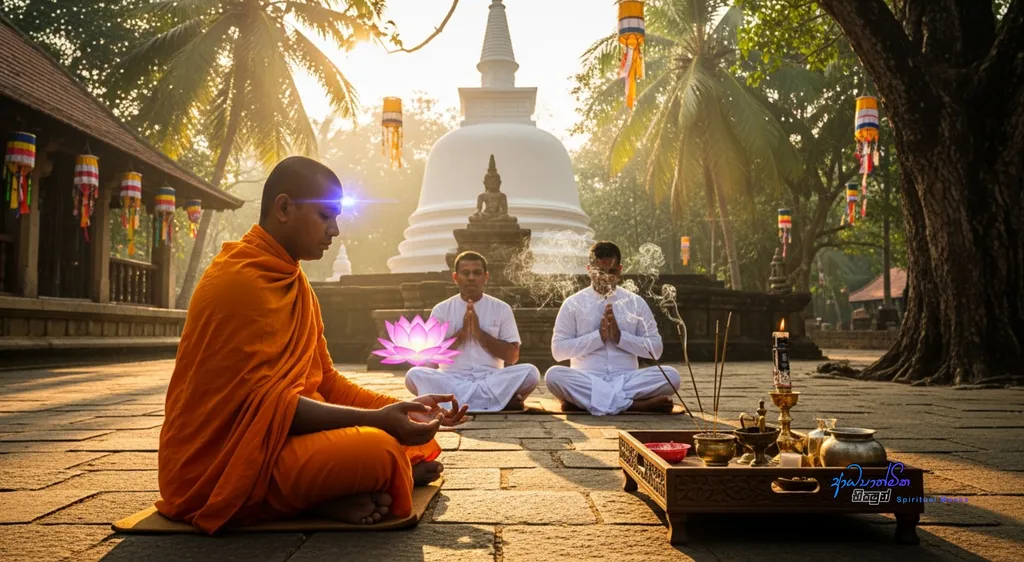
Here are four common ways people practice Buddhānussati meditation. There is no single “wrong” way among these:
1. Contemplating the qualities without a focal point: Some people simply close their eyes and, while looking into the darkness of their inner ‘display screen,’ recite the nine qualities in Pali and contemplate their meaning in their own language (e.g., Sinhala, English, Tamil).
2. Using a single word with a focal point: Others take one word, like “Arahaṃ,” and focus their attention on the point between the eyebrows or the center of the forehead while mentally repeating the word.
3. Using a single word without its meaning: Some repeat a word like “Arahaṃ” while looking at their inner display screen, without focusing on the forehead or contemplating its meaning. This is purely for concentration.
4. Combining focal point, word, and meaning: A practitioner might focus on the point between the eyebrows while mentally repeating the Pali word (e.g., “Arahaṃ”) and simultaneously contemplating its meaning.
Step 1: Building the Foundation with Consistent Practice
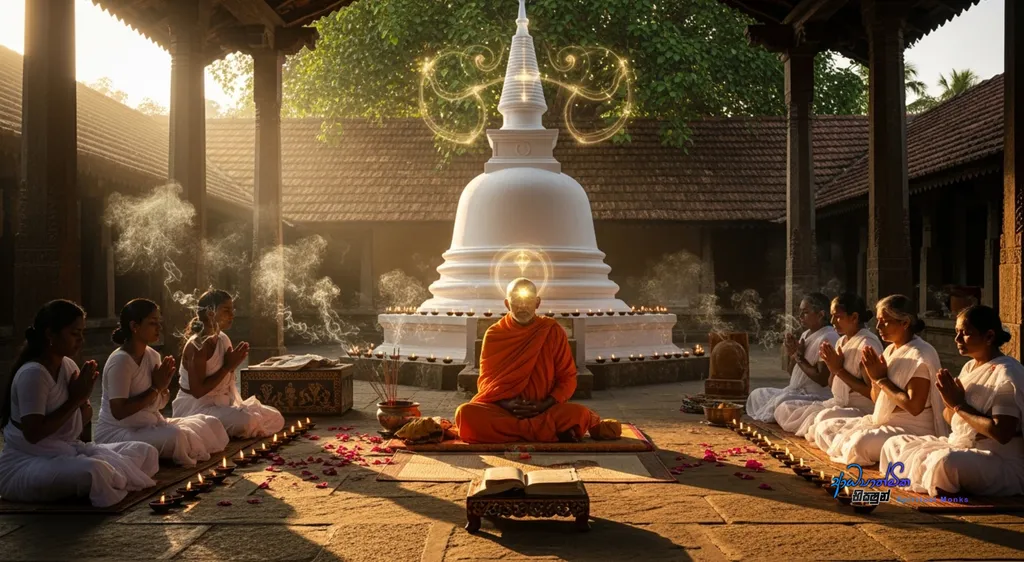
You can practice for twenty minutes, half an hour, or an hour. You can start with all nine qualities or just one. You can use the Pali words alone, or with their meaning. Any of these methods is perfectly fine. The goal for someone on the insight path is to use this practice to build faith. For this, it is necessary to know the meaning. For example, the quality of Arahaṃ has several meanings:
- He is worthy of offerings as he is far from defilements.
- He has destroyed the enemy, which is defilement.
- He has broken the spokes of the wheel of saṃsāra.
- He is worthy of receiving requisites like robes.
- He does no evil, even in secret.
Many people contemplate this last meaning. As you mentally repeat “Arahaṃ, Arahaṃ, Arahaṃ” at a moderate pace, the meaning “He does no evil, even in secret” may naturally arise in your mind, deepening your faith. You can do this with or without focusing on the forehead. The key is consistent practice.
Step 2: The Sensation of Tightness on the Forehead
As you practice consistently with any of the methods described, the next stage for many, though not all, is a physical sensation. You may begin to feel a tightness or pressure in the middle of your forehead or between your eyebrows. It might feel like a tingling, or even like a small electric current.
This is a sign that the nerves in the brain are being stimulated and preparing themselves for meditation. We have a separate teaching that explains in detail why this tightness occurs and the various sensations one might feel. If this happens to you, it signifies the beginning of a new phase. You have now reached the second step.
Step 3: The Emergence of the Light Sign (Āloka-saññā)
After practicing for some time at the second step, whether it’s days, weeks, months, or even a year, as it is relative to each individual, you may progress to the third step: the arising of the light sign, or āloka-saññā. A light will appear in your field of vision.
When this happens, you have reached the third grade. You no longer need to focus your attention on the forehead. Instead, focus your mind on the light itself. While looking at the light, you can continue your chosen practice: repeating “Arahaṃ,” contemplating the nine qualities, or thinking of their meaning.
Alternatively, you can switch to the method taught in our third eye series and begin contemplating the sign of “emptiness.” If the light disappears, simply return your focus to the point between your eyebrows and resume your chosen recitation until it reappears.
Step 4: The Appearance of Mental Images (Citta-rūpa)
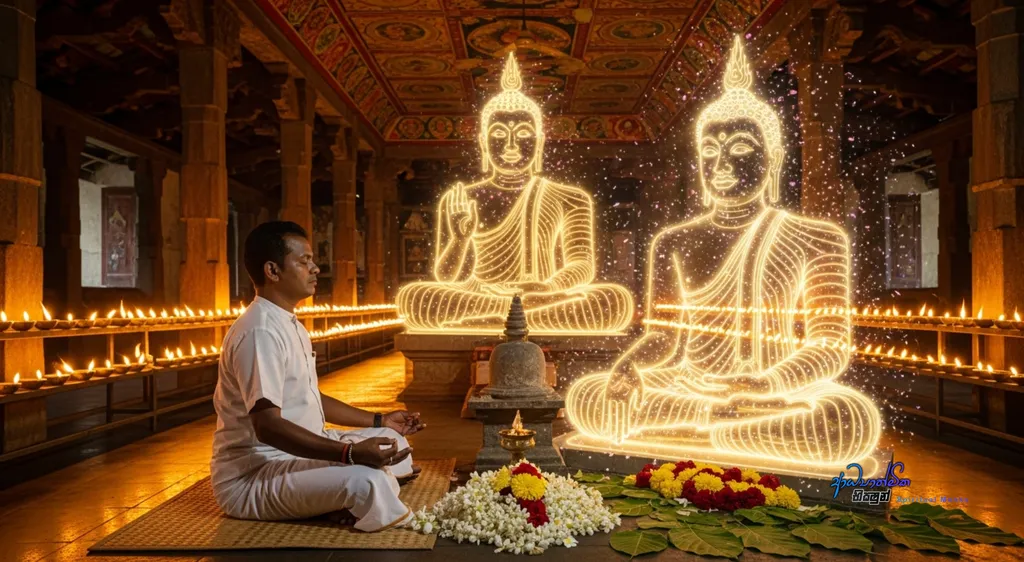
As you continue your practice, focusing on the light, you will eventually reach the fourth step. This is the stage where citta–rūpa, or mental images, begin to appear. Because you are practicing Buddhānussati meditation, the most common image that will manifest for the majority of people is an image of the Supreme Buddha. Seeing this image will cause your faith to grow immensely. Even if you were a person of another religion or a born Buddhist with little faith, this experience will establish a deep sense of conviction.
Other mental images may also appear, as we’ve discussed in our teachings on citta–rūpa, but the image of the Buddha will be the most prominent. While looking at this image, you can continue contemplating the Buddha’s qualities. This will further strengthen your faith. Alternatively, you can switch to contemplating “emptiness” while observing the image. The choice is yours. Remember, the words and techniques are tools to get you to these stages. Once you arrive, the tools themselves become less necessary.
Step 5: The Vision of Boundless Sky (Ākāsa)
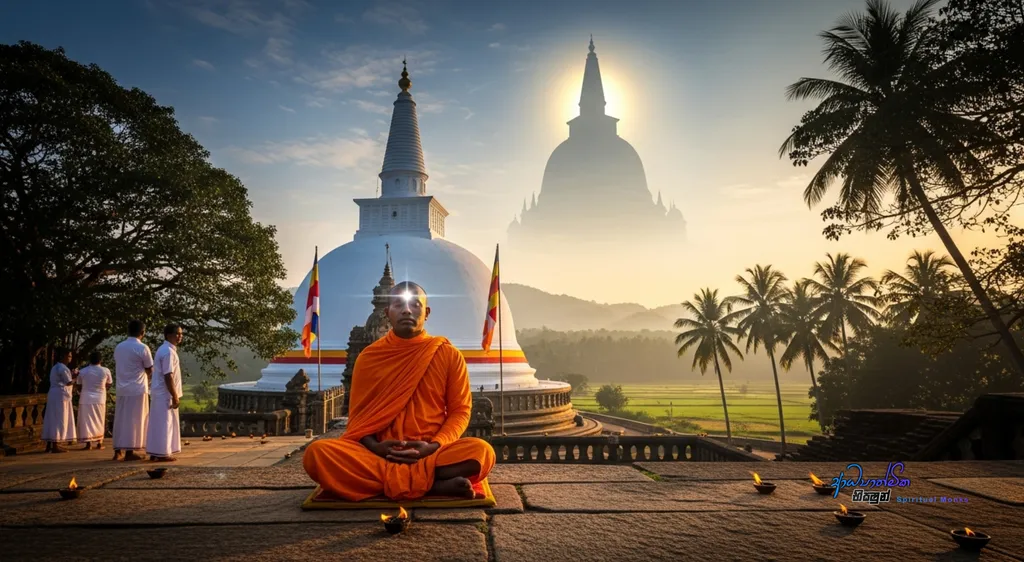
After abiding in the fourth stage, you will progress to the fifth and final step in this sequence. The mental images will fade, and what appears next is the vision of the sky, or boundless space (ākāsa). This is a very important stage.
Once you reach this point, if you wish to awaken the third eye or develop the formless absorptions (arūpāvacara jhānas), you no longer need to practice Buddhānussati meditation. The foundation has served its purpose. From here on, according to our practical meditation program, you should begin contemplating the sign of “sky.”
Do not go back to contemplating the Pali words or their meanings. Focus solely on the sign of “sky.” As you continue this practice, the third eye will eventually open. Initially, you may see sacred places like the Ruwanwelisaya stupa. With practice, you will be able to direct your vision with intention. From there, you can proceed to develop the first formless jhāna, the sphere of infinite space (ākāsānañcāyatana).
Navigating the Path: Final Words of Encouragement
Now, I must repeat that the Buddha did not lay out this specific step-by-step method for awakening the dibba-cakkhu-ñāṇa in the scriptures as we have it today. Perhaps such teachings existed and were lost over time due to various invasions and destructions, we cannot say for sure.
We should neither cling to the idea that texts were lost nor that they weren’t. We should be grateful for the eighty-four thousand units of teaching that have been preserved and use them for our practice, without wasting time in arguments.
Some may accuse me of teaching methods of brahmins or heretics, as this exact sequence isn’t in the Tripitaka. Do not be shaken by such claims. I am not shaken. The scriptures do mention the supernormal powers (abhiññā) separately. They do mention Buddhānussati meditation for those lacking faith. And they do state that one who develops Buddhānussati meditation can attain Nibbāna. The only missing part is the precise, step-by-step connection, which we have laid out from practical experience.
Do not get stuck. Many people reach the stage of seeing light or even images of the Buddha and remain there for years, stagnating. These methods are a foundation to move forward. This practice can be done by anyone, of any race or religion, of any age, even young children. Practice discreetly and develop your spirituality. The only outcome is a benefit to your mind and your spiritual life.
The results are for you. As for how long it takes, I cannot give a timeframe. It is relative. But I always recommend practicing a single meditation technique continuously for at least three to six months. This same step-by-step principle can also be applied to Dhammānussati (recollection of the Dhamma) and Saṅghānussati (recollection of the Sangha) to achieve similar spiritual abilities and meditative states. I will not prolong this further.
Conclusion and Blessing
Today, we conclude this practical teaching on opening the third eye through Buddhānussati meditation. By the power and blessings of the Triple Gem, the Buddha, the Dhamma, and the Sangha, may you all be able to understand these matters well. May you have the ability to practice with understanding, intelligence, and wisdom.
We invite you to walk this path with us. Read our teachings, and most importantly, apply them practically in your own life. as you practice, questions will naturally arise. Please feel free to share your experiences and questions in the comments below, via email or contact form. I will do my best to offer guidance in future talks based on your progress. For now, begin this practice with an open heart and a mind free from expectation. Cultivate it correctly, and may you find the clarity and peace you seek.
Thank you for joining us. We hope this blog will be of great benefit to your spiritual journey.
May you all be well and happy.
May the blessings of the Triple Gem be with you all!


