


Categories: Third Eye: Practical Meditation
May the blessings of the Triple Gem be with you all!
Today, through our Adhyathmika Bhikshun (Spiritual Monks) Website, I wish to explain a special method to discipline the mind. You could call this a specific meditation subject, or in our tradition, a Kammatthana, a subject for meditation. But for our purposes, let’s call it a special way to tame your restless mind. With this unique method I will explain, you can gain control over your thoughts and develop your mind through meditation. We share this because we know from direct, hundred-percent experience that it works. We have practiced it ourselves, and that is why we are teaching it to you.
If you haven’t read the earlier parts of this series, I encourage you to do so they lay the foundation for what follows.
Who Can Benefit from This Practice?
Before I explain the technique itself, let me clarify who this practice is most suitable for. It is especially beneficial for certain people.
- Your mind feels constantly scattered, jumping from one thought to another without your control.
- You are healing from heartbreak or the pain of a past relationship and wish to find peace.
- You are struggling with addiction and have a sincere desire to use meditation to support your recovery.
- You are experiencing mental stress (Dukkha) from work, studies, or family pressures. Whether it’s the anxiety of exams or conflict at home, this practice can create inner space.
This technique is designed to address these very human struggles and help anyone who wishes to tame your restless mind and cultivate a foundation for deeper meditation.
Getting Started: Your Posture and Anchor Point
Next, I want to talk about how quickly you can see results. The results can genuinely appear within a day or two. For some, it might even be within an hour. Many experiences positive effects from the very first day.
However, I should mention that you might feel a little physical discomfort when you practice this. The method involves a kind of wrestling match with your mind, so your body might feel a bit strained. But it will not be a major discomfort.
To begin, find a comfortable seated meditation posture. While the traditional full-lotus posture (Baddha Pariyankasana) is mentioned, the most important thing is to sit with your back straight in a way you can maintain. This can be on a cushion on the floor or even seated on a chair or bed.
So, what is this method?
Let me explain it clearly. In a previous video on the ‘Third Eye Practical Meditation Method,’ we discussed placing your attention at the point between your eyebrows. We said to know if the mind goes to the past, know if it goes to the future, and know if it is in the present. By simply knowing this, the mind naturally comes back to the point between the eyebrows.
Similarly, begin this practice by sitting in your full-lotus posture and bringing your attention to that same point between the eyebrows. Once your mind settles there, begin the meditation. Soon, your mind will start to wander here and there. It will start to run. And we know where it runs: either to the past, or to the future, or it stays in the present, reacting to things through our senses. The Buddha taught that the mind runs out through five gates: the eye, ear, nose, tongue, and body. Wherever it runs, it uses one of these paths.
Your task is this: wherever the mind runs, you must travel with it. Wherever it goes, you go right along with it.
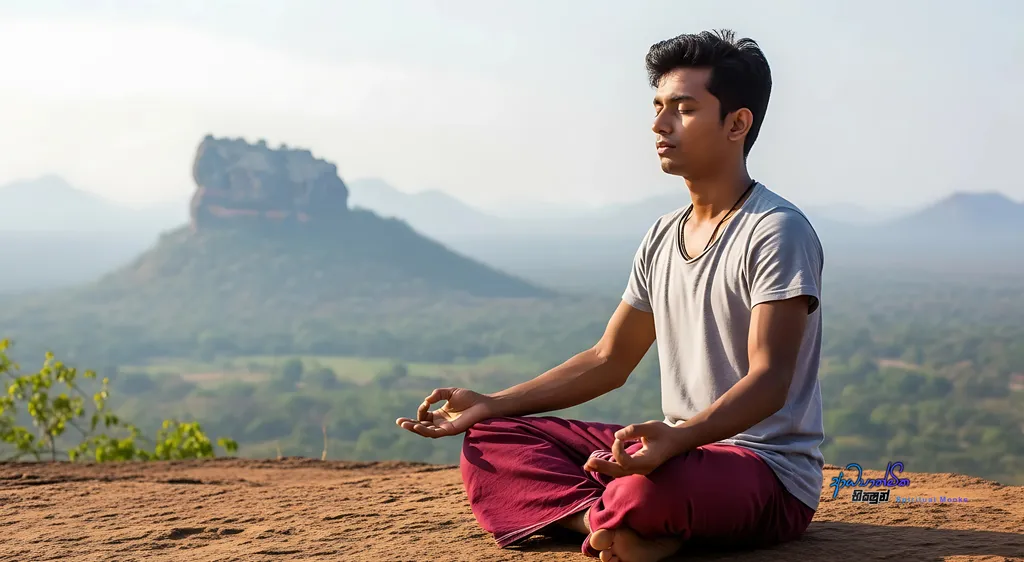
The Core Technique: Follow and Mirror Your Thoughts
Here is the core of the technique. Once you are settled, your mind will naturally start to wander. Instead of fighting it, we will do something different. You are going to follow your mind wherever it goes.
Let’s say your mind wanders to the past, to your school days. It might say, ‘I remember studying math in the 11th grade.‘ As soon as this thought appears, you consciously and internally repeat it: ‘My mind is saying I studied math in the 11th grade.‘
Then, the mind might jump to the future. ‘I need to save money to buy a new car.‘ Again, you follow it. You repeat the thought exactly as your mind presented it: ‘My mind is saying I need to buy a new car.‘
The key is to mirror the mind’s exact words and intentions without judgment. You are not analyzing the thought; you are simply acknowledging it by repeating it to yourself. As you do this, you will notice something amazing. Before you can even finish repeating the thought, the mind will have already jumped to something else. This reveals the true nature of thoughts their impermanence, By shadowing each thought, you begin to wrestle with the mind on its own terms.
Working with Distractions: Sounds, Sensations, and Emotions
What about distractions?
Many people say, ‘I can’t meditate at home during the day, it’s too noisy in the city.‘ Or, ‘The TV is on too loud at home. It’s only easy to meditate late at night or early in the morning.‘ They mention hearing chanting from the temple or prayers from the mosque. For someone who wants to tame your mind using this method, none of these external things are an obstacle.
Let me show you how this applies to the senses of eye, ear, nose, tongue, and body. Imagine the TV is on very loud at home while you are trying to meditate. It becomes a distraction. Your mind goes to the sound. Your mind then says, ‘Ah, mom turned on the TV,’ or if it’s your brother, ‘That guy turned on the TV.’ The mind says this in your own internal voice and phrasing. When it does, your job is to repeat it: ‘That guy turned on the TV.‘ The mind is reacting to the sound heard by the ear. The moment you consciously repeat the thought; the mind will naturally jump away from it. It doesn’t get stuck. Then, it doesn’t matter how loud the TV is.
Another example from Sri Lanka: the musical bread van, the ‘choon paan,’ drives by with its loud jingle. Your mind says, ‘There goes the choon paan van.‘ You must then say to yourself, ‘There goes the choon paan van.‘ You’ll find that before you even finish the sentence, your mind has already jumped to something else.
What about physical feelings? Let’s say your legs start to hurt while meditating. Your mind immediately goes there. It says, ‘My legs are hurting, I can’t do this, my legs hurt.‘ You must then repeat, ‘My legs are hurting.‘ The mind won’t stay there either; it will move on. Many people also experience itching during meditation. The mind asks, ‘Should I scratch it?‘ Try to endure it. But with this technique, when the mind says, ‘It’s itching,‘ and goes to that spot, you simply acknowledge it. The mind says, ‘That spot is itching.‘ You then repeat, ‘That spot is itching.‘ As you say it, the mind jumps away from there. The itching sensation fades from your awareness.
Even strong emotions like lust (Raga) or anger can be handled this way. If a lustful image appears, you acknowledge what the mind is presenting without getting entangled. If anger towards someone arises, ‘My mind is angry at Nimal for not returning my money,‘ you repeat that very thought. The act of observing and stating the thought disarms its emotional charge.
The Return to Stillness and Inner Peace: Tame your Restless Mind
When you consistently apply this technique cooking the pig with its own fat, as the saying goes the mind becomes tired of its game. It has nowhere to run where you are not watching. In its exhaustion, it does something remarkable: it returns, all by itself, to the anchor point between the eyebrows.
It will come back and say, ‘I am here now, at the center.‘ And you will repeat, ‘My mind is here now, at the center.‘ Then it might say, ‘My mind is empty, there are no thoughts.‘ And you will repeat that as well. This is how you tame a restless mind. You will experience a profound sense of relief and stillness.
This applies to all thoughts, good or bad; virtue and sin are irrelevant to the technique. Let’s say you start thinking of the virtues of the Buddha. For this specific practice to tame your mind, even that is a distraction. The Buddha himself advised not to just think about him, but to do the practice. So, if the mind brings up the Buddha, you acknowledge it with the mind and then it will jump away.
What if you think of a good deed, like giving a donation (dāna)? Your mind plans it out. Who is doing the talking? Your mind. Repeat its exact words, and it will jump from there too.
This isn’t just suppressing thoughts; it is genuinely exhausting the mind’s habit of wandering until it chooses to be still.
Practical Advice for Your Daily Practice
People often ask practical questions. How long should I meditate? Where should I sit? The beauty of this technique is its flexibility. Meditate for as long as you can, as often as you can. It doesn’t matter if you are on a bed, on a cushion on the floor, in a quiet forest, or in the middle of a noisy city. The external environment is not a barrier.
By practicing this, you will directly realize that peace is not dependent on your surroundings. The chaos of the world does not have to become the chaos of your mind. I share this with 100% confidence in its results. Please, engage with it practically. True understanding doesn’t come from just listening, but from doing. The methods we share are simple, without difficult words, so you can put them into practice and see the results for yourself.
We invite you to walk this path with us. Read our teachings, and most importantly, apply them practically in your own life. as you practice, questions will naturally arise. Please feel free to share your experiences and questions in the comments below, via email or contact form. I will do my best to offer guidance in future talks based on your progress. For now, begin this practice with an open heart and a mind free from expectation. Cultivate it correctly, and may you find the clarity and peace you seek.
Thank you for joining us. We hope this blog will be of great benefit to your spiritual journey.
May you all be well and happy.
May the blessings of the Triple Gem be with you all!


