


Categories: Maintaining Mindfulness
May the blessings of the Triple Gem be with you all!
Through our spiritual teachings, we explore ways to navigate the challenges that arise in life. We aim to show you how to understand these difficulties with your mind and, through that very same mind, release the pressure they create. We have often discussed practical methods for achieving this inner freedom.
Today, we will delve into a common and powerful source of suffering: thoughts that create mental pressure, defeat our spirit, and leave us filled with regret. These are not rare; in fact, every single one of us experiences them. The crucial questions are: How do we manage these thoughts? How do we neutralize the immense pressure they bring? We will explore the practical method the Buddha taught for let go of the past and finding peace.
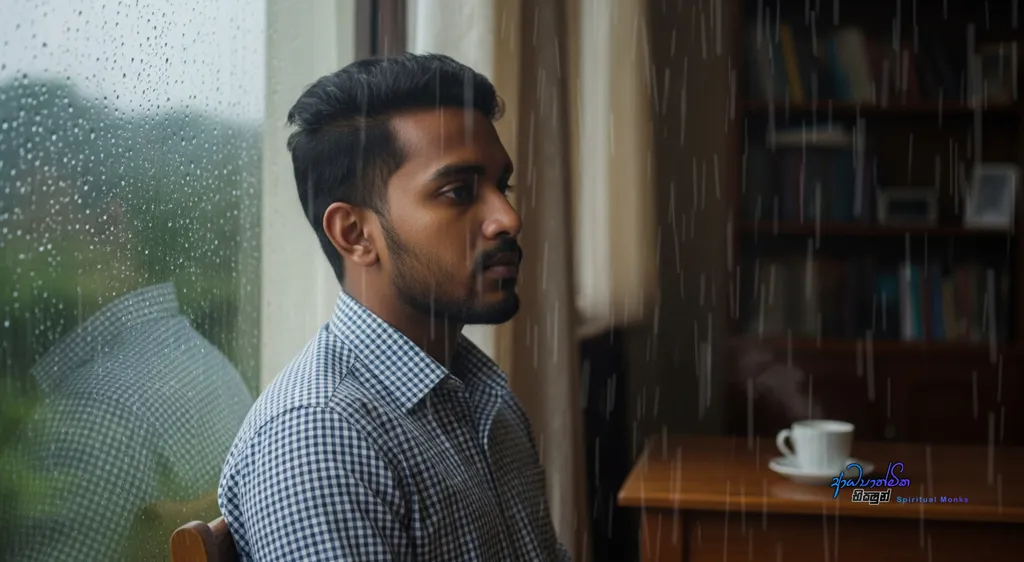
Understanding the Mind’s Trap: Why We Cling to the Past
This teaching is especially important for those who feel haunted by past relationships. Many people share that they are unable to stop thinking about a love from their past. Perhaps they were with someone they deeply loved, but for one reason or another, the relationship ended, and they could not marry that person.
Now, in a different marriage, they find themselves constantly remembering the affection and tenderness of that previous partner. This can become so overwhelming that it begins to sabotage their current family life, turning into a constant source of mental anguish.
This is a widespread issue in our world today. When we are unable to build a life with the person we hoped for, we carry the weight of those unfulfilled dreams into our present. A deep sense of regret can linger until the very end of our lives. This is the nature of the mind; it is how our minds work, and it’s essential to recognize this pattern.
We form a connection with a person and experience a certain kind of pleasure or satisfaction from it. If a new relationship doesn’t provide that same level of perceived satisfaction, the mind naturally drifts back to the old, lost pleasure. This is what creates such profound mental pressure.
While I begin with the example of romantic love, please understand that this principle applies to everything in life. Be wise and apply this teaching to your feelings about your children, your parents, your spouse, or your attachment to physical things like land, vehicles, money, and property. These reflections are not meant to be memorized.
Instead, seek to grasp even one word, one core idea, and contemplate it deeply. Then, apply the practical steps described in this article. Only through practice will you see the results and begin the journey of letting go of the past.

The Pain of Comparison: How Past Ideals Create Present Suffering
When these painful memories from the past begin to torment you, they become a significant obstacle in your present life. They can prevent you from truly loving your children, your current spouse, or dedicating yourself to your work. As mentioned, this mental pain can even destroy family life.
So, how do we practically solve this?
Let’s return to our example. You were in a relationship before your marriage that ended for some reason. Now, married to someone else, you find that your current partner doesn’t provide the love or satisfaction you expect, perhaps in terms of affection, intimacy, gifts, financial support, or shared experiences like travel. Because of this perceived shortcoming in the present, your mind immediately compares.
It tells you, ‘My previous partner treated me better, loved me more.‘ This deficit in the present makes you recall everything you received in the past. One by one, the memories flood in. This is the nature of the mind.
This constant stream of comparison throws your mind into a state of confusion. You might find yourself becoming easily angered. You lose the ability to focus on tasks with clear awareness. This is the effect of being trapped. This state is what in Buddhism we call Dukkha, a deep, pervasive sense of stress, suffering, and unsatisfactoriness.
It arises because we expect the world to conform to our desires, and when it doesn’t, we experience a profound sense of inner turmoil.
For some, this pressure can manifest as physical ailments like migraines, leading them to seek medical help for what is, at its root, a mental state. You must understand and accept this fundamental truth: this is the nature of the mind. If we don’t grasp this, we can never reduce the pain these thoughts cause. The more you understand this process, the more you will be capable of letting go of the past and its painful grip.

The First Step to Freedom: Observing Your Mind with Mindfulness (Sati)
There are times when people feel so trapped they even consider ending their lives. But let’s assume your past relationship is over, perhaps due to family pressure or other circumstances, and you are now married, with children and a reputation to uphold. You cannot go back. Yet you are living with this immense pressure. If you wish to find a way to heal your mind without relying on medication, you must train it according to the Buddha’s teachings.
How do we do this?
When this overwhelming pressure arises, the first step is to cultivate mindfulness, a concept we call Sati. It means developing a calm, non-judgmental awareness of the present moment. I have explained how to do this practically in other teachings, but the essence is simple: if you cannot go back to the past and you cannot fix it, why continue to suffer mentally in the present?
Instead, make an effort to strengthen your mind in the here and now.
Begin by identifying the thoughts that are weakening you, causing you pressure, and destroying your mental well-being. If you practice Sati and watch your mind continuously, you will start to see the conflicting thoughts clearly. You will notice the thoughts that find fault with your current partner: ‘This person is like this. They don’t care for me like the other one did. They don’t love me like the other one did.‘ Your mind naturally compares.
At the same time, you will see the thoughts that cling to the past: ‘Oh, if only I were still with them, they would do this for me, they would love me this way.‘ Your own mind will show you both sets of thoughts. When you observe this with mindfulness, you gain a profound insight. You are caught between two extremes: the past you are clinging to, which is over and cannot be retrieved, and the present you are resenting.
The Middle Path: Releasing the Two Extremes of Attachment and Aversion
To find true, lasting peace, we must learn to let go of both extremes. When we release both clinging and aversion, we arrive at what the Buddha called the Majjhimā Paṭipadā, or the Middle Path. This is a state of balance, neutrality, and profound equanimity, known as Upekkhā.
Use your wisdom, what we call Paññā,and ask yourself: ‘Am I going to live with this person from the past? Can I go back to them?‘ If the answer is no, then you must find a way forward. This is the technique, the method, that the Buddha taught. Look closely with a mindful mind. You are trapped between two forces: on one side, attachment (clinging), and on the other, aversion (conflict). Both are pressuring you.
See the incredible power of these thoughts! They can cause physical headaches, migraines, loss of appetite, and an inability to enjoy life. You may find yourself unable to eat at regular times, only able to stomach food at odd hours. You lose the desire to bathe, to work, to engage with life. You might go through the motions of your responsibilities, for your job, your family,but only because you must, all while bearing this immense internal burden.
Otherwise, you might just want to lie in bed, pull the covers over your head, and disappear. The pressure can be so intense that it feels like you want to take your head off and set it aside. This suffering is not unique to relationships; people in business and students face similar pressures. The method for letting go of the past is universal and applies right up to the point of ultimate liberation, or Nibbana.

The Practical Art of Letting Go: How to Release Thoughts
When you face your spiritual or mental problem, become neutral and reflect on it with mindfulness. The answer will inevitably come to you, perhaps in a few hours or a few days. You will realize: ‘To find my mental peace, I must continuously practice identifying these two types of thoughts.‘
So what do you do?
You recognize, ‘I am clinging to thoughts of the past. I am in conflict with the life I am experiencing now.‘ Then you resolve, ‘I must mentally release both sides. By letting go of these thoughts, I will surely find neutrality, equanimity (Upekkhā), and mental relief. I can reach a point where I don’t need to see a doctor for this pain.‘
Some may ask, ‘But how do I let go of these thoughts?‘ The answer is simpler than you think. You don’t have to do anything to them. They are just thoughts. As you go about your day, doing your work, caring for your children or parents, interacting with friends, engaging in society, you simply maintain your mindfulness (Sati).
When a thought of your past partner arises, you just acknowledge it silently: ‘Ah, a thought about that person from the past has come.‘ When a feeling of resentment toward your current spouse arises, you note: ‘A feeling of conflict has come. A clinging to the good qualities of my ex has come.‘ You just identify the clinging and the aversion as they appear.

A Gentle Pace: The Gradual Path to Inner Freedom
As you practice this again and again, the attachment you feel in thoughts about your past partner, let’s say it’s at 100%,will begin to decrease. It will drop to 98%, then 95%. This happens as your wisdom (Panna) grows and you truly understand the pain these thoughts are causing you.
Similarly, if your conflict with your current spouse is at 100%, as you keep identifying it, that value will drop to 99%, then 95%. The energy, the weight, the pressure of both sets of thoughts will gradually diminish.
As this pressure lessens, your head will feel clearer. You will feel relaxed and free. Mental well-being will arise. You will naturally become a more neutral, equanimous person, free from the problem that plagued you. In time, both sets of thoughts will cease to bother you.
I cannot give you a timeline for this. It depends on how diligently and wisely you practice. But do not approach this with aggressive effort, thinking, ‘I must do this perfectly now!’ The mind is a trickster; if you try to force it with too much energy, it will sabotage your efforts.
Likewise, do not try to force yourself to be mindful all the time. Let it happen naturally. Even the most enlightened beings practiced gradually. There is no need to rush, but there should also be no laziness or lack of interest. Find a middle pace.
Think of it like learning to drive a car. At first, it takes concentration, but over time, it becomes second nature. Practice gently and consistently, and you will reach a point where the process of letting go of the past happens naturally.

Living with Wisdom: The Fruit of Letting Go
As you continue, you will begin to realize for yourself: ‘I no longer have a strong attachment or aversion related to that person from the past. It has faded.‘ You’ll also see: ‘I have no conflict with my current partner. I have become a neutral, upright person.‘ This is self-realization. This is wisdom (Paññā).
You will find that you can live with your current spouse without conflict. Whether they treat you well or not, you remain centered. You will still fulfill your responsibilities as a husband or wife, but without the baggage of clinging or aversion.
Similarly, you will have no emotional turmoil regarding the person from your past. If a situation ever arose where you needed to help them responsibly, your wisdom would guide you to act appropriately for that moment, without being swayed by emotion.
You will become a person who does not seek answers while drowning in feelings. You will find answers directly through wisdom. Until now, you may have been making decisions with the feeling of ‘love‘ or craving in front, and wisdom far behind. Through this practice, you put wisdom first. The love and aversion fade into the background. This practical method taught by the Buddha can be done anytime, anywhere.
You don’t need a special time or place to meditate. Whether you are at your job, walking down the street, driving, bathing, cleaning the bathroom, or cooking, whenever the painful thoughts that bother you arise, apply this method of mindful identification. This is the path to truly letting go of the past.
This teaching is for everyone. Whether your stress comes from academics, your career, family issues, or financial troubles, apply this same framework. Be wise enough to adapt this method to your specific struggle. Think deeply about these points and put them into practice.
Your Path to Peace Begins Now
I believe this teaching is sufficient for you to begin the practical work of understanding and resolving the issue of being tormented by past thoughts. I hope you will apply it with understanding.
I will conclude this teaching for today. By the power and blessings of the Buddha, the Dhamma (His Teachings), and the Sangha (the community of the enlightened), may you all gain the practical ability to overcome the problem of painful past thoughts. May you, through mindfulness and wisdom as the Buddha taught, understand these thoughts, reduce their power, and become neutral, equanimous individuals. May you live with mental well-being and inner peace.

We invite you to walk this path with us. Read our teachings, and most importantly, apply them practically in your own life. as you practice, questions will naturally arise. Please feel free to share your experiences and questions in the comments below, via email or contact form. I will do my best to offer guidance in future talks based on your progress. For now, begin this practice with an open heart and a mind free from expectation. Cultivate it correctly, and may you find the clarity and peace you seek.
Thank you for joining us. We hope this blog will be of great benefit to your spiritual journey.
May you all be well and happy.
May the blessings of the Triple Gem be with you all!


