


Categories: Maintaining Mindfulness
May the blessings of the Triple Gem be with you all!
Through your spiritual journey, perhaps by engaging with teachings here or elsewhere, you have been practicing. You have been applying both calming meditation, known as Samatha, and insight meditation, or Vipassanā,the very mindfulness the Buddha taught. You have been practically examining your own mind. Have you taken the time to truly check in with yourself?
This teaching is an invitation to reflect on your journey. Whether you’ve been practicing for a long time or just started, whether you focus on identifying thoughts, recognizing mental defilements, or other methods like ‘third eye’ or ‘Brahma world’ meditations, the question remains the same: have you paused to mindfully consider if you are the same person you were before? Have you genuinely investigated this? Many have, and they have shared their transformations with me.
Look closely. Is the mental state you inhabit today the same as the one you lived in before? In the past, you might have been someone who didn’t keep the Five Precepts,perhaps a heavy drinker or unfaithful. You may have engaged in sexual misconduct or other unskillful actions like gambling.
You might have been a person who caused harm. Now, reflect: have you moved from that place? Are you in a different mental state today? Even if you only uphold one of the five precepts, where you once upheld none, that is progress. If you used to be defined by jealousy, anger, hatred, or a tendency to undermine others’ success, has that changed? Have those qualities vanished, or have they at least diminished? Have you mindfully observed this change?.
This is the core of what we need to explore, because as we advance spiritually, we not only identify these weaknesses, but with time, they gradually decrease. Today, you might be at a point where you can truly measure this progress. This, in a very real sense, is what it means to erode the defilements, the kilesas.
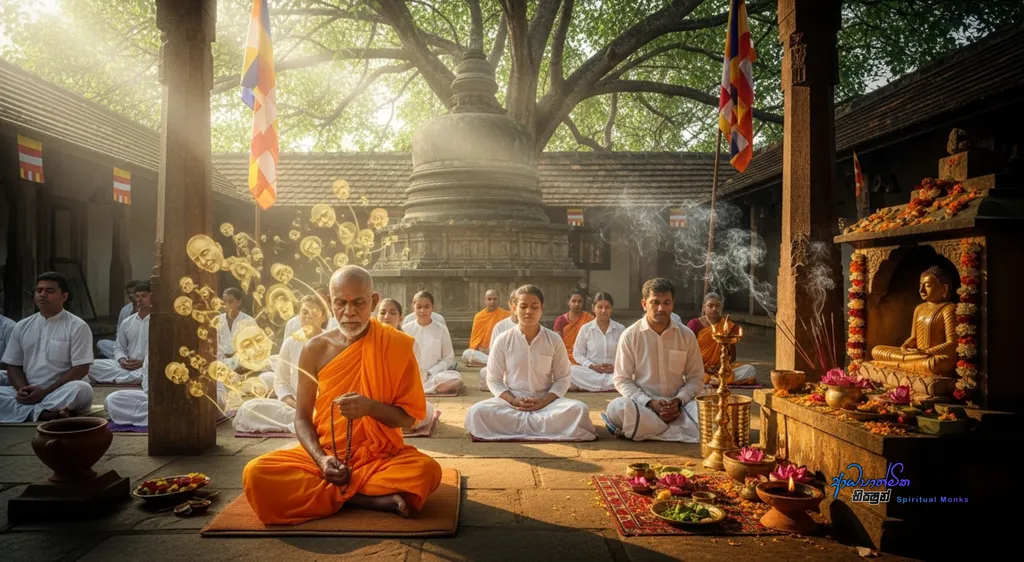
From Jealousy to Joy: A Practical Guide to Transforming a Poisonous Mindset
To illustrate this, let’s consider an emotion that many find troublesome: jealousy. Imagine a situation arises, and you feel a pang of jealousy towards someone. Where does this jealousy arise? As a practitioner, you know it is born, generated, and produced within your own mind, your citta. You know that if left unchecked, this jealousy can grow, spill out into words that hurt others, and even manifest as harmful actions. Your practice has likely already prevented you from reaching that extreme stage.
But let’s look deeper. Perhaps this jealousy has become a burden for you. It might stem from your karmic habits from past lives, or from associating with envious people in this life, be it parents, siblings, friends, or colleagues. It may have become deeply ingrained in you.
When you began your spiritual practice, this jealousy might have felt like a persistent annoyance. You see someone excel in their studies, get a promotion at work, build a nice house, buy a vehicle, or enjoy a happy marriage with beautiful children, and your mind is stirred up with an unbearable feeling of envy. You know this feeling is a kilesa,a mental defilement, and it’s painful. You might even feel disgusted with yourself for having such a thought.
The Buddha’s teaching isn’t about being tormented by this defilement, but about how to reduce and eliminate it. When you mindfully recognize the thought,’ Ah, jealousy has arisen in me’,its power begins to diminish. You see it as just another thought. But you can go further. When you feel envy towards your successful friend, you can consciously generate a counter-thought. You can cultivate loving-kindness, or Mettā, and genuinely wish:
- ‘May they become even more successful.’
- ‘May their family life be even more prosperous and happy.’
You send them thoughts mixed with loving-kindness, compassion (karuṇā), and equanimity (upekkhā). Paradoxically, this helps them prosper even more. Meanwhile, you may still be struggling in your worldly life, but by purifying your mind of this defilement, you become truly superior. You become a true disciple of the Buddha, aligned with the natural law of the universe. This is the level of inner nobility you can achieve.

The iPhone and Impermanence: Evolving Your Mindset Beyond Attachment
Now, let’s talk about attachment, or lobha, the clinging mind. Imagine you have a new, expensive iPhone. You are very attached to it. Observe your mind: does owning this phone make your mind cling even more tightly to it? Or have you cultivated the wisdom to understand that this phone is impermanent? This is the teaching of Anicca. You know that at any moment, it could fall and shatter. It could be lost or destroyed. Have you prepared your mind to face this reality? Can you bear its potential loss?
The practice is this: while you use the phone, while you touch it and benefit from it, you simultaneously work on mentally releasing your grip. You see its changing nature, its vulnerability, its place within the three characteristics of existence (Tilakkhaṇa). As you do this, your mental attachment to the iPhone will gradually decrease. You will still care for it, put a screen protector and a case on it, and keep it clean. But you use it with the profound understanding of its impermanence.
Think about it. If you have owned the phone for a year and a half, has your mindset regarding it evolved? Just as you use a negative feeling like jealousy to uplift your mind, you can use a positive feeling of attachment to an object to do the same. Look at how your phone, this simple material object, has become a tool for evolving your mindset, for letting go of clinging, for shortening your journey through saṃsāra (the cycle of rebirth).
Your jealousy towards your friend and your attachment to your phone both become helpers on your path. This same principle applies to everything you are attached to, living or non-living, from the smallest object to your most cherished relationships, and even to your own body.

Evolving Through Grief: How Mindfulness Changes Our Response to Loss
The greatest test of an evolved mind is how it faces loss. Let’s take a difficult example. Imagine the person you love most is your mother, and she suddenly passes away. The grief is unbearable. You weep, you lament, you might not eat for weeks. You fall into a deep state of sorrow. Sometime later, after you have discovered these practical Buddhist teachings and have started to apply them, your father, whom you also love dearly, passes away.
Observe your mind then. Will your reaction be the same as when your mother died? Because you have been practicing, you may find that while you still feel sorrow, your weeping has lessened. Your understanding of reality, of the nature of the mind, has grown. The number of tears you shed, the number of meals you skip,it has all reduced.
This is how you measure the progress of evolving your mindset. Enlightened beings, Buddhas, Arahants, Anāgāmīs,do not weep. Why? Because the causes for tears, for grief and lamentation, have been completely uprooted from their minds. For them, there is no reason in this world to grieve. In one sense, this is a characteristic of Nibbāna (Liberation).
Let’s continue the example. Perhaps after your father’s death, your grief was reduced by 20%. You know the Dhamma now, so you continue to practice, knowing that your spouse, your children,anyone,can pass away at any time. You prepare your mind. Two years later, your spouse passes away. By then, you may have uplifted your mind by another 40%. The lamentation and despair are significantly less.
You can see how practical this path of eliminating the defilements is. It is a real training. Through it, mindfulness of death (maraṇānussati) and contemplation on the unattractive aspects of the body (asubha bhāvanā) naturally develop. This is wisdom, or paññā: using every life experience to bring the mind to a state unshaken by the Eight Worldly Winds: gain and loss, fame and disgrace, praise and blame, pleasure and pain.

Your Daily Practice: Committing to a Lifetime of Mental Evolution
So, from today onwards, make this your practice. Use every experience to elevate your mind, to update your consciousness day by day. Every thought that arises, every object you use, every person you interact with,use it all. From the most valuable thing you own to the least, from your dearest relationships to your own limbs, see everything through this lens of wisdom.
When you listen to a Dhamma talk or read a spiritual book, notice your mental state. If you revisit this very teaching a month from now, is your mind in the same place? Or has it become more refined, more updated? If it has, rejoice! You are following the Buddha’s path. You have reached a higher level. Make a determination to continue this practice.
Imagine the person you will be in two or three years, and then imagine the state of your mind at the moment of your death. How elevated could it become if you practice with every passing minute? It doesn’t matter if you are young or old, wise from past lives or just starting out. The technique is available to all. This is the mental strength we are building. The only obstacle is a lack of practical application, a failure to mindfully understand our own experience.
When you do this, you will see that every event is a chance to check in. Am I facing this situation with the same old mental state, or has my mindset evolved? You will clearly see your own progress. This is what is necessary. As your mind becomes more elevated, you will find you can understand the deep teachings of the Buddha directly. You can read the scriptures, or listen to talks, not to go to a heavenly realm, but to continue this process of evolving your mindset here and now.
May the power of the Buddha, Dhamma, and Sangha bless you with the ability, the energy, and the mindfulness to understand this practical path and to continue developing on it, day by day.

We invite you to walk this path with us. Read our teachings, and most importantly, apply them practically in your own life. as you practice, questions will naturally arise. Please feel free to share your experiences and questions in the comments below, via email or contact form. I will do my best to offer guidance in future talks based on your progress. For now, begin this practice with an open heart and a mind free from expectation. Cultivate it correctly, and may you find the clarity and peace you seek.
Thank you for joining us. We hope this blog will be of great benefit to your spiritual journey.
May you all be well and happy.
May the blessings of the Triple Gem be with you all!


