


Categories: Other Meditation Teachings
May the blessings of the Triple Gem be with you all!
Welcome. In our ongoing exploration of the spiritual life, it is my wish to offer you some clarity on certain matters that arise on the path. For those of you who have been following our teachings on practical spirituality, we have explored both Vipassanā (insight meditation) and Samatha (tranquility meditation), providing step-by-step guidance. By now, many of you have gained a broad understanding, and some have moved from knowledge to direct practical experience, deepening your journey.
Today, I wish to address two common questions or points of confusion that practitioners often encounter. This understanding is important for your continued spiritual development.
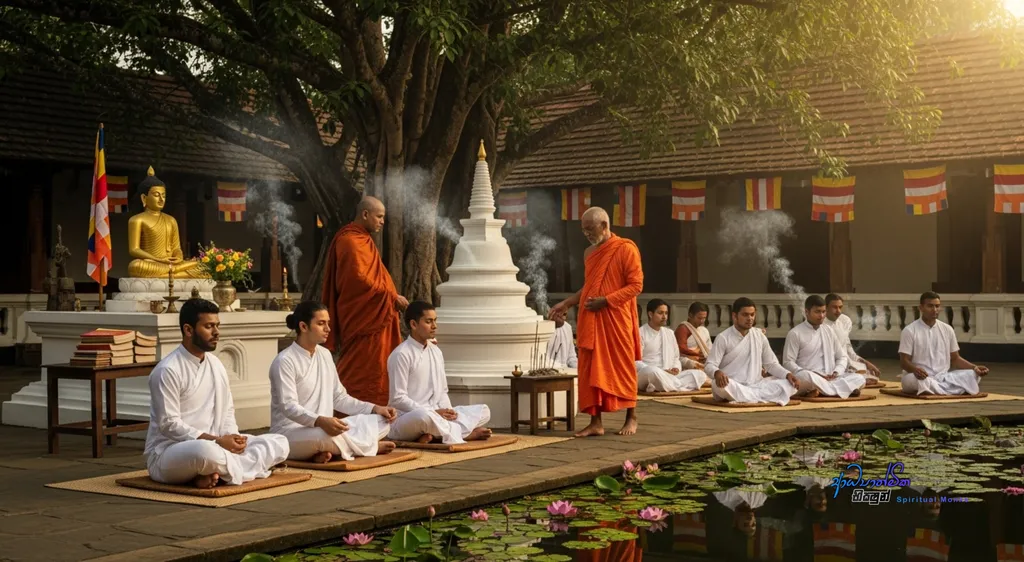
Can I Meditate Lying Down? A Look at Posture for Beginners
A frequent question I receive, particularly from young people who may be grappling with challenges like substance use, is: “Venerable Sir, is it appropriate to meditate while lying down?”
The ability to meditate effectively while lying down is something reserved for those who are highly advanced in their spiritual development. For a beginner, who is still building the foundation of their practice, attempting to meditate in a lying posture is often counterproductive. While it is true that mindfulness can be developed in all four postures, sitting, standing, walking, and lying down, as we have taught in our mindfulness series, the practice of concentration meditation, or Samatha, is different.
You can practice mindfulness of your actions and thoughts in any posture. However, trying to develop deep tranquility or concentration while lying down as a beginner is exceptionally difficult. Your mind and body have a deep-seated association between lying down and sleeping, which presents a significant obstacle.
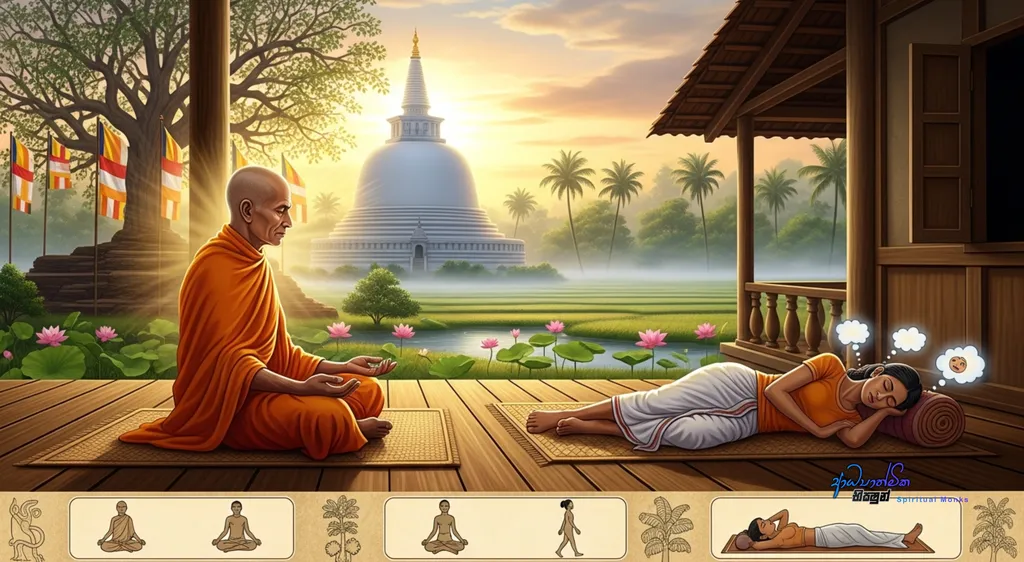
Why Lying Down Leads to Sleep: Understanding the Five Hindrances
Why is it so difficult? The reason lies in what Buddhism calls the Five Hindrances, or Nīvaraṇa, mental states that block our progress. They are:
- Kāmacchanda: Sensual desire.
- Vyāpāda: Ill will or aversion.
- Thīna-middha: Sloth and torpor, or deep sleepiness.
- Uddhacca-kukkucca: Restlessness and worry.
- Vicikicchā: Skeptical doubt.
When you lie down to meditate as a beginner, the hindrance of Thīna-middha, sloth and torpor, becomes especially prominent. Sleepiness will inevitably arise, and you will drift off to sleep. For a beginner to attempt this is like a child in primary school trying to study advanced-level university subjects; it simply won’t work because the necessary foundation, the subduing of the hindrances, has not been established.
You might experience fleeting meditative sensations for a few minutes, like a pressure between the eyebrows as the mind begins to concentrate. However, sustaining this state for an extended period, as you might for half an hour in a proper sitting posture like the lotus position (Padmāsana), is nearly impossible at the initial stages. The mind will succumb to sleep.
When Is It Possible? The Path for Advanced Minds
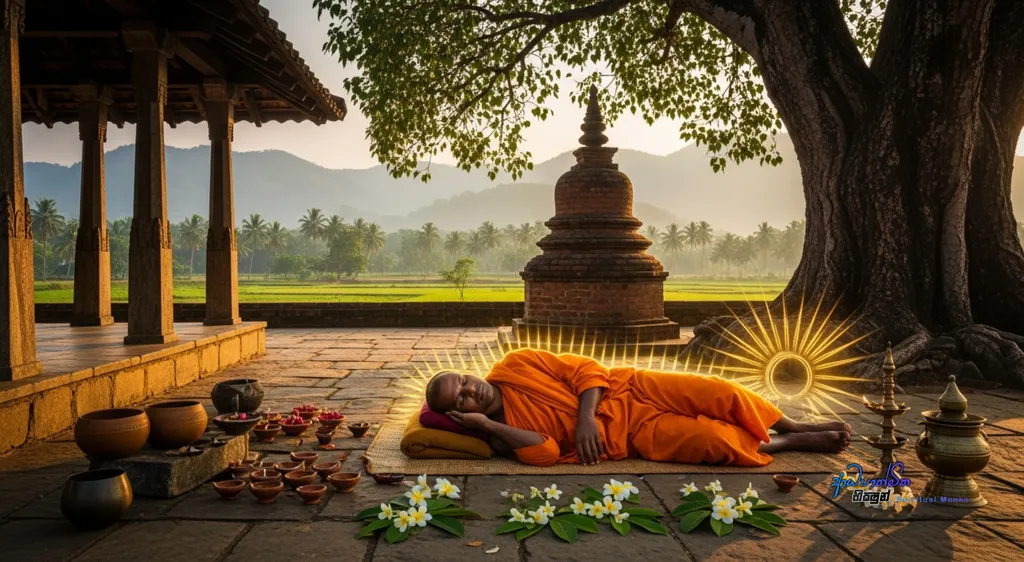
However, this does not mean it is impossible. For a highly accomplished practitioner, meditating while lying down is entirely possible. The Buddha himself demonstrated this. In the Great Discourse on the Final Passing Away (Mahāparinibbāna Sutta), it is described that the Buddha entered his final Nibbāna from the lion’s posture (lying on his right side), systematically entering and emerging from all eight deep meditative absorptions, or Jhānas.
Likewise, fully enlightened beings, the Arahants, have developed their minds to such a degree that they can maintain profound meditation in any posture.
It is only after a significant period of practice, perhaps months or years, when you have developed your practice to the level of mastering the Jhānas and can enter them at will, that you become suitably equipped to meditate in a lying posture without falling asleep. On that day, you too will be able to enter these states of deep concentration even while resting. Until then, it is wise to build your practice in a formal, seated posture.
Navigating Spiritual Dreams: Visions, Insights, and the Mind
It is important to know that falling asleep while attempting to meditate is not harmful to your mind or your physical body. In fact, it can be beneficial, leading to a very deep and restful sleep, often free of dreams. So, while you should not try to develop your formal practice this way, it is perfectly fine to spend a few moments in a meditative state as you lie down to sleep, and then allow yourself to drift off naturally. Do not worry about this.
Now we come to our main topic: do not be concerned about spiritual things you see in your dreams. When you embark on a spiritual path, your mind naturally becomes absorbed with it. You listen to talks, read books, and constantly think about concepts like Jhāna, Kundalini energy, the third eye, and psychic abilities. Your entire focus shifts to these spiritual subjects.
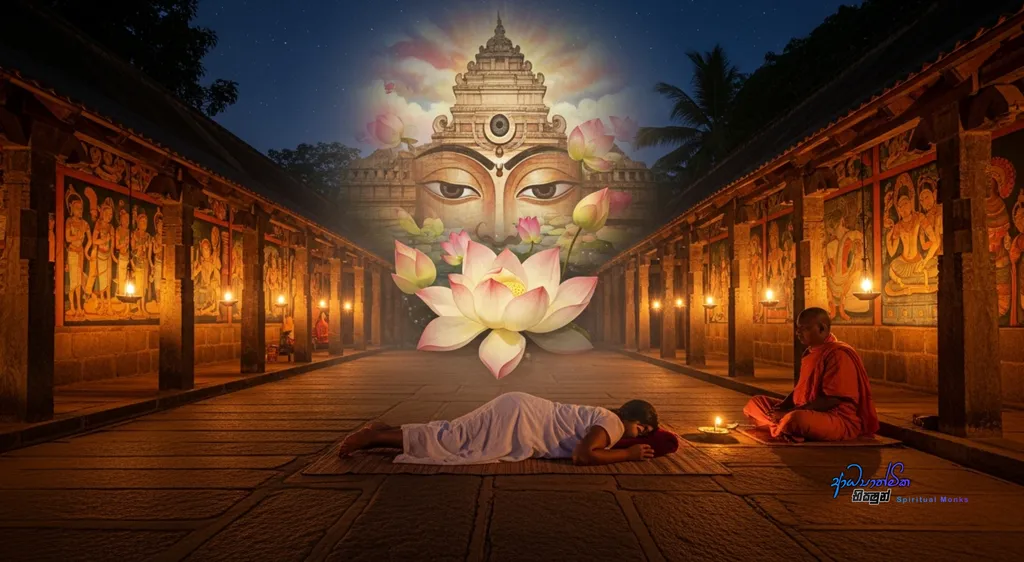
Consequently, these themes begin to appear in your dreams. For example, I have had people contact me after listening to a teaching about visualizing the great Ruwanwelisaya stupa with the third eye (Dibba-cakkhu). They will have a dream where they see themselves entering the stupa’s western gate and witnessing its inner chambers, exactly as described. They then send me a message asking, “Venerable Sir, is my third eye open?”
There is no need to ask. If your third eye were truly open, you would be able to see these things while you are awake. The fact that you cannot is the answer. You can determine for yourself: “This appeared only because it was embedded in my mind.” These are not real meditative results or psychic breakthroughs; they are simply spiritual dreams reflecting your waking preoccupations. Do not take them seriously.
A Sign of Progress: Practicing Mindfulness in Your Dreams
There is, however, a very positive aspect to how practice can manifest in your dreams. A person who diligently practices mindfulness, or Sati-sampajañña, may find this skill appearing even while asleep. This is something I have seen from my own experience and the experience of those I guide personally.
Imagine you are having a nightmare, an elephant is chasing you. Because you have been training your mind to be aware, a thought might arise even within the dream: “I must be mindful.” This moment of awareness can trigger a deeper realization right inside the dream: “Wait, I am dreaming. This isn’t real.” At that moment, the fear vanishes. The mind, even in its dreaming state (the mind-door, or manodvāra, is active), is applying the practice.
This is a sign of true progress. It shows that mindfulness is becoming second nature. You might even find yourself practicing other techniques; for instance, if you practice a Third Eye meditation focused on the “emptiness” sign (his-sanna), you might apply it to the dream-elephant. When you awaken, the fear is gone, and you can remain neutral and undisturbed, no matter if you were chased by demons, ghosts, or snakes. You see it for what it was: a dream.

The Mirror of the Mind: What Your Dreams Reveal About Your Waking Life
Our dreams are a mirror of the dominant activities of our mind. Whatever we do, think about, and feel most intensely during our waking hours, during the day, the week, or the month, is what tends to surface when we sleep. This is much like how the final thoughts of a dying person (the cuti citta) are shaped by their lifelong habits.
If you are deep in debt, you will have spiritual dreams where creditors are chasing you for money. If you engage in meritorious deeds (puñña kamma), like giving offerings, you will dream of such positive events. If you are filled with sadness, your dreams will reflect that sorrow.
This is why some ancient traditions, recorded in palm-leaf manuscripts (pus-kola poth), could interpret dreams; they are based on observing these patterns. A snake in a dream might signify impending trouble, an interpretation born from analyzing recurring mental states and their dream symbols.
However, you should not waste your time seeking interpretations for these spiritual dreams. Do not go to fortune-tellers, consult astrologers, or even see a psychiatrist about them. There is no point. See the dream, let it go, and return your focus to your waking practice. The real progress happens when you are awake and aware.
A Teacher, Not a Fortune Teller: The True Path to Insight
Please understand my role here. Some people have come to believe I am a dream interpreter or a fortune-teller (saastara kiyana kenek) and ask me for the meaning of their dreams or about their future and career. This is a burden to me, and it is not my purpose. I do not engage in such things, as they are fruitless and keep us at a primary, undeveloped level.
My purpose is not to give you answers, but to teach you the practical methods to develop your own spirituality. The goal is for you to cultivate your own insight to the point where you can see your own path and find your own solutions. We are not here to fall into a dependent, “beggarly” state of seeking answers from others. We are here to empower you to find them within yourself.
I believe these points have been made clear. The key takeaway from this teaching is this: do not worry or overthink the things that appear in your spiritual dreams. Understand them for what they are and focus your energy on what truly matters.
Conclusion: Embrace Your Waking Practice, Not Your Spiritual Dreams
The real work and the real results are found in the cultivation of meditation and mindfulness in your waking life. Your progress is measured by the peace, clarity, and insight you develop while you are conscious, not by the fleeting visions of the night.
With the blessings and power of the Triple Gem, the Buddha, the Dhamma, and the Sangha, may you understand these matters well and continue to develop your spiritual life.

We invite you to walk this path with us. Read our teachings, and most importantly, apply them practically in your own life. as you practice, questions will naturally arise. Please feel free to share your experiences and questions in the comments below, via email or contact form. I will do my best to offer guidance in future talks based on your progress. For now, begin this practice with an open heart and a mind free from expectation. Cultivate it correctly, and may you find the clarity and peace you seek.
Thank you for joining us. We hope this blog will be of great benefit to your spiritual journey.
May you all be well and happy.
May the blessings of the Triple Gem be with you all!


